
Phycocyanin in reduced sugar beverage formulations poses two linked decisions: which sweetener system delivers the desired taste, and whether that same system supports the blue shade through the intended shelf life. Replacing sucrose changes soluble solids and often forces an acid adjustment; a color result from the original full-sugar recipe cannot simply be transferred. A 2022 original study of saccharides and sugar alcohols examined thermal and oxidative stability of food-grade phycocyanin under controlled conditions.
It offers candidate variables, not a universal winning sweetener for a packaged drink.
Contents
- What is the reduced-sugar decision?
- Which sweetener systems should enter the screen?
- How can the experiment isolate sweetener effects?
- Why record pH and acidity separately?
- How should heat and mixing be standardized?
- What color, haze and sensory endpoints count?
- How should packages and storage be challenged?
- What US color-use check is required?
- How should suppliers quote comparable grades?
- When does a sweetener change require reapproval?
1. What is the reduced-sugar decision?
Write down the baseline beverage and the commercial reason for changing it. Define the intended sugar reduction, sweetener declaration, calories, taste profile, target blue hue and delivered cost. A low-sugar sports drink, a zero-sugar soda and a reduced-sugar still juice drink can have very different acidity, preservative and package conditions. The procurement brief should name the real finished beverage rather than say only “phycocyanin for drinks.” Ask whether a clear appearance is mandatory; even a small haze may disqualify a transparent RTD while being acceptable in a cloudy drink.
Use the current full-sugar formula as a reference if one exists. Compare it to the proposed reduced-sugar formula at the same pigment dose, process and package, but do not call a difference a sweetener effect until pH and other ingredients are controlled. Set a release threshold for blue color at the proposed end of life, as well as taste and sediment. The decision is a total product decision: a stable blue color with unacceptable sweetness, label claims or cost is not commercially useful.
| Decision field | Define before screening | Acceptance owner |
|---|---|---|
| Sugar target | Per serving and local labeling basis | Regulatory and marketing |
| Color target | Hue and allowed end-of-life change | Brand and quality |
| Appearance | Clear, cloudy, sediment tolerance | Product team |
| Economics | Cost per finished unit | Procurement |
2. Which sweetener systems should enter the screen?
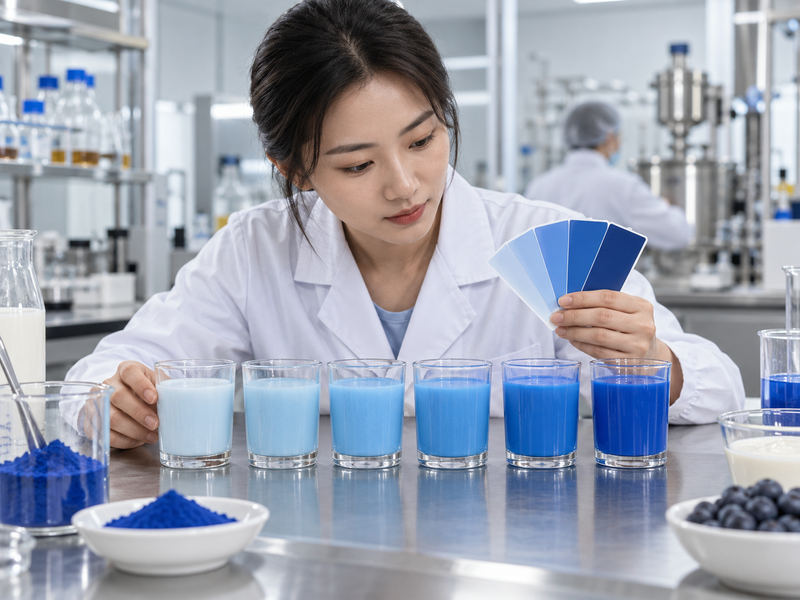
Screen the actual approved combinations under consideration, not a theoretical list of sweetener names. A high-intensity sweetener may need a bulking ingredient or flavor modifier; a polyol may change mouthfeel and have a destination-specific labeling or use limit. Include the concentrations intended for the final recipe. The saccharide and sugar-alcohol paper studied protection against defined heat and oxidation challenges, but concentration and matrix affect performance. Its outcome cannot be read as approval, sensory acceptance or a finished-drink shelf life.
Build a shortlist that is manageable in a controlled pilot: baseline sucrose, one or two reduced-sugar blends, and, if relevant, a no-sugar version. Record every ingredient and active concentration. If the colorant itself arrives with a sugar or maltodextrin carrier, include that contribution in the ingredient and nutrition review. Reconstitution water and any preservatives should remain identical where possible. A supplier can suggest a starting point, but the brand must validate the exact local sweetener authorization and the completed formula.
| Candidate | Formula purpose | Extra question |
|---|---|---|
| Sucrose reference | Benchmark color and taste | Is its solids level comparable? |
| Reduced-sugar blend | Target commercial option | What replaces body? |
| Zero-sugar blend | Maximum reduction option | Does aftertaste alter blue perception? |
| Polyol-containing blend | Mouthfeel option | Is use and declaration acceptable locally? |
3. How can the experiment isolate sweetener effects?
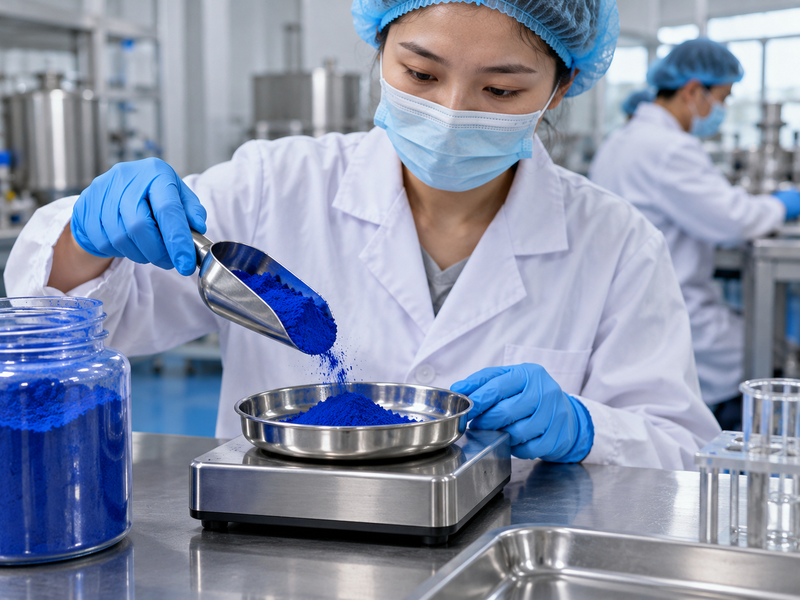
Use one lot of blue spirulina extract and hold its delivered color dose constant across every arm. Keep base flavor, process, package, light exposure and storage temperature constant. Measure and, for the first comparison, match pH. Then run a second set at the taste-optimized pH for each candidate. This separates the effect of the sweetener substitution from the practical effect of reformulating the whole drink.
Include a no-pigment blank for each formula if background color or cloudiness could interfere with readings.
Randomize making order and replicate samples. Predefine how many production-equivalent packs will be opened at each interval, so different arms receive the same handling. If a blend needs a different preservative or processing route, treat that as a separate formulation rather than attributing every color change to the sweetener. Document the full recipe versions. The carbonated-beverage study reported very different pigment retention among commercial matrices; it illustrates why a controlled comparison matters, even when this product is not carbonated.
| Comparison | Held fixed | Changed | Interpretation |
|---|---|---|---|
| Matched-pH screen | Pigment, pH, pack, process | Sweetener blend | Sweetener-system signal |
| Taste-adjusted screen | Pigment, pack, process | Sweetener and required acid | Commercial formula result |
| No-pigment blank | Formula and process | Pigment absent | Background color and haze |
4. Why record pH and acidity separately?
The pH meter gives the immediate acidity environment around the pigment; titratable acidity reflects the amount of acid that shapes taste and buffering. Two recipes can match at one pH yet taste very different and respond differently to storage. Log the acidulant identity and concentration as well as pH after mixing, after any heat step, at fill and during storage. This reveals whether color changes follow a drifting formula rather than the original sweetener choice. Check the instrument on a consistent temperature basis.
Do not adjust a reduced-sugar sample by eye after the colorant is added. Decide whether pH matching or taste optimization is the objective of each arm, record the adjustment, then prepare a fresh replicate. Citrate, fruit juice and flavor compounds introduce additional variables. If the goal is a commercial drink, use the real acid system after the initial controlled comparison. A buffer-only result is useful for mechanism but cannot predict a fruit- or flavor-containing formulation.
Ask the sensory panel to evaluate acidity and aftertaste in the same session as perceived hue, since flavor can alter product acceptability even when measured blue remains stable.
5. How should heat and mixing be standardized?
Map the beverage process from water treatment through sweetener dissolution, blending, any pasteurization or filtration, cooling and filling. Hold temperature and residence time consistent between arms. If the extract can be added after a heat step, test that route only with the plant’s food-safety team and validate any necessary hygienic control. The 2022 stability experiment challenged phycocyanin with heat and oxidation under defined laboratory conditions; the actual line may involve different temperatures, oxygen pickup and holding times.
Make a fixed pre-dispersion protocol: water temperature, addition order, mixing speed and hold. A sweetener syrup of higher viscosity may disperse powder differently from a thin zero-sugar base. Sample the tank and finished pack to distinguish mixing loss from storage loss. Record filter pressure or retained blue material if filtration is used. Avoid increasing pigment dose to compensate for an uncontrolled processing loss. A consistent process gives procurement a fair basis for comparing extract grades and formula costs.
| Process point | Record | Why it matters |
|---|---|---|
| Pre-dispersion | Water, time, mixing | Clumps and initial hue |
| Heat/filtration | Temperature, residence, pressure | Process loss |
| Fill | Oxygen exposure and lot | Starting color in pack |
6. What color, haze and sensory endpoints count?
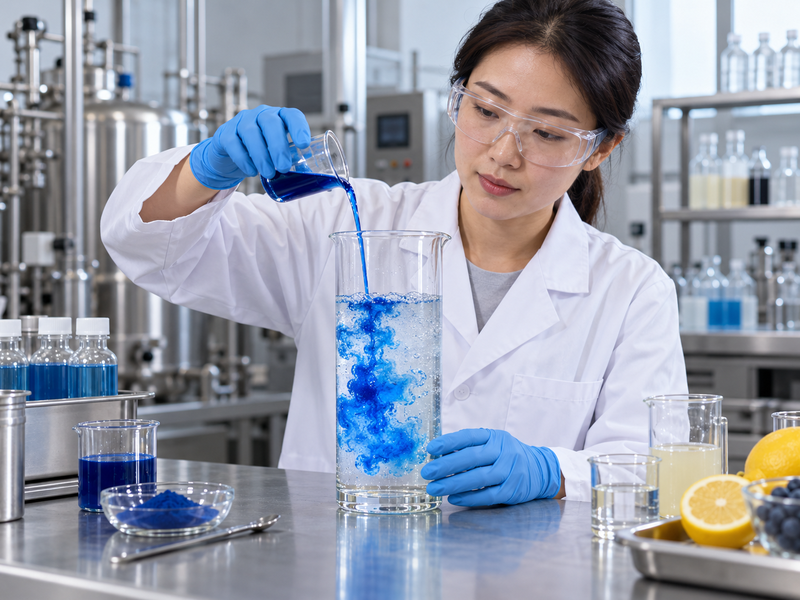
Measure initial and stored color with a calibrated method, then judge appearance in the intended serving container. A pigment absorbance assay helps follow phycocyanin; a colorimeter records the visible hue of the full beverage. Measure turbidity and inspect for sediment, surface ring or precipitate. A blend can preserve apparent blueness while forming particles, or can stay clear while fading to a shade outside the brand standard. Set both an absolute final color target and a maximum change from fill.
Blind sensory assessment should cover sweetness quality, lingering aftertaste, acidity and any color-related expectation. The panel should compare coded samples at the intended serving temperature. Do not let a blue laboratory reading overrule obvious consumer defects. Calculate delivered colorant cost from the dose that passes the endpoint, not simply from price per kilogram of powder. Record any carrier contribution to sugar and energy claims.
If the commercial team wants a clean-label statement, have regulatory staff review the exact ingredient declaration and local rules; the color trial cannot settle that claim.
| Endpoint | Method | Failure example |
|---|---|---|
| Hue | Calibrated color and visual standard | Dull or shifted blue |
| Pigment signal | Agreed absorbance assay | Loss through storage |
| Clarity | Turbidity and sediment inspection | Haze or bottom deposit |
| Sensory | Blinded tasting | Sweetener aftertaste |
7. How should packages and storage be challenged?
Use production-equivalent sealed packs, with a separate unit for each sampling time. Include intended storage temperature and a realistic excursion; add controlled light exposure if the package is transparent. Record headspace and oxygen where relevant. A clear PET bottle presents a different light challenge from an opaque can, even with identical formulation. Run the sweetener screen in one pack format first, then verify the chosen formula in the final commercial pack. Never infer a labeled life from a freshly made beaker.
At each pull, measure color, pigment signal, pH, haze, sediment and taste. Note whether a sample remains safe and otherwise meets finished-product specifications through independent microbiological and process validation. Keep the shelf-life decision tied to the lot, recipe, process, pack and storage profile actually tested. If the brand changes sweetener concentration later to improve taste, repeat a focused color and stability comparison.
The purpose of the screen is to find a robust product choice, not to issue a universal statement that one carbohydrate protects phycocyanin everywhere.
8. What US color-use check is required?
For US use, identify whether the offered ingredient meets the definition and specifications for spirulina extract in 21 CFR 73.530. The effective rule lists non-alcoholic beverages and alcoholic beverages below 20% ABV, among specified categories, at levels consistent with good manufacturing practice. It restricts use in foods with standards of identity unless the applicable standard authorizes added color.
A reduced-sugar claim does not itself change the color category, but the finished beverage identity and labeling still need review.
The February 2026 foods-generally expansion was delayed indefinitely. Do not assume the wider text is operative. Check current destination rules for the exact finished beverage and sweetener system, including permissible sweetener uses and any sugar-content claim. Obtain composition and a lot COA for the proposed extract; “phycocyanin” on a sales sheet alone does not establish that it is the regulated spirulina extract. Regulatory approval and shelf-life performance are separate signoffs.
9. How should suppliers quote comparable grades?
Send the intended pH range, sweetener and acid systems, processing temperature, pack, desired color, destination and forecast demand in one RFQ. Ask for lot-matched extract samples, technical sheets, full carrier declarations, current COAs, color-strength methods, storage recommendations and application-specific quotations. Quote evaluation should include the quantity required to reach the color endpoint, expected process loss and delivered price. An apparently inexpensive grade may require more kilograms to reach the same shade or may introduce a carrier incompatible with the sugar target.
Avoid treating a technical sheet as proof of behavior in the final beverage. Use it to select grades for the controlled screen. Record every sampled lot and formulation version, and ask how the supplier controls changes in color strength and carriers. If a proposed replacement grade arrives, compare it against the approved reference under the same formula and storage conditions. Procurement can then contract around measurable incoming criteria and a defined change-notification process rather than an untestable promise of “stable blue.”
| RFQ element | Buyer states | Supplier returns |
|---|---|---|
| Formula | Sugar target, acid and pH | Grade proposal |
| Process | Heat, filtration and mixing | Handling data |
| Appearance | Target hue and clarity | Color-strength method |
| Supply | Quantity and destination | Lot documents and quote |
10. When does a sweetener change require reapproval?
Approve a named formula and pigment grade only after the chosen sealed drink passes color, clarity, taste, cost, safety and regulatory gates. Document the sweetener concentrations, pH, acidulant, process, pack and storage profile alongside the extract lot. If the brand later swaps one high-intensity sweetener for another, reduces the sugar level further, changes the bulking agent or alters acid balance, reopen the relevant trial. A change that seems minor on the label can shift pH, soluble solids, sweetness perception or haze.
Use a tiered change rule. A new supplier lot within an established specification may need incoming color and a shorter confirmation; a new carrier, grade or formula may require the full pilot and storage work. Do not claim that the literature’s laboratory protection applies automatically to every beverage concentration. Keep the original full-sugar reference and approved reduced-sugar sample available as comparison standards. The practical outcome is a repeatable buying specification for one product, with clear triggers for testing when formulation or supply changes.
FAQ
Q1. Which sweetener protects phycocyanin best? Published effects depend on type, concentration and matrix; screen the actual approved blends in the finished drink.
Q2. Can the same blue dose be used after sugar reduction? Start with a fixed dose for a fair comparison, then optimize against color, taste and cost.
Q3. Is matched pH enough to make formulas equivalent? No. Acid type, soluble solids, flavors and preservatives may still differ.
Q4. Does a supplier’s E-value establish shelf life? No. It describes a test characteristic of the ingredient, not performance in sealed beverages.
Q5. Does a reduced-sugar claim grant US color permission? No. Check the effective color rule and the exact finished beverage separately from sugar-claim rules.
Conclusion: Buy the formula-tested blue grade
A reduced sugar beverage needs a controlled sweetener comparison and a finished-pack decision. Contact SpirulinaCN with the application, target specification and shade, sweetener and acid systems, anticipated quantity, process, pack and destination. Request a lot-matched sample, technical sheet, current COA and application-specific quotation for the grade you will actually test.