
Phycocyanin for low alcohol ready to drink beverages must be qualified in the intended alcohol-containing drink, not in a non-alcoholic soda. A low ABV RTD combines ethanol, acid, flavor, sometimes carbonation and packaging conditions that can change blue color or cause sediment. A 2024 original study of phycobiliproteins in a 20% ethanol solution found strong effects of light and temperature under its experimental conditions.
It provides a reason to control those variables; it cannot set the shelf life of a commercial cocktail with a different ABV and recipe.
Contents
- What exact alcoholic drink is being qualified?
- Which extract and alcohol details belong in the brief?
- How should the ABV and acid matrix be screened?
- Where does the colorant enter production?
- How should light and package options be compared?
- What endpoints reveal instability?
- How should a finished-pack study be run?
- What does the effective US rule actually cover?
- Which RFQ evidence is worth requesting?
- When can procurement approve the grade?
1. What exact alcoholic drink is being qualified?
Define the commercial product with its target and allowable ABV range, acidulant and pH, sweetener, flavor system, carbonation, preservative if any, processing, pack and distribution conditions. A spirit-based citrus RTD, fermented hard seltzer and wine-based cocktail may have different solids, proteins and regulatory identities. Do not treat the words “low alcohol” as a technical specification. Record the maximum ABV the production line could release, since that boundary matters for both formulation and US color-use review.
Describe the target appearance: transparent bright blue, opaque pastel blue or a mixed hue from fruit ingredients. State acceptable haze, sediment and neck-ring limits before screening samples. Include sensory requirements; increasing blue extract dose to overcome fading can shift flavor or cost. Use a colorless control of the same finished drink to reveal background turbidity and natural yellow or pink components. Compare the pilot result with a physical reference standard under controlled light.
The purchase decision is whether a named grade gives a repeatable color in this drink through its intended distribution, not whether an ingredient makes water look attractive.
| Product input | Record | Purchase implication |
|---|---|---|
| ABV | Nominal and tolerance | Ethanol challenge and use category |
| Acid | Type and pH | Pigment environment |
| Pack | Can, glass or clear PET | Light and oxygen exposure |
| Distribution | Chilled or ambient | Stability test conditions |
2. Which extract and alcohol details belong in the brief?
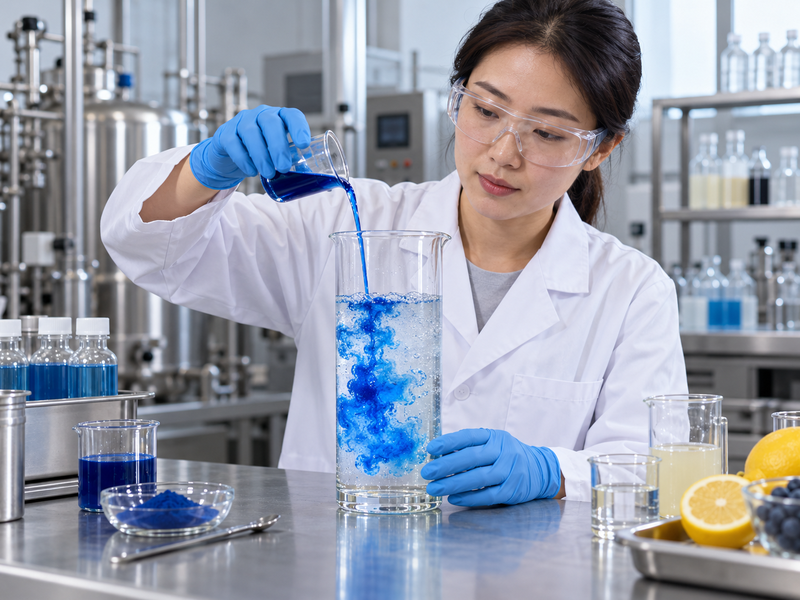
Ask for the identity and composition of the blue spirulina extract offered, including color-strength method, carriers, handling guidance and a current lot COA. A pure-pigment laboratory extract and a formulated food color may behave differently. If the supplier proposes a liquid dispersion, count its water and other ingredients in the RTD formula. If it proposes a powder, test how readily it disperses into an ethanol-containing base without flecks or clumps. Do not infer solubility from an aqueous E-value alone.
Specify both the nominal ABV and manufacturing tolerance, and measure actual ABV in the trial arms. A hydroalcoholic study at 20% ethanol is not a direct test of a 4% or 8% canned drink. The 2024 paper used isolated pigment extracts in a laboratory solution, with cold/dark versus room-light storage; it did not include every RTD acid, sweetener, fruit flavor or package. Treat its light and cold findings as variables to test, not promises that the offered supplier lot will perform identically.
| Material question | Supplier evidence | Buyer verification |
|---|---|---|
| Identity | Extract TDS | Regulatory fit |
| Carriers | Full composition | Label and formula fit |
| Color strength | Defined assay | Incoming comparison |
| Lot safety | Current COA | Risk-based receiving plan |
3. How should the ABV and acid matrix be screened?
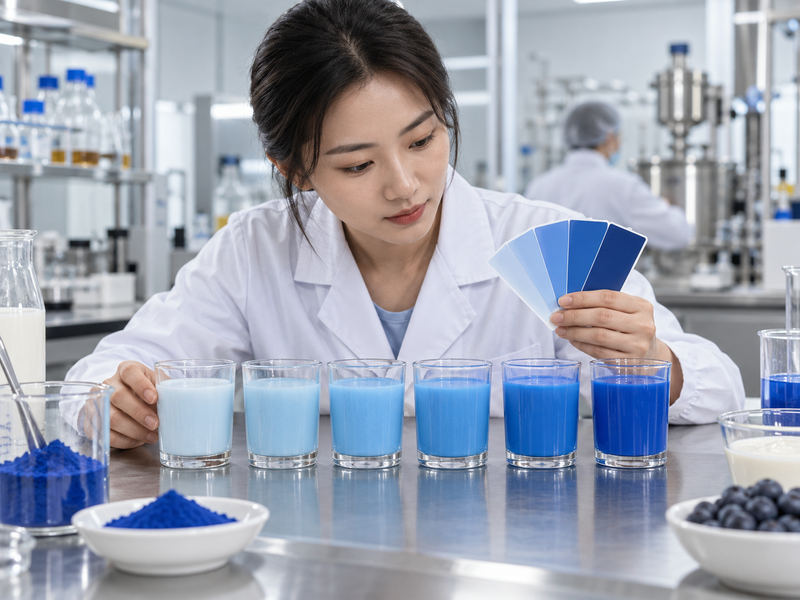
Start with the actual finished recipe and make a small controlled matrix around its allowed ABV and pH limits. Hold pigment lot, initial color target, package and storage constant. One arm at nominal ABV, one at the upper manufacturing limit and one at the lower limit can reveal whether ordinary line variation affects color. Repeat at the permitted pH extremes only if the product specification spans a meaningful range. Do not multiply arms without enough sealed-pack replicates to make the outcome interpretable.
Measure color immediately after mixing and after a realistic hold before filling. Check haze and sediment after cooling. Ethanol concentration can interact with soluble solids and flavor emulsions; if a citrus oil clouding system is present, include it in the test and run a no-pigment control. Do not assume that a change seen with a higher ABV is caused solely by ethanol if acid or flavor concentration changed at the same time. Record every formula adjustment.
A short bench screen should select candidates for the real packaged trial, not assign a shelf-life date.
| Trial arm | Variable changed | Main question |
|---|---|---|
| Nominal recipe | None | Baseline color and taste |
| Upper ABV limit | Alcohol only where feasible | Production tolerance |
| Lower ABV limit | Alcohol only where feasible | Dilution effect |
| Acid extremes | pH with documented adjustment | Color and haze margin |
4. Where does the colorant enter production?
Map the process from alcohol base preparation through flavor addition, any filtration or heat step, carbonation if used, and filling. Try a fixed aqueous pre-dispersion if the powder cannot be added uniformly to the mixed alcoholic base. Record water quality, concentration, mixing energy and hold time. Compare color before and after each operation. A filter may remove particles but also adsorb or retain blue material; a closed mixing tank may reduce light exposure but create a longer hold.
Quantify losses rather than compensating blindly with extra dose.
Any change in addition point must fit the plant’s process and food-safety controls. A suggestion to add pigment after heat treatment is not permission to bypass a validated hygienic step. Run at least one line-scale trial once the bench sequence looks feasible, because transfer times and agitation differ. Inspect filler components and pack closure for residual color, foam and oxygen pickup. A lot that disperses only with a laboratory mixer may be unsuitable for a production RTD even if its initial shade is attractive.
| Process point | Observation | Possible action |
|---|---|---|
| Pre-dispersion | Clumps and color uniformity | Adjust mixing protocol |
| Post-filtration | Color-strength drop | Review filter interaction |
| At fill | Shade, foam, oxygen | Review fill conditions |
5. How should light and package options be compared?
Light is a material variable for phycocyanin in hydroalcoholic liquid. The 2024 storage experiment reported much faster C-phycocyanin degradation in light at room temperature than in cold darkness for its 20% ethanol extract. It does not prove that every opaque can will succeed or clear bottle fail, because the finished recipe and package properties matter. Compare the intended commercial pack under the actual retail-light profile, plus a matched dark control at the same temperature.
If the marketing team proposes a clear bottle, test that format rather than relying on data from a can. If an opaque can is selected, still measure color after opening and pouring into a glass; consumers judge the product at consumption. Record exposure duration, lamp type or intensity, distance and sample orientation. Temperature and light must be controlled separately; otherwise a warm light shelf confounds both.
A package change made to improve blue retention needs renewed oxygen, seam or closure, migration and distribution checks as appropriate to the pack.
6. What endpoints reveal instability?
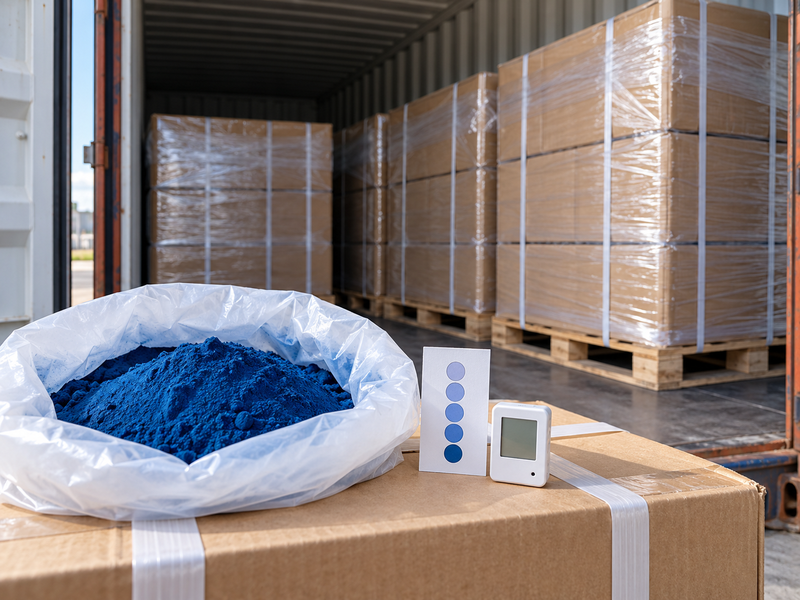
Use standardized color measurement alongside visual assessment at the intended serving temperature. Track the pigment signal by a validated method, but also measure finished-drink hue and cloudiness. A weak blue can turn gray or green against a yellow citrus base before the pigment assay looks disastrous. Inspect the can or bottle for sediment, floccules and a colored ring at the liquid line; evaluate whether any particles reappear after a normal consumer pour. Record pH and ABV at each relevant stage.
Set a pass window at fill and at the proposed end of life. Add a blinded sensory check for flavor balance and any extract note. If the product is sparkling, include dissolved CO2 and pressure because flatness can be a commercial failure separate from color. If it contains fruit or dairy components, check their own stability as well. Do not allow a single photograph or colorimeter number to stand in for full product acceptance.
Document the analytical method, calibration and sample handling so a future ingredient lot can be compared meaningfully.
| Endpoint | Why it matters | Review trigger |
|---|---|---|
| Visible hue | Consumer expectation | Out-of-standard shade |
| Pigment assay | Detects blue component loss | Trend outside target |
| Haze and sediment | Physical stability | Flocculation or ring |
| Taste and ABV | Product identity | Off-note or out-of-spec alcohol |
7. How should a finished-pack study be run?
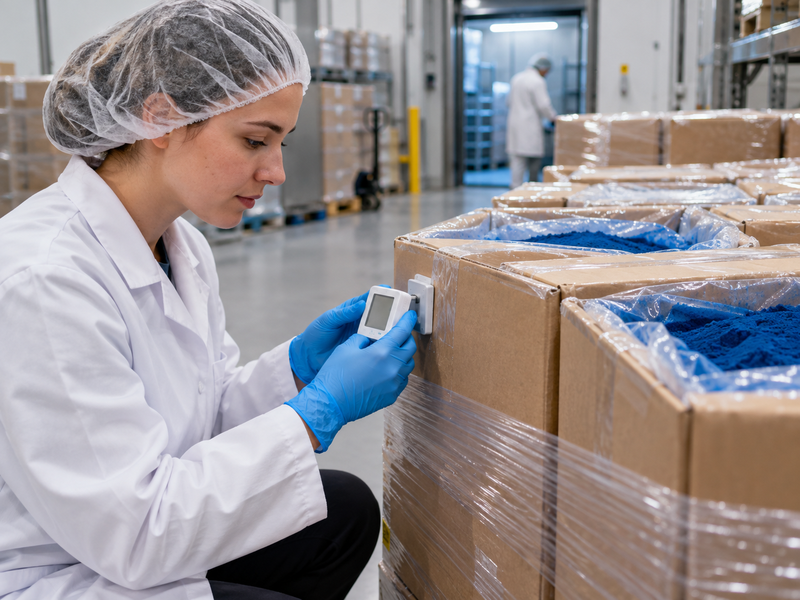
Use closed, production-equivalent cans or bottles made with the intended filling process. Store separate unopened units for each planned time point at normal conditions and one justified excursion condition. Add light/dark arms if the commercial pack is transparent. Record fill lot, extract lot, ABV, pH, headspace, oxygen where applicable, temperature and light exposure. Sample at fill and through the proposed labeled life. An opened glass held under light is a screening demonstration, not a packaged shelf-life study.
At each pull, inspect color before opening, then measure appearance, pigment, pH, ABV, sediment and taste after a standard pour. Evaluate microbial safety and package integrity in the site’s separate validated program. Where a laboratory assay suggests color survival but a tasting panel dislikes the hue, follow the agreed product standard. If a high-temperature excursion causes irreversible color loss, decide whether the distribution specification can reliably prevent it.
Do not quote the research paper’s 25–30 day preservation observation as an RTD expiry date; it came from a different solution and storage design.
| Storage arm | Commercial question | Sampling rule |
|---|---|---|
| Intended chain | Can the product meet its life? | Sealed unit per interval |
| Warm excursion | Is transport robust? | Defined exposure |
| Lit shelf | Is visible retail display viable? | Matched dark control |
8. What does the effective US rule actually cover?
For US-bound products, 21 CFR 73.530 lists qualifying spirulina extract for coloring alcoholic beverages with less than 20 percent alcohol by volume, among other named categories, at levels consistent with good manufacturing practice. The category boundary is less than 20%, not 20% or less. The rule also restricts use in foods governed by standards of identity unless the standard authorizes added color. Confirm the actual finished RTD category and its maximum released ABV with regulatory counsel.
FDA’s February 2026 foods-generally expansion was delayed indefinitely in March 2026. Do not use it as a blanket authorization. Confirm that the offered pigment meets the rule’s identity and specifications; the label “phycocyanin” alone is insufficient. Alcohol labeling and approval pathways may involve additional authorities depending on the product. This article is a procurement test plan, not a legal determination for a particular cocktail.
9. Which RFQ evidence is worth requesting?
Provide suppliers with the planned RTD type, nominal and maximum ABV, pH, acid, flavor, processing, pack, intended storage, desired shade, destination and anticipated quantity. Request a lot-matched sample, technical sheet, carrier and ingredient declaration, current lot COA, color-strength method, recommended handling and application-specific quotation. If a supplier presents a hydroalcoholic stability claim, ask for the tested alcohol concentration, matrix, package, light and temperature. Compare it to your product rather than accepting a headline stability duration.
Price the delivered color per finished unit that passes the storage endpoint. A high-dose candidate may be expensive and can alter flavor; a cheaper grade may have a carrier or low color strength that complicates processing. Keep sampled and quoted grades identical. Record whether a later production lot matches the technical specification and the receiving color standard. A change in carrier or color-strength method should trigger review. Do not describe requested documents or capacity as already supplied by SpirulinaCN.
| RFQ item | Buyer gives | Supplier asked to give |
|---|---|---|
| Matrix | ABV, pH and flavor | Proposed grade |
| Process | Mixing, heat, fill | Handling guidance |
| Quality | Hue, clarity and life | Lot COA and assay |
| Supply | Volume and market | Quote, MOQ and lead time |
10. When can procurement approve the grade?
Approve a named extract grade and commercial formulation after the line trial and finished-pack study meet color, haze, sediment, flavor, safety and regulatory criteria. File the exact ABV, pH, formula, pigment lot, package and storage profile with the decision. If the tested product differs from the marketed one in alcohol base, flavor emulsion or pack, commission a bridging trial instead of assuming equivalence. A study in plain 20% hydroalcoholic solution cannot replace this evidence.
Set change-control triggers for ABV range, acidulant, sweetener, pigment carrier, process hold, packaging and distribution temperature. Monitor incoming color strength and retain a reference from the approved lot. If the product repeatedly fails under expected retail light, address the recipe or package before buying bulk pigment. If the intended market changes, recheck its color and alcohol rules. This turns a visually appealing blue cocktail concept into a reproducible purchase specification with explicit limits and owners.
FAQ
Q1. Can a non-alcoholic soda trial qualify an alcoholic RTD? No. Test the actual ethanol level, acid, flavor and package.
Q2. Does cold, dark storage guarantee color? No. It was favorable in a defined study, but the commercial formula still requires a sealed-pack trial.
Q3. Is 20% ABV included in the US listed category? No. The effective wording says alcoholic beverages with less than 20% ABV.
Q4. Can color be judged only through the can? No. Include a standard consumer pour and measure hue and sediment.
Q5. Does a COA establish RTD shelf life? No. It describes the ingredient lot, not the finished alcoholic beverage.
Conclusion: Match extract to the actual alcoholic drink
A low ABV RTD should pass a controlled alcohol, acid, light and finished-pack program before the blue extract is purchased at scale. Contact SpirulinaCN with the application, nominal and maximum ABV, target specification and shade, pack, anticipated quantity and destination. Request a lot-matched sample, technical sheet, current COA and application-specific quotation.