
A phycocyanin natural purple food color blend is a two-color purchasing decision. Blue phycocyanin from spirulina extract can be combined with a separately selected red colorant, but a purple swatch in water cannot establish how either component will behave in the finished food. The red and blue may respond differently to pH, heat, light, oxygen and storage.
For U.S. projects, spirulina extract use is limited to the categories and conditions in 21 CFR 73.530; the February 2026 broader expansion was delayed indefinitely. The red partner needs its own destination-specific review. Qualify the blend in the real matrix before asking for a volume quote.
Contents
- What is the purple shade decision?
- Which blue material is being purchased?
- How should a red partner be shortlisted?
- How can initial ratio be screened without overfitting?
- What pH and base-color conditions matter?
- How should heat and process order be tested?
- What storage drift must be measured?
- How should regulation and labeling be checked?
- What is the right cost and supplier comparison?
- Which documents close the purchase decision?
1. What is the purple shade decision?
Specify the intended food, package, market and visual target before combining pigments. “Purple” can mean a bluish violet, a red berry tone or a muted lavender. Use a physical reference at the intended product opacity and serving temperature. Set a tolerance for initial shade and for the worst acceptable shift by the end of shelf life. If the product is layered or contains pieces, decide whether every phase must match.
A useful blend is one that holds the intended hue through the actual process and sale period while meeting taste, labeling and cost limits.
Create an uncolored control and individual red-only and blue-only controls. Those reveal whether the base itself changes color or whether one pigment is responsible for a shift. Judge samples in their retail pack, not only an open cup; light transmission and printed backgrounds change perceived purple. Identify who will approve color, regulatory use, sensory effects and supply continuity. A blend that looks right in an R&D vial but has no approved red SKU or reproducible blue value is not ready for procurement.
| Brief element | Record before trial | Reason |
|---|---|---|
| Target | Physical purple standard | Prevent subjective adjustment |
| Matrix | Formula and pH range | Controls pigment behavior |
| Process | Heat, mixing and fill | Tests real exposure |
| Market | Finished category/destination | Drives each color review |
2. Which blue material is being purchased?
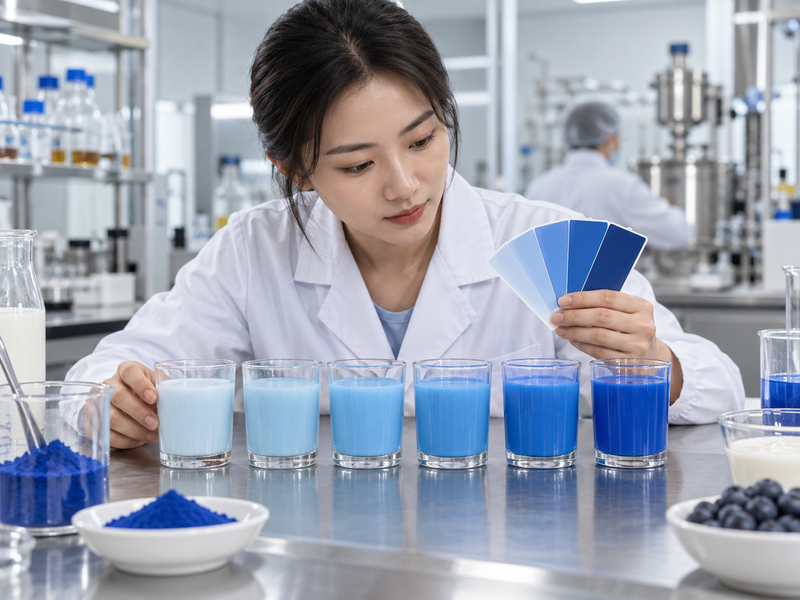
Request a named food-color SKU with its as-sold composition, source organism, extraction identity, carrier and lot-linked color assay. In the U.S., §73.530 defines spirulina extract as filtered aqueous extract of dried Arthrospira platensis biomass, with phycocyanins as the principal coloring components. A laboratory phycocyanin reagent or a whole green spirulina powder should not be assumed to meet the same product identity.
The SpirulinaCN blue spirulina page is a starting point for a grade request, not evidence that any particular lot has passed the buyer’s specification.
Ask for a technical sheet, full carrier declaration, color strength and method, lot COA, microbiological and impurity criteria and storage instructions. Normalize comparisons to the same analytical basis; a high quoted “purity” and a high visible color value are related only through the method and formulation used. Test the actual as-sold material, not a vendor photograph. If the blue grade changes carrier or strength, the red-to-blue balance may move even when the weighed ratio stays constant.
| Blue evidence | What to check | Purchasing implication |
|---|---|---|
| Source and extraction | Identity for destination | Regulatory gate |
| As-sold carrier | Formula and label fit | Different dose or declaration |
| Color-value method | Units and conditions | Fair quote comparison |
| Lot COA | Sample and shipment link | Repeatability |
3. How should a red partner be shortlisted?
Select red candidates for the actual product category and destination, not from a generic “natural reds” list. Candidate families can differ substantially in pH response, heat tolerance, light sensitivity, flavor contribution, opacity and permitted uses. Ask each red supplier for the named source, complete as-sold composition, technical data, lot assay, applicable regulations and sample. Let the qualified regulatory specialist confirm whether that specific color and use are permitted.
Do not infer that a red ingredient is approved simply because it occurs in foods elsewhere or because both suppliers describe their products as natural.
Make the red partner decision using the finished product. A red that performs in an acidic fruit drink may not behave the same way in a neutral dairy-style dessert; the opposite can also occur. Start with a small shortlist and document why each candidate was included. Exclude candidates that fail the legal gate before spending time on fine color matching. A backup red source may be commercially prudent, but it must be tested independently because its color value and carrier can alter hue.
Treat blue and red supplier change control as part of the blend specification.

4. How can initial ratio be screened without overfitting?
Use a small design of experiments in the actual matrix: a few levels of blue and red around an initial target, with a no-color control. Weigh as-sold materials precisely and record any dilution water. Compare a grid rather than changing one pigment at a time without a log. Measure initial shade under fixed conditions and use visual scoring to catch differences an instrument average misses. Select more than one plausible combination for process testing, because the best day-zero shade may drift the most during storage.
There is no universal red-to-blue recipe; it depends on both colorant strengths and the product’s base color.
Record dose in mass per finished product and, where meaningful, in comparable color units. Avoid assuming an absorbance ratio directly predicts perceived hue in an opaque product. A peer-reviewed phycocyanin stability review describes how processing and environmental conditions affect blue pigment, but the blend’s two-component behavior still needs empirical testing. If a ratio requires excessive colorant load, assess taste, solids and legal use before refining the swatch further.
| Screen sample | Why keep it | Later comparison |
|---|---|---|
| Uncolored base | Tracks matrix color | Base drift |
| Blue only | Tracks blue loss | Heat/light response |
| Red only | Tracks red shift | pH/light response |
| Two blend ratios | Tests purple balance | End-of-life shade |
5. What pH and base-color conditions matter?
Measure pH in the finished product at production and during storage, not only in the premix. Acids, proteins and buffers can change the visual expression of a red colorant and the stability of the blue. If the formulation has a plausible pH range from raw-material variation, prepare samples near both edges. Do not move the product outside its established food-safety or sensory specification merely to stabilize a pigment.
If the red hue changes sharply near the normal operating range, it may be a poor partner even if a single bench sample is excellent.
Base opacity and background matter just as much. A creamy white matrix makes pastel purple; a yellow or brown base can produce a muddy shade. Include the real sweetener, protein, fruit solids, minerals and emulsifiers in the test. If a clear beverage is filled in colored packaging, inspect both bottle and poured glass. Record whether pigments partition into droplets, particles or foam. A comparison in distilled water is useful for initial solubility only.
The purchase decision must be based on the product customers will actually see.

6. How should heat and process order be tested?
Map all heating and mixing steps, then measure each pigment’s exposure under realistic product time and temperature. Test whether the colors can be added together or need separate premixes for dispersion. Earlier addition may distribute efficiently but face more heat; later addition may spare color yet require a controlled hygiene step. Do not sacrifice validated food safety for a brighter shade. Record vessel geometry, mixing speed, hold duration, fill temperature and cooling rate.
Sample before and after each significant step to identify whether red, blue or both change.
The blend may shift hue even when total color intensity looks acceptable. For example, disproportionate blue loss makes a redder purple; disproportionate red loss makes it bluer. Use the individual-color controls to interpret this rather than simply increasing both doses. If an intended hot-fill or bake destroys the target shade, decide whether a different partner, packaging or product concept is needed. Supplier stability charts can prioritize tests but do not replace validation in your own matrix and process.
| Process stage | Sample to retain | Question |
|---|---|---|
| Premix | Each color and blend | Dissolution/dispersion |
| Post-heat | Blend plus controls | Relative pigment change |
| Post-fill | First and last pack | Uniformity |
| After line stop | Held product | Dwell-time sensitivity |
7. What storage drift must be measured?
Store production-style packages under the claimed shelf conditions and a justified excursion scenario. Check color at multiple intervals, especially the end of shelf life. Include light-exposed and light-protected sets when retail lighting is relevant. Measure overall color difference and direction of hue change; a similar total difference can represent very different customer impressions. Photograph samples beside the fixed reference and individual pigment controls. Monitor pH, phase separation and visible settling, because what appears to be pigment fade may actually be matrix change or uneven distribution.
Set the acceptance rule before seeing the best sample. It should specify the acceptable shade range, uniformity and any off-color at the package edge or interface. An accelerated warm hold can screen risk but cannot automatically predict a chilled shelf period. Complete the real-time study required by the brand. If purple depends on a narrow ratio that changes with every supplier lot, that commercial fragility belongs in the purchase decision.
A stable slightly different purple may be better than a perfect day-zero purple that drifts visibly.
8. How should regulation and labeling be checked?
Review each color separately for the exact food category, function, use level, source identity, specifications and destination. For U.S. projects, the currently operative §73.530 lists specific categories and a standards-of-identity restriction. The 2026 broadening has not taken effect. Another red color may have a different listing or may be unsuitable for the target food. The finished blend does not inherit a new blanket permission merely because the blue component has a permitted use.
Check the as-sold carriers and the required ingredient declaration for both.
Use a formula revision number and supplier SKU in the regulatory decision. If either pigment or the final food changes, reopen the review. Label terms such as “natural color,” “no artificial colors” or a named source need market-specific substantiation. “Natural purple” is a product-development description here, not a certification or universal legal label claim. The regulatory lead should approve the actual production formula before procurement commits to scale. This avoids a successful color trial becoming stranded by a labeling or category issue.
| Regulatory question | Blue file | Red file |
|---|---|---|
| Source and identity | §73.530 match, if U.S. | Own governing rule |
| Food category | Listed use and restriction | Separate permitted use |
| As-sold composition | Carriers and purity | Carriers and purity |
| Declaration | Market-specific wording | Market-specific wording |
9. What is the right cost and supplier comparison?
Compare approved shades at end of shelf life, not the list price of pigment powders. Calculate dose of each as-sold material per unit of finished food, add premixing losses and any packaging or process changes required to protect the hue. Record yield and rejected packs in line trials. A lower-priced red that needs more blue to stay purple may increase total cost. Conversely, a higher-priced blue with stronger usable color could reduce dose, but only if its carrier, legal identity and stability meet the brief.
Request quotes at the anticipated annual volume and pack format without inventing a supplier’s MOQ or lead time.
Supplier resilience matters. Identify whether both colorants can be sourced with lot COAs, specification change notices and sufficient shelf life for your inventory pattern. If the pair comes from separate suppliers, establish who owns blend adjustment when one lot changes strength. A single preblended SKU can simplify dosing, but the buyer still needs component identity, full composition and regulatory review. The economical blend is the one that reliably meets the finished-product brief with documented supply, not the prettiest or cheapest lab vial.
10. Which documents close the purchase decision?
Build a dossier with the finished formula and target, individual blue and red TDSs, full as-sold compositions, lot COAs, assay methods, sample codes, process records, sensory results, shelf-life color data and destination-market sign-off. Include a color specification for incoming lots that is meaningful to the chosen blend. The pilot report should state the approved addition point and mixing instructions, plus what to do if a lot falls outside the agreed color range.
Include the measured pH, package light exposure, reference viewing conditions and individual pigment doses. If the red supplier changes its extraction or carrier, repeat the red-only and blend stability checks; adjusting blue alone may hide a red instability. Give production a controlled ratio adjustment procedure and a defined point at which the batch must be held for R&D review. Retain physical reference samples and controlled photographs for later comparisons.
Specify how long the references remain valid and replace them when fading makes visual comparison unreliable.
Send suppliers the food category, base matrix, pH range, process exposure, shade standard, package, destination and projected quantity. Include an agreed method for preparing the shade reference; dilution, sample thickness and lighting can otherwise make two identical lots appear different. Record who may adjust the red-to-blue ratio and the maximum adjustment allowed without repeating regulatory or sensory review. Ask for traceable samples and quotes tied to specific SKUs. Treat any future change in carrier, extraction source, red partner, process or label as a requalification trigger.
This makes the natural purple food color purchasing decision repeatable rather than dependent on a single formulator’s memory.

FAQ
Q1. Is there a standard red-to-blue mixing ratio? No. Both color strengths and the finished matrix determine the ratio.
Q2. Can a purple blend be approved because spirulina extract is listed? No. Each color and the finished use need separate review.
Q3. Why test the colors individually? Single-color controls show which component causes a hue shift.
Q4. Does a high phycocyanin purity ratio guarantee good purple? No. It does not establish food-grade suitability or blend stability.
Q5. What should be quoted? Named as-sold SKUs at the dose that meets the finished shelf-life shade, with volume and packaging stated.
Next step: Contact SpirulinaCN with the proposed red colorant, finished food, pH, shade reference, process, destination and anticipated quantity. Request a named blue spirulina grade, color-value data, full composition and lot-linked sample for a matched-matrix blend trial.