
A chlorella lot may meet its chemical specification yet smell different enough to disrupt a beverage launch. A chlorella powder sensory panel gives buyers a structured way to compare color, aroma and taste before accepting a supplier or lot. The panel needs controlled preparation and a clear decision rule; casual office tasting cannot carry the same weight. ISO 13299 gives guidance for sensory profiles, and ASTM E1871-25 addresses consistent sample-serving protocols for food and beverages.
Contents
- What decision should the panel make?
- Which attributes should assessors describe?
- How should samples be prepared and served?
- Who should sit on the panel?
- How can color be compared fairly?
- How should aroma and flavor be assessed?
- What makes a reference sample useful?
- How should results turn into a lot decision?
- How can storage changes be monitored?
- What should buyers ask from suppliers?
1. What decision should the panel make?
Define the use case before opening bags
A panel can screen a new supplier, compare commercial lots with an approved reference or investigate a complaint. Those aims need different designs. A descriptive panel records attributes and their intensity; a simple difference test asks whether samples can be distinguished. A preference test asks what people like. Do not use a small internal quality panel as proof of broad consumer preference. State the purchase decision in advance: accept for a specific application, request more data, or hold a lot for review.
Keep the product in view: a powder destined for dark green tablets may tolerate color variation that a pale beverage cannot. Aroma in the dry bag may differ from aroma after hydration or mixing with fruit. Set the presentation matrix to match the intended use where practical. ISO sensory-profile guidance provides a framework for building consistent descriptors, but the buyer must select relevant attributes. Record product code, inclusion level and decision owner. A supplier needs those details to respond to a complaint without guessing what the buyer tasted.
2. Which attributes should assessors describe?
Use specific words that can be trained
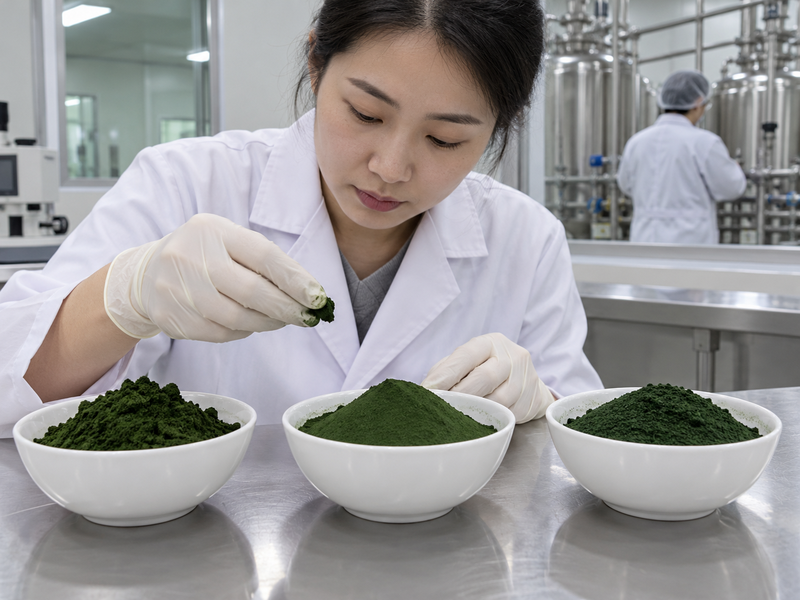
Start with appearance: green hue, brightness, brown cast and visible specks. Aroma might include fresh green, sea-like, earthy or oxidized notes. In a defined tasting matrix, assess bitterness, vegetal flavor, aftertaste and mouthfeel. These are descriptive labels, not verdicts. A panel that writes only “good” or “bad” cannot tell production what changed. Create a short lexicon with reference examples and intensity anchors suitable for your product.
Avoid a long checklist for its own sake. A small set of reliable attributes can separate lots better than dozens of vague terms. Ask panelists to note defects that fall outside the current lexicon, then review whether a new descriptor deserves formal adoption. The panel should not infer safety from taste or color; microbial or contaminant testing belongs elsewhere. Conversely, a COA cannot replace a sensory comparison when customers care about flavor. Keep sensory, analytical and application results side by side so an unusual observation can be investigated through the production record instead of dismissed as personal preference.
| Attribute family | Example descriptor | Control needed |
|---|---|---|
| Appearance | Dark green, brown cast | Consistent light |
| Aroma | Fresh green, stale | Defined container |
| Flavor | Bitter, vegetal | Fixed dilution |
| Texture | Gritty, smooth | Same mixing time |
3. How should samples be prepared and served?
Control every step assessors experience
Use coded, identical containers and a randomized serving order. Fix powder mass, liquid type, temperature, mixing method and time from preparation to evaluation. If assessing dry powder, standardize how long a container is opened before sniffing. If assessing a beverage, choose a base with known flavor and a fixed chlorella inclusion rate. ASTM E1871-25 emphasizes consistent serving, because presentation differences can create false sensory differences.
Think about masking: assessors who see one supplier’s branded bag may expect a particular result. Blind codes reduce that influence. Avoid preparing one sample hours before another, especially when color or aroma changes after hydration. Record water source and cup type if they affect perception. Offer a palate-reset procedure suited to the matrix and keep the room free from strong odors. If samples have different particle sizes, note how much of a difference comes from dispersion rather than intrinsic flavor. Preparation should reflect real use while remaining repeatable across test days and suppliers.

4. Who should sit on the panel?
Match assessor training to the test
A trained descriptive panel needs people who can recognize and scale the selected attributes consistently. A receiving check may use a smaller qualified group comparing a lot with an approved reference. A consumer acceptance question calls for a different population and study design. Record who participated, their training status and any conflicts such as recent illness, strong perfume or direct knowledge of sample identity. Do not ask one buyer to taste a powder and label the result “panel approved.”
Use calibration sessions: give assessors the same reference materials and discuss descriptor meaning before scoring commercial samples. Repeatability can be checked by presenting the same sample under two codes. If an assessor cannot recognize a training reference, retrain or exclude that result under a documented rule. Keep panel fatigue in mind; too many intensely green or bitter samples can dull discrimination. The ASTM sensory standards overview describes structured sensory methods. The buyer can adopt a fit-for-purpose subset while stating the limits of what a small internal panel can conclude.
| Panel type | Appropriate task | Boundary |
|---|---|---|
| Trained descriptive | Attribute profile | Not consumer liking |
| Qualified QC group | Reference comparison | Limited detail |
| Consumer sample | Acceptance insight | Needs suitable design |
| Single expert | Early screen | Not a panel result |
5. How can color be compared fairly?
Standardize light, background and sample state
Chlorella color changes appearance under warm versus cool lighting and in thick versus thin layers. Decide whether to compare powder in a shallow dish, a hydrated dispersion or the finished recipe. Use the same vessel and depth for each sample. Evaluate under controlled illumination with a neutral background and record the time after preparation. A photograph can document a large difference, but camera white balance and screen settings make casual phone images unreliable for tight acceptance limits.
Pair sight with measurement: an instrument can capture color coordinates under defined conditions, while trained assessors judge whether the difference matters in the application. Neither replaces the other. A darker powder might be acceptable in a capsule but alter a smoothie shade. If particle size changes, light scattering can shift appearance without a true pigment change. Ask the supplier whether drying, milling or storage changed between lots. Keep an approved reference sample in a pack that preserves its color, then replace it under a controlled schedule. A faded reference will make every fresh batch appear “too green.”

6. How should aroma and flavor be assessed?
Describe intensity and quality separately
A green or marine note may be expected, while a rancid or musty note may signal a problem. The panel should use defined descriptors and intensity scales rather than one global “strong smell” score. Serve powder or beverage at consistent temperature, because volatile aromas change with warmth. Taste only material that has passed relevant safety and identity checks; a sensory panel cannot make suspect stock safe. Ask assessors to record aftertaste and mouthfeel when those traits matter to the final product.
Be precise with comparisons: a lot with stronger aroma is not automatically worse if the approved reference also has that profile. Decide in advance which notes are acceptable and which require investigation. Separate powder-in-water results from powder-in-recipe results; fruit acids, sweeteners and heat can alter perceived flavor. If an off-note appears only after storage, examine packaging and warehouse conditions as well as raw biomass. An assessor who recognizes a defect should record the code, attribute and intensity, then hand the lot to quality for a documented disposition. Avoid solving a real difference by blending it away without traceability.
| Sensory question | Controlled condition | Useful follow-up |
|---|---|---|
| Dry aroma | Equal powder and vessel | Check storage |
| Beverage flavor | Fixed recipe and time | Repeat in product |
| Aftertaste | Timed observation | Compare reference |
| Mouthfeel | Same mixing method | Check particle size |
7. What makes a reference sample useful?
Treat it as a controlled material
An approved reference should come from a documented lot that performed well in the actual application. Store it in a sealed, labeled pack under defined conditions and record when it was opened. Replace it before age changes its profile. If the buyer uses a long-term standard and a current production control, explain their roles. A new supplier’s sample should be compared with the right reference, not the nearest jar on a shelf.
Link the reference to the file: retain its COA, processing grade, packaging and panel profile. If the reference moves from one lot to another, run an overlap comparison and record the decision. Otherwise the sensory target can drift silently. A supplier may keep its own standard, but your facility’s standard should reflect your finished product. Send a split sample to the supplier when discussing a difference so both teams examine the same material. Keep the reference free from light, moisture and oxygen exposure as appropriate for the powder. A reference is evidence only while its identity and condition remain trustworthy.

8. How should results turn into a lot decision?
Set the rule before seeing scores
Define which attributes are release-critical and how much difference from the reference is tolerable. A panel may flag a lot for technical review without automatically rejecting it; the response depends on intended use, strength of evidence and other test results. Record individual scores, group summary, outliers and comments. Do not hide disagreement by reporting only an average. If several assessors describe the same new off-note, investigate even when mean intensity stays inside a broad range.
Connect the decision to action: quality should decide accept, conditional use, hold or reject and record the rationale. A conditional use may require testing in the finished recipe or limiting the lot to a specific product. Purchasing should not negotiate an acceptance after the panel sees a supplier price. Repeat tests can check reproducibility, but keep original records. Where results are borderline, use a preplanned retest with fresh coded portions and the same panel rules. This gives the supplier a fair route to challenge an unusual finding while preserving buyer confidence in the decision.
| Result | Possible action | Required record |
|---|---|---|
| Matches reference | Release | Panel sheet |
| Minor difference | Application check | Trial result |
| New off-note | Hold and investigate | Deviation report |
| Repeated defect | Reject or restrict | Disposition |
9. How can storage changes be monitored?
Test the powder in the final pack over time
A fresh lot can change in aroma or color during shipment and warehouse storage. Include sensory checks at planned intervals in a shelf-life study using the final commercial pack. Define storage temperature, humidity, light exposure and pack-opening conditions. ASTM E2454-20 discusses design and decision criteria for sensory shelf-life work. A short hot-room challenge may be useful in development, but commercial shelf life should not rest on an unexplained accelerated result alone.
Watch the route: a foil pouch inside a drum and a thin clear bag may protect the same powder differently. Compare retained samples with incoming shipment samples if a complaint arises. Record whether a pack was opened; its in-use life may differ from unopened shelf life. A panel result that trends toward an off-note before the stated expiry should prompt packaging or process review. Keep a sensory endpoint tied to consumer-facing quality rather than simply declaring that any measurable difference equals failure. Buyer, supplier and product team should agree on what still performs as intended.

10. What should buyers ask from suppliers?
Agree on a profile and a response process
Request a product-specific sensory specification, approved reference sample, preparation protocol, assessor qualification summary and recent commercial-lot results. Ask what happens when a panel notes a new odor or color shift, and how the supplier links that finding to cultivation, drying, milling, packing and storage. A COA should not use “sensory: normal” without a described method and standard. Buyer and supplier can run a joint calibration session before setting limits for annual volume.
For the next order: evaluate a commercial-lot sample in the intended product, then record the profile your team accepts. A chlorella powder sensory panel works when it uses consistent preparation, defined language and a preagreed decision rule. It does not replace identity or safety testing. Ask the supplier to notify you of process and package changes that may alter aroma or appearance, even if chemistry remains in range. Clear sensory records make quality discussions more specific and help both parties protect the consumer experience.
| Supplier item | Buyer asks | Purpose |
|---|---|---|
| Profile | Defined descriptors | Comparable language |
| Reference | Lot and storage | Stable target |
| Protocol | Serving and scoring | Repeatable test |
| Deviation rule | Hold and investigation | Timely decision |
FAQ
Q1. Can one employee be a sensory panel? One person may screen a lot, but a panel result needs a defined group and procedure.
Q2. Can color alone prove a lot is safe? No. Identity and safety testing answer different questions.
Q3. Should samples be blinded? Yes, coded presentation reduces expectation bias when comparing suppliers or lots.
Q4. Can a dry-powder panel predict beverage flavor? It can flag concerns, but the finished recipe needs its own test.
Q5. When should a reference sample be replaced? Replace it on a controlled schedule or sooner if its condition changes.
Closing note
Prepare coded samples consistently and compare them with an approved commercial reference. Record specific attributes and a decision before negotiating a shipment. That shared evidence lets buyers request corrections without vague claims that a batch “just tastes wrong.”