
A buyer may approve chlorella by color and composition, then find that the next lot will not fit the same sachet. Chlorella powder bulk density links powder mass with occupied volume, so it affects filling, storage and freight. This guide shows how to ask suppliers for comparable results and turn a laboratory figure into a packaging decision. USP general chapter <616> addresses bulk and tapped powder density; use its method details or another agreed protocol when specifying your ingredient.
Contents
- What is bulk density for chlorella powder?
- How does tapped density differ?
- Which sampling rules make results comparable?
- What equipment and method details matter?
- How does density affect package fill?
- What does density imply for blending?
- Why can lots show different results?
- How should a buyer set acceptance limits?
- What should receiving teams verify?
- How does density enter a supplier agreement?
1. What is bulk density for chlorella powder?
Define mass divided by loose occupied volume
Loose bulk density compares a measured powder mass with the volume it occupies after being introduced into a vessel under a defined method. That volume includes spaces between particles. It is not the density of chlorella solids themselves. A fluffy powder can take more room than a denser granule at the same weight, even when both meet the same chemical specification. Report units clearly, such as grams per milliliter or kilograms per cubic meter, and state whether the result is loose or tapped.
The buyer’s practical question: how much space will a target mass occupy in the real pack? Do not calculate a commercial pouch exactly from one bench reading, because filling equipment, vibration and handling change the powder bed. Use the lab result to screen formats, then confirm on the line. The USP <616> notice provides a recognized framework for loose and tapped measurements. A supplier’s number only becomes comparable when method, sample condition and unit match yours. Add that context to any request for quotation instead of asking for “density” alone.

2. How does tapped density differ?
Measure powder after standardized settling
Tapped density uses the same basic mass-to-volume relationship after controlled tapping reduces space between particles. It is often higher than loose density, but the amount of change depends on particle shape, size distribution, cohesion and test conditions. The two figures together describe packing behavior more usefully than either one alone. They do not, by themselves, prove good flow in a hopper or trouble-free tablet pressing.
Ask for the tapping procedure: equipment, drop height or method, count or endpoint, cylinder size and sample mass. USP <616> distinguishes measurement approaches, so a vague “tapped density” line on a COA is not enough for strict comparison. A powder can settle during ocean freight or after repeated movement in a filling machine; the tapped result can help bound that effect. Still, a commercial pack may settle differently from a laboratory cylinder. Run a pilot fill and record headspace before and after handling. If the two densities diverge sharply, investigate flow and compaction with additional tests rather than treating the ratio as a diagnosis.
| Measure | Sample state | Primary use |
|---|---|---|
| Loose density | Defined untapped fill | Initial volume |
| Tapped density | Defined settled state | Compaction potential |
| Pack trial | Commercial handling | Actual fill fit |
| Flow trial | Equipment movement | Production behavior |
3. Which sampling rules make results comparable?
Sample a lot, not a convenient scoop
Powder from the start and end of a dryer or mill run may differ in particle size and moisture. Ask where samples come from and whether increments are combined or tested separately. A composite can estimate the lot average, but it may hide a portion that overfills sachets. If several process runs form one sales lot, the plan should cover each. Document container number, sample depth, date and storage before test. A retained sample should match the material the buyer receives.
Mind segregation: fine and coarse particles can separate during shipping or pouring. A sample taken from a bag’s top may not match material at the bottom. Define a mixing or sampling procedure that does not artificially compact the powder before a loose-density test. Test both supplier and buyer samples using the same method when qualifying a new source. If results disagree, compare sample conditioning and apparatus before declaring a lot defective. Density can change with moisture uptake, so note water activity or moisture and the time since bag opening. A good sampling record makes the figure meaningful for the actual shipment rather than just the laboratory jar.

4. What equipment and method details matter?
Lock down vessel and handling
The cylinder or measuring vessel, powder introduction method, sample mass and leveling procedure can alter apparent volume. A funnel may aerate powder differently from a scoop. Tapping height and count affect settled volume. Ask for a controlled method number and revision, apparatus qualification and analyst training. The report should identify whether any clumps were broken before measurement and how powder was conditioned. Those steps matter for a cohesive green biomass powder.
Try a method transfer: send a sealed sample to the supplier and buyer labs, then compare results obtained using the same written procedure. If one technician shakes the cylinder before reading loose volume and another does not, their numbers cannot be used to judge supply consistency. Repeat measurements reveal within-lab variation. Include the average and spread where a specification limit is tight. The USP bulk-density chapter notice can guide method selection, but the purchase agreement still needs the chosen procedure and result format. Avoid placing a limit on an unspecified “density” field.
| Method variable | Record it? | Effect |
|---|---|---|
| Sample conditioning | Yes | Moisture and temperature |
| Introduction method | Yes | Loose packing |
| Vessel and mass | Yes | Volume reading |
| Tapping program | Yes | Settled volume |
5. How does density affect package fill?
Translate grams into usable headspace
A low-density powder needs more volume for the same mass. That can force a taller pouch, larger drum or lower target fill weight. A denser powder may leave excessive headspace in a package designed around an older lot. Calculate approximate volume from target mass divided by measured loose density, then add allowance for filling variability and pack geometry. Use this as a planning estimate, not a final engineering drawing.
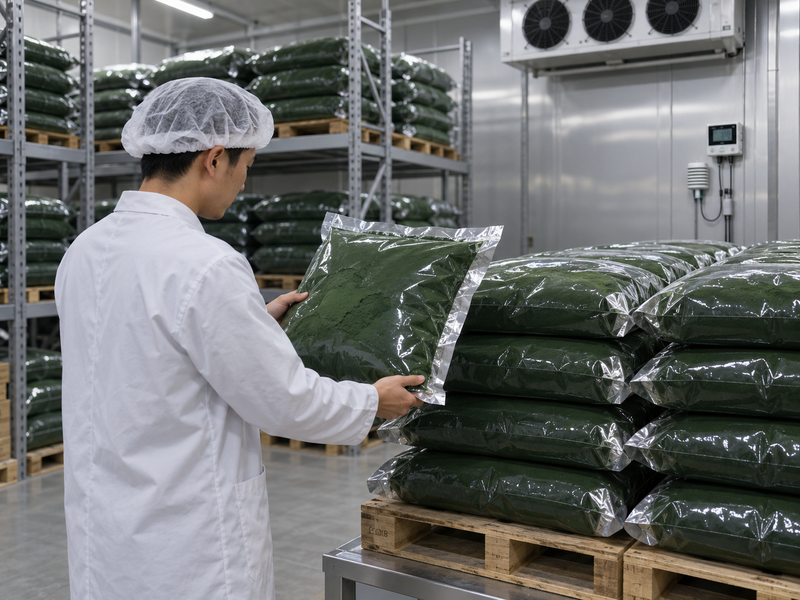
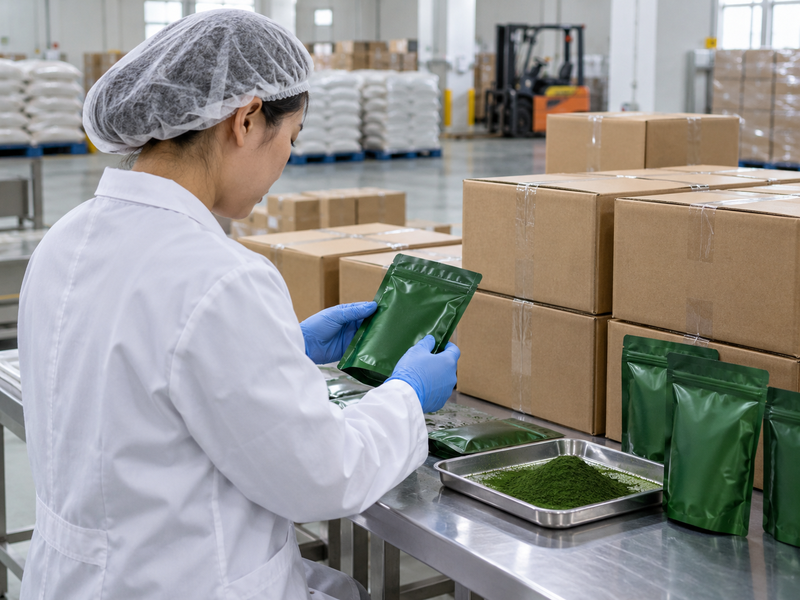
Run a commercial trial: fill representative units at line speed, check weight, seal cleanliness and headspace, then handle them as freight would. A powder that settles after vibration may leave a loose-looking pack even though weight is correct. Overfilled pouches can contaminate seals or create excessive pressure at corners. Ask your supplier whether its own bulk packs were qualified at the proposed weight and whether liner dimensions changed. For capsules or sachets, density also affects volumetric dosing and machine settings; a lab value should trigger a line trial rather than substitute for one. Record the tested lot so future changes can be compared.
6. What does density imply for blending?
Watch segregation and dose uniformity
When chlorella joins a blend with substantially different particle size or density, components can separate during transfer or vibration. Bulk density alone does not predict segregation, but a changed result can signal altered particle structure or moisture. Ask for particle-size distribution, flow behavior and blend uniformity data where your application requires them. Run the actual recipe at intended batch size and sample from multiple blender locations and discharge points.
Do not infer cause from one number. A powder may become denser because it was milled finer, granulated, compacted in shipping or exposed to humidity. Those routes have different effects on mixing. Keep sample age, handling and method constant while investigating. If a new supplier’s material settles in a tote, the final product could vary even though every incoming COA passes composition. A pilot blend should monitor weight, color and an appropriate component marker rather than rely only on visual green uniformity. Work with the supplier on a physical specification that supports your line, then verify across more than one commercial lot.
| Observation | Possible question | Check |
|---|---|---|
| Low density | More entrained air? | Fill trial |
| High density | Finer or compacted? | Particle size |
| Broad variation | Segregation? | Multi-point samples |
| Caking | Moisture uptake? | Water activity |
7. Why can lots show different results?
Review upstream and storage variables
Cultivation, harvesting, drying, milling, sieving and packing all influence powder structure. A different dryer setting may change particle shape; a new screen can shift size distribution. Moisture uptake during storage may create clumps and alter how powder fills a cylinder. If a supplier mixes lots before packing, its blending method can change apparent uniformity. Ask for the production changes that occurred between a reference lot and an outlier.
Compare the whole record: density, moisture or water activity, particle size, flow observations and bulk-pack condition. A single abnormal figure could come from the method rather than the process. Repeat with a sealed retained sample and inspect the sampling procedure. If the change is genuine, identify whether it affects your pack or formulation. Rejecting every statistical difference would waste usable material; ignoring a change that jams a sachet machine would be costly. Define material impact through application trials and an agreed specification. A supplier should notify the buyer before changing processes that can meaningfully shift physical powder properties.
8. How should a buyer set acceptance limits?
Use process capability and package needs
Measure several commercial lots with the chosen method, then determine which density range your equipment can handle. The lower limit may protect against overfilled packs, while an upper limit may guard against an unexpected process change or altered blending behavior. A narrow range may be unrealistic if method variation is large. Consider separate limits for loose and tapped density only when each has a clear decision purpose.
Put the method beside the limit. State units, sample conditioning, apparatus and number of replicates. Agree on what happens when a result sits near a boundary: retest, joint sample or additional pack trial. Do not change limits after seeing an outlier without a documented technical review. A trial order can reveal whether the proposed specification fits real production. Ask the supplier to share its historical range without requesting proprietary recipes. The goal is a tolerable operating window that protects your finished product and permits normal controlled variation in chlorella powder.
| Limit input | Why review it? | Evidence |
|---|---|---|
| Lab variation | Avoid false rejects | Replicate study |
| Lot variation | Assess capability | Historical results |
| Pack geometry | Prevent overfill | Fill trial |
| Blend behavior | Maintain uniformity | Pilot run |
9. What should receiving teams verify?
Check the delivered lot against the approved grade
Receiving staff should verify product code, lot, pack integrity and COA method before a density value is accepted. If the COA lists only a number without units or whether it is loose or tapped, ask for clarification. Take a representative incoming sample under the same handling procedure used for qualification. If shipment settling creates dense layers in a bag, mix or sample according to a controlled instruction. Do not simply scoop the easiest surface and compare it with a supplier composite.
When results differ: hold the lot if the discrepancy affects a defined requirement, then compare method versions and sample identities. A quick bench test can screen for a serious fill-volume problem, but the agreed method should govern formal acceptance. Record how the material runs in the first production batch. A supplier may ship a powder that meets laboratory density yet clogs a feeder because of caking; report both observations. Linking incoming tests with manufacturing outcomes will help refine future limits and reveal whether the chosen density measurement predicts the issue you actually care about.

10. How does density enter a supplier agreement?
Make the number actionable
Specify product grade, loose or tapped result, method revision, units, sampling plan, acceptance range and COA reporting. Include change notification for drying, milling, sieving, granulation, carrier composition and pack format. If your line depends on a specific flow or fill behavior, attach a pilot-trial acceptance test rather than asking density to stand in for every physical property. Agree on retained samples and dispute procedure before volume orders start.
For the next shipment: compare the supplier’s density data with your receiving result and actual fill performance. Keep those three records tied to one lot. Chlorella powder bulk density is a useful bridge between lab and factory when measured consistently and interpreted with particle size and moisture. Ask the supplier to supply two independent production lots for qualification. That gives both sides evidence of repeatability and a realistic basis for pack design, freight estimates and purchasing decisions.
| Agreement field | Required detail | Owner |
|---|---|---|
| Test method | Revision and condition | Quality |
| Acceptance band | Loose and/or tapped | Buyer and supplier |
| Change notice | Physical process changes | Supplier |
| Dispute route | Retained sample and lab | Both parties |
FAQ
Q1. Is bulk density the same as particle density? No. Bulk density includes spaces between powder particles.
Q2. Why report tapped density too? It shows how measured volume changes after controlled settling.
Q3. Can density predict powder flow by itself? No. Flow needs additional testing and a line trial.
Q4. Does a larger density number mean better chlorella? No. Suitability depends on your formulation and pack.
Q5. Should buyers compare COAs from different methods? Only after confirming sample condition, method and units are comparable.
Closing note
Agree on one repeatable method, measure several commercial lots and trial the powder in its final pack. The result will help you buy a material that fits your equipment while leaving room for normal, controlled production variation.