
Phycocyanin in plant based milk can behave differently across oat, soy, almond and coconut drinks. Their starting shades, protein levels, fat droplets and suspended solids differ. A powder that makes a bright blue sample in water can look gray in an oat base or uneven after storage in a soy drink. A plant-based milk project therefore needs a color trial and a physical-stability trial on the same commercial formula.
The Spirulina CN Blue Spirulina page lists milk or plant-based drinks as possible applications and calls for sample testing under actual conditions. It does not specify a grade or dose that works for every base. The plan below helps a beverage team choose what to measure, when to add the color and how to connect the pilot result to the ingredient specification.
Contents
- Why is the plant base the first variable?
- What ingredient information is needed?
- How can the target blue be defined?
- What should a bench dose ladder include?
- How might protein and fat change the result?
- Where should processing be tested?
- How should separation and sediment be measured?
- What belongs in the filled-pack storage study?
- How should lot and base variation be challenged?
- When is the formulation ready for scale-up?
1. Why is the plant base the first variable?
A blue extract does not erase the base color
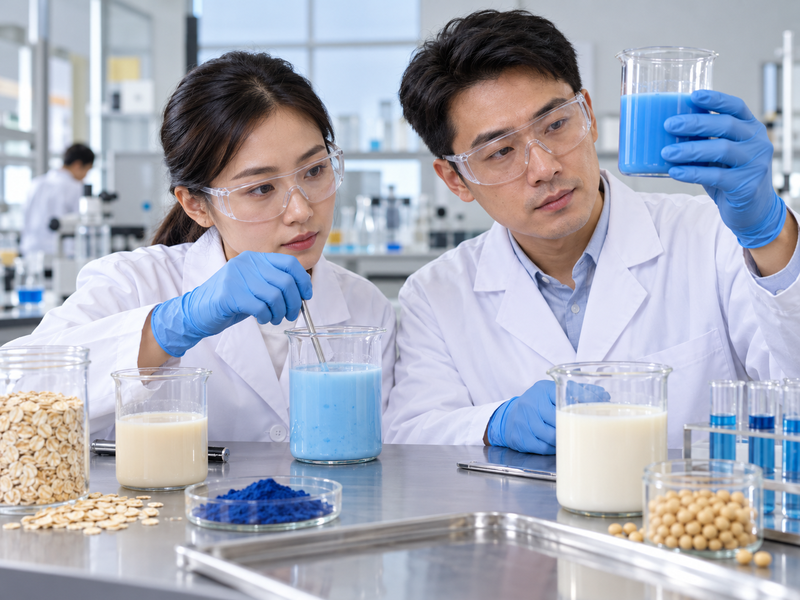
Plant beverages are colloidal systems, not clear water. The base may contain yellow or beige tones, fat droplets and insoluble particles that change perceived hue and scatter light. An original study comparing UHT bovine, oat, rice and soy drinks measured different particle sizes and separation behavior among the sampled products. It does not establish a universal ranking for today’s brands, but it shows why a formula-specific test is necessary. Start with the uncolored commercial base, not an idealized laboratory substitute.
Record the base’s plant source, solids, protein, fat, pH, viscosity and existing stabilizers. Then inspect its color and separation before adding phycocyanin. A blue ingredient cannot fix a base that already sediments or creams beyond the brand’s acceptance range. If the base changes during processing or storage, its color may shift independently of the pigment. Keep an uncolored control through the full trial so the team can tell whether a change is caused by the plant matrix, the blue ingredient or their interaction.
| Base characteristic | Why it matters to blue appearance |
|---|---|
| Starting color | Changes final hue at the same dose |
| Protein and fat | May affect optical opacity and interactions |
| Insoluble solids | Can create sediment or uneven color |
| pH | Changes pigment environment |
| Stabilizers | Influence flow and phase separation |
2. What ingredient information is needed?
Get the exact phycocyanin preparation
Request the offered SKU, its full ingredient and carrier statement, color-value method, current specification, COA and sample lot. “Blue spirulina” is a commercial term rather than one uniform composition, as the site’s product page explains. A carrier that works in water may influence mouthfeel, labeling or powder wetting in a plant beverage. The buyer should know whether the product is sold as an extract powder, a formulated color preparation or another form before trials begin.
Ask for the supplier’s recommended handling conditions as a starting hypothesis, not a substitute for the plant’s own test. Record sample storage history and ensure the eventual quote covers the same SKU. Quality should review contaminant and microbiological documentation separately from color performance. In the US, 21 CFR 73.530 defines and restricts spirulina extract for coloring uses; regulatory staff must assess the exact preparation and intended finished product. Approval in another market requires its own review.
| Supplier item | Decision supported |
|---|---|
| SKU and lot | Trial-to-order traceability |
| Carrier statement | Label and matrix compatibility |
| Color method | Grade comparison |
| COA and specification | Incoming quality limits |
| Storage instruction | Sample and warehouse handling |
3. How can the target blue be defined?
Set a target for each base formula
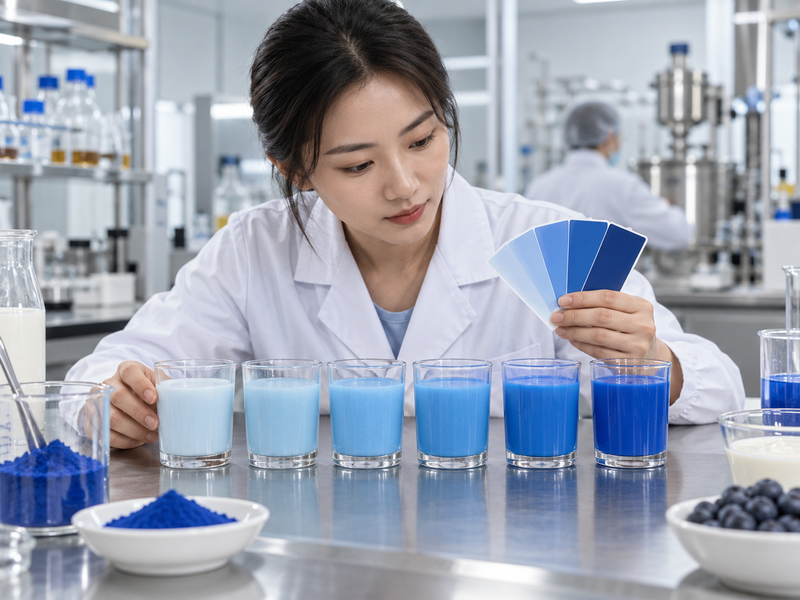
The same amount of pigment can look different in oat and soy drinks because the underlying bases differ in color and opacity. Marketing should approve a physical reference for each finished product, viewed in its intended package under controlled light. R&D can also record color coordinates using a repeatable instrument method. The CIE color-difference framework supports a numeric comparison, but the brand must choose an acceptance limit appropriate to its customers and package.
Define whether the product should be pastel blue, saturated blue or a particular shade after mixing with flavors. A vanilla oat drink may begin beige; a coconut drink may begin white. Do not push a dose until both appear identical if the sensory or ingredient cost becomes unacceptable. Instead, set a feasible target for each SKU. Record appearance at fill and at the proposed end of life. If separation creates blue and pale layers, an average color measurement alone will miss the defect. Include visual uniformity in the acceptance rule.
4. What should a bench dose ladder include?
Compare as-sold powder doses in the full formula
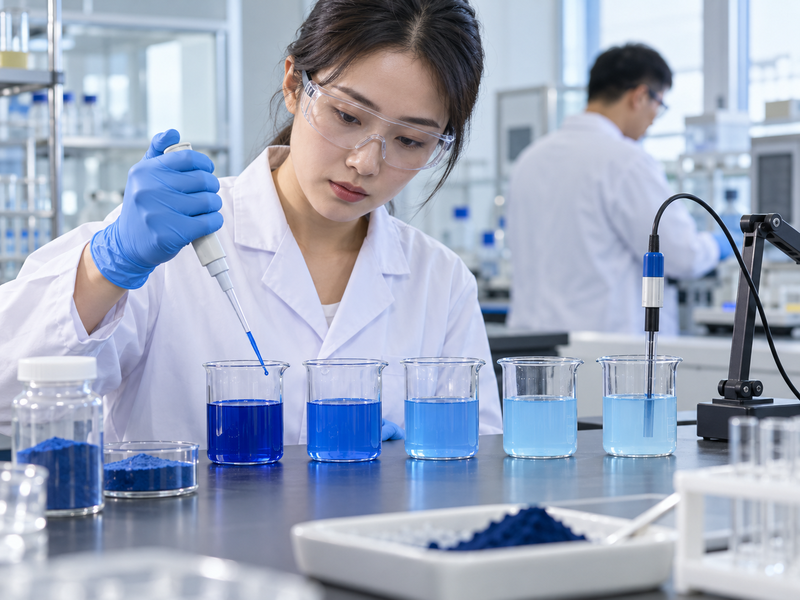
Prepare several measured doses of each candidate phycocyanin SKU in the complete base. State grams per liter or another production unit, and keep batch size, mixing speed, order of addition and temperature constant. Include the uncolored base. Measure shade, pH, viscosity, visible particles and flavor. A stronger blue may require less powder but still behave poorly if it creates specks or changes mouthfeel. The best dose is the lowest one that meets the full acceptance set after processing and storage.
Test the ladder in at least the normal base and a realistic formulation edge, such as the low and high ends of protein or pH ranges, if those vary in production. Do not extrapolate a dose directly from an E grade. The commercial color number reflects a defined optical test, while the plant drink is a complex matrix. Keep retained samples of each dose in the intended package. The ladder should tell procurement what the ingredient will cost per finished unit and tell production the range within which operators can adjust without improvising.
| Dose level | Color | Uniformity | Flavor | Storage result |
|---|---|---|---|---|
| Blank base | Record | Record | Record | Retain |
| Low | Measure | Inspect | Taste | Retain |
| Mid | Measure | Inspect | Taste | Retain |
| High | Measure | Inspect | Taste | Retain |
5. How might protein and fat change the result?
Watch interactions without assuming the direction
Phycocyanin is a pigment-protein complex, and plant beverages contain their own proteins and oil droplets. An original in-vitro phycocyanin study tested interactions with several proteins, including soy protein, under defined light and temperature conditions. It found formulation-dependent outcomes; those results should guide test design, not be copied as a performance prediction for a commercial soy milk. An original plant-beverage study separately shows that the base’s particle system affects physical stability.
Observe whether blue color remains evenly distributed or follows one phase during creaming or sedimentation. Measure viscosity, particle appearance and any flocculation after processing. If the formula has emulsifiers or hydrocolloids, change one ingredient at a time when investigating a defect. Do not add a stabilizer solely because a lab paper reported a benefit in a different system. The target is a drink that looks and tastes acceptable at sale and through storage, using ingredients the brand can declare and manufacture consistently.
6. Where should processing be tested?
Reproduce the commercial sequence
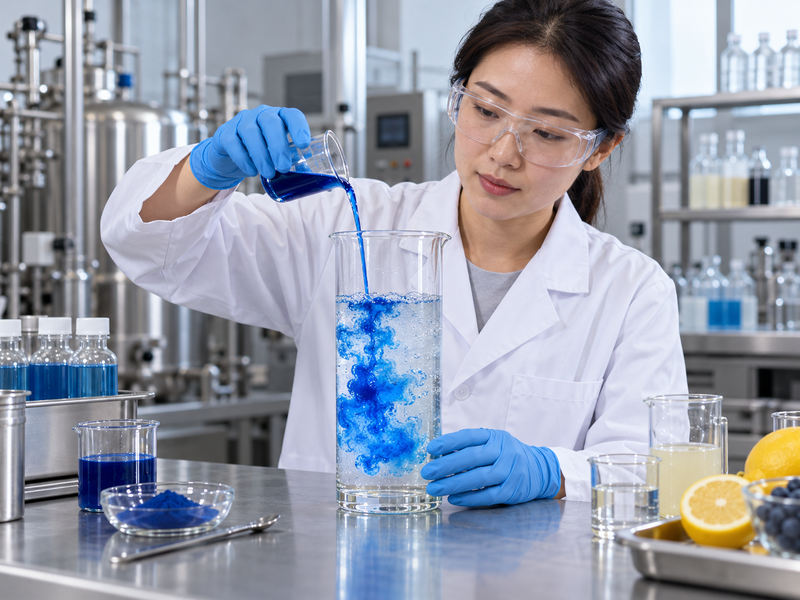
Plant-based drinks often undergo homogenization, heat treatment or another validated preservation process. The color trial should follow the chosen line’s actual order and time-temperature profile. Record whether phycocyanin is introduced before or after homogenization, heating and cooling. Adding after a major heat step may be worth investigating for color, but food-safety and sanitation teams must approve any post-process addition. A blue result cannot justify bypassing the validated process.
Compare color and physical stability before and after each critical step. A pilot-scale phycocyanin study found that some commercial Arthrospira samples lost color under particular pH and heat conditions. Those experimental thresholds are not specifications for a plant milk. The product’s protein, fat, stabilizers and package may change the outcome. A bench cup is therefore a screen; a pilot line is where the team confirms process fit. Keep the pilot’s mixing energy and hold times in the final work instruction.
| Process point | Record |
|---|---|
| Premix | Wetting and local concentration |
| Homogenization | Pressure, passes and appearance |
| Heat step | Product temperature and hold time |
| Cooling | Time to fill temperature |
| Fill | Color, phase behavior and pack code |
7. How should separation and sediment be measured?
Inspect undisturbed packs first
Store filled units upright and inspect them without shaking. Record cream layer, sediment height, color bands and any ring at the pack wall. Then use a standardized inversion or shaking procedure to assess whether the drink returns to a uniform appearance. A customer may shake a plant drink, but the brand should decide in advance what undisturbed and redispersed states are acceptable. Centrifuge or particle-size tests can help investigate a problem, but they should not replace a realistic shelf observation.
Plant-based drinks can separate for reasons unrelated to phycocyanin. Research on oat milk made from different cultivars measured physical and sensory differences and linked instability in its samples to density-based separation. Keep an uncolored control from the same base lot through every storage point. If both control and blue drink sediment similarly, base formulation may be the priority. If only the blue drink forms a colored ring or floc, examine the pigment carrier, addition method and ingredient interactions. Document observations with a scale and consistent photography.
8. What belongs in the filled-pack storage study?
Test the route and the visible result
Fill the final commercial package and store it under the proposed distribution conditions. Include a justified challenge condition if quality wants to understand excursions. At planned intervals, measure shade, pH, separation, flavor and package integrity. A light-exposed pack may need a separate comparison because phycocyanin color can change under illumination in some systems. The in-vitro stability study is evidence that light and temperature matter to testing; it does not assign shelf life to a plant-based drink.
Use unopened units at each time point so repeated opening does not change oxygen exposure or contamination risk. Record the formula revision and pigment lot on every sample. If the pack is opaque, judge the decanted drink as the consumer will see it; if transparent, also record through-pack appearance. The supplier’s powder storage claim and the finished drink’s shelf life are separate. A storage study should finish with a signed acceptance decision, not merely a photo of a blue sample on day one.
| Storage observation | Why it matters |
|---|---|
| Color and shade | Brand appearance |
| Phase separation | Consumer acceptance |
| Sediment redispersion | Use experience |
| Flavor and odor | Product quality |
| Pack integrity | Distribution performance |
9. How should lot and base variation be challenged?
Confirm the process works beyond one sample
The first trial may use a carefully prepared base and one pigment sample. Commercial production sees variation in plant raw materials, ingredient lots and process conditions. Test a second lot of the approved phycocyanin SKU and, where feasible, more than one base batch. Start at the same approved dose and process, then observe whether color and physical stability remain within limits. If operators need to adjust the dose, define a written range and a measurement that triggers the adjustment.
Ask the ingredient supplier for lot-specific COAs and change notification for carrier, site or method changes. A passing E value does not prove identical shade in an opaque plant base. Keep a retained powder sample and filled reference product from the approved lot. The Spirulina CN product page says batch documentation and application support can be coordinated, but a buyer should obtain the actual documents for the lot offered. Purchasing can then order the material tested rather than an interchangeable-sounding grade name.

10. When is the formulation ready for scale-up?
Approve the ingredient and the base together
Scale-up is justified when the selected SKU, dose, plant base and process meet the shade and physical-stability targets in pilot filled packs. The record should include carrier, ingredient lot, base formula, target pH, process profile, package, sensory review and storage results. Define which measurements will be repeated during routine production and who can approve a deviation. A statement that “blue spirulina works in oat milk” is too broad to guide a line operator or a purchasing agent.
Regulatory staff should confirm the color’s permitted use and declaration in every intended market. For US use, current 21 CFR 73.530 is a starting point for spirulina extract; it does not approve the brand’s specific formulation. Confirm that the commercial quote names the same grade sampled. The resulting specification should protect both the blue appearance and the plant drink’s texture through normal production, distribution and use.
Frequently asked questions
Q1. Will phycocyanin make every plant milk blue? It can color suitable formulas, but the final shade depends on the base and tested dose.
Q2. Is a water test enough to select a grade? No. Use the complete plant beverage and its real process.
Q3. Does soy protein always stabilize the color? No. Research results depend on preparation and conditions; test the commercial formula.
Q4. Should a sedimented sample be shaken before inspection? Inspect it undisturbed first, then assess redispersion using a fixed method.
Q5. Can one result cover oat, soy and almond variants? No. Each base needs its own color and stability approval.
Request samples for a plant-beverage pilot
Send Spirulina CN the plant base, target blue, process profile, package, market and expected volume through its Blue Spirulina page. Request the exact grade’s composition, specification and matching lot COA. Test the candidate in filled pilot packs before setting a commercial dose or label.