
Blue spirulina clear RTD beverage formulation needs a clarity test as well as a color test. A clear blue ready-to-drink beverage has little room to hide a formulation problem. Small particles become visible as haze, a ring on the bottle or sediment. Acid, heat and light can change the hue after the line trial. A powder that looks blue in a supplier photo may make a finished drink cloudy or shift color after filling. Buyers and developers need a shared test plan before purchasing a commercial grade.
The Spirulina CN Blue Spirulina page identifies beverages as an application and asks for pH, process, light and mixing tests on the actual formula. That is a useful starting point, not a guarantee of clarity for every SKU. This article covers the decisions that matter to a clear RTD project, from sample selection through filled-pack approval.
Contents
- What makes a clear blue RTD different?
- Which ingredient documents should arrive with the sample?
- How should the base formula be screened?
- How can clarity and haze be measured?
- Where should the color be added in the process?
- What should a dose ladder record?
- How do carbonation and other ingredients change the test?
- What must the filled-pack study include?
- How should supplier lots be compared?
- When is the RTD formula ready to scale?
1. What makes a clear blue RTD different?
Every physical defect is easy to see
In an opaque smoothie, suspended particles may be acceptable. In a transparent beverage, the same particles can look like contamination even if the product is safe. A clear RTD therefore needs separate targets for color, haze, sediment and ring formation. “Dissolves in water” is too broad; ask whether the exact product is soluble or merely dispersible at the proposed dose and process conditions. The site’s product guidance also distinguishes these behaviors and recommends a test in the finished formula.
Define the visual standard with the intended bottle, fill volume and viewing background. A pale blue color can expose haze differently from a dark blue one. Record whether the drink will be still or carbonated, acidified or neutral, and chilled or ambient. These variables decide the trial design. An original study of C-phycocyanin in carbonated beverages investigated one beverage context; it supports application-specific testing rather than a blanket claim for all RTDs.

| Product attribute | Question for the project team |
|---|---|
| Blue shade | What reference sample is acceptable? |
| Haze | How clear must the drink remain? |
| Sediment | Is any visible deposit acceptable? |
| Flavor | Does the color alter the base? |
| Storage | What route and duration will be claimed? |
2. Which ingredient documents should arrive with the sample?
Match the test powder to the offer
Request the exact SKU, full ingredient statement, carrier declaration, color-value method, current specification and a lot COA that matches the sample. A product family page is not enough. Two E18 powders may use different carrier systems or show different clarity in a low-solids drink. The Spirulina CN product page says grades and composition must be confirmed by specification; the same condition should appear in the buyer’s sample register.
Record the sample’s manufacturing or packing date and how it was stored before testing. Aged or repeatedly opened powder can be a poor basis for choosing a grade. Quality should review microbiological and contaminant documents separately from the color trial. For a US coloring use, 21 CFR 73.530 defines spirulina extract and its use conditions. It does not certify the offered batch or approve a specific RTD label. Regulatory review must use the destination market and exact product composition.
| Sample record | Why it belongs in the file |
|---|---|
| SKU and lot | Connects trial to commercial offer |
| Carrier statement | Supports clarity and label review |
| Color method | Explains grade comparison |
| COA and spec revision | Sets receiving criteria |
| Storage history | Interprets unexpected trial behavior |
3. How should the base formula be screened?
Begin with the drink without blue
Measure the blank beverage’s color, pH, turbidity, flavor and visible particles before adding phycocyanin. A base with natural yellow tones may turn cyan or green rather than the intended blue. Cloudiness from juice, protein, minerals or flavor emulsions can make a “clear” concept unrealistic before the color is considered. A blank also helps identify haze that develops during storage independently of the blue ingredient. Treat the blank as a control, not a competing finished product.
Prepare samples across the normal manufacturing range of pH and solids. Use actual process water because mineral content and treatment may differ from laboratory water. Record addition order: acid added before or after the color can produce a different local environment. A pilot-scale study comparing commercial Arthrospira phycocyanin samples found that behavior changed with pH and heat in its test system. Do not copy its thresholds into this beverage; use them to justify a controlled screen. Keep the base formula fixed while comparing candidate color grades.

4. How can clarity and haze be measured?
Combine viewing with a repeatable instrument method
Use a standard transparent vessel, background and lighting for visual review. Record haze, floating particles, sediment and any neck ring separately. If the plant has a turbidity meter or spectrophotometric method, define the instrument, calibration, sample temperature and units. A colorimeter can track shade, but color difference is not the same measurement as haze. The CIE color-difference standard helps define a color comparison; it does not set a clarity limit for a beverage brand.
Measure after mixing, after processing and during storage. Invert one retained bottle only after recording the undisturbed condition; shaking first can hide sediment. If the pack is tinted, decant into a standard vessel as well as judging through the pack. The team should agree on an acceptance threshold before seeing the results. Otherwise a preferred sample can bias the definition of “clear.” Photograph coded samples under fixed settings to support an investigation, while retaining numeric and written observations as the decision record.
| Observation | Method rule to fix |
|---|---|
| Through-pack clarity | Bottle, lighting and background |
| Decanted haze | Vessel and sample temperature |
| Sediment | Undisturbed hold time |
| Color | Instrument geometry or visual reference |
| Ring formation | Fill level and inspection point |
5. Where should the color be added in the process?
Trial the real sequence, including heat
The point of addition affects the time the pigment spends in acid, heat and shear. A pilot plan should compare feasible stages without compromising the product’s validated food-safety process. For example, adding the color after a major heating step might improve visual retention in a particular formula, but a post-process addition creates its own sanitation and regulatory questions. Production and food safety staff must approve the sequence; color optimization alone cannot determine it.
Record peak product temperature, hold time, cooling, mixing energy and time before filling. A beverage study of high-pressure processing and phycocyanin mixtures found outcomes depended on pH and formulation, underscoring that a processing label such as “HPP” or “pasteurized” is not a complete stability condition. Compare the color immediately before and after every critical step. Keep the chosen addition point in the batch instruction and recheck it when equipment or batch size changes.
6. What should a dose ladder record?
Find the lowest accepted dose in the finished drink
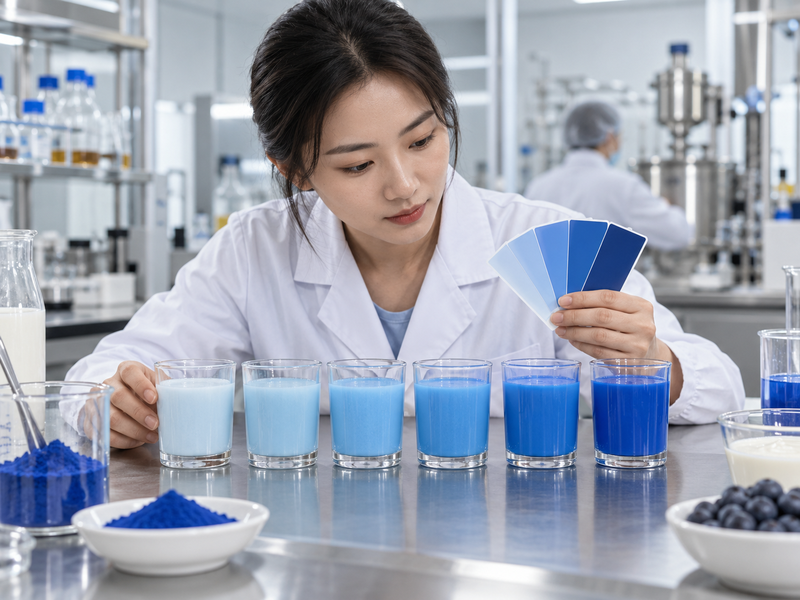
Prepare several measured additions of the exact SKU into identical base formula portions. Record grams of as-sold powder per liter, not an unspecified drop count or spoon measure. Note the carrier and moisture basis if the supplier reports other pigment calculations. Review color, haze, sediment and flavor at each dose. A higher addition may deepen the blue but also worsen visible particles or taste. The selected dose is a balance of acceptance criteria rather than the darkest sample.
Repeat the ladder after the planned process and at storage time points. A lower dose may appear sufficient on day zero but fall below the target later. Include a control without blue and a reference color approved by the brand. If a candidate grade fails clarity at every useful dose, a stronger E number will not automatically solve the physical problem. Procurement can calculate cost per saleable bottle after R&D has identified a dose that meets both color and clarity targets. Keep all rejected dose results; they define the operating window.
| Dose level | Day-zero color | Haze | Post-process color | Stored result |
|---|---|---|---|---|
| Blank | Record | Record | Record | Record |
| Low | Measure | Inspect | Measure | Retain |
| Mid | Measure | Inspect | Measure | Retain |
| High | Measure | Inspect | Measure | Retain |
7. How do carbonation and other ingredients change the test?
Challenge the whole matrix
Carbonation, flavors, acids, sweeteners, minerals and preservatives all belong in the trial. A still-water result cannot certify a carbonated SKU. Gas release can affect foam and fill behavior, while flavor systems may introduce haze or a background tint. The original carbonated-beverage study provides a research example of testing C-phycocyanin in a specific drink rather than extrapolating from a pigment solution. It should not be used to claim that the site’s grades will perform the same way.
Add ingredients in the planned manufacturing order and sample at defined points. If a formula contains protein or hydrocolloid, watch for aggregates after processing or storage. An HPP study observed formulation-dependent interactions involving phycocyanin, whey protein and carrageenan. Plant-based systems may behave differently, so use those findings to identify variables to test rather than to predict the final answer. Record dissolved gas or pressure where relevant and inspect bottles without first disturbing sediment.

8. What must the filled-pack study include?
Follow color and clarity through distribution
Fill the commercial package with pilot product, not only a glass lab vial. Retain units under the intended storage conditions and a justified challenge condition. Include light exposure where the product will be displayed. Sample multiple unopened units at planned intervals to check shade, haze, sediment, flavor, pH and package integrity. A clear bottle may reveal fading that an opaque pack masks, but through-pack appearance and decanted product condition should both be recorded.
Separate a shelf-life claim from a short screening trial. The latter can reject poor candidates quickly; it cannot establish the full commercial period. The Spirulina CN product guidance directs buyers to test light, pH, processing and storage in the finished application. Supplier powder shelf life is not the beverage’s shelf life. If the drink is sold chilled, test the actual cold-chain plan and a realistic temperature excursion approved by quality. Document the exact formula and pack version attached to every result.
| Time point | Required records |
|---|---|
| Fill day | Formula, lot, pH, color and haze |
| After process | Temperature record and color change |
| Planned storage checks | Shade, particles, sediment and flavor |
| End of proposed life | Acceptance decision and package condition |
9. How should supplier lots be compared?
Confirm repeatability before relying on one sample
One successful sample lot establishes feasibility, not repeat supply performance. Ask for the current specification and COAs from relevant commercial lots, then test a second lot in the approved formula if the launch risk warrants it. Use the same dose and process first to see whether the finished shade and clarity remain within limits. If a dose adjustment is needed, document the allowed range and who may authorize it. Do not accept a substitute carrier because the E grade label matches.
Quality should link the ingredient lot to every pilot and commercial batch. Retain a sealed sample of the approved lot and a filled-product reference. A new lot COA may pass its broad color range while giving a visible shade difference in a clear bottle. The purchasing specification can therefore include both material limits and a defined application comparison. This is especially useful where the blue is the product’s main visual feature. Supplier notification of changes in extraction, carrier or test method should trigger review before the new lot reaches the line.

10. When is the RTD formula ready to scale?
Approve a product and process, not a beaker color
The formula is ready when the chosen SKU produces the specified blue in the full drink, remains acceptably clear, survives the validated process and meets the filled-pack storage target. The approval should name the ingredient lot, carrier, dose range, addition point, pH range, mixing instruction, package and methods used to judge color and haze. It should also state what happens if incoming material or production results drift. A commercial run should not depend on an undocumented operator adjustment.
Regulatory and food safety sign-off remain separate from color performance. For US color uses, review current 21 CFR 73.530 and the full ingredient composition. For other destinations, review their own rules. Obtain a written commercial offer for the exact grade sampled. With those records, procurement can buy the tested ingredient and production can reproduce the result, rather than trying to match a supplier photograph during the first full-scale fill.
Frequently asked questions
Q1. Does an E18 label guarantee a clear drink? No. The exact carrier, formula and process decide clarity; test the supplied SKU.
Q2. Can water-only tests select the final grade? They can screen candidates, but approval needs the complete finished beverage and package.
Q3. Should sediment be checked after shaking? Inspect undisturbed packs first; shaking can hide a deposit.
Q4. Is color loss the only shelf-life concern? No. Haze, sediment, flavor, pH and package condition also matter.
Q5. What belongs in the first supplier brief? Share drink type, pH, process, pack, target shade, destination and expected volume.
Request a clear-beverage sample
Send the product brief through Spirulina CN’s Blue Spirulina page. Request exact SKU and carrier details, current specifications, a matching COA and samples for a dose and clarity trial. Approve the grade only after a pilot filled-pack test reproduces the required blue without unacceptable haze or sediment.