
Choosing natural blue food coloring for beverages is difficult because beverages expose color to water, acid, heat, light and months of display. A color that looks vivid in a cold beaker can fade after pasteurization or form a ring in a clear bottle. Spirulina extract is one relevant blue option; gardenia (genipin) blue and other approved colors may also be considered where the exact market and beverage category permit them. The right starting point is the beverage specification, not a universal “most stable blue” claim.
The FDA’s spirulina extract listing includes non-alcoholic beverages among specified US uses, with conditions that a buyer must check for its actual SKU.
Contents
- What should a beverage brief specify?
- Which blue sources are legally plausible?
- How does beverage pH shape the shortlist?
- What process stresses must be reproduced?
- How should a dose curve be built?
- What role does packaging play?
- How do haze and sediment affect success?
- What evidence should a supplier provide?
- How should cost and scale-up be assessed?
- What is the launch acceptance checklist?
1. What should a beverage brief specify?
Define the liquid, process and market
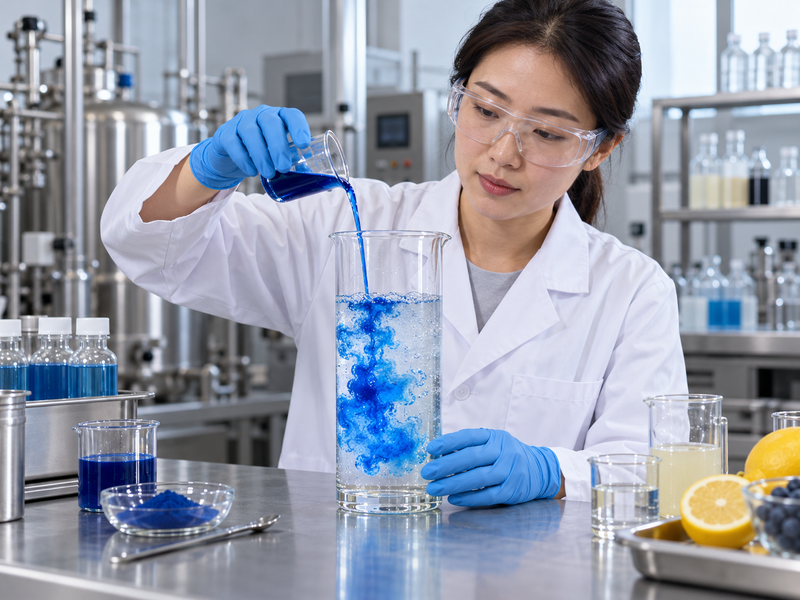
Write a one-page brief before requesting colors. Include whether the drink is still or carbonated, transparent or opaque, its target pH and allowed range, sweetener system, flavor, cloud or protein content, process temperature-time profile, package, shelf life and destination markets. Define the desired blue with a retained reference or color coordinates. State whether the brand accepts a new hue or needs to match an existing SKU.
A blue for a clear enhanced water faces a different task from one in a cloudy smoothie or sports drink.
Add business constraints: ingredient declaration, retailer policy, target cost per serving and production line dosing method. The legal food category should be confirmed before an expensive stability study. If the formula is still changing, record the version used for every color trial; an acid or flavor adjustment can change color performance. Ask the blue spirulina supplier for samples matched to the actual application parameters. A useful inquiry provides pH, processing conditions and pack, not only the requested shade.
This brief lets every candidate be tested against the same product rather than against different assumptions.
2. Which blue sources are legally plausible?
Screen exact identity and food category first
Spirulina extract is an aqueous Arthrospira extract with phycocyanins as principal coloring components, distinct from whole green spirulina powder. In the United States, 21 CFR 73.530 lists uses including non-alcoholic beverages and alcoholic beverages below the specified alcohol threshold, subject to its restrictions. FDA issued a general-use expansion in February 2026 but delayed its effective date; do not assume the broader language controls a new SKU.
Gardenia (genipin) blue gained a US listing in 2025 for specified drinks and candies; the FDA status record identifies its listed beverage categories.
Other natural-origin blues may be available in some markets, but each needs its own exact listing and use review. Do not select by a generic “natural” category. The regulatory team should record substance, supplier specification, beverage category, market, use rate and label declaration. A sport drink, juice, standardized beverage or flavored water can raise different questions. Check export rules separately. If a color is unlisted for the intended use, remove it from the trial shortlist even if it seems technically promising.
This first gate protects R&D time and avoids designing a formula that cannot be sold.
| Candidate | US starting reference | First question |
|---|---|---|
| Spirulina extract | 21 CFR 73.530 | Is this beverage within listed use? |
| Gardenia blue | 21 CFR 73.168 | Is the drink category specified? |
| Other blue | Exact applicable listing | Is the source/form permitted? |
| Existing certified blue | Applicable color regulation | Does brand policy allow it? |
3. How does beverage pH shape the shortlist?
Test the range, not one nominal number
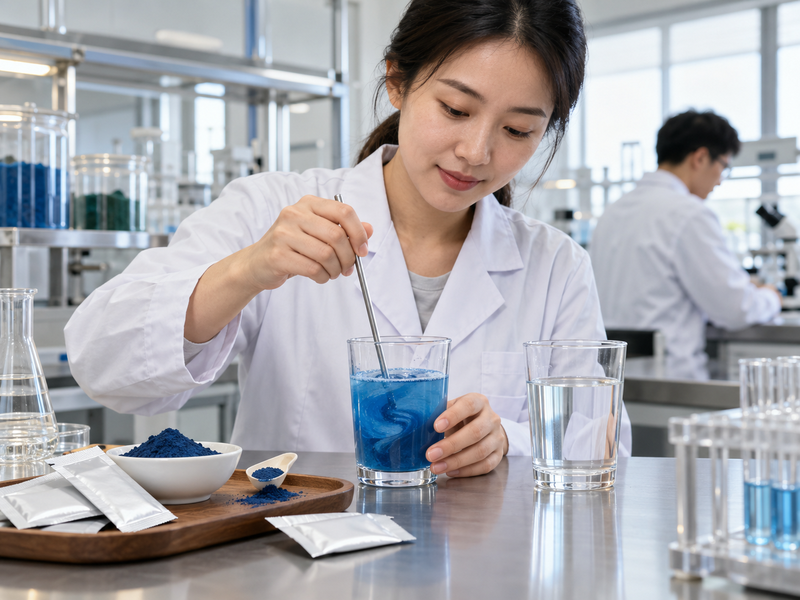
Beverage pH affects color chemistry and may also be part of the product’s microbial safety design. Measure the base pH before and after adding color, then prepare samples at the normal target and the allowed process extremes. A phycocyanin-rich blue can respond differently across pH values; an original stability study demonstrates that temperature and pH affected a defined spirulina pigment preparation. That finding is a reason to screen, not a transferable dose rule for every commercial extract.
Gardenia blue or another candidate needs the same matrix-specific test.
Use the finished recipe, including acids, buffers, sweeteners, flavors, vitamins and minerals. A test in plain water may rank candidates differently from the real beverage. Record initial hue, turbidity and any precipitate, then hold samples before remeasurement. If blue disappears at the required acid level, do not simply raise pH without a process authority review. Consider a different color system, package or product concept. The acceptable pH range must be fixed by product and safety requirements, and the color choice must fit inside it.
A vendor’s “acid stable” description should be evaluated against the buyer’s actual pH and shelf life.
4. What process stresses must be reproduced?
Include heat history and production holds
Document the entire process, not just the hottest temperature. A color may spend time in a premix tank, pass through a heat exchanger, wait before filling, then cool in a bottle. Test the maximum realistic residence time and the lowest and highest allowable process conditions. Compare color before processing, immediately afterward and after cooling. An original study on thermal degradation kinetics evaluated phycocyanin under controlled heating; it supports the need for a time-temperature design, but the finished beverage still needs its own pilot.
If the color is added after a kill step, the process and hygiene controls must be validated for that sequence. Do not change an established safety process merely to protect appearance. Carbonation, homogenization, filtration and shear can also affect foam, haze or color distribution. Prepare a control beverage without color and one with the incumbent color if available. This helps distinguish color loss from a base-formula change. Record tank geometry, mixing speed and line hold so a successful lab result can be reproduced.
A pilot batch should show not only an acceptable shade but also a practical dosing method and no unexpected deposit or line-cleaning problem.
| Process step | What to capture | Color question |
|---|---|---|
| Premix | Time, temperature, concentration | Clumps or local fading? |
| Heat | Full temperature-time profile | Color retention? |
| Transfer | Shear and filtration | Loss on equipment? |
| Fill/cool | Package and cooling time | Final shade? |
5. How should a dose curve be built?
Measure color efficiency without over-dosing
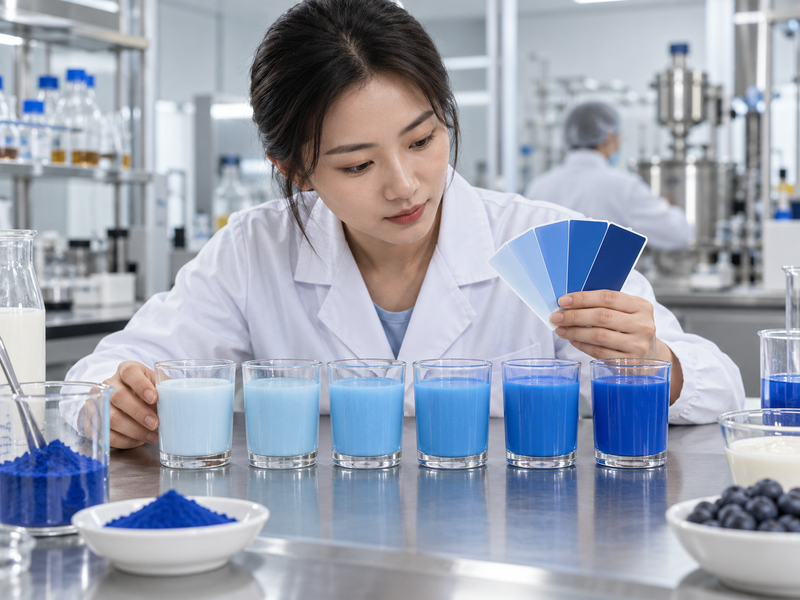
Choose several color doses around the supplier’s suggested starting point, but keep the formula and process identical. Measure Lab* color, visual preference, haze and any flavor change at each dose. The target is the smallest dose that meets the approved finished shade with a safety margin for normal lot and process variation. Equal grams of two colors are rarely a fair comparison because color strengths and carriers differ. Compare each candidate at the shade consumers will see after processing and storage.
Ask how the supplier measures color value. A grade label such as “E18” may be useful inside one supplier’s method, but it is not a universal cross-supplier unit without a shared protocol. Get a commercial-lot certificate and test its strength in a standard reference solution and the actual beverage. If a high dose produces a darker but greener or duller blue, adding more will not solve the hue mismatch. Record the dose window that operations may use and who may authorize adjustment.
Check any legal maximum or GMP condition and verify that carriers and color contribute appropriately to the label.
6. What role does packaging play?
Test light and oxygen in the proposed retail pack
A transparent PET bottle, tinted glass and opaque carton expose the color to different light and oxygen histories. Test candidates in the actual package with the intended headspace and closure. Place real-time samples under normal storage and a defined retail-display simulation. Measure shade at planned intervals and note haze, ring formation or precipitate. Accelerated tests can help rank risks, but they should be checked against real-time results before a shelf-life claim is finalized.
If an opaque sleeve or oxygen barrier improves blue retention, include its cost, recyclability, line compatibility and brand effect in the decision. A package change may be a better solution than simply increasing color dose, but it may also reduce the product’s visual appeal on shelf. Keep an uncolored control because the beverage base itself may discolor. Record dissolved oxygen at filling if that variable is suspected.
A successful lab bottle is not the same as a commercial bottle with different fill height and cap torque. The shade specification should apply to the finished retail pack at both release and end of life.
| Package variable | Trial comparison | Decision impact |
|---|---|---|
| Light barrier | Clear vs opaque | Fade and shelf display |
| Headspace | Normal fill conditions | Oxidative exposure |
| Closure | Production cap | Oxygen ingress |
| Bottle color | Actual retail material | Perceived hue |
7. How do haze and sediment affect success?
Judge appearance beyond blue intensity
Clear beverages often have narrow tolerance for haze, particles and rings. A color preparation may be blue enough yet fail because it clouds the drink or creates a deposit at the neck. Ask whether the commercial grade is a filtered extract, a dispersion or a whole-biomass product with particles. Whole green spirulina powder is not a direct substitute for blue extract when clarity matters. Check carrier compatibility and mixing order.
If the base contains protein, minerals or acid, test whether interactions create precipitation after hold.
Measure turbidity, inspect against dark and light backgrounds, and document sediment after shipping vibration and a shelf hold. Evaluate redispersion if the product permits “shake well” instructions, but do not use that phrase to excuse an unacceptable ring or clump. A filtration step may remove particles but also strip color; test before and after the actual filter. For cloudy beverages, haze may be less visually important, but separation lines and flavor changes still matter.
The finished appearance criterion should be agreed with brand and quality staff before selecting a candidate, so the trial does not reduce success to a single blue color-value number.
8. What evidence should a supplier provide?
Request a dossier tied to the proposed grade
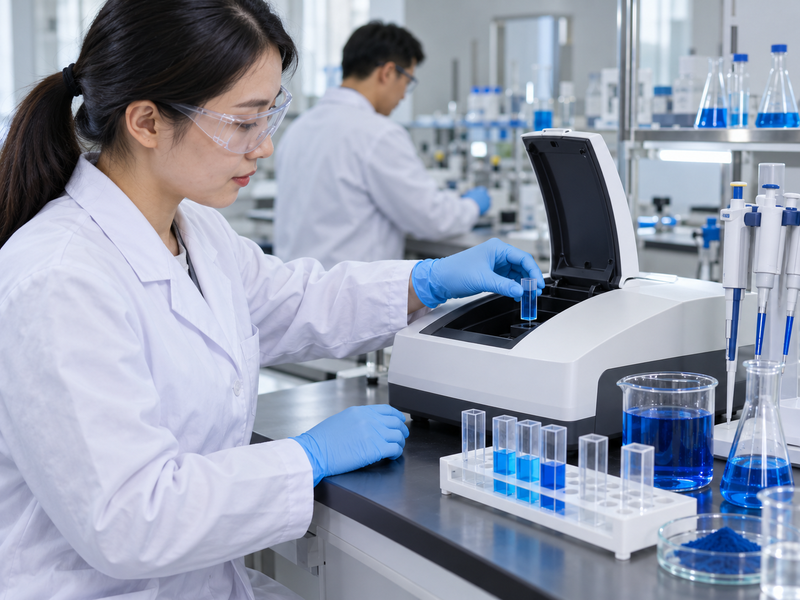
Ask for exact color identity, source, manufacturing site, full composition and carrier list, regulatory documents for intended markets, specification, test methods and representative commercial-lot certificates. Include contaminant and microbiological results required by the applicable listing and buyer hazard analysis. Ask for color value by a defined method, packaging, storage conditions, shelf life and change-notification procedure. Application data should state the actual beverage matrix, pH and processing conditions, not merely show a bright stock solution.
The FDA color-additive overview explains that permitted uses, amounts and labeling follow the specific color regulation. A buyer should match the supplier’s claimed identity to that regulation and have regulatory staff sign off the exact SKU. Request at least two normal production lots for shade-variation assessment. Keep a sealed reference from the lot that passes the pilot, and test the first delivered lot against it. Ask the supplier contact team for a lot-specific extract dossier when comparing spirulina blue grades.
A sales brochure can begin the conversation; it should not be the release packet.
| Supplier item | Why needed | Red flag |
|---|---|---|
| Identity and composition | Legal and formula review | “Natural blue” only |
| Lot certificate | Release decision | Generic values |
| Application data | Trial design | No pH or process |
| Change notice | Ongoing consistency | Silent carrier changes |
9. How should cost and scale-up be assessed?
Model the saleable bottle, not the color kilogram
Calculate color dose at the accepted shelf-end shade, then add freight, premixing, process loss, testing, packaging changes, waste and minimum-order inventory. A high-strength color can be cheaper per bottle than a lower-priced weak grade; another grade may be more stable and reduce waste. Use current supplier quotations rather than universal price claims. If a beverage must be refrigerated or moved to an opaque pack to preserve blue, those are product-system costs. Include them in the decision before approving an ingredient.
Pilot the color on the intended equipment. Verify feeder or liquid-dosing accuracy, mixing order, tank-to-tank shade variation, filter losses and cleaning. Define the adjustment range for future lots and whether a different color strength requires a new regulatory or label review. If a backup supplier is needed, qualify its exact grade rather than assuming two blues with similar catalog names are interchangeable. Record process yield and bottles rejected for shade or sediment. Finance can then compare cost per saleable bottle under realistic conditions.
A beautiful bench sample without a supply and scale-up plan is still only a sample.
10. What is the launch acceptance checklist?
Close technical, quality and label gates together
The final file should contain the beverage brief, exact color identity, current market permission, signed supplier specification, sample and commercial-lot certificates, bench dose curve, pilot report, shelf-life data, sensory assessment, packaging decision, cost model and approved artwork. Quality should confirm incoming identity and safety criteria; product development should confirm shade and sensory; operations should confirm dosing and sanitation; regulatory staff should confirm declaration and claims. Assign the final release owner and a procedure for deviations.
Match the first commercial color lot to the approved pilot reference using the same standard solution and finished-beverage test. Keep retained bottles at normal and stress conditions during launch. If a future lot, carrier, process or package changes, reopen the relevant checks rather than relying on the original sample forever. A good acceptance decision is narrow and precise: this color grade works at a defined dose in this beverage, through this process, in this pack, for this market and shelf life.
That is far more useful to manufacturing than saying the brand has found the “best natural blue” in general.
| Final gate | Required evidence | Owner |
|---|---|---|
| Legal use | Current category and declaration | Regulatory |
| Ingredient quality | Lot-linked certificate | Quality |
| Beverage performance | Pilot and shelf-life data | R&D |
| Commercial readiness | Cost and supply plan | Procurement |
Frequently asked questions
Is blue spirulina the same as whole spirulina powder? No. Food-color spirulina extract is a filtered blue extract; whole biomass is green and adds solids.
Can natural blue survive pasteurization? Some systems may work, but performance depends on grade, pH, time-temperature profile and matrix. Run the actual process trial.
Is gardenia blue permitted in every beverage? No. Its US listing names specific beverage categories. Check the exact SKU and destination market.
Does a stronger powder always cost less? Not necessarily. Use dose at accepted shelf-end shade and include losses, packaging and inventory.
What is the most important first test? Regulatory fit is the first gate; the first technical screen should use the actual beverage pH and process.
Conclusion
The best natural blue food coloring for beverages is the one that is permitted for the exact SKU and meets the target appearance through manufacture and shelf life. Start with pH and process, compare real commercial grades at matched shade, then qualify packaging, quality and cost. A recorded trial plan makes the result repeatable.