
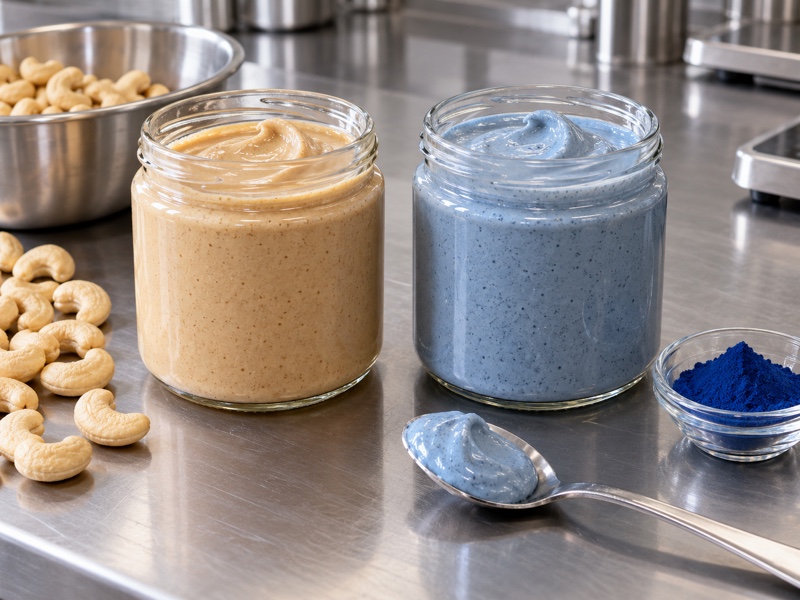
Blue spirulina cashew butter looks simple: a pale nut butter with a blue ingredient mixed in. In production, the result depends on the cashew roast, pigment grade, particle size, process temperature, and jar storage. A spoonful that looks bright on mixing day can become dull, streaky, or oily after distribution. This guide gives nut-butter makers and private-label buyers a practical way to develop a product that still looks and tastes right at the end of shelf life.
Contents: 1 · 2 · 3 · 4 · 5 · 6 · 7 · 8 · 9 · 10
1. What is blue spirulina cashew butter?
It is cashew butter formulated with a blue spirulina ingredient, usually a phycocyanin-rich extract. Phycocyanin supplies the blue color; the ingredient may also contain carriers or moisture. It is different from adding whole green spirulina powder. The latter contains a broader mixture of pigments and can shift the product toward green. Ask suppliers for a full specification before treating two blue powders as interchangeable.
What belongs in the product brief?
Describe the desired blue shade, cashew flavor, texture, serving size, price, shelf life, and target market. Decide whether the spread should be smooth, crunchy, sweetened, or unsweetened. A bright turquoise reference photo should be tested against the actual base. Deeply roasted cashews give a darker, browner canvas than lightly roasted cashews. A formulation team should approve the final shade in a filled jar, not a blue powder in water.
| Decision | Record before trials |
|---|---|
| Cashew base | Roast, particle size, color |
| Blue grade | Form, carrier, color strength |
| Target use | Spread, filling, topping |
| Pack | Jar material and size |
| Market | Ingredient and claim rules |
The brief prevents the team from changing the base midway through a pigment trial and then misreading the results.
2. Which cashew base gives the cleanest color?
A pale, consistent cashew base usually makes a clean blue easier to achieve. Roast level, nut origin, oil separation, and grinding all influence the starting color. A darker base can turn a blue pigment gray or greenish even when the pigment itself is excellent. Compare several base lots before increasing color dose. If the product uses coconut oil, white chocolate, or another pale ingredient, include it in the actual pilot rather than predicting its visual effect.
How should base variation be measured?
Photograph each plain base under fixed lighting, then dose every base with the same measured amount of blue extract. Compare immediately and after a short hold. Record roast lot, viscosity, and oil separation. A color meter can support visual assessment, but it should not replace tasting and shelf observation. The reference sample should be an approved production lot, not a screen image whose color depends on the display. When a cashew supplier changes, repeat the shade check before the next commercial run.
| Base variable | Likely effect on appearance |
|---|---|
| Darker roast | Mutes blue shade |
| Coarser grind | Makes specks easier to see |
| Surface oil | Changes apparent color at the top |
| Sweetener color | Can shift hue |
Base standardization may save more pigment cost than a more concentrated extract.
3. How should the blue ingredient be selected?
Request a food-grade specification, certificate of analysis, complete ingredient declaration, microbial limits, and a documented color-strength method. Ask whether the grade is a powder, concentrate, or liquid and what carriers it contains. A dry grade often fits a low-moisture spread better, but it may clump or remain visible as particles. A liquid may disperse readily while changing moisture or texture. Neither format is automatically superior without a test in the cashew matrix.
What should the comparison trial include?
Test at least three measured doses of each candidate in the same cashew batch. Record pigment mass as a percentage of the total formula, mixing sequence, temperature, and time. Evaluate shade, graininess, flavor, and uniformity after standing. Take samples from different points in the mixing vessel and from the first and last jars. When a supplier quotes a price per kilogram, convert it to cost at the dose that reaches the approved finished-product shade. A strong ingredient may cost more per kilogram and less per jar.
The FDA spirulina extract listing is a starting point for US color review. Confirm the current permitted use and labeling rules for the actual product and sales market.
4. How can the pigment be dispersed evenly?
Viscous nut butter resists quick mixing. Adding a small pile of powder directly to a large tank can leave blue streaks or dense spots. A controlled preblend with a small portion of the cashew butter often helps. Return the preblend gradually to the main batch and use the approved mixing settings. Avoid adding water as an improvised dissolving aid; it can alter the product's safety and texture. Follow the supplier's handling guidance and test the process at production scale.
What does a good uniformity check look like?
Sample the top, middle, and bottom of the tank after mixing. Then compare early, middle, and late fills. Spread each sample at a fixed thickness on a white card or plate so small streaks are visible. Inspect for undispersed blue particles under normal retail lighting. Keep a retained sample from the approved pilot and record mixing energy. If uniformity fails, change the order of addition or preblend method before simply extending mixing time; excessive processing can heat the spread.
| Sampling point | Question |
|---|---|
| Tank top | Is oil carrying pigment upward? |
| Tank middle | Is bulk color uniform? |
| Tank bottom | Are particles settling? |
| Final jars | Does fill order change shade? |
A jar that looks even only after manual stirring is not a reliable retail specification.
5. Will processing heat affect the blue color?
Phycocyanin is sensitive to process conditions, including heat and pH. A published study of phycocyanin stability found that temperature and pH can strongly affect the pigment in solution. Cashew butter is a different matrix, so the paper cannot provide a universal temperature limit for this spread. Grind and mixing steps can warm the product even when no heat is deliberately applied. Measure actual product temperature at each stage.
Where should a maker add the extract?
Compare addition before and after the hottest processing step where the equipment allows it. Use identical base, dose, and package for the comparison. Track immediate shade and color after planned storage. The later addition may improve color but must still meet the plant's validated hygiene and mixing controls. Do not bypass a necessary safety step to protect appearance. If a process needs substantial heat, evaluate whether the formulation is commercially feasible before committing to packaging or claims.
Heat management should be documented as a process parameter, not left to an operator's impression of a warm tank.
6. How do fat, moisture, and texture change the formula?
Cashew butter is a high-fat, low-moisture matrix. A blue extract's behavior in water does not predict how it will distribute through nut solids and oil. A liquid color may introduce water; a powder may change graininess. Sweeteners, emulsifiers, and stabilizers may also affect visual uniformity. Measure water activity where the quality plan requires it, particularly if a liquid ingredient or flavor is added. Texture should be evaluated after shipment simulation and storage, not just after grinding.
Which tests catch practical failures?
Check oil separation, hardness, spreadability at room and cool temperatures, and visible blue sediment. Stir the jar according to the intended consumer instructions and observe whether the color returns evenly. If the product will be a filling, test it under the actual bakery process and against the surrounding food. A blue cashew filling may migrate into a light cake or lose its visual edge next to dark chocolate. Define acceptable variation in the finished application.
| Test | Why it matters |
|---|---|
| Water activity | Product safety and stability |
| Oil separation | Surface appearance |
| Spreadability | Consumer use |
| Particle visibility | Perceived quality |
The finished spread must work as food, not merely as a color sample.
7. How should flavor be checked?
At a low color dose, a blue extract may have little sensory effect. At a higher dose, a marine, earthy, or mineral note may become noticeable. Cashew roast, salt, vanilla, and sweetener can change what tasters perceive. Use a blind comparison with the plain cashew control and at least two blue doses. Taste at the beginning and near the end of the planned shelf life. Also test the product on bread, fruit, or another intended serving format.
What belongs on the sensory scorecard?
Ask about cashew character, sweetness, salt, off-notes, aftertaste, graininess, and visual appeal. Note whether tasters can identify the colored sample by flavor alone. If extra flavoring is required to mask the extract, include its cost and labeling effects in the decision. A higher pigment dose should only be chosen if the visual benefit is worth the sensory and cost trade-off. Do not infer nutritional benefits from a color dose of phycocyanin-rich extract.
The winning formula is the lowest dose that reaches the approved shade while keeping the expected cashew-butter experience.
8. What should packaging and shelf-life work cover?
Blue color can change during storage as a product experiences light, temperature shifts, and repeated opening. Compare clear and opaque packaging if the brand wants shoppers to see the spread. Use the real closure, fill volume, headspace, and distribution conditions. Keep a plain control and an approved blue reference. Review color, flavor, texture, oil separation, and microbiological results according to the quality plan at scheduled intervals.
How should the trial be documented?
Photograph unopened and opened jars under consistent lighting. Measure color if the company has an established method and set an acceptable range based on sensory review. Store samples under realistic retail and warm-distribution conditions without treating an accelerated study as a substitute for real-time data. Check the first jar filled, the last jar filled, and different cashew lots. If the color turns gray, inspect base variation, package light exposure, and process heat before changing pigment dose.
| Storage variable | Observation |
|---|---|
| Light | Fading or hue shift |
| Warmth | Color and oil separation |
| Repeated opening | Surface appearance |
| Lot variation | Consistency across production |
Set shelf life from the finished product, not the blue ingredient's unopened shelf life.
9. Which labels and claims need review?
The ingredient list should use the exact declaration appropriate for the purchased grade and market. A cashew spread needs clear tree-nut allergen handling. “Blue spirulina” can describe an ingredient in marketing, but it should not replace a compliant ingredient declaration. Claims such as “high protein,” “antioxidant,” or “immune support” need evidence for the finished serving and legal review. A tiny color dose cannot justify copying claims made for whole spirulina powder.
What documents should a buyer request?
Ask for the specification, COA, full composition, allergen statement, country of origin, regulatory statement, traceability details, and storage conditions. Review supplier change-control terms: a carrier change may affect texture and label copy even when the pigment looks similar. The FDA color additives guidance explains the US framework; a qualified regulatory reviewer should verify the current rules for the exact use. For international sales, review each destination separately.
Claims belong in the commercial approval process before labels are printed, not in a late-stage packaging edit.
10. What should a production pilot decide?
Run a controlled pilot that includes ingredient receipt, preblend, mixing, filling, storage, and end-use tasting. Approve both the minimum acceptable shade and the maximum acceptable flavor impact. Record the formula by weight, the exact blue grade, and the base-cashew specification. Calculate cost per saleable jar including waste, quality tests, freight, and any extra process time. A formula that looks good in a laboratory bowl may need a different process to remain uniform in a larger mixer.
What is the final go/no-go checklist?
Require five answers: Is the shade consistent across jars? Does flavor remain acceptable? Does texture survive storage? Do the label and claims pass review? Can the supplier deliver the same grade with documented lot controls? If one answer is unclear, narrow the next pilot to that issue. Avoid repeating a full trial with several variables changed at once. Keep a dated retain of the approved product so purchasing and quality can compare future lots against a real standard.
| Approval area | Evidence needed |
|---|---|
| Color | Jar samples over shelf life |
| Sensory | Blind comparison with control |
| Process | Tank and fill uniformity |
| Compliance | Approved label and documents |
| Supply | Repeatable grade and COA |
The product is ready when the repeat batch is as convincing as the first sample.
FAQ
Q1: Is blue spirulina cashew butter made with whole spirulina?
Usually it is made with a blue extract rich in phycocyanin. Confirm the exact ingredient on the supplier specification. Whole spirulina powder has a different composition and may produce a greenish result.
Q2: Can the blue powder be mixed straight into a retail jar?
It may make streaks and uncontrolled dosing. Commercial production should use a measured formula and validated mixing sequence, followed by checks across the batch.
Q3: Does the color add meaningful protein?
Do not assume so. The extract may be used at a small color dose. Any nutrient claim should be based on analysis of the finished serving and market rules.
Q4: Why did the spread turn gray after a month?
Possible causes include a dark or variable cashew base, pigment degradation, process heat, and package light exposure. Compare retained controls and measured storage data before changing the formula.
Q5: Is a liquid blue extract easier to use than a powder?
It may disperse faster, but it can introduce moisture and affect texture. Test both formats in the actual cashew base and compare total cost at the accepted shade.