
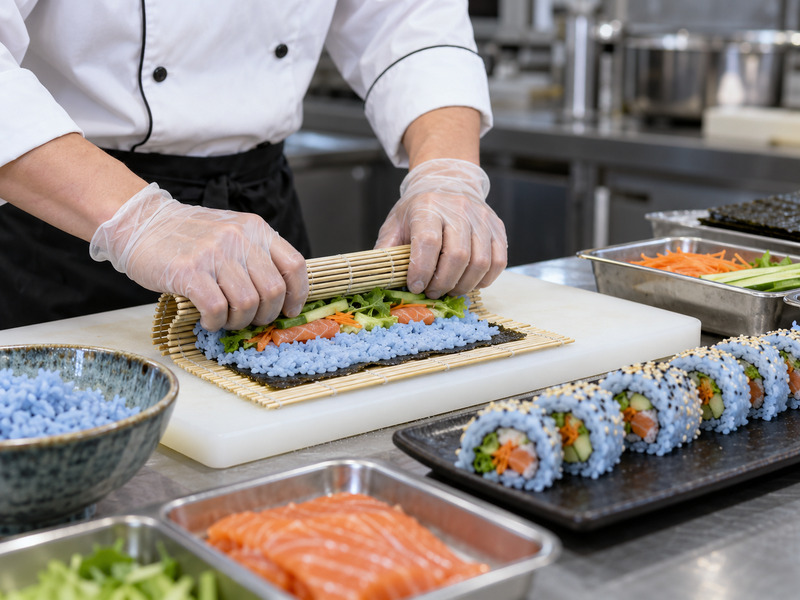
Blue spirulina sushi is a visual variation of a familiar ready-to-eat product: a blue-tinted rice layer around seafood, vegetables, or another filling. The striking photograph is easy to understand; the operating brief is harder. A restaurant group or prepared-food manufacturer must protect rice texture, food safety, and color consistency through cooking, seasoning, rolling, packing, and service. This guide turns the idea into a controlled pilot for buyers sourcing blue spirulina powder in bulk.
Contents: 1. Product definition · 2. Ingredient · 3. Addition point · 4. Seasoning · 5. Rolling · 6. Food safety · 7. Service · 8. Cost · 9. Labeling · 10. Supplier brief.
1. What is blue spirulina sushi in a commercial kitchen?
Define the product before the shade
The phrase usually means sushi rice colored with a phycocyanin-rich blue spirulina extract. It does not mean that whole green spirulina biomass has been added to a roll. Start with one format: specify a maki roll, inside-out roll, rice ball, or chilled retail tray and state where the blue should appear. A blue outer rice layer is more visible than a blue center, but it faces more contact with hands, equipment, packaging, and light.
The Vibrant Blue Spirulina Powder Sushi Rolls recipe demonstrates a real culinary use. A home recipe cannot establish a restaurant holding time, a manufacturing dose, or a legal color use in every market. For a commercial brief, identify rice type, filling, serving temperature, target shade, and portion size. Photograph an uncolored control beside a blue trial under the same lighting. That comparison prevents a beautiful digital mockup from becoming the only acceptance standard.
| Format | Visible blue area | Main development question |
|---|---|---|
| Maki roll | Cut face | Can the rice stay even after cutting? |
| Inside-out roll | Outer rice | Will color transfer during handling? |
| Rice ball | Whole surface | Does the surface dry or stain a wrapper? |
| Retail sushi tray | Several exposed pieces | Will display conditions change shade? |
2. Which blue ingredient belongs in the rice?
Distinguish extract from biomass
Blue spirulina generally refers to an extract rich in phycocyanin. Whole spirulina powder is green and has a different appearance, flavor, and ingredient profile. Ask for the full identity: ingredient statement, carriers, country-specific regulatory documentation, batch certificate, and intended food use. The confirmed supply catalogue includes blue spirulina grades E3, E6, E18, E25, E35, and E40. Those names alone do not establish pigment concentration, legal status, or a universal dosage.
Rice is an aqueous starch matrix, so a water-compatible color is a plausible starting point. Plausible does not mean automatically stable. Ask the supplier for the exact lot to be purchased and make a small premix trial with the same water and rice used in production. Compare shade, odor, taste, and visible particles. If a supplier suggests an application rate, treat it as a trial starting point, not a finished-product specification. Keep the amount added and the mass of cooked rice on a run sheet so procurement can calculate actual use per portion.
3. When should the blue color enter the rice process?
Compare addition points on the same batch
Rice can be tinted in cooking water, in the post-cook seasoning, or after seasoning through a separately prepared solution. Each route exposes the ingredient to different heat, mixing, and handling. Run an addition-point comparison: divide one cooked rice batch into matched portions where possible and document the water, temperature, mixing time, and final appearance. Introducing color before a hot cook may expose it to more heat. Adding it late may leave uneven patches if workers must mix quickly to protect grain texture.
Use a controlled premix rather than sprinkling dry powder over an entire rice tub. The premix volume matters: too much additional liquid can change stickiness and yield. Record rice weight before and after seasoning and coloring. Photograph top, middle, and bottom samples from each tub; an even surface can hide pale rice underneath. The selected procedure should be repeatable by the next shift, with an order of operations and a visual endpoint that does not require one unusually skilled operator.
| Addition point | Potential advantage | Check before adopting |
|---|---|---|
| Cooking water | Broad contact with grains | Heat exposure and pan-to-pan shade |
| Seasoning blend | Uses an existing mixing step | Acidity and added liquid |
| Post-seasoning premix | Less heat exposure | Uneven mixing and grain damage |
4. How does sushi rice seasoning affect the color?
Test the actual vinegar system
Sushi rice seasoning changes pH and adds liquid, salt, and sugar. Phycocyanin color can respond to the surrounding formulation, so a water-cup trial is not a rice trial. Keep the recipe fixed: prepare the restaurant’s current seasoning and compare an uncolored control with the proposed blue versions. Note whether the blue shifts, dulls, or becomes patchy immediately and after the normal preparation interval. Measure pH if the kitchen or plant already uses a validated method, and record the actual product result.
Do not lower vinegar or alter a validated acidification step merely to preserve color. That would change the food safety basis and the sensory profile of sushi rice. If the pigment does not withstand the required seasoning, choose a different placement, a different concept, or a compliant alternative color strategy. A supplier may offer formulation advice, but the food operator owns the finished-rice process. Taste the blue and plain rice blind; a bold hue can lead panelists to describe flavors they expect rather than flavors they actually perceive.
5. What happens to blue rice during rolling and cutting?
Follow contact points through assembly
Color that appears uniform in a tub can smear on a mat, glove, knife, or nori sheet. Map the handling route: roll, compression, cut, tray placement, garnish, and lid closure. Check whether blue rice transfers to a pale filling or stains a white garnish. A wet knife may carry color between pieces. A dry blade may pull grains from the cut face. Test the intended cutting and cleaning procedure on a representative run rather than on a single styled plate.
The roll also needs the texture customers expect. Extra liquid in a pigment premix may make rice too soft or sticky; aggressive mixing can break grains. Measure portion mass and inspect five or more pieces from each roll for consistent rice thickness and visible color. If the design includes raw seafood, keep its handling controls separate from the visual trial. A visually acceptable roll that takes twice as long to assemble might still be unsuitable for a busy service line, so log labor time and reject rate alongside photographs.
| Observation | Possible cause to investigate | Practical record |
|---|---|---|
| Pale pockets | Premix distribution | Tub sampling photos |
| Blue on filling | Moisture or handling transfer | Cut-face inspection |
| Torn outer rice | Texture or compression | Roll and cut reject count |
| Stained tray | Surface contact | Packed-unit inspection |
6. Which ready-to-eat controls matter most?
Keep food safety independent of color novelty
Sushi is a ready-to-eat food with short and tightly managed handling conditions. Blue color does not preserve rice or seafood, and it cannot replace temperature control, supplier approval, sanitation, or a validated rice process. Use the existing food safety plan: apply the operation’s rules for cooked rice, acidification if used, cold holding, seafood handling, allergens, and discard time. Record the time and temperature of each pilot batch as the kitchen would for ordinary sushi.
If the blue premix is prepared in advance, define its container, water quality, preparation time, storage, and discard rule. Never let an unvalidated premix sit at room temperature for convenience. Assess cross-contact when the same utensils prepare colored and plain rice or allergen-containing fillings. Quality staff should review the ingredient documentation and the process before staff training. A consumer may assume the blue roll is a new flavor or functional product; service staff should have an accurate, short explanation that does not imply unsupported health effects.
7. How should the team evaluate hold time and display?
Recreate the actual sales environment
A sushi counter, delivery box, and chilled retail case expose a roll to different lighting, condensation, and handling. Pack the pilot as sold: use the intended tray, lid, label, garnish, and display temperature. Inspect the same units at defined intervals within the operation’s established safe holding window. Compare the blue roll with a plain control for rice drying, condensation, color transfer, and cut-face appearance. Keep photographs under consistent lighting; a phone’s automatic white balance can exaggerate blue.
Do not extend a safe holding time because the color still looks attractive. Conversely, a safe roll may lose its merchandising value if the exposed rice turns dull. Record both outcomes. Delivery testing should include ordinary movement and a realistic travel time, then inspect how pieces have shifted against the tray. For a retail SKU, use the actual proposed packaging and shelf-life validation program. Ingredient certificates do not prove the assembled sushi remains attractive or safe through distribution.
| Channel | Stress to reproduce | Acceptance evidence |
|---|---|---|
| Made-to-order counter | Assembly and brief display | Consistent appearance at service |
| Delivery | Movement and condensation | Intact rolls on arrival |
| Chilled retail case | Light, lid contact, holding | Approved shelf-life study |
8. What is the cost of a saleable blue sushi roll?
Count labor and rejects, not only powder
The bulk powder price is one part of a roll’s economics. Cost the finished portion: calculate ingredient use from actual rice weight and dose, then include premix preparation, additional mixing, cleaning, labor, rejected pieces, packaging, and any change in sell-through. A blue outer layer may need more color than a narrow stripe, yet be easier for a customer to recognize. Test both designs if the sales brief allows them.
Use a standardized run sheet. Record rolls started, acceptable rolls packed, rice left in the tub, and pieces rejected for poor color or shape. Compare cost per saleable unit at pilot scale and again on a representative service shift. A price quotation may vary by lot size or delivery terms, so ask procurement to use a current quote. The supplier grade’s code is not a price or potency proxy. A slightly higher-priced powder can still be cheaper per saleable roll if it disperses consistently; verify that with the plant’s own trial rather than an assumed calculation.
9. Which market and labeling checks come before launch?
Check the actual food category
Color-additive permission depends on the destination market and the product’s legal food category. The FDA’s color-additives information notes that a 2026 order expanding uses of spirulina extract had its effective date delayed. Confirm current permission: regulatory staff must review the applicable rules for this sushi product before US sale, including the exact extract and all carriers. Permission for one food does not automatically extend to a ready-to-eat sushi roll.
The label or menu should accurately describe the ingredient and filling. “Blue spirulina” may be familiar marketing language, while the formal ingredient declaration may require a different term. Avoid broad claims about immunity, detoxification, or other health outcomes based on the color. Keep ordinary disclosures for fish, shellfish, sesame, soy, wheat, egg, and other relevant allergens. A restaurant menu and a sealed retail label have different requirements; have the appropriate reviewer sign off on each channel before printing materials.
| Gate | Responsible team | Evidence to retain |
|---|---|---|
| Color permission | Regulatory | Current market/category rule |
| Ingredient name | Label or menu owner | Supplier statement and formula |
| Allergen disclosure | Quality and operations | Filling and cross-contact assessment |
| Claims | Marketing and regulatory | Finished-product substantiation |
10. What should a bulk supplier receive before a pilot?
Make the sample request testable
Send the supplier a short brief: sushi format, cooked rice weight, seasoning composition, addition point, target visual, sales market, intended holding channel, and expected purchasing scale. Ask for the exact grade: request its ingredient statement, batch certificate, specification, carrier information, regulatory support, sample availability, and current quotation. Confirm how samples relate to the production lot and how lot changes will be communicated.
Set pass criteria before testing. They should cover rice texture, shade consistency across a tub, transfer on gloves and trays, accepted rolls per run, sensory acceptance, and compliance review. Use the kitchen’s normal safe handling conditions throughout. If a late-addition premix protects shade but creates a long assembly delay, the team has a clear decision to make. If the desired blue cannot survive the required sushi-rice process, do not hide that failure with a styled photograph. A documented trial gives procurement a defensible answer on whether to buy bulk powder for this application.
FAQ
Q1: Is blue spirulina sushi made with whole green spirulina? Usually the blue appearance comes from a phycocyanin-rich extract; check the supplier’s actual ingredient identity.
Q2: Can we add the powder directly to cooked rice? A measured premix is often easier to distribute, but the team must test its effect on rice texture and safe handling.
Q3: Does blue rice have a longer holding time? No. Follow the operation’s validated sushi-rice and ready-to-eat controls.
Q4: Can one recipe set a commercial dose? No. Dose depends on the specific ingredient, rice, seasoning, desired shade, and market rules.
Q5: What makes the supplier trial successful? A consistent, saleable roll that meets food safety, labeling, sensory, and cost requirements on a representative shift.
Final thoughts
Treat blue spirulina sushi as a rice-process and assembly project. Test the actual seasoning, roll format, packaging, and service window, then cost accepted portions. Those records tell a buyer whether a documented bulk powder belongs in the product.