
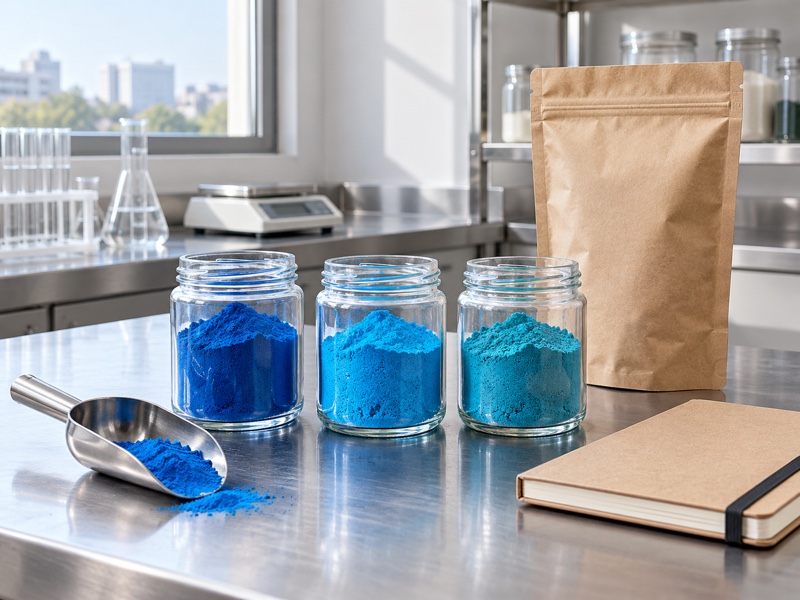
High quality blue spirulina gives a manufacturer the same defined blue ingredient, documented safety profile, and finished-product performance from one approved lot to the next. A brilliant sample photograph cannot establish those things. Buyers need an exact grade, a lot-specific certificate of analysis, a clear ingredient declaration, and an application trial under real processing conditions. This checklist shows what to ask for before a brand commits to a color, formula, or supplier.
Contents: 1 · 2 · 3 · 4 · 5 · 6 · 7 · 8 · 9 · 10
1. What does “high quality” mean for blue spirulina?
Quality means the material matches a written specification and performs reliably in its intended use. For a beverage buyer, that may mean a consistent shade after mixing, packaging, and storage. For a supplement buyer, identity, composition, and contaminant controls may carry more weight. For a bakery, the critical result may be color after a particular heat step. The same blue extract can succeed in one application and fail in another, so “high quality” needs a use case.
Which three questions set the standard?
Ask what the material is, how a lot is accepted, and how it behaves in the product. The first question covers the source organism, extraction method, carriers, and declared ingredients. The second covers analytical limits, test methods, and traceability. The third requires a pilot in the actual formula. A supplier may offer several grades with different phycocyanin strengths or carrier systems. Compare the grade that will ship, not an attractive demonstration sample.
| Quality dimension | Buyer evidence |
|---|---|
| Identity | Specification and composition |
| Lot control | COA with methods and limits |
| Application fit | Documented pilot trial |
| Repeat supply | Change control and retained sample |
A useful quality claim names the grade and the result it must deliver.
2. How do you confirm ingredient identity?
Start by distinguishing blue spirulina extract from whole spirulina biomass. Whole biomass is dark green because it retains more of the organism's components. Blue extract is selected for phycocyanin, a water-soluble pigment. Two blue powders may still differ in concentration, carriers, and processing. Ask for the botanical source, common and technical names used on the supplier's documents, a full ingredient statement, and a process summary that explains how the blue fraction is obtained.
What should be on the specification?
The specification should state the form, appearance, composition, recommended storage, and relevant acceptance limits. If the supplier reports “phycocyanin percentage,” request the assay method and calculation basis. If a carrier is present, ask whether the percentage applies to the total powder or only the extract portion. Match the specification to the sample code and the later invoice. An unmarked bag of blue powder should never be the sole basis for a long-term purchasing decision.
The FDA food substance listing identifies spirulina extract as a color additive in the United States. Buyers should check the current permitted uses and labeling rules for their own market and product.
3. Which test results deserve close attention?
The right test panel depends on the destination market and customer specification, but identity, color or phycocyanin assay, microbiology, relevant contaminants, and moisture are common starting points. A COA should identify the lot, method, units, result, and acceptance range. A single word such as “pass” hides information needed to compare suppliers. Ask when the test was run and whether an external laboratory or the manufacturer's own laboratory performed it.
How should two COAs be compared?
Line up equivalent methods and units before comparing numbers. One supplier may state a pigment percentage; another may report absorbance or an application color value. Those figures cannot be ranked until their methods are understood. Check whether the COA covers the offered grade rather than a related product. Review the limits against the buyer's internal standards, especially for microbiology and contaminants. If a result falls unusually close to a limit, ask for the trend across more than one lot.
| COA line | Why it matters |
|---|---|
| Lot identifier | Links shipment to test |
| Method and unit | Makes results comparable |
| Acceptance range | Defines release decision |
| Actual result | Shows margin from limit |
| Date and sign-off | Establishes record currency |
Good paperwork does not replace a pilot, but it gives the pilot a traceable material.
4. Does a stronger blue powder always perform better?
Higher measured pigment strength can lower the required use level, but strength alone does not settle an ingredient choice. Dispersion, pH stability, flavor, carrier, packaging, and price can outweigh a single assay number. A strong powder that clumps in a ready-to-drink formula may force extra processing. A slightly weaker grade that spreads evenly and stays blue through shelf life can be the better choice. Test a dose ladder in the actual product and calculate cost at the dose that meets the approved shade.
What should a dose ladder record?
Use at least a low, target, and high dose under the same mixing conditions. Record powder lot, water or formula temperature, pH, mixing order, package, and color immediately after production and over storage. Photograph samples under fixed lighting, then judge taste and visual acceptance blind if practical. If the formula is acidic, do not assume the result in plain water predicts the shelf-end color. A phycocyanin stability study found temperature and pH affected pigment retention, which makes an application trial more useful than a spoon photo.
The winning grade is the one that meets the finished-product target at an acceptable total cost.
5. How should a buyer test heat, acid, and light?
Use the process that the commercial product will actually experience. A beverage may face acidification, pasteurization, clear packaging, and weeks under store lighting. A frosting may be mixed cold and placed under chilled display. A gummy may be exposed to heat before it sets. Define the process window, then test color immediately and at relevant points during shelf life. A result at day one is only the start of the evidence.
What if the color fades?
First identify where the change occurs. If it happens during heating, a later addition point or a different processing route may help. If it happens in storage, examine package light exposure, pH drift, oxygen, and temperature. Changing the extract grade may be sensible, but it should not be the only response. Document each trial so the team can separate a formulation problem from a material problem.
| Stress | Pilot observation |
|---|---|
| Heat step | Shade before and after processing |
| Low pH | Color and precipitation |
| Light | Package comparison |
| Storage | Shelf-end retention |
Set pass criteria before the trial. Otherwise, the team may call a visibly faded product “good enough” after investing in the formula.
6. What safety documentation belongs in the file?
Ask for relevant microbiological and contaminant results, a statement of composition, a manufacturing-site profile, and a traceability route back to the source lot. Certification claims should be checked for the precise product and facility. The buyer's quality team should decide which additional documents are necessary for the destination market and customer category. A premium-looking pouch does not show whether its contents were controlled during cultivation, extraction, drying, and packing.
How should a buyer handle a new supplier?
Approve the facility and grade through a documented process. Review the proposed specification and representative COAs from more than one lot if available. Ask how deviations are handled, how changes in carriers or production sites are communicated, and how fast a lot can be traced in a complaint. Retain an approved sample. If the next shipment differs visibly, quarantine it for investigation rather than adjusting the formula on the production line.
For a product with a gluten-free, organic, or other regulated claim, verify that the evidence applies to the finished product and market. Ingredient quality is necessary, but the brand owns its final label.
7. How do price and yield change the comparison?
Calculate the cost per saleable unit after the formula reaches its agreed shade. A kilogram price hides the use level, process loss, shipping terms, and potential waste from failed batches. A stronger extract may reduce dose; a more stable grade may prevent color returns or reformulation. Conversely, a costly grade that offers no visible advantage in the finished product may not earn its premium. Commercial and technical teams should review the same dose data.
Which cost lines should be included?
Use ingredient price at the real order volume, freight, duties, package size, storage, expected process loss, and the amount used per finished unit. Add the cost of qualification and change control if a supplier has a history of inconsistent lots. Ask for a price schedule tied to a forecast the business can actually meet. A pilot order can be more expensive per kilogram and still be cheaper than an oversized first purchase that expires before use.
| Cost line | Calculation basis |
|---|---|
| Ingredient | Approved dose per unit |
| Freight and duty | Delivery term and route |
| Waste | Pilot process result |
| Inventory | MOQ and remaining shelf life |
Cost becomes meaningful only after the application trial fixes the dose.
8. What separates a reliable supplier from a good sample?
A reliable supplier can reproduce the approved grade and provide matching documents for every shipment. Ask who manufactures the extract, who issues the COA, and who approves substitutions. Clarify lead times, minimum order quantities, packing formats, and complaint routes. The supplier should respond to a technical failure with a traceable investigation, not merely send another bag of powder and hope for a different result.
What belongs in the supplier agreement?
Record the approved grade, specification revision, acceptance method, manufacturing site, change-notice period, shelf-life minimum on delivery, and remedy for a nonconforming lot. If the supplier also repacks into a retail format, define who owns the ingredient declaration, lot coding, and release decision. A distributor can be a strong partner when it offers local stock and good documentation; a factory can be strong when it gives direct process support. Judge the actual service and controls.
The blue spirulina wholesale article offers a broader purchase checklist. Keep the final agreement specific to the grade and application you tested.
9. Which shortcuts create the most risk?
Buying from a photograph, accepting a generic COA, assuming all blue powders contain the same carrier, and approving a product before shelf-life testing are expensive shortcuts. A small test batch can hide a lot change that becomes obvious in production. Teams also sometimes compare assay values from different methods or quote a supplier's certification without checking its scope. Each shortcut turns an avoidable question into a future customer complaint.
How can a launch team catch those problems early?
Use one signed product brief across purchasing, R&D, quality, and marketing. Attach the approved sample code, formula, specification, COA, application photos, and claim review. Set a release checklist for the first commercial lot. If the delivered material differs from the sample, test it before use. If a formula or package changes, repeat the stability work that the change could affect. Version control matters when several teams share a fast-moving product launch.
High quality blue spirulina is a repeatable supply decision. It is not a color adjective on a supplier page.
10. What should a buyer send in the first RFQ?
Send the finished-product type, target shade, process temperature, pH if known, package, destination market, expected order size, and document requirements. Ask for the supplier's proposed grade, full composition, sample, current specification, representative COA, lead time, and pricing at realistic volumes. The more precise the brief, the easier it is to identify a fit and reject a mismatched offer before a costly trial.
What is a sensible approval sequence?
Screen documents first, run a bench test second, then pilot the full process and package. Compare the finished product at time zero and over its intended shelf life. Agree on grade, cost, and supply terms only after the technical result is acceptable. Keep an approved reference sample for incoming inspection. If the supplier cannot provide the basic identity and batch records, there is no reason to start label design around its powder.
This sequence makes the purchase decision reviewable. It also gives the supplier a specific target to meet on repeat orders.
| Supplier proof | Buyer use |
|---|---|
| Lot COA | Release decision |
| Full composition | Label review |
| Retain sample | Color comparison |
FAQ
Q1: Is brighter powder always higher quality?
No. Brightness must be assessed alongside identity, documentation, consistency, and performance in the finished formula.
Q2: What is the most useful first document?
A current specification for the exact grade, followed by a lot-specific COA and full composition statement.
Q3: Can two phycocyanin percentages be compared directly?
Only if the assay methods, units, and calculation bases match.
Q4: How many lots should a buyer examine?
Start with a representative sample and ask for more than one lot's records when repeat color or supply consistency is critical.
Q5: When should a supplier be approved?
After documents, application trials, finished-product stability, cost, and supply terms meet the buyer's written criteria.