
Food grade vs analytical grade phycocyanin is a procurement distinction that a blue color value alone cannot settle. An analytical grade phycocyanin reagent may be optimized for a laboratory assay and sold in tiny packs, while a production food-color SKU needs traceable composition, relevant impurity and microbiological controls, regulatory identity, commercial consistency and workable cost-in-use. A higher A620/A280 purity ratio does not automatically make a material suitable for eating.
For U.S. food-color projects, 21 CFR 73.530 lists spirulina extract by identity and permitted uses; the broad 2026 expansion was delayed indefinitely. Compare actual SKUs and their dossiers before choosing one for a pilot.
Contents
- What purchasing question does “grade” answer?
- What is the material’s intended use?
- How should as-sold composition be compared?
- What does the purity ratio really measure?
- Which quality and safety tests belong in the dossier?
- How should regulatory identity be checked?
- What does a food-matrix pilot need to prove?
- Can the supplier support commercial repeatability?
- How should cost-in-use be calculated?
- What should the purchasing specification say?
1. What purchasing question does “grade” answer?
Define the role of the material first. Is the buyer calibrating an instrument, conducting biological research, or coloring a packaged food? Those uses need different documentation and quantities. “Food grade,” “reagent grade,” “analytical grade,” and informal E-value labels are often used in marketing, but they are not a single universal regulatory classification of phycocyanin. The buyer must inspect the supplier’s exact intended-use statement and actual as-sold specification. A research material should not be promoted into production simply because a sample produces an attractive shade.
Equally, an analytical label alone does not prove that a material is intrinsically unsafe; it says the offered dossier and use were designed for a different purpose.
Write the finished food, destination, target color, process and annual requirement. Then ask which offered SKU the supplier explicitly supports for that application. The appropriate selection is a documented food-color product whose identity, composition and permitted use fit the project and whose lot-to-lot color works in the formula. If there are two candidate grades, compare them on the same evidence template. A broad comparison between “phycocyanin” prices without named SKUs is not meaningful.
| Buyer use | Primary requirement | Typical missing piece if confused |
|---|---|---|
| Laboratory assay | Defined purity and assay method | Commercial food dossier |
| Food coloring | Legal identity and food controls | Unverified from purity alone |
| Pilot development | Traceable production-equivalent sample | Scale or change control |
2. What is the material’s intended use?
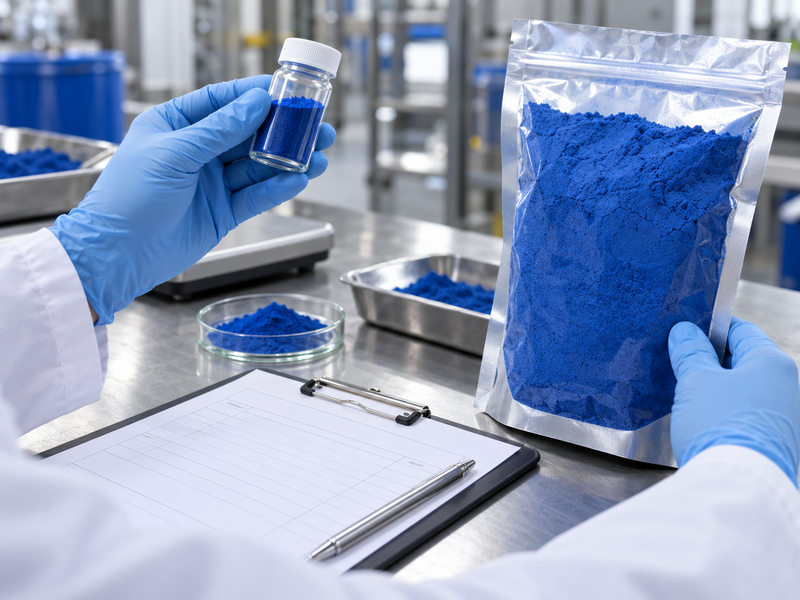
Read the product label, technical sheet, safety documentation and supplier terms. A vial sold “for research use” may have been manufactured, packed and tested under controls appropriate to laboratory work rather than food manufacturing. Do not assume it is approved for human consumption. Ask the supplier whether the exact SKU is produced and sold for food coloring in the destination market and request its regulatory and quality dossier. A food-color line should identify the commercial pack, recommended storage and how samples relate to production lots.
The SpirulinaCN blue spirulina product family can be used to request a named commercial grade; the webpage itself does not certify the offered lot.
Make “intended use” a purchase-order requirement, not a verbal assurance. If a lab reagent is used for early color exploration, label those trials non-qualifying and repeat them with the proposed food SKU. Differences in carrier, concentration and dissolution can invalidate the lab result. Preserve the formulation record so R&D can see when the grade changed. The decision is practical: buy a supply route suited to the final application rather than attempting to retrofit an analytical product into a food dossier.

3. How should as-sold composition be compared?
Request a full composition statement: pigment source, extraction route, carrier, diluents, preservatives if any, moisture and other relevant constituents. A highly purified solution might include buffers or stabilizers chosen for assay storage, while a food-color powder may use a permitted carrier for dosing and shelf life. Neither can be evaluated from a pigment percentage alone. Ask for the full as-sold description and the applicable food-use status of every component for the destination.
If commercial confidentiality limits disclosure, arrange a direct technical review with the buyer’s regulatory team under confidentiality rather than accepting an unidentified “proprietary blend.”
Confirm whether quotations refer to dry powder, liquid concentrate or pigment mass. Normalize color value to an agreed basis before comparing price. The material may be sold at different strengths, and a lower assay can still deliver a better usable color if dispersion or process stability is superior. Record the carrier’s effects on label declaration, formula solids, allergen review and organic claims where relevant. A grade change that keeps the word “phycocyanin” but changes its as-sold mixture is a new qualification event.
| Composition field | Food buyer’s question | Action |
|---|---|---|
| Source organism | Does listed identity match? | Obtain species statement |
| Extraction and filtration | Is the color material correctly defined? | Review process summary |
| Carrier/preservative | Is each component suitable? | Market and label review |
| Strength basis | What is the effective dose? | Normalize test method |
4. What does the purity ratio really measure?
The A620/A280 ratio compares visible absorbance near phycocyanin’s blue band with absorbance near a general protein band under a stated method. It is useful as one indicator of purification, not a full food-safety or regulatory test. Published extraction research and process studies use the ratio to describe grades, but numerical grade labels vary across sources. Do not turn an informal threshold into a claim that a material is legally food grade.
Ask about dilution, solvent, wavelengths, blank, instrument and reporting basis before comparing ratios from different labs.
A higher ratio may reflect removal of other proteins; it does not reveal every impurity, viable microorganism, manufacturing aid or carrier. Nor does it guarantee the desired color strength once diluted into a food. For procurement, keep separate fields for purity ratio, pigment concentration or color value, and the complete lot COA. If a vendor says “analytical grade is purer, therefore safer,” request the actual food-use dossier rather than arguing about the label. The buyer needs evidence matched to the finished product and jurisdiction.

5. Which quality and safety tests belong in the dossier?
Define tests from the intended use and applicable law. For a U.S. spirulina extract color additive, §73.530 specifies identity and impurity limits, including lead, arsenic, mercury and a negative microcystin toxin requirement in the operative text. The buyer may also need microbial criteria, moisture, color value, carrier verification and other risk-based parameters in its own specification.
Request the test methods and limits, not merely “pass.” Lot COAs should be linked to the offered sample and shipment, and third-party reports should identify the laboratory when the purchase specification calls for them.
Do not transfer a COA from a published study or another supplier to the offered lot. Analytical reagents can have detailed purity assays but omit tests needed for food release; food color materials may have different assay emphasis. Review manufacturing controls and traceability at the production site. Ask how out-of-specification results are handled and whether significant changes in source, extraction, carrier or plant trigger notification. A high A620/A280 number is only one line in this larger dossier.
| Evidence | Why it matters | Minimum review action |
|---|---|---|
| Lot COA | Meets agreed specification | Match sample and shipment |
| Impurity/microcystin data | Listed U.S. specification, if applicable | Check method and limits |
| Microbial specification | Process risk control | Match intended food |
| Manufacturing traceability | Repeatability and recall | Identify site and lot chain |
6. How should regulatory identity be checked?
For U.S. use as a color additive, the operative 21 CFR 73.530 describes filtered aqueous extraction of dried Arthrospira platensis, lists specific food categories and imposes good manufacturing practice and standards-of-identity conditions. The February 2026 order to expand uses to foods generally has not become effective. Request a source-organism and process statement for the SKU, then have a qualified reviewer check the exact finished food and destination.
A generic “food grade” stamp is not a substitute for that category-level analysis.
Other markets may classify phycocyanin or spirulina extract differently. Do not copy a U.S. listing into an EU, Asian or other dossier. Also distinguish an ingredient used for nutrition from a color additive used to impart blue. The regulatory path can turn on its technological function and exact composition. The supplier can provide documents; the finished-product manufacturer remains responsible for its own use and label review.
Record the regulatory conclusion with formula revision, SKU and market so it can be revisited if any of those change.

7. What does a food-matrix pilot need to prove?
Test the proposed commercial SKU in the actual food at a realistic dose. Record pH, heat exposure, mixing, light, packaging and shelf conditions. Compare initial color, uniformity, taste and end-of-life shade. A purified laboratory reagent may produce a useful scientific control, but it should not set the production dose. The food-color sample’s carrier and moisture can change dispersion. A published review of phycocyanin stability identifies relevant stressors; it does not predict the result in your own matrix.
Build a control and at least one process limit condition. Sample before and after the most severe heat or hold step and from first to last filled units. Keep a lot-linked retain sample. If a grade fails, identify whether the problem is insoluble particles, loss of hue, a carrier taste or unacceptable cost. Do not automatically raise the dose to mask a processing issue. A pilot that also measures yield and reject rate provides procurement with a cost basis.
The winning material is the one that meets a finished-product specification, not the one with the most impressive reagent label.
| Pilot measure | Why record it | Acceptance owner |
|---|---|---|
| Initial and stored shade | Color performance | R&D/marketing |
| Dispersion and specks | Line fit | Production |
| Sensory effect | Product quality | Sensory lead |
| Dose and yield | Cost-in-use | Procurement |
8. Can the supplier support commercial repeatability?
Ask whether the sampled SKU is manufactured at the site and scale intended for production orders. Obtain the standard pack format, storage conditions, shelf-life basis, lot traceability and change-control practice. An analytical vendor may provide excellent milligram-scale consistency but no route to the kilograms needed by a food plant. A food-color supplier should be able to identify the commercial product and agree on specification boundaries, subject to negotiation.
Do not invent a lead time, MOQ or guarantee; request a quote against the projected volume and delivery destination.
Compare two commercial lots where the project risk justifies it. Color value, carrier content and moisture may vary within specification, and the formula should tolerate normal variation. If not, set an incoming adjustment protocol with measurable boundaries rather than informal operator judgment. Determine how a material substitution would be approved and who receives change notice. Keep supplier backup plans realistic: another producer’s blue extract still requires identity, quality, market and matrix review.
Set a minimum remaining shelf life at delivery and a receiving hold rule for mismatched seals, lot codes or storage history. Continuity is part of grade selection, not a task to postpone until after launch.
9. How should cost-in-use be calculated?
Calculate cost per acceptable finished unit. Start with quoted price per kilogram of as-sold material, then multiply by the dose required after normal processing and storage. Add premixing, loss, rejected product, packaging and any extra controls needed for that grade. A laboratory reagent may be expensive per gram but unsuitable for a bulk quote; a cheap low-strength food color may need a high dose. Neither comparison is valid without matching shade and end-of-life performance.
Report the units and currency in the calculation and ask suppliers to quote comparable delivery terms.
Do not equate higher A620/A280 with fewer grams needed. That ratio describes one aspect of purity, while actual color value and stability determine dose. Request the method used to report color strength. If the grade has a carrier, compare pigment-adjusted and as-sold calculations, but buy on the latter because that is what arrives at the plant. A well-documented, repeatable SKU may have lower operational cost even when its invoice price is not the lowest. Procurement should present that reasoning in the approval file.
| Cost input | Source | Common mistake |
|---|---|---|
| As-sold price | Supplier quote | Comparing different pack terms |
| Effective dose | Matrix pilot | Using water-swath dose |
| Loss/reject | Line trial | Ignoring changeover waste |
| Shelf result | Stored samples | Pricing failed shade |
10. What should the purchasing specification say?
Name the approved SKU, as-sold composition range, source organism and extraction identity, intended food-color use, destination, color assay and acceptable range, microbial and impurity tests, packaging, lot identification and change notice requirements. Attach the pilot outcome and regulatory sign-off for the exact formula. Ask for a TDS, full composition, lot COA and commercially representative sample with the quote. Specify who signs off a replacement lot if the original sample lot has been exhausted.
If any requested document is unavailable, record the gap and its effect on approval rather than interpreting silence as a pass.
The buying decision can be summarized plainly: an analytical grade phycocyanin reagent is useful for the purpose it was made for, while a food project should qualify a documented production food-color SKU. Do not claim all analytical materials are unsafe or all “food grade” labels are trustworthy. The complete, lot-specific evidence decides. A purchase order linked to a named lot specification and application trial makes later receiving checks possible and prevents a successful early lab experiment from being mistaken for a commercial supply qualification.
Define incoming sampling, the color test method and the action for a borderline result. If the laboratory control and production color differ, investigate the assay setup and as-sold carrier before revising the food formula.

FAQ
Q1. Is an A620/A280 value a legal food-grade certificate? No. It is an analytical ratio that needs method context and a separate food-use dossier.
Q2. Is analytical grade automatically unsafe? No general conclusion follows from the label. The offered SKU may lack the necessary food-use evidence.
Q3. Can a lab vial establish the production dose? No. Repeat the trial with the intended as-sold food-color SKU.
Q4. Does U.S. §73.530 allow all foods? No. The current operative text lists specific uses and restrictions.
Q5. What should be compared in a quote? Cost per acceptable finished unit at the approved shade, with lot documentation and supply terms.
Next step: Contact SpirulinaCN with your finished-food application, target specification, destination, process conditions, pack format and anticipated quantity. Request a named production blue spirulina color SKU, full composition, lot COA, regulatory identity statement and commercial sample before comparing prices.