
A formulation team cannot buy “mild chlorella” from a brochure and assume it will taste mild in a finished product. Chlorella powder taste can be described as green, vegetal, marine, earthy or bitter, but those words do not specify intensity or consumer acceptance. Species, cultivation, drying, particle size, inclusion rate and the food around the powder all affect perception. This guide gives food brands a repeatable way to screen real lots, choose a workable dose and document sensory controls before scale-up.
In an original beer formulation study, increasing Chlorella vulgaris addition changed measured sensory responses; that product-specific result illustrates why each new matrix needs its own trial.
Contents
- What does chlorella actually taste like?
- Why do commercial lots differ?
- How should a sensory panel be designed?
- Which food bases are worth screening first?
- How does dose affect taste and color?
- Can flavors mask an unwanted note?
- What changes during processing and storage?
- Which supplier specifications help?
- How should a pilot compare grades?
- When should a formula be rejected?
1. What does chlorella actually taste like?
Use descriptors, intensity and context
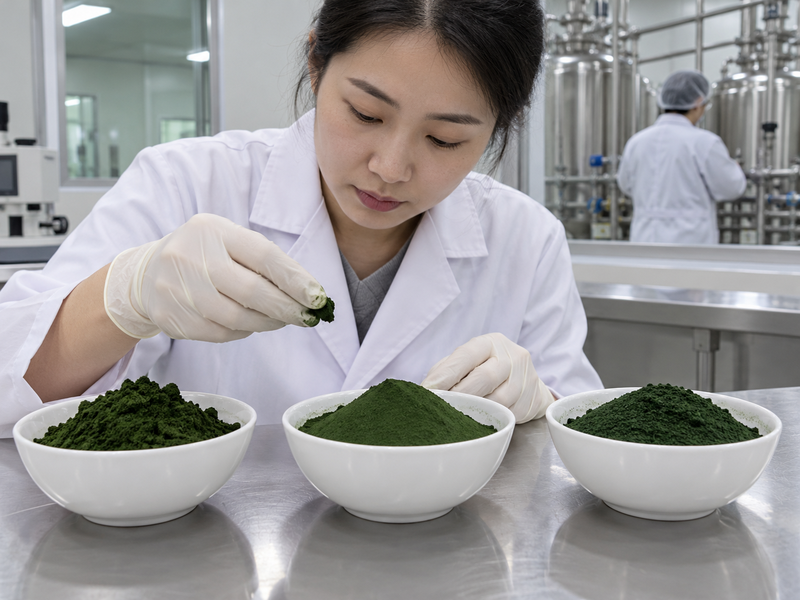
Chlorella is a whole-cell green microalgal powder, so a recognizable plant-like or algal character is plausible. “Grassy,” “marine,” “earthy” and “bitter” are useful descriptors, but they are not universal defects or precise measures. A dry-powder sniff test may highlight a note that disappears in a cocoa bar; a pleasant aroma in the jar may still leave an aftertaste in water. Evaluate the powder in plain water for diagnosis and in the proposed food for purchase decisions.
Have panelists name the note, score its strength and mark when it occurs.
Create a reference vocabulary with real samples. One retained accepted lot can anchor “typical” character; a clearly rejected lot can anchor an unacceptable note. Give the panel a neutral control and blind-coded samples, with randomized order. Record base recipe, dose, serving temperature and time since mixing. Those details matter because particles can hydrate and flavor can build during hold.
The chlorella product formats offer a starting point for sample requests, but sensory suitability must be decided with the exact commercial grade. Do not substitute a broad “low odor” claim for evidence in the intended application.
2. Why do commercial lots differ?
Follow the powder from culture to pack
Cultivation conditions, harvest timing, cell-wall processing, drying method, milling and storage can change a powder’s composition and volatile profile. A buyer need not assume a particular method is always superior; the practical task is to identify which process and lot produced the approved flavor. Ask for production site, species, batch code, drying description, particle-size range and packaging barrier. Compare at least two commercial lots to the development sample.
If the first order is made at another facility, treat it as a new sensory candidate until tested.
Also examine what happens after delivery. An opened bag stored warm or exposed to humidity may smell different from a sealed retain. Use consistent opening times and storage conditions when comparing lots. Record the powder’s moisture, water activity where relevant, color and visible clumping. A change in any of these can accompany an odor complaint, even if the supplier’s generic certificate still passes. Keep an unopened retain from the approved lot and take an incoming retain from each shipment.
The goal is to distinguish real supply variation from a test method that changes every time.
| Variable | What to record | Why it matters |
|---|---|---|
| Production route | Facility and drying method | Batch comparability |
| Particle size | Distribution, not just mesh label | Mouthfeel and wetting |
| Package | Liner, seal and headspace | Storage exposure |
| Sample age | Open date and conditions | Fair sensory comparison |
3. How should a sensory panel be designed?
Separate detection from preference
First ask whether panelists can detect a difference between candidate and control. Then ask whether they like the result at the intended dose. A triangle or paired comparison can help establish a perceptible change, while a descriptive scorecard identifies what changed. A consumer liking test has a different purpose and sample size. Do not turn five internal staff opinions into a claim that “consumers prefer” one powder. Internal screening is valuable for eliminating obvious failures and selecting samples for broader testing.
Blind-code samples, randomize order and control the serving conditions. Define intensity scales for vegetal aroma, marine note, bitterness, aftertaste, grittiness and overall acceptance. Rinse and rest between samples so the previous green drink does not influence the next. Repeat any close decision on another day and another lot. The original chlorella bread study assessed sensory properties in its specific bread application; the lesson for buyers is methodological, not a universal “best dose.” Record panel size and limitations in the report.
A product team can then distinguish a true grade difference from the noise of an informal tasting.

4. Which food bases are worth screening first?
Choose matrices that reveal the business risk
Screen in the product the brand intends to sell, but use a few contrasting bases to understand the powder. Plain water exposes algal notes and insoluble particles. An acidic fruit drink tests whether sharpness amplifies aftertaste. A cocoa or nut base can show whether familiar robust flavors accommodate the ingredient. A baked bar tests how heat and fat change perception. These are hypotheses for trial selection, not a ranking of guaranteed “good” applications.
Use the same dose by finished serving and a matching control in each base.
Do not compare a one-gram dose in a 100-milliliter shot with one gram in a 300-milliliter smoothie without noting concentration. Calculate grams per 100 grams and grams per serving. Include the target consumer’s preparation method: a stick pack mixed by hand may expose clumps that a high-speed blender hides. For ready-to-drink products, taste immediately and after the proposed shelf hold. A powder that works in a cold smoothie may fail in a hot-processed drink.
Application matching on the supplier’s chlorella page can inform sample selection, but the decision belongs to the finished-formula data.
| Matrix | Main question | Failure sign |
|---|---|---|
| Water | What is the native note? | Strong lingering odor |
| Citrus drink | What does acid reveal? | Sharp bitter aftertaste |
| Cocoa base | Can robust flavor integrate it? | Green note remains dominant |
| Baked bar | What does process change? | Stale or harsh flavor |
5. How does dose affect taste and color?
Find the window between usefulness and overload
Increasing chlorella usually deepens green color and increases the mass of whole-cell solids. It may also increase detectable taste or texture; the relationship need not be linear in a complex formula. Set three or four doses around the product’s proposed inclusion. Calculate any nutritional contribution at those same doses, then run color and sensory checks on the very same samples. That creates a usable “window” where the ingredient meets the product goal without crossing a sensory rejection threshold.
If the only purpose is green color, consider whether a purpose-made permitted color ingredient is a better route than raising whole chlorella until flavor fails. If whole-biomass positioning is central, lower the target shade or adjust the base formula within honest label constraints. In an original Chlorella vulgaris beer experiment, different incorporation levels altered consumer-relevant attributes in that matrix. The exact numerical result should not be carried into a bar or smoothie.
Document the upper dose for each formula and the reason for it; this prevents a later marketing request from silently pushing the ingredient above its tested range.

6. Can flavors mask an unwanted note?
Aim for integration rather than concealment
Sweetness, acidity, cocoa, fruit flavor, spice, fat and salt can shift how a green note is perceived. A masking strategy should be tested with the full formula, because an acid may suppress one note while making another harsher. Begin with the least complicated change: adjust dose or select a better grade before adding multiple flavors and sweeteners. If a masking system is needed, evaluate its own ingredient declaration, cost and shelf stability.
The label and nutrition panel must reflect the final recipe, including any sugar or sodium added to make the flavor acceptable.
Run matched controls: original base, base plus chlorella, base plus masking change, and the full combination. That reveals whether the mask truly addresses the chlorella note or merely changes the base everyone likes. A blind panel can score aftertaste several minutes after swallowing, not just first sip. Avoid promising “no chlorella taste” unless a suitable consumer test supports it under normal use. A careful claim is that the tested formula meets its sensory target at a defined inclusion range.
Scale-up can change mixing and flavor release, so repeat the check on pilot material before launch.
| Adjustment | Potential role | Check before approval |
|---|---|---|
| Lower dose | Reduces ingredient impact | Product goal remains met |
| Alternate grade | Changes native profile | Commercial lot repeatability |
| Flavor pairing | Balances green note | Full label and aged taste |
| Texture system | Reduces particle perception | Sediment and mouthfeel |
7. What changes during processing and storage?
Test the flavor after the actual process
Heat, shear, oxygen exposure and storage can alter the food around chlorella as well as the powder itself. A finished beverage may develop a stale note from another fat-containing ingredient; a bar may develop more pronounced green aroma after its flavor top notes fade. Do not automatically blame chlorella without a control batch. Prepare samples with and without it, use the intended process, then store in the proposed package under realistic and accelerated conditions. Track color, odor, taste and texture at defined intervals.
Packaging can influence the result. An oxygen barrier, moisture barrier or opaque container may help protect a formula, but each change has cost and recycling implications. Compare packages under the same storage protocol rather than assuming one solves the problem. Retained powder and finished-product samples support root-cause work if an aged batch differs. Establish a sensory shelf-life acceptance limit before reviewing the data.
A product that is attractive on day one but unacceptable before its declared shelf life is not ready for a commercial purchase contract, no matter how good the incoming powder looks.

8. Which supplier specifications help?
Put flavor into a controlled purchasing standard
Specifications should include species identity, composition, microbiological and contaminant criteria suited to the product, moisture, particle distribution, pack format and lot traceability. For sensory, establish a sealed reference and a short method: powder mass, dilution or food base, mixing time, serving temperature, panel size and pass criterion. “Pleasant flavor” is too subjective for a dispute. A color reference can supplement the sensory standard, but a shade match does not guarantee odor match.
Ask the supplier how it handles deviations and how soon it reports process changes.
Use the receiving facility’s hazard analysis to decide which safety tests and supplier verification steps apply. The FDA supply-chain guidance is useful for US facilities where a hazard requires a supplier-applied control. Request a certificate tied to the lot, then run the agreed application test when it arrives. A sales sample approved six months ago should remain a reference, not become an invisible substitute for current-lot review.
If buying through a distributor, record which plant made and packed each lot so a flavor complaint can be investigated at the source.
| Attribute | Method or evidence | Decision owner |
|---|---|---|
| Lot identity | Traceable pack code | Quality |
| Sensory | Matched reference trial | Product development |
| Particle size | Agreed distribution method | Operations |
| Safety criteria | Risk-based certificate and checks | Quality |
9. How should a pilot compare grades?
Use a controlled matrix and commercial samples
Select candidate grades that differ for a reason, such as particle size, processing route or declared mildness. Ask for samples from normal commercial production and their lot certificates. Blind-code them and test at equal dose in the same base. If one grade is more concentrated in the nutrient or color that the brand wants, run a second comparison at equal functional outcome. Otherwise an apparent flavor advantage may simply reflect less material in the cup. Record mixing energy, hold time and serving temperature.
Advance no more than two grades to a pilot line, with pre-agreed sensory and process criteria. Compare fill consistency, visible specks, sediment, color and aged flavor. Calculate cost per accepted serving after the dose and any masking change are fixed. Ask whether the selected grade can be supplied across forecast volume and whether a second lot will match the approved retain. The contact page can be used to request targeted chlorella samples with the application and desired volume.
A good pilot report ends with a grade, dose window, reference lot and requalification trigger.

10. When should a formula be rejected?
Respect the agreed sensory ceiling
Reject or reformulate when the dose needed for the product promise exceeds the dose consumers or the intended channel can accept. Also stop if an approved bench sample cannot be reproduced with normal commercial lots, if aged flavor fails before shelf life, or if masking changes make the nutrition and price proposition unattractive. These are business decisions, not failures of the ingredient category. A powder may work well in a savory cracker but not in a clear lemon drink. Keep those application results separate.
Document why a candidate was rejected: specific sensory note, intensity, dose, matrix, process and lot. That information lets sourcing request a genuinely different grade rather than a renamed sample. If quality or safety criteria fail, hold the material regardless of flavor. A final decision should name the approved formula version and the conditions under which taste remains acceptable. For a product sold with a “mild” descriptor, consider a suitable consumer assessment instead of relying solely on internal panel scores.
Sensory proof should match the strength of the claim.
| Stop signal | Likely next action | Record |
|---|---|---|
| Taste fails at target dose | Lower dose or new concept | Dose-response data |
| Lot drift | Requalify source or grade | Retain comparison |
| Aged off-note | Package or formula trial | Shelf-life samples |
| Safety failure | Hold and investigate | Quality disposition |
Frequently asked questions
Does chlorella always taste fishy? No. Some samples are described that way, while others are more grassy or earthy. Test the actual lot and formula rather than treating a descriptor as universal.
Can fruit flavor completely hide chlorella? It may help, but the result depends on dose, acid, sweetener and shelf life. Verify with blind, aged-product tests.
Is broken-cell chlorella milder? Cell-wall processing may alter powder behavior, but it does not guarantee a particular flavor. Compare commercial lots under the same conditions.
What dose should a brand use? Choose from the product’s measured nutrition or color goal and its sensory ceiling. There is no single best food-formula dose.
Should the supplier guarantee “no taste”? A defined sensory range or reference comparison is more usable than an absolute promise. Specify the method and pass criteria in the agreement.
Conclusion
Managing chlorella powder taste means controlling the decision, not assuming a fixed flavor. Screen real lots blind, test several doses in the finished food, repeat after processing and storage, and keep a sensory reference with the purchasing specification. Then choose the grade and formula that remain acceptable at commercial scale.