
A chlorella powder lutein content specification should begin with the offered whole-biomass ingredient, not a published maximum from another culture. Chlorella can contain lutein, but the amount in an ingredient lot depends on the material and its handling. For a buyer, the practical question is whether the tested lot contributes enough lutein to the intended product to justify an assay limit or a nutrient-positioning brief.
An original Chlorella vulgaris cultivation study quantified lutein using HPLC in its own biomass. Its experimental yield cannot be assigned to a commercial chlorella raw material. Request a current, named-lot report.
1. Is the material whole chlorella powder?
Identify the species, processing description and whether the product is dried whole biomass or a concentrated extract. A lutein-rich extract has a different denominator and ingredient statement. Ask for the exact grade and lot that will be sampled for the formulation. If a supplier presents research on a specially cultivated strain, do not assume its value applies to a conventional bulk grade.
2. How should lutein be measured?
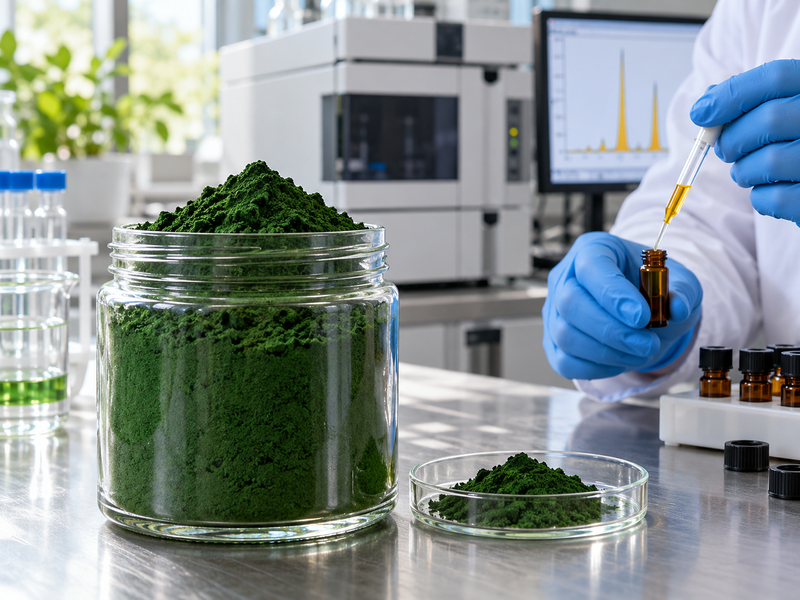
Request a method that identifies lutein separately from other carotenoids. The research study describes an HPLC assay with an external standard; a commercial laboratory may use another validated method. Obtain sample preparation, calibration, reporting limit and measurement uncertainty. A general “total carotenoids” figure cannot be read as lutein. Use the same method when comparing suppliers or repeat lots.
| Evidence | Acceptable question |
|---|---|
| Lot identification | Was this shipment tested? |
| Lutein-specific assay | Was lutein separated from other pigments? |
| Units and basis | Can it be used in a serving calculation? |
| Method report | Can a second lab reproduce it? |
3. Which units support a purchase decision?
Ask for milligrams per 100 grams of powder as received, with moisture from the same lot. If a paper reports lutein per liter of culture or per gram of extracted pigment, it cannot be copied into a whole-powder specification. Keep dry-basis data for process comparison but use as-received material in the actual formulation. Record the test date because pigment values may change during prolonged storage.

4. How much lutein reaches the product?
Multiply the lot’s mg/g powder by the planned grams of chlorella per finished serving. Include realistic dosing tolerance and verify the finished product if the amount supports a label or marketing statement. Do not equate an ingredient’s high value per 100 grams with a meaningful amount in a small-serving food. The regulatory review must consider the destination market and how lutein is characterized on the label.
5. What can change before the powder is used?
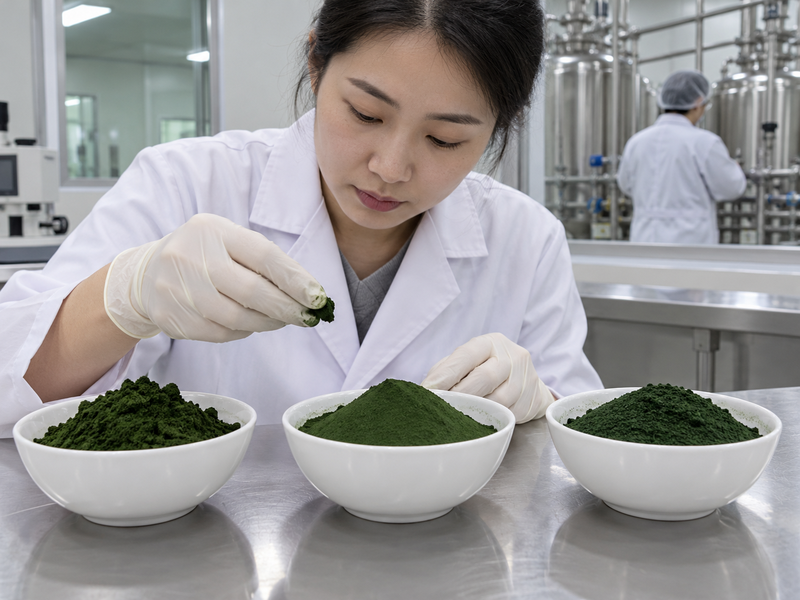
Record production date, barrier package, storage temperature and light exposure. Keep sealed retain samples and compare receipt and end-of-use points if a guaranteed lutein value matters. Whole-powder color can be a useful warning sign but does not quantify lutein. A sample stored on an open bench is not an adequate reference for a sealed commercial lot.
6. What else should a lutein-focused buyer check?
Check species identity, cell-wall processing if relevant to the application, moisture, microbiology and contaminants. Lutein content does not certify safety, nutritional accessibility or product performance. Test taste, dispersion and appearance in the actual formula. If a higher-lutein lot has a stronger grassy note or different particle behavior, the product brief may favor the lower value.
| Buyer goal | Test besides lutein |
|---|---|
| Nutrition positioning | Finished-serving calculation and label review |
| Natural green appearance | Formula color after process and storage |
| Smooth beverage | Particle and sediment trial |
7. When is a minimum lutein limit justified?
Set one only if the ingredient’s lutein contribution affects product acceptance. Collect several commercial lot results and check their dispersion before writing a threshold. Discuss method uncertainty and how borderline results are resolved. A specification copied from a cultivation paper may exclude good food-grade material without improving the finished product. Separate target, typical and guaranteed minimum in supplier documents.

8. What belongs in the inquiry?
Tell the supplier the final format, planned dose, lutein target, destination, required evidence and expected annual quantity. Ask whether the requested grade can be supported with repeat-lot testing and a signed specification. Retain a sample from the approved lot, then test the first shipment with the agreed method when the result is claim-critical.
Suppose the formula team compares two grades with different lutein numbers but finds that only the lower-content grade disperses acceptably. Calculate the resulting lutein per serving before deciding whether the difference is commercially meaningful. A label-led product may need a different material or dose; a color-led product may accept the lower assay if the finished appearance is better. This decision should be recorded with the lot, dose, method and observed product result. It is safer than selecting the largest lab number and discovering later that the powder cannot pass a normal production run.
FAQ
Is total carotenoids the same as lutein? No. Lutein needs an analyte-specific result.
Can I use the value from a scientific study? Use it as context, not a guarantee for your supplier’s powder.
Does a greener powder always contain more lutein? No. Several pigments and physical factors affect visual shade.
Should testing use dry or as-is values? Use as-is for formula math, and retain dry-basis data when comparing processes.
Do I need finished-product analysis? Consider it when the final label or product claim relies on lutein content.
Request a chlorella sample, current lutein report and quote with the formulation dose, target, quantity and destination.