
Chlorella powder for couscous manufacturers should be purchased against a granulation and cooking brief, not merely a green-color sample. A biomass that disperses in semolina can still change water demand, create excessive fines on the sieve, darken during drying or make steamed grains sticky. The relevant decision is whether a named food-grade lot runs through the intended roll, sieve and dry line and produces separated, palatable couscous after the consumer’s cooking method.
A 2021 couscous study compared several algae biomasses in a traditional hand-rolled process. Its chlorella strains and addition level are research conditions, not an assertion about what SpirulinaCN sells or what an industrial line should use. Industrial buyers need their own water, yield, drying and rehydration data.
Contents
- What couscous brief should the trial meet?
- How should chlorella lots be screened?
- What hydration ladder should be run?
- Will granules form consistently?
- What does sieve yield reveal?
- Can the granules be dried safely and evenly?
- How will steam rehydration be assessed?
- What cooked texture and flavor pass?
- How should quality and cost be compared?
- What locks the purchasing specification?
1. What couscous brief should the trial meet?
Define whether the product is fine, medium or large-grain couscous and record the current semolina grade, water addition, rolling method, sieve bands, drying profile, final moisture and consumer preparation instructions. A green variant must meet the same practical expectations for free-flowing dry granules and separate cooked grains. Decide in advance how much green color and algae aroma the brand accepts. A beautiful dry sample can fail when boiling water or steam releases an earthy note.
Compare with a plain control from the same semolina lot and production shift. Set objective targets for in-range granule yield, fines, cooking loss, hydration time and clumping. If the purpose is a nutrient statement, calculate it from the finished product and check destination rules; the presence of chlorella does not establish a claim. The published study tested traditionally made couscous, so treat it as feasibility evidence and design a separate industrial qualification.
| Brief element | Record for control | Candidate gate |
|---|---|---|
| Grain size | Sieve distribution | In-range yield |
| Dry handling | Flow and dust | Filling performance |
| Consumer preparation | Water and time | Separate cooked grains |
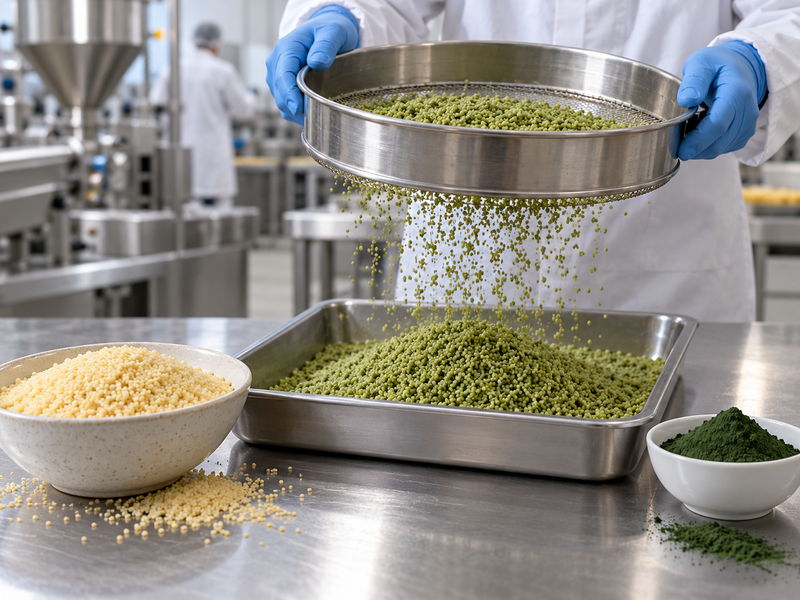
2. How should chlorella lots be screened?
Ask for a lot-matched sample, identity and species declaration, technical data sheet, current COA, particle-size data, storage guidance and intended commercial specification. Screen the dry powder for color and odor before spending line time. Compare sealed sample, freshly opened sample and a retained reference under consistent light and temperature. Do not infer that the pigmentations or strains in the research are available as supplier SKUs. Request explicit confirmation of the grade that will be quoted.
Review microbiological and contaminant evidence with the receiving hazard plan and destination limits. The COA should identify methods, units and the lot tested; a pass/fail statement without those details may be insufficient. Check whether powder fines create dosing dust or segregation in the dry feed. Retain enough of each lot to repeat the color and odor comparison after the first process trial. If a different lot is offered for commercial supply, conduct a bridging trial rather than assuming all green chlorella behaves alike.
| Incoming factor | Why it matters | Evidence |
|---|---|---|
| Species and grade | Reproducible identity | TDS and declaration |
| Color and odor | Finished grain acceptance | Retain comparison |
| Size and moisture | Mixing and flow | Lot data and bench screen |
| Safety results | Food suitability | Lot-linked reports |
3. What hydration ladder should be run?
Set a controlled series with a plain control and several chlorella additions chosen around the brand’s color and taste target. Specify whether powder replaces some semolina or is added to the formula; the mass balance and water demand will differ. Hold semolina lot, mixing energy and water temperature constant in the first pass. Record the water needed to reach the normal rolling or agglomeration condition, then run a second, clearly labeled adjustment series if the first treatment needs more or less water.
The 2021 paper used a particular enrichment level in hand-rolled samples. It cannot set a universal dose for a continuous industrial line. Watch for wet lumps, dark streaks and dry powder pockets during mixing. Measure the distribution of color and mass through the batch, including late discharge, because powder and semolina may segregate. A formulation should advance only when it produces workable granules and a flavor range acceptable after cooking, not just an appealing green dry blend.
| Trial arm | Fixed factors | Variable |
|---|---|---|
| Control | Semolina, water method, line | No chlorella |
| Low screen | Same base process | First measured addition |
| Mid screen | Same base process | Higher addition |
| Water correction | Selected addition | Water only |

4. Will granules form consistently?
Observe the agglomeration or rolling stage at its normal throughput. Record formation time, machine loading, build-up on surfaces and the proportion of weak granules that collapse during transfer. Hand rolling in a research kitchen applies different shear and residence time from industrial rolling equipment; the published process description therefore cannot guarantee plant performance. Sample at startup, steady state and after any recipe correction.
Check whether the powder changes how water distributes across semolina. Dark micro-clumps may become oversized grains, while dry pockets may remain as powder. Sieve a fixed mass of wet granules and photograph representative defects. If more water produces acceptable formation but later increases drying load, record that trade-off rather than declaring the hydration problem solved. Define acceptable granule integrity through the transfer to the dryer, because a grade that works in a small bowl may create fines before it reaches the commercial sieve.
5. What does sieve yield reveal?
Collect mass in each defined sieve band after formation and again after drying. Calculate saleable in-range granules, oversize requiring rework and fines that cannot enter the intended package. Compare with the plain control at equal throughput. A darker product may appear higher quality while carrying a costly loss to fines; purchasing needs the mass balance, not only a photograph. Record how many times reworked material passes through the system and whether color becomes less uniform.
Use the actual commercial sieve openings. The research’s particle characterization may describe its own traditionally made grains, but industrial specifications should reflect the brand’s cook time and mouthfeel. If an alternative chlorella particle size is available, test it in a separate run with the same sieve and water protocol. Avoid changing both powder and semolina simultaneously. An approved supplier should be linked to a repeatable acceptable yield, including startup and end-of-batch data.
| Sieve fraction | Commercial interpretation | Next action |
|---|---|---|
| Oversize | Uneven cooking risk | Review water and rolling |
| Target band | Saleable yield | Confirm after drying |
| Fines | Dust and yield loss | Review granule strength |
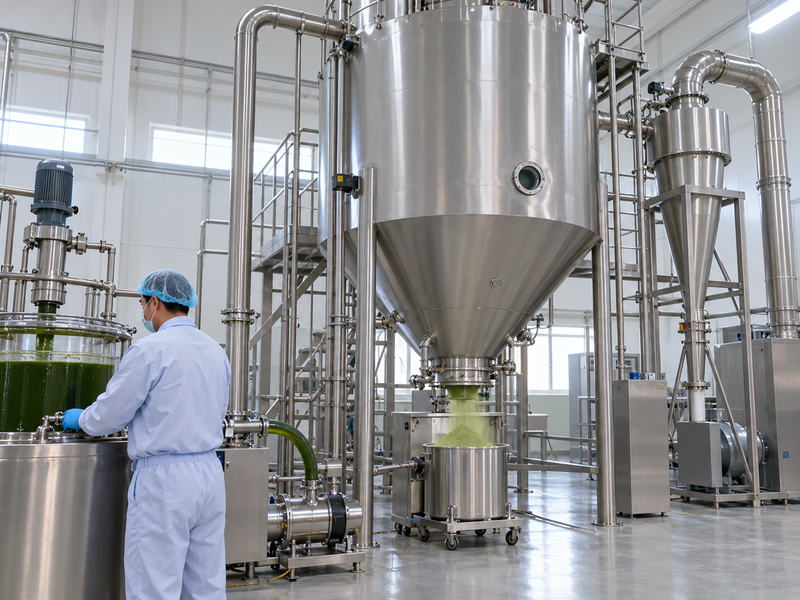
6. Can the granules be dried safely and evenly?
Run the plant’s intended dryer profile first and record inlet and product temperatures, residence time, bed depth, final moisture and water activity. Sample across the dryer, not just the most accessible discharge point. Wet granule size affects heat and moisture transfer, so a formulation with more oversized pieces may produce a broad final-moisture distribution. Check color before and after drying under matched light. A change from bright green to dull olive may be a commercial failure even if the lot meets moisture limits.
Do not shorten drying merely to preserve appearance without evaluating food safety and storage stability. Conversely, an unnecessarily severe profile may damage color and flavor. Any revised profile is a new process trial requiring yield, color, moisture and rehydration checks. Pack dry samples immediately in the intended barrier system and monitor caking or dust after handling. Define the release moisture and water activity for the finished couscous from the facility’s validated product program, not from an unrelated algae study.
| Drying record | What it diagnoses | Release concern |
|---|---|---|
| Product temperature | Heat exposure | Color or aroma drift |
| Moisture distribution | Uneven drying | Storage risk |
| Post-dry sieve | Granule breakage | Dust and yield |
7. How will steam rehydration be assessed?
Prepare control and green couscous with the package’s proposed water amount, steam or boiling-water method and rest time. Weigh water uptake, check uncooked centers and separate grains with the same number of fork strokes. Measure cooking loss or soluble solids in the drained liquid if the product method permits it. A dry green grain that meets sieve specifications can still hydrate unevenly because its structure or size distribution changed during rolling and drying.
Repeat with the realistic range of household preparation conditions if the market uses both steaming and pour-over methods. The study’s cooking-quality results belong to its own process and biomass set. For an industrial purchase, compare at least the proposed finished recipe with the control after actual manufacturing. Record how long the candidate takes to reach an edible center and whether green color leaches or turns dull. Packaging instructions should be finalized from these finished-product tests.
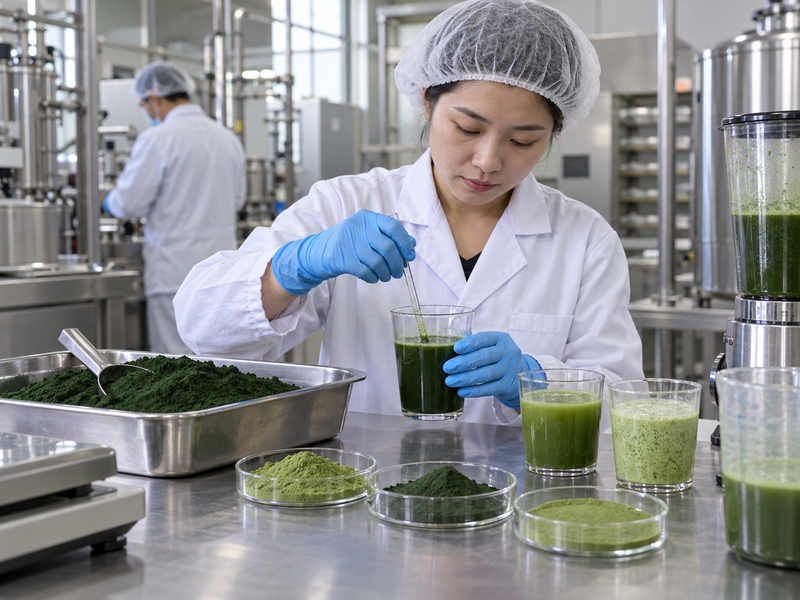
8. What cooked texture and flavor pass?
Use a blinded panel at a fixed serving temperature. Score separation, clumping, chew, firmness, grittiness, aroma and aftertaste. Serve a plain preparation first so strong sauces do not hide defects, then confirm the intended meal context. If a higher chlorella level adds attractive color but creates lingering earthy notes, the lower level may be the better commercial choice. Set the failure boundary before comparing price.
Instrumental texture can support the panel, but the key question is whether consumers receive distinct, pleasant grains. Measure stickiness or compression under a repeatable preparation method. Distinguish weak granules caused by formation from overhydration caused by consumer instructions. Evaluate samples at the end of planned dry storage as well as just after production. A stored powder odor or package moisture pickup can appear only later.
Do not extrapolate sensory acceptance from the hand-rolled research to a new strain or industrial dryer.
| Sensory dimension | Useful descriptor | Reject example |
|---|---|---|
| Grain separation | Loose versus clumped | Persistent masses |
| Bite | Firm versus pasty | Uneven hard centers |
| Flavor | Clean versus earthy | Lingering off-note |
9. How should quality and cost be compared?
Request quotes for an identified grade, anticipated annual and order quantity, packaging, destination and delivery basis. Calculate effective powder cost per saleable couscous kilogram after sieve losses, rework and any extra dryer energy. A low ingredient price can be erased by poorer granulation yield. Include extra incoming testing and any need for special dust handling. Compare candidates only after they have passed the same hydration, sieve, drying and cooking protocol.
Ask whether commercial supply will match the pilot material and how the supplier communicates process or specification changes. A trial sample with a particular pigmentation cannot substitute for a documented repeatable grade. Use a retained ingredient sample and a finished couscous reference for incoming checks. Do not count a possible nutrient claim as commercial value until the finished recipe and destination labeling requirements have been reviewed. Price is meaningful after the product’s physical and sensory criteria have been met.

10. What locks the purchasing specification?
Write one approved specification covering ingredient identity, lot documentation, particle-size method, color and odor reference, relevant safety criteria, addition level, semolina and water basis, granulation settings, sieve yield, drying endpoint and cooked acceptance. Attach the line trial and sensory results. Define which changes trigger requalification: new chlorella grade, semolina source, dryer profile, package or cooking instructions. That prevents an attractive pilot batch from becoming an unrepeatable procurement decision.
Run a confirmation batch at the intended throughput and package it as sold. The receiving plan should compare each new lot’s documents and practical attributes with the approved reference. If the supplier offers a different strain or processed biomass, treat it as a new candidate rather than an automatic equivalent to either the approved grade or the research material. Include regulatory review for the product and destination, especially before using nutrition or health language.
Release only when quality, production, procurement and labeling owners sign the same evidence file.
FAQ
Q1. Does the published 6% research addition set a target? No. It describes a traditional process and specific biomasses, not a universal industrial formula.
Q2. Is couscous equivalent to extruded pasta? No. Its granulation, sieving and rehydration gates are different.
Q3. Why test powder odor before the line? It can eliminate an unsuitable candidate before costly production trials.
Q4. Which yield matters most? Saleable target-size granules after drying and handling, not wet agglomerates alone.
Q5. Can a dry color approval replace cooking tests? No. Hydration changes color, texture and flavor.
For chlorella powder for couscous manufacturers, contact SpirulinaCN with your couscous application, target powder and finished-grain specifications, anticipated quantity, destination, semolina grade and trial line details. Request a lot-matched sample, technical sheet, current COA and application-specific quotation.