
Blue spirulina non dairy pudding manufacturing is a packaged-dessert decision, not a home recipe. A vivid bench sample may become dull after starch cooking, incomplete dispersion, hot filling or weeks beside the retail case light. The buyer should choose a traceable blue extract grade only after the actual coconut, oat or other plant base passes color, texture and shelf-life gates.
In the United States, 21 CFR 73.530 lists puddings, including non-dairy puddings, for spirulina extract under specified conditions. The broader February 2026 expansion was delayed indefinitely; the listed category and finished formula still need review. This guide makes the line trial and purchase decision explicit.
Contents
- What outcome must the pudding trial prove?
- How does the plant base change the starting color?
- Which blue extract grade should be requested?
- When can the extract be added safely in the process?
- How should starch and gum hydration be assessed?
- What belongs in a dispersion and fill trial?
- How should chilled shelf appearance be measured?
- What should sensory and texture approval include?
- How do regulatory and label checks affect release?
- What is the right sample-to-volume buying sequence?
1. What outcome must the pudding trial prove?
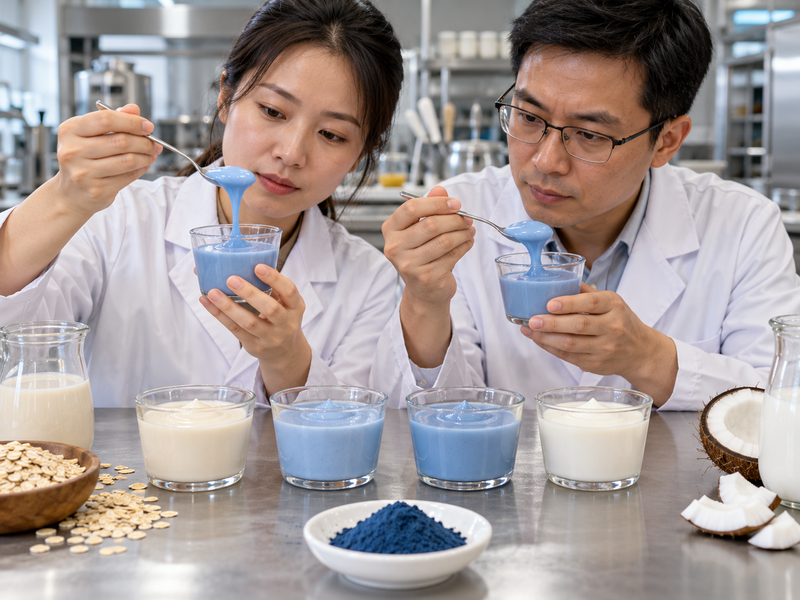
Start with a product brief: package size, base formula, process flow, desired blue, distribution temperature and claimed shelf life. Decide whether color must be uniform throughout, swirled, or confined to a separate layer. Those are different dispersion and stability problems. Set a physical shade reference viewed in the intended pot and lighting, because a blue spoonful in a clear beaker can look different behind a printed sleeve.
Make success conditional on normal pudding quality as well as color: viscosity, spoonability, absence of watery separation and acceptable taste. A trial that solves hue by changing texture beyond the product brief has not qualified the ingredient.
Define who owns each release: R&D for appearance and eating quality, production for repeatable filling, quality for microbiological and shelf-life requirements, and regulatory for the exact destination. The codified spirulina extract rule names non-dairy puddings but also restricts uses in foods with standards of identity unless an added color is authorized by the standard. The legal check is therefore attached to the precise finished SKU.
Do not infer permission from a supplier brochure or from a different dessert category.
| Gate | Written target | Trial evidence |
|---|---|---|
| Shade | Reference in retail pack | Instrument and visual panel |
| Body | Spoonability and viscosity range | Finished product test |
| Separation | Acceptable syneresis limit | Chilled hold observations |
| Market | Destination and product category | Regulatory sign-off |
2. How does the plant base change the starting color?
Screen the exact commercial base before adjusting pigment dose. Coconut fat can make a base look opaque and pale, while oat or nut bases may carry beige or yellow tones. Cocoa, fruit, minerals or protein ingredients can alter hue further. The same amount of blue extract may appear clean blue in one matrix and teal or gray in another. Use control batches made with the normal raw-material range, not just the palest supplier lot.
Record pH, solids, fat content and any heat treatment because these may influence the appearance or stability of the complete system.
Photograph the base alone and the colored version under fixed lighting. For a two-layer dessert, assess color bleed across the interface and whether the darker layer changes the perceived blue. A color test conducted only in water does not establish a dose for pudding. If a formulation change such as using a lighter base would help, calculate its sensory, nutrition-label and cost consequences before treating it as part of the solution.
The buyer needs to know which shade is achievable with the intended recipe, not with a convenient substitute base.
3. Which blue extract grade should be requested?
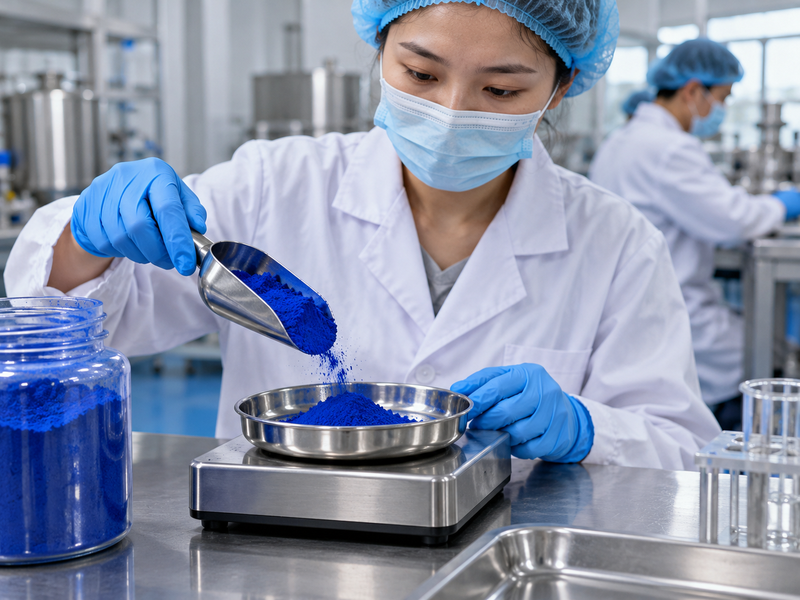
Request a named as-sold SKU, full composition and lot-linked sample. The U.S. color-additive identity is filtered aqueous extract of dried Arthrospira platensis biomass with phycocyanins as principal coloring components under §73.530. A product marketed as “blue spirulina” might contain a carrier, and different grades can have different color value, solubility and solids contributions. Ask for a technical data sheet, color-value method, lot COA, microbial limits, package information and handling recommendations.
Check whether the supplier can provide the same SKU for the planned volume; a lab reagent or an unidentified blue powder is not a qualified commercial substitute.
The SpirulinaCN blue spirulina page identifies the product family, not the composition or suitability of the lot you will buy. Evaluate any carrier against the finished recipe and market rules. Calculate cost from the amount needed to reach the approved shade, including processing loss, rather than from powder price alone. Keep the original sample code on every trial sheet so a promising sample can be traced to a quote and later production material.
| Supplier item | Why the buyer needs it | Decision if missing |
|---|---|---|
| Full as-sold composition | Carrier and label review | Hold formulation approval |
| Color method and value | Comparable cost-in-use | Request common assay basis |
| Lot COA and sample ID | Traceability and quality | Hold procurement qualification |
| Pack and storage guidance | Line and warehouse fit | Set validation trial |
4. When can the extract be added safely in the process?
Draw a process map from ingredient receipt to chilled dispatch. Mark base heating, starch cook, homogenization or high-shear mixing, cooling, extract addition, fill and seal. Trial at least the operationally feasible addition points. Earlier addition may distribute easily but expose blue pigment to more heat. Later addition may preserve appearance but introduce an ingredient after the main lethality step.
A review of phycocyanin stability explains why heat and matrix conditions matter, but its data do not validate your particular process. Record actual product temperature and time at the addition point rather than relying on a kettle setpoint.
If late addition is proposed, have the plant’s food-safety team assess ingredient microbiology, transfer equipment, sanitation, environmental exposure and the validated finished-product process. Do not move a color to the end of the line solely because it looks brighter. If the line cannot accommodate a controlled late-addition step, compare a heat-exposed route honestly and decide whether the achievable shade meets the brief. A purchasing specification cannot compensate for an unvalidated manufacturing route.
| Addition point | Potential benefit | Required check |
|---|---|---|
| Before cooking | Simple dispersion | Heat-driven color change |
| During cooling | Less thermal exposure | Uniform distribution and hygiene |
| Just before fill | Shortest heat exposure | Validated post-heat controls |
5. How should starch and gum hydration be assessed?
The blue ingredient must work in the pudding’s structure, not merely tint it. If starch or gums are dispersed before cooking, follow their usual hydration sequence first and evaluate whether adding extract changes lump formation, viscosity development or shear requirements. A predissolved extract contributes extra water that belongs in the formula calculation. Dry addition needs a separate check for clumps or localized blue specks after commercial mixing time. Run a no-color control through the same process, then compare viscosity at defined temperatures and times.
A cold benchtop mix cannot stand in for a starch-cooked production batch.
Watch for settling or color migration when the pudding stands before filling. Some plant bases have suspended particles or fat that can shift after cooling. Record mixing speed, duration, batch geometry and hold time, because the same ingredient can appear homogeneous at the kettle surface but streak during the last pots filled. If a different thickener or mixing step improves color, check whether that change remains acceptable for ingredient declaration, clean-label positioning and plant throughput. These are commercial constraints, not just laboratory observations.

6. What belongs in a dispersion and fill trial?
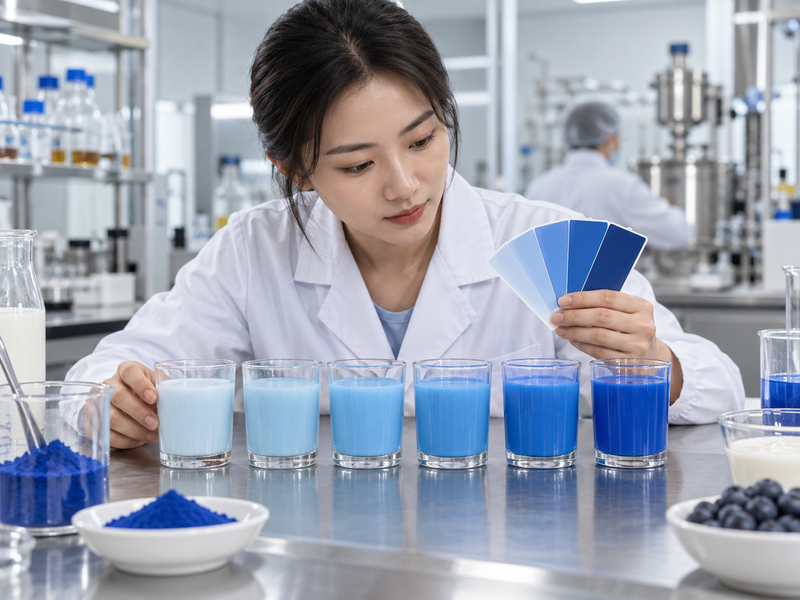
Sample the kettle at the top, middle and bottom, then collect the first, middle and last filled pots. Look for specks, streaks, foaming, color carryover and uneven fill weights. Use a fixed sample size and lighting so different batches can be compared. Instrumental color readings may help, but define how an opaque, thick pudding is presented to the instrument. A smooth surface measurement and a mixed spoonful may answer different questions. Record whether the lid and pot material alter the apparent hue.
Evaluate the normal line stop and restart condition; a static hold can reveal settling that continuous running hides.
Calculate actual extract usage from weighed additions and finished yield, including any product in the piping. If a grade requires unusual premixing or frequent cleaning, include that labor and waste in cost-in-use. Test cleaning and changeover if the next product is pale; residual blue can be commercially expensive even if the color itself is inexpensive. Define acceptable batch-to-batch shade spread, then repeat the pilot with another qualified extract lot or raw-base lot to check whether the chosen dose has enough tolerance.
| Sample point | Observe | Why it matters |
|---|---|---|
| Kettle top/middle/bottom | Shade and specks | Bulk dispersion |
| First/middle/last pots | Shade and viscosity | Fill consistency |
| After line stop | Sedimentation or streaks | Restart control |
| After changeover | Residual blue | Cleaning cost |
7. How should chilled shelf appearance be measured?
Hold sealed production-style pots at the intended distribution temperature, plus a justified excursion condition. Inspect at the start, several intermediate points and the proposed end of shelf life. Measure hue, visible fading, liquid separation, color at the lid interface and any ring around the pot. Compare light-exposed and protected packages if the product will sit in a lit display.
Keep the uncolored control, because a base that changes color during storage can make the blue appear to drift even when the pigment itself is relatively stable. Photograph unopened packs and mixed spoonfuls separately.
Record package oxygen and light properties if the pack is being selected alongside the color. A barrier change may improve appearance but affect cost or recyclability. Do not treat an accelerated warm hold as proof of refrigerated shelf life; use it to screen risk, then complete the required real-time study under the brand’s protocol. The purchase decision should use the shade at the end of shelf life, not only the filling-day photograph.
Also check whether syneresis concentrates color in one phase and leaves the pudding uneven after normal transport.
8. What should sensory and texture approval include?
Run a blinded comparison of control and color trials at filling and through shelf life. Ask assessors about flavor, aftertaste, aroma, mouthfeel and visual appeal. Do not assume a low color dose has no sensory impact; carriers and the plant base may interact. Nor should color alone be blamed for a base’s inherent graininess. Use an appropriate reference and the same storage conditions. Record viscosity or firmness with the plant’s approved method and assess spoonability at the actual serving temperature.
For layered or inclusions-based puddings, assess mixing by the consumer as well as the product straight from the pot.
Set acceptance limits before the panel. A saturated blue that needs so much extract that flavor or cost becomes unacceptable is not a successful solution. If a lower dose gives a muted but marketable shade, the brand can decide deliberately rather than drifting into compromise without evidence. Ensure that the chosen appearance matches label photography and consumer expectations over the whole shelf period.
A buyer should receive the panel outcome and test conditions in the qualification file, not only an R&D statement that the sample “tasted fine.”
| Sensory/texture gate | Test condition | Pass decision |
|---|---|---|
| Aroma and aftertaste | Blinded stored samples | Brand’s preset limit |
| Spoonability | Serving temperature | Existing product range |
| Visual liking | Retail pot and spoonful | Panel target |
| Syneresis | Unopened and opened pot | Shelf-life limit |
9. How do regulatory and label checks affect release?
Match the exact extract identity, diluents, use level, finished-food category and destination. For the U.S., §73.530 includes puddings, including non-dairy puddings, at levels consistent with good manufacturing practice and states an important standards-of-identity limitation. The delayed general expansion does not replace that narrower list. Other countries have their own classification, permitted uses, purity and label rules; obtain market-specific review rather than carrying U.S. wording into a global package.
The label needs the correct declaration for the as-sold color mixture and any carrier, reviewed against the local rules.
Marketing claims deserve their own evidence. “Natural” or “organic” language cannot be inferred from the blue appearance. Neither a supplier sample nor this article certifies the finished pudding. If the recipe or finished-food name changes, revisit the classification. Keep the regulatory sign-off with the exact formula revision and source SKU, so a formulation change does not inherit an approval it no longer matches. Procurement should not release a production contract on the basis of a color trial alone.
10. What is the right sample-to-volume buying sequence?
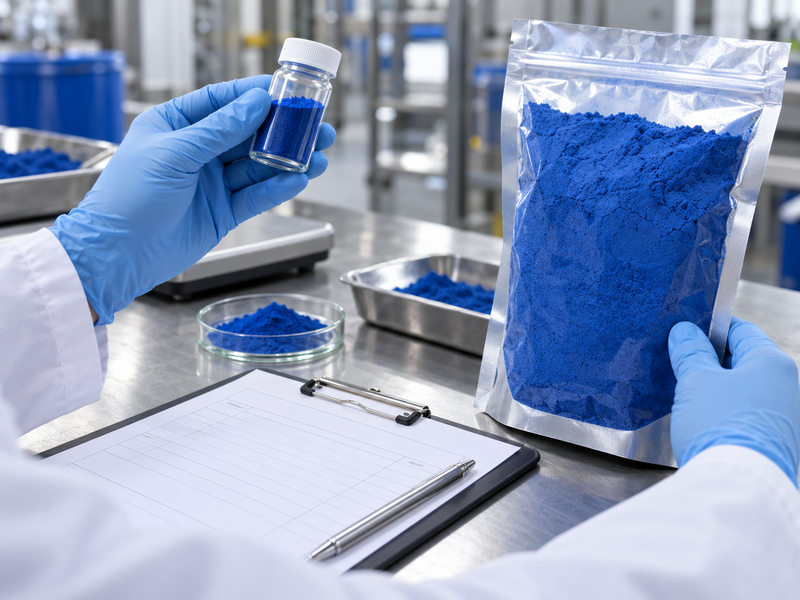
Provide the plant base, target shade, process temperatures and times, addition point, package type, shelf-life target, destination and anticipated quantity. Ask for a named blue spirulina extract sample, TDS, full composition, lot COA and quote basis. Screen at bench scale, then use a production-relevant pilot to determine actual dose and processing losses. Follow with a line trial that captures fill-position samples and stored pots.
Price the approved grade by cost per acceptable finished pot, including premix work, yield and cleaning, rather than powder price alone.
Set a change-control rule for extract strength, carrier, process site and packaging. Define a retained-reference sample and who may adjust dosage within the approved range. If a new lot needs a larger correction, pause routine release and compare its assay and stored shade with the original qualification lot before accepting the change. If any change occurs, rerun the sensitive gates: initial shade, dispersion, shelf drift and regulatory review.
Document the chosen grade and sample lot in the purchase specification, but require each production lot to meet the agreed COA and traceability conditions. When the line and shelf study pass, procurement has a defensible basis for a volume agreement; when they fail, the result identifies the process or ingredient variable to investigate.
FAQ
Q1. Does U.S. §73.530 include non-dairy pudding? Yes, the listed puddings category includes non-dairy puddings, subject to the rule’s conditions and product review.
Q2. Can a water-color test set the plant dose? No. Base hue, solids, heat and packaging change the finished result.
Q3. Is late addition always better? It may help color, but the plant must validate hygiene and food-safety controls after the heat step.
Q4. Should dose be raised whenever blue fades? First identify whether heat, light, pH, phase separation or base color is responsible.
Q5. When is the ingredient qualified? After the named grade meets line, sensory, shelf-life, quality and destination-market gates.
Next step: Contact SpirulinaCN with your non dairy pudding base, thermal sequence, desired shade, package, market and anticipated quantity. Request a named grade, full specification, traceable sample and lot COA for a matched-matrix trial.