
A bulk pouch can pass weight and powder tests yet leak during transit because green dust interrupted its seal. Chlorella packaging seal integrity means the chosen closure consistently protects the powder under intended filling, handling and storage conditions. Buyers need evidence from actual packs rather than an attractive film specification alone. Food-packaging research from the University of Twente supports examining particles and sealing conditions together; the product-specific acceptance rule belongs in the supplier agreement.
Contents
- What does seal integrity mean for a bulk powder pouch?
- Which defects should operators recognize?
- How does chlorella dust affect heat sealing?
- What process settings need a defined window?
- Which test methods answer different questions?
- How should samples represent a packing run?
- What can transport and storage reveal?
- How should a failed seal be investigated?
- What should buyers check at receiving?
- What belongs in a packaging specification?
1. What does seal integrity mean for a bulk powder pouch?
Define protection for the actual supply route
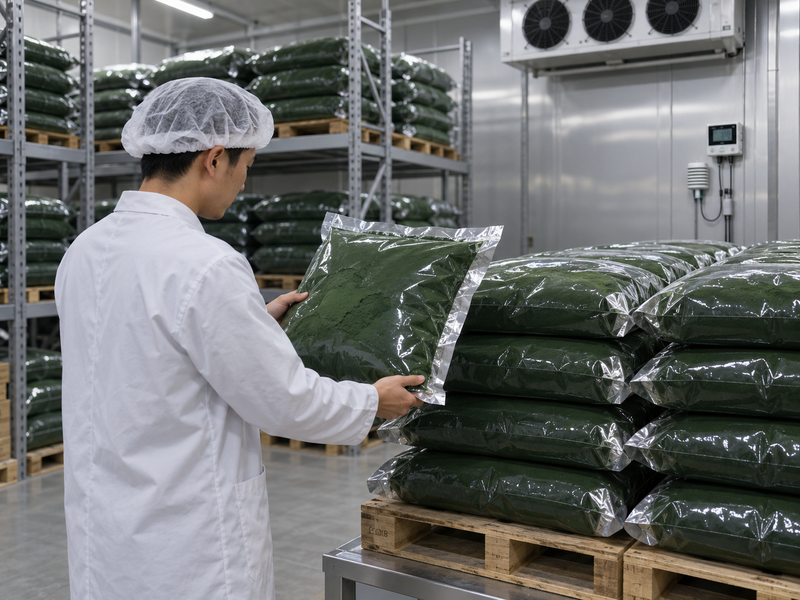
For a dry ingredient, a sound seal helps contain powder and limit exposure to ambient air, moisture and handling contamination. The needed protection depends on film structure, pouch size, closure design, shelf-life claim and distribution route. A seal can feel strong when pulled yet contain a narrow channel. Conversely, an intact seal may be easy to open by design. Evaluate both closure continuity and appropriate strength rather than reducing performance to one number. Document which edges are factory-made and which are closed after filling.
Start with intended use. A palletized 20 kg liner faces different flexing and compression from a small retail sachet. Define whether the pouch is the primary food-contact barrier or an inner liner within another bag. Note how customers open and reseal it, since post-opening protection is a separate question. FDA 21 CFR 117.80 requires suitable food packaging materials and sanitary packing operations for covered food facilities. It does not prescribe a universal peel force for chlorella pouches. Supplier and buyer must agree on a test method and limit suited to their format.
2. Which defects should operators recognize?
Train against real examples from the chosen pouch
Look for powder trapped across the seal, wrinkles, foldovers, channels, incomplete edge fusion, punctures and split corners. A printed film can hide a narrow void; inspection needs consistent lighting and a defined view of both sides. Keep photographic examples from the site’s own equipment because an acceptable cosmetic mark on one laminate may signal a leak on another. Operators should know when to stop, segregate packs and call quality. They should not trim away a suspect area and return the pouch to shipment without approval.
The defect location matters. A weak cross seal, damaged gusset and pinhole in the body have different likely causes. Record the defect’s position, film roll, jaw or sealer ID and pack sequence. The FDA container-integrity examination chapter lists seal anomalies such as entrapped food, voids and wrinkles for flexible containers. Its detailed procedures address specific container types; use the defect concepts as a diagnostic aid, not as a ready-made powder-pouch specification. A buyer can ask for the supplier’s defect photo standard and evidence that inspectors use it.
| Visible sign | Likely question | Immediate action |
|---|---|---|
| Powder in seal | Fill timing or dust extraction? | Hold and inspect sequence |
| Long wrinkle | Film tracking or tension? | Check jaw alignment |
| Split corner | Pouch geometry or impact? | Inspect adjacent packs |
| Body pinhole | Contact with sharp surface? | Trace handling route |
3. How does chlorella dust affect heat sealing?
Keep sealing faces clean before adjusting heat
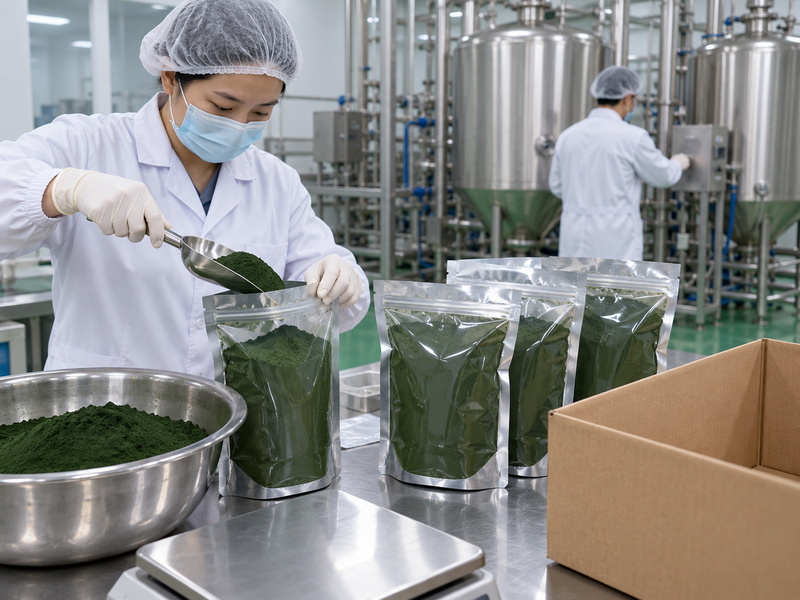
Fine chlorella powder can rise during filling and settle on the upper seal area. Particles between heat-seal layers may interfere with bonding or create a path across the closure. A peer-reviewed film study found that solid particle contamination and sealer geometry affect seal strength in tested polyethylene-based food films. That finding explains why powder control deserves attention, but it does not give a numeric limit for every chlorella laminate.
Find the dust source. Check fill-head height, dosing speed, pouch mouth support, extraction, static and settling time. Increasing heat may hide a poor filling setup while causing distortion or burn-through elsewhere. Clean the jaws and inspect their covers according to a documented schedule. During a trial, compare deliberately varied fill rates and actual seal cleanliness while keeping suspect packs out of saleable stock. The right response may be better dust capture or a wider clean seal zone, not simply a hotter machine. Record the change and repeat tests with the approved film.
4. What process settings need a defined window?
Connect machine readings to the seal actually formed
Heat-seal performance depends on jaw temperature, contact time, pressure and film contact. Jaw condition, cooling and film tracking also matter. Define operating ranges through trials using the exact pouch construction, dimensions and fill level. Readings on the controller should be checked against instrument calibration and the sealing surface where feasible. A nominal setting copied from another film roll is not proof of a suitable bond. Record startup stabilization and what happens after a prolonged stop.
Check the edges of the window. Run trials at justified low and high conditions, then inspect both seal continuity and any film distortion. Include the slowest and fastest production speeds planned. If a jaw has uneven pressure across a broad pouch, samples from only its center may miss weak corners. A University of Twente study on flexible bag designs links package geometry and pressure distribution to local seal behavior. A supplier can use that principle to justify sampling at folds and gussets, while validating its own equipment rather than borrowing another study’s parameters.
| Parameter | Record | Failure signal |
|---|---|---|
| Temperature | Set and measured values | Weak or distorted seal |
| Contact time | Machine speed or dwell | Incomplete fusion |
| Pressure | Jaw setting and condition | Uneven width |
| Film tracking | Alignment check | Wrinkle at edge |
5. Which test methods answer different questions?
Use more than one view of package performance
Visual inspection finds obvious trapped powder, wrinkles and gaps. A peel or tensile test measures resistance to separating a specified strip, but it may miss a tiny channel elsewhere. Leak tests can target through-paths in a pack, yet their sensitivity and suitability depend on pack construction and powder. A pressure or vacuum method may be impractical for a large flexible sack unless adapted and validated. Ask what defect size a method was shown to detect and how good and intentionally flawed samples behaved.
Match method to claim. “Passed seal strength” is not identical to “no leak.” Report sampling location, strip width, peel direction, rate and failure mode when strength is measured. For whole-pack tests, document setup and acceptance interpretation. The FDA’s container-integrity methods illustrate why package examination involves multiple observations. Their applicability to a non-retorted chlorella pouch requires technical judgment. Buyers should request the supplier’s approved method, qualification summary and a raw example rather than accepting a method name alone.
6. How should samples represent a packing run?
Cover starts, changes and the end of production
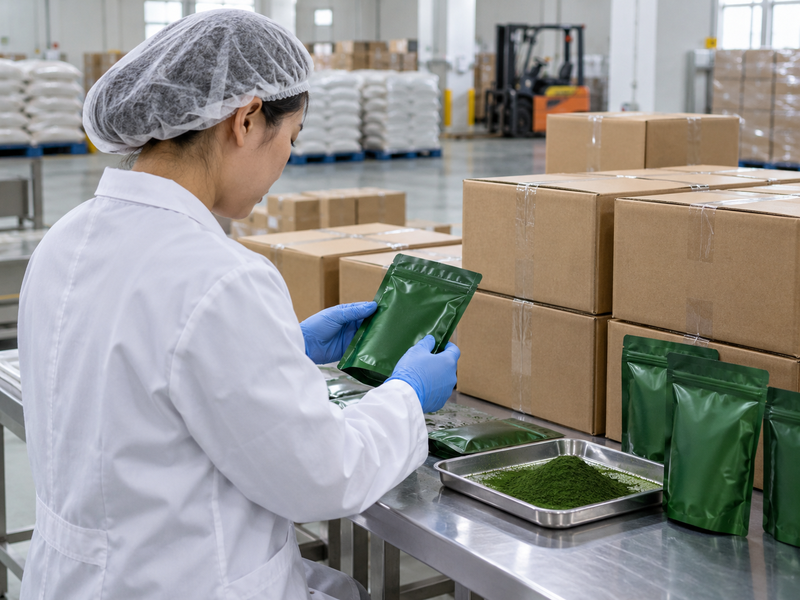
Build the sampling plan around known sources of drift: startup, film-roll changes, sealer cleaning, downtime, jaw replacement, speed changes and final packs. Record exact pack IDs or time positions so a failure can define an affected window. Sample both sides of a multi-jaw machine and the corners or gussets that trials found vulnerable. A convenient center strip from one pouch at shift start cannot represent an entire day. Keep retention packs under stated storage conditions for later comparison.
Avoid invisible replacement. If an operator discards a failed strip and chooses another, the original failure still requires investigation. Record every result, including invalid tests and reasons for invalidation. Averages can conceal a weak seam segment, so retain individual results and failure modes. Where tests destroy pouches, reconcile sacrificed packs against the fill count and clearly mark the rest as saleable or held. Buyers can ask for a chronological sample map rather than a summary pass rate. It shows whether testing follows the process events that matter.
| Run event | Suggested sample focus | Record link |
|---|---|---|
| Startup | Stabilized jaws and clean mouth | Start time |
| Film change | New roll seam behavior | Roll ID |
| Cleaning or stop | Restarted setting | Intervention log |
| End of run | Drift and jaw residue | Final case IDs |
7. What can transport and storage reveal?
Test packs after realistic handling
Powder pouches experience compression, vibration, carton edges and pallet movement. A pack that passes an immediate bench check may fail after rough transfer or prolonged stacking. Run handling trials with the intended pouch, outer carton and pallet pattern. Inspect corners, bottom seals and gussets after the trial. The objective is not to simulate every route perfectly, but to reveal weaknesses relevant to the actual shipping method. Record the trial conditions and pack age so results can be interpreted.
Keep moisture separate from leaks. A stable powder may still cake after humid air enters a damaged pouch. Compare pack integrity with water-activity or caking observations where appropriate, but do not use caking alone as proof of a leak. A pouch with a good seal can also suffer a body puncture. Our chlorella caking article explains the powder side of this issue. At receiving, a crushed case should prompt inspection of inner packs before the lot is accepted. Save the carton and pallet details if a failure may relate to transport rather than sealing.

8. How should a failed seal be investigated?
Hold the sequence and preserve the defective pack
Isolate affected pouches back to the last credible passing check, then inspect later packs until a stable good condition is demonstrated. Photograph the fault before cutting the pouch. Record fill time, jaw, film roll, settings and any nearby intervention. Look for powder at the interface, uneven pressure, damaged film, worn jaw cover or excessive handling. Compare passing and failing packs from the same interval. A laboratory result should inform the cause, not erase a visible through-channel.
Define disposition before rework. Opening, resealing or repacking changes traceability and may expose powder. Quality should authorize any method and verify resulting packs under the same specification. If the defect appeared in shipped stock, notify buyers with affected lot and pouch counts. FDA 21 CFR 117.150 gives a corrective-action framework where a food preventive control fails; the site’s food-safety plan determines its relevance. Closing an investigation requires proof that the corrected process produced acceptable packs, not merely a promise to remind operators.
| Investigation clue | Likely route | Confirmation |
|---|---|---|
| Powder across seal | Fill plume | Observe fill and seal timing |
| Weak single corner | Jaw pressure | Map force by position |
| Repeated roll change failures | Film or setup | Compare roll specifications |
| Puncture away from seam | Handling | Inspect carton and conveyor |
9. What should buyers check at receiving?
Inspect the shipment before opening inner packs
Record pallet and carton condition, then sample inner pouches from more than one location. Look for escaped green dust, broken corners, trapped powder in visible seals, tears and unplanned tape repairs. Photograph any suspect pack beside its lot label and outer carton. Do not wash or wipe away powder before recording where it appeared. Check that pouch material, fill weight and closure format match the approved specification. A receiving screen cannot replace supplier process records, but it can catch transport damage and unauthorized format changes.
Use a hold rule. Segregate suspect cases while quality decides whether the issue is isolated or systemic. Ask the supplier for film roll, packing time and seal-check records that map to the affected cases. Our chlorella lot traceability guide helps make that request precise. If the powder will be repacked or blended, assess whether any exposed material can be used safely. A damaged outer carton alone may not condemn an intact inner barrier; the disposition should rest on observed pouch condition and documented risk.

10. What belongs in a packaging specification?
Tie material, process and acceptance to one version
Name the film construction, food-contact status, pouch dimensions, seal design, fill range, outer packaging and approved supplier. Specify visual defect categories, test methods, sampling points, acceptance criteria and retest rules. Identify who approves film substitutions or machine changes. Include storage and transport conditions that informed qualification. A specification that names only film thickness leaves the closure itself undefined. If a supplier uses two pouch makers, qualify both or show a justified equivalence assessment.
Make complaints actionable. Require lot and case codes that can lead back to film roll and packing interval. Agree how photographs, retained packs and test results will be shared after a leak. State who can authorize rework and who releases a held shipment. Buyers can then compare a delivered pouch with an approved sample and ask the right process question when something differs. This agreement turns chlorella packaging seal integrity from a vague sales claim into a repeatable acceptance decision for the actual powder route.
| Specification line | State explicitly | Owner |
|---|---|---|
| Pouch | Film, size and seal layout | Packaging team |
| Test | Method and sample locations | Supplier quality |
| Defect | Reject and hold definitions | Both quality teams |
| Change | Notice and approval route | Supplier management |
FAQ
Q1. Does a strong peel result prove a pouch has no leak? No. Strength and through-path leakage are different properties.
Q2. Can a buyer judge every seal by eye? Visual checks help, but narrow channels may need another qualified test.
Q3. Why does powder collect in a top seal? Filling dust, static or short settling time can place particles there.
Q4. Must every bulk pouch use the same seal limit? No. Set limits for the actual film, format and use.
Q5. What should accompany a leak complaint? Keep the pouch, carton, lot code, photos and receiving conditions.
Chlorella packaging seal integrity depends on a clean sealing zone, a qualified process window and checks that follow production changes. Request pack-specific test results and inspect received cartons before opening them. If a leak appears, preserve the pack and trace its packing interval. That evidence lets supplier and buyer protect the powder without arguing from appearances alone.