
A greens-powder team can add chlorella to a draft formula and still face clumps, strong flavor or an ingredient declaration that contributes little at the actual serving size. This guide to broken cell chlorella powder for greens blends helps buyers choose a grade and run a meaningful dry-blend trial. SpirulinaCN’s chlorella page identifies broken-cell powder for nutritional premixes, while an independent commercial greens-blend TDS shows that chlorella can be one component among spirulina and grasses.
Neither source proves that a particular inclusion will work in your formula; the finished serving and production route decide.
Contents
- What role should chlorella play in the blend?
- Which broken-cell evidence should be requested?
- How should the contribution per serving be calculated?
- Which co-ingredients change color and taste?
- How can a pilot detect dry-blend segregation?
- What reconstitution test reflects consumer use?
- Which incoming specifications matter most?
- How should packaging and stability be screened?
- What does a matched commercial quote require?
- When is the grade ready for a bulk order?
1. What role should chlorella play in the blend?
Define whether chlorella is a named hero ingredient, a source of green color, or one of several biomass ingredients. Those roles imply different dose, sensory and labeling requirements. A formula that already contains spirulina, wheatgrass, barley grass and flavor powder can make a small chlorella dose visually invisible while still affecting aftertaste. Set a target inclusion range in grams per serving before requesting samples. Then list what it must achieve: a specified ingredient declaration, desired shade, measured nutritional contribution, or a recognizable flavor position.
Do not copy the 20% chlorella share in one supplier’s published blend TDS as a universal target. That document is one finished formulation with its own other ingredients. Decide the role first: if the product cannot tolerate enough chlorella to deliver the intended message, adjust the concept or claim rather than hiding an impractical dose in a crowded blend.
| Intended role | Trial priority | Approval evidence |
|---|---|---|
| Named ingredient | Dose and label | Formula and declaration |
| Color contributor | Shade in final drink | Controlled color check |
| Nutrient contributor | Amount per serving | Lot and finished data |
| Broad greens mix | Taste balance | Sensory panel |
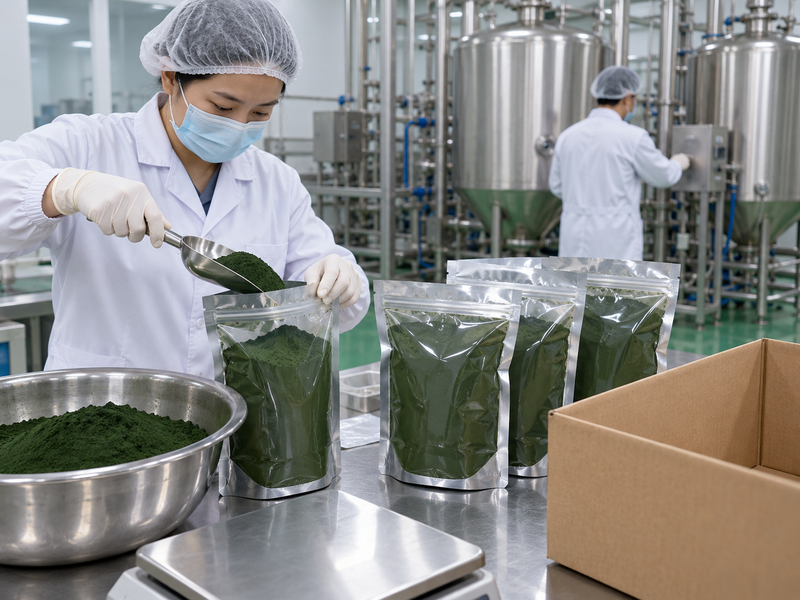
2. Which broken-cell evidence should be requested?
Ask for species, strain if specified, disruption method, measurable disruption criterion, method description and lot COA. Mesh size belongs on the TDS too, but it measures powder granulation rather than cellular rupture. SpirulinaCN explicitly separates these two properties. A supplier’s “broken cell” phrase without a test method is a weak purchasing limit because two laboratories may count differently. If the blend’s positioning depends on disruption, agree on the assay basis before selecting a vendor.
Ask whether milling or disruption adds heat, changes color, or alters the powder’s tendency to clump in your mix. Compare a broken-cell candidate with any alternate only after confirming they have comparable species, composition and safety documentation. Do not turn a disruption percentage into a blanket digestibility or health claim for the finished product. The material’s purchasing identity and the finished label’s allowed claims require separate review.
3. How should the contribution per serving be calculated?
Multiply the finished serving weight by the chlorella fraction to obtain grams of chlorella, then multiply by the sample lot’s measured nutrient fraction if a nutrient contribution matters. A 10 g greens serving with 10% chlorella contains 1 g of the ingredient. At a hypothetical 60% ingredient protein assay, that yields 0.6 g ingredient protein before finished-product testing and labeling rules. The example is arithmetic, not a recommended dose or claim.
Count the other ingredients and their contributions separately; a high protein percentage on a raw-material sheet can sound impressive while adding little to a small serving. Review how much formula space chlorella displaces and whether flavor masking requires extra sweetener or carrier. Check the trade: a lower inclusion may improve taste but reduce the basis for a highlighted ingredient. The purchasing decision should state the accepted dose range and the maximum cost per serving, not merely “include chlorella.”
| Serving example | Calculation | Interpretation |
|---|---|---|
| 10 g blend, 5% chlorella | 0.5 g ingredient | Small named inclusion |
| 10 g blend, 10% chlorella | 1.0 g ingredient | Recheck taste and color |
| 10 g blend, 20% chlorella | 2.0 g ingredient | More formula displacement |

4. Which co-ingredients change color and taste?
Map all green and strongly flavored components. Spirulina brings a different hue and flavor; grasses add earthy notes; fruit acids and citrus flavors can change how green pigments look and how algal notes register. Sweeteners and aromas may mask one off-note while amplifying another. Build a subtraction trial: full blend, blend without chlorella, and blend with chlorella at two doses. Keep other mass constant with a neutral base so the difference is attributable to the ingredient.
Evaluate dry appearance and prepared drink under the same light and serving conditions. A blend that tastes good only when very cold might disappoint consumers who use room-temperature water. Do not assume the ingredient composition of a commercial greens blend establishes your sensory result; it simply shows a feasible category. Record color and flavor after mixing and after a realistic wait. An attractive powder scoop can produce a muddy liquid once all co-ingredients hydrate.
5. How can a pilot detect dry-blend segregation?
Compare chlorella powder particle distribution and bulk density with major ingredients, then test them in the intended blender. Charge ingredients in the planned sequence and run a small design of mixing times. Pull samples from multiple locations immediately after mixing and again after transfer into the packaging hopper. Analyze a validated marker or use another qualified uniformity method; visual green intensity alone may reflect several ingredients. Record dust, adherence to equipment walls and losses during conveying.
A blend can be uniform in a bench jar and segregate when vibration moves dense and light particles differently. The published greens-blend TDS lists weighing, sieving and blending steps, but each plant must validate its own sequence and equipment. If the blend fails, review particle-size alignment, preblending and fill route before changing the ingredient grade. Keep results tied to lot and mixer settings.
| Sampling location | Question | Possible response |
|---|---|---|
| Blender top/bottom | Initial uniformity | Adjust mix sequence |
| Transfer outlet | Segregation during discharge | Review conveying |
| First/last pack | Fill consistency | Change hopper practice |
| Retained pack | Settling in distribution | Review particle matching |
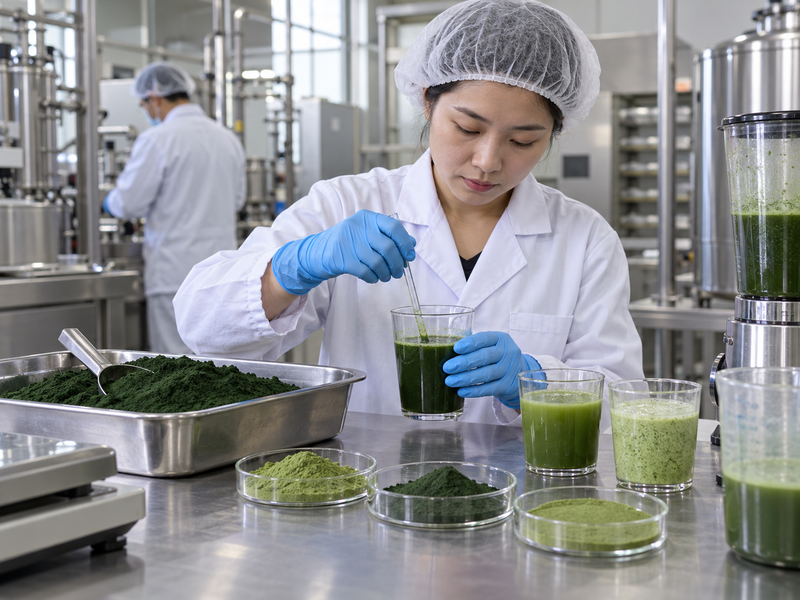
6. What reconstitution test reflects consumer use?
Use the labeled serving in the suggested volume of water or milk, at likely consumer temperatures. Compare a spoon, shaker and blender only if the directions allow them. Time wetting, count clumps, assess foam, note mouthfeel and photograph settling after the realistic drinking window. Whole chlorella powder is particulate; describe suspension, not complete solubility. If a fine grade looks smooth at first but settles quickly, a consumer may need a “shake again” instruction, which the product team must judge.
Test the blend, not chlorella alone, because fibers and other powders change hydration and viscosity. Evaluate after flavoring is finalized, since acidity and sweeteners alter perception. Use a pass rule: perhaps no obvious dry agglomerates after the stated mixing method and acceptable flavor after a specified hold. The rule should come from the brand’s product standard, not a generic supplier claim about “instant dispersion.”
7. Which incoming specifications matter most?
Specify taxon, broken-cell method and limit, composition, moisture, mesh or particle distribution, relevant microbiology and contaminants, plus color and odor ranges if these drive the product. Request a current TDS and lot-specific COA for the material actually offered. If the blend will carry an organic claim, confirm certification scope for the exact ingredient and supply route.
Set test methods and sampling basis for critical limits. FDA’s overview distinguishes CGMP frameworks for foods and supplements; determine which applies to the finished blend and destination. Avoid copying another supplier’s specification without checking whether its methods and units match your acceptance system. A very tight color requirement may reduce available lots or increase rejects, so tie it to an actual consumer-facing need.
Record which attributes demand every-lot evidence and which can be monitored periodically under your quality program.
| Attribute | Why the blend cares | Evidence |
|---|---|---|
| Disruption | Material identity | Defined lot test |
| Particle profile | Uniformity and mouthfeel | Measured distribution |
| Moisture | Flow and stability | COA and pack check |
| Sensory | Finished acceptability | Approved reference |

8. How should packaging and stability be screened?
Select the final retail pack early enough to test moisture pickup, clumping, color shift and aroma over the proposed shelf life. Green powders can be sensitive to handling and storage, but do not assign a universal stability period to chlorella or the whole blend. Ask the supplier for its pack and storage specification, then evaluate the complete formula in the intended barrier material. Compare first-opening performance with repeated-opening conditions if the consumer pack is used for many servings.
Check whether a scoop buried in powder changes handling or hygiene. If a desiccant or oxygen barrier is considered, validate it within the complete packaging design and destination rules. Monitor a retained lot at planned checkpoints, using objective measures where possible. A blend that pours well on filling day can cake later because other components carry moisture. That outcome cannot be diagnosed from the chlorella COA alone, so preserve ingredient and finished-product retain samples.
9. What does a matched commercial quote require?
Send the draft formula, target chlorella inclusion, serving size, process, market, annual forecast and first-order quantity. Ask for a sample from the same broken-cell grade and process that will be quoted at scale. Obtain pack size, MOQ, lead time, trade term and destination-specific document list. Compare price as cost per accepted serving and consider losses from dusting or rework.
If the supplier proposes a more finely milled grade to improve mouthfeel, run a new dry-blend uniformity and cost comparison; finer is not automatically better across all tests. The SpirulinaCN chlorella category describes powder-blend applications, but current commercial availability and lot values need written confirmation. Avoid asking for “best price” before defining the material that passed your pilot. Procurement can negotiate a useful offer only when the formula team specifies which technical variation is acceptable.
| Quote field | Buyer provides | Supplier returns |
|---|---|---|
| Application | Complete blend context | Matched grade |
| Dose/volume | Serving and forecast | Tiered pricing |
| Target market | Destination and claim | Document availability |
| Process | Mixing and pack route | Sample and pack specification |

10. When is the grade ready for a bulk order?
Approve only after the exact grade passes document review, dry-blend uniformity, reconstitution, sensory and early stability screens at the intended dose. Record the accepted sample lot and its TDS and COA. Set purchase limits for critical attributes and define how an alternate lot will be checked. If the current blend still changes materially, treat the ingredient approval as provisional; a new acid flavor or sweetener can change the outcome.
Ask quality, R&D and procurement to sign the same decision record so technical acceptance and commercial terms align. The first bulk lot should be inspected and trialed against the approved reference before routine release. A robust gate avoids an expensive situation where a low-priced ingredient technically meets its own brochure yet cannot be used consistently in the brand’s finished powder. The purchase order should name the exact grade, pack and change-notice expectations.
FAQ
Q1. Does broken-cell mean fully soluble? No. Disruption describes cell structure; whole chlorella biomass remains a particulate ingredient in drinks.
Q2. Can I copy another greens blend’s chlorella percentage? No. Serving size, co-ingredients, taste and label objectives differ; trial your own formula.
Q3. Is mesh size the same as disruption percentage? No. They answer separate particle and cellular questions.
Q4. How do I verify uniformity? Use a validated marker and samples from the blender, transfer and filled packs, not visual color alone.
Q5. What should a supplier quote include? The exact purchasable SKU, matched sample, TDS/COA, pack, MOQ, lead time and delivery term for your forecast.
Specify the greens blend you actually plan to sell
Broken cell chlorella powder for greens blends earns a place when the approved dose, taste, mixing behavior and cost all work in one finished product. Send your draft blend, application, target specification and chlorella inclusion, serving size, anticipated quantity, label constraints and destination through SpirulinaCN’s contact page. Request a matched broken-cell sample with current TDS and lot COA so the team can move from an appealing ingredient list to a validated purchase.