
A bar formula can accept a spoonful of green powder on the bench yet fail after scale-up: color looks uneven, the binder tastes grassy or texture hardens during storage. This chlorella powder for nutrition bar manufacturers guide makes ingredient approval a process decision. SpirulinaCN lists chlorella food-formulation options, but the exact lot and finished bar must be tested.
A published Golden Chlorella health-bar formulation demonstrates a commercial-use example; Golden Chlorella is a distinct ingredient, so its dose and process cannot be copied automatically into a green Chlorella vulgaris bar.
Contents
- What bar format sets the chlorella brief?
- Which food-formulation grade should be sampled?
- What dose survives a sensory test?
- How does binder and fat change the green appearance?
- Which processing points should the pilot record?
- How should texture and moisture be tested?
- What shelf-life checks can reveal delayed failure?
- Which quality records support ingredient release?
- How should cost be calculated per saleable bar?
- When is the ingredient ready for a production quote?
1. What bar format sets the chlorella brief?
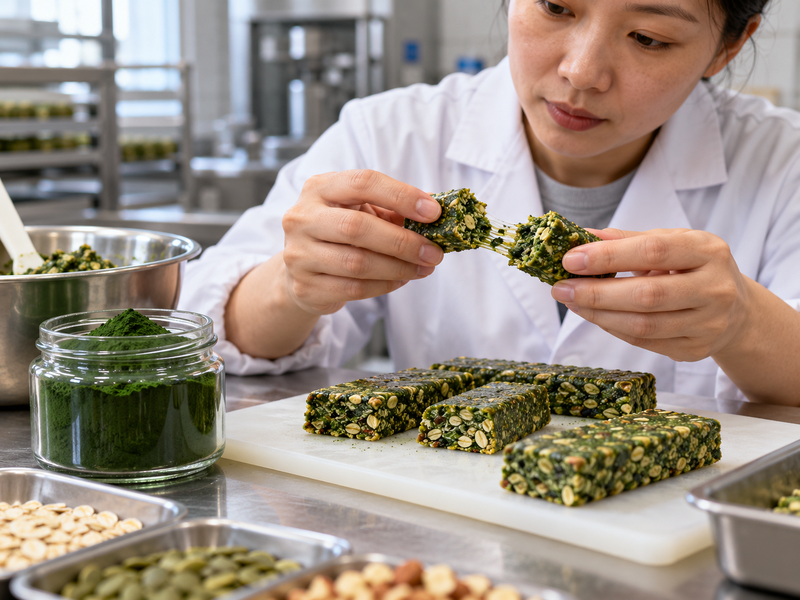
State whether the product is a cold-formed protein bar, baked cereal bar, pressed fruit-and-nut bar or coated snack bar. Record base recipe, binder, fat level, sweetener, water addition, dimensions, processing temperature and intended pack. Each format creates a different place for chlorella to enter and a different sensory challenge. A dark cocoa bar can hide green visually but not necessarily in flavor; a light oat bar makes speckling obvious.
Decide whether chlorella should color the whole mass, appear as visible green inclusions or simply be named in the ingredient list. Set the intended grams per bar and the maximum acceptable dose before requesting powder. Define the finished bar: a supplier cannot recommend a useful food grade from the phrase “bar application” alone. Keep this separate from a spirulina bar formula; algae species, powder color and flavor profile differ, and a successful recipe with one does not qualify the other.
| Bar input | Record | Formulation effect |
|---|---|---|
| Base | Oat, nut, protein or fruit | Background flavor and color |
| Binder | Syrup, paste or fat | Powder wetting |
| Process | Cold form or bake | Heat and moisture exposure |
| Pack | Film and target life | Texture stability |
2. Which food-formulation grade should be sampled?
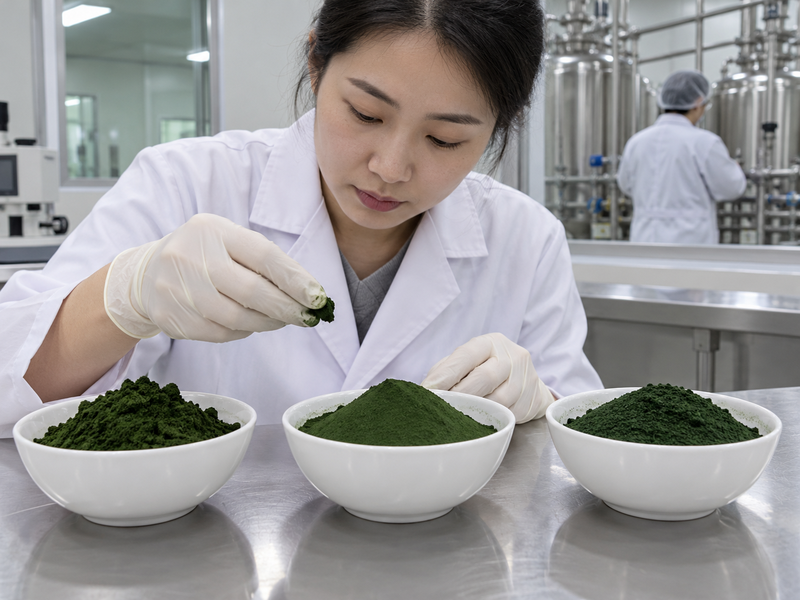
Request Chlorella vulgaris identity, composition, cell-wall disruption status and method, particle distribution, moisture, sensory description and current lot COA. The supplier’s chlorella page presents a food-formulation solution and explains that disruption and mesh are distinct attributes. For a bar, an extremely fine powder may color more evenly but also disperse its taste throughout the binder; a coarser powder may show visible flecks. Neither outcome is universally better.
Ask whether the grade has any carrier or processing aid that changes the bar’s label or solids balance. Use a sample from a commercially saleable route, not an unlabeled jar. Record pack format, MOQ and the link from sample lot to prospective bulk supply. If the bar will be positioned as organic, require exact certificate scope and destination-specific review. Technical approval should name one SKU and the conditions under which another lot or grade must be re-trialed.
3. What dose survives a sensory test?
Build an uncolored control and a dose ladder at equal final bar weight. Replace displaced solids consistently, then prepare coded samples in the same batch order. Taste at least immediately after setting and after initial package equilibration. Score aroma, grassy or marine notes, sweetness balance, bitterness, aftertaste and whether green appearance matches the flavor expectation. Some binders may mask an off-note on day one but reveal it as aroma changes during storage.
Calculate chlorella grams per bar and the nutrient contribution from the actual lot result, then validate any finished-product claim separately. An ingredient sold as “high protein” may contribute little at an acceptable bar dose. Do not borrow the 9% Golden Chlorella level from the published example formulation: that product uses a distinct ingredient and a specific recipe. The pilot’s winning dose must meet your own taste and economics limits.
| Trial arm | Chlorella level | Main question |
|---|---|---|
| Control | 0 | Base flavor and texture |
| Low | Buyer-selected | Does color show? |
| Target | Buyer-selected | Does concept work? |
| High | Buyer-selected | Where does taste fail? |
4. How does binder and fat change the green appearance?
Test where the powder enters: dry phase, a portion of binder or a preblended ingredient mix. Record mixing time and inspect cut surfaces as well as outer surfaces. Clumps can appear dark green in a pale bar; inadequate wetting can leave dusty pockets. A high-fat binder may coat particles differently from a syrup-rich paste, while cocoa or brown fruit paste can mute the desired green. Run samples with identical ingredient temperature and mixing sequence so differences can be attributed to dose or grade.
If a recipe needs added water to disperse powder, count the consequences for texture and shelf life. Use fixed-light photography or a color instrument when green shade is a product promise. Judge the packed bar: the surface may look uniform at the mixer yet reveal streaks after pressing or cutting. A purchasing decision should account for the production method that makes saleable bars, not a well-stirred laboratory paste.
5. Which processing points should the pilot record?
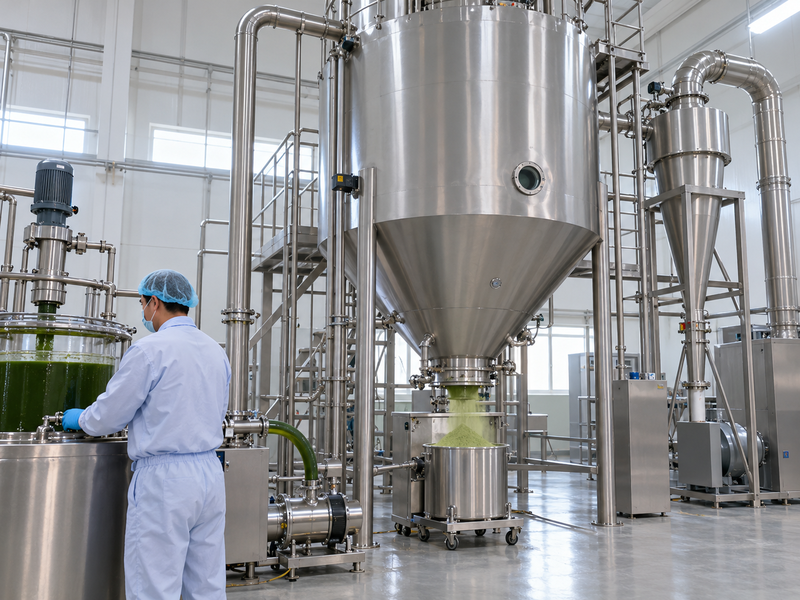
Map ingredient charging, binder preparation, powder incorporation, forming, heating if any, cooling, cutting and wrapping. Measure actual product temperature and residence time rather than only equipment setpoints. The Golden Chlorella example includes a specific mixing and heating sequence, but it does not establish safe or ideal conditions for green Chlorella vulgaris in another recipe. Check whether powder dusts at addition, sticks to equipment, changes forming pressure or produces edge cracks during cutting.
Record mass before and after each step and count rejects. If the bar is baked, measure the color and flavor after the full thermal process; if cold formed, check whether binder temperatures still affect the ingredient. Pilot enough material to see stable line operation and packaging behavior. A few hand-pressed pieces may miss segregation and mechanical losses that become costly at scale.
| Process point | Measure | Potential issue |
|---|---|---|
| Charging | Dust and loss | Inconsistent dose |
| Mixing | Time and distribution | Streaks or clumps |
| Forming/cutting | Pressure and rejects | Cracks and waste |
| Packing | Bar temperature and seal | Shelf-life risk |
6. How should texture and moisture be tested?
Measure moisture or water activity at appropriate points, then evaluate hardness, chewiness and crumbling after packaging equilibration. Chlorella can displace other solids and alter binder demand; a bar that presses well immediately may become too firm after water redistributes. Use the same test geometry and temperature across pilot arms. Record sensory texture alongside instrumental measurements if available, because a numerical hardness result may not capture gritty particles or sticky surfaces.
If added water improves mixing, verify that the final water activity and microbiological safety targets still pass. If more syrup improves cohesion, account for nutrition and label changes. The quality team should set appropriate limits for the exact product, not borrow a universal value from a different bar. Track weight variation and cut loss as part of texture assessment: a formula that breaks at the blade has a lower saleable yield even if consumers like the surviving pieces.
7. What shelf-life checks can reveal delayed failure?
Pack each pilot arm in the proposed film and store under conditions relevant to the intended distribution. At planned checkpoints, compare color, odor, texture, surface stickiness, oil migration and pack integrity with the control. Watch for green color fading or browning, but avoid attributing every shift to chlorella; other ingredients and packaging may drive it. Record moisture or water activity movement where useful. An accelerated screen can identify problems, but shelf-life claims need a validated program for the actual bar and destination.
Keep retains of ingredient powder and finished bars so a failure can be investigated. If the product has a coating, inspect color transfer and adhesion separately. A small sample may appear attractive at launch and fail in transit heat or warehouse storage. Make shelf life a buying gate: if the target dose shortens the acceptable life, the nominal ingredient price understates its commercial cost.
| Checkpoint | Observe | Decision link |
|---|---|---|
| After forming | Shade and cohesion | Process fit |
| After packing | Moisture and seal | Starting condition |
| During storage | Aroma, color, texture | Shelf-life trend |
| End of target life | Saleable acceptance | Launch decision |

8. Which quality records support ingredient release?
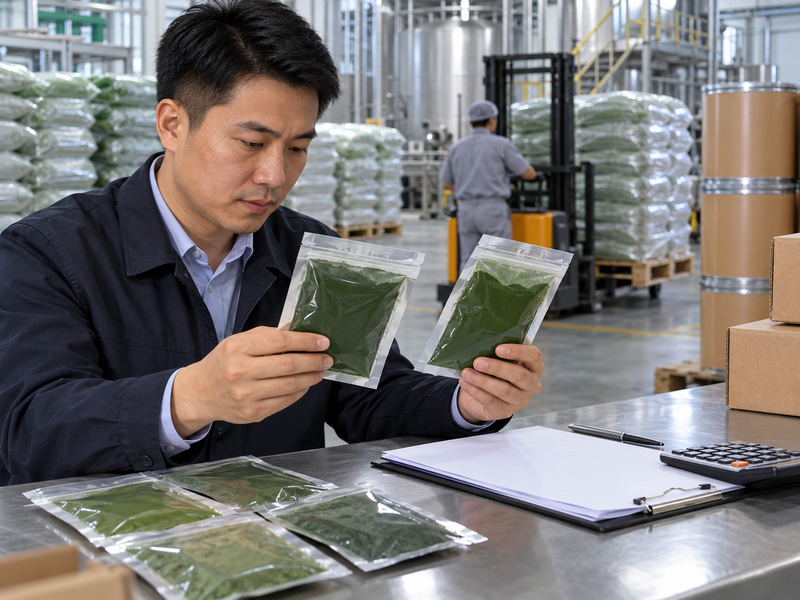
Retain a current TDS, sample-lot COA, identity and disruption evidence, composition, moisture, microbiology and relevant contaminant results. Verify the legal seller and manufacturing site. Define incoming limits that matter to the bar: powder color, odor, particle profile and flow may be as operationally important as protein percentage. Check certificates against the exact site and SKU when making organic or other claims. FDA’s overview distinguishes food CGMPs from dietary supplement CGMPs; a nutrition bar’s regulatory status and destination should be reviewed by the responsible team.
Ask how a new lot or process change will be communicated. A supplier certificate without a matching lot COA cannot tell you what entered the pilot. Align the bar pilot’s approved sample code with the first purchase order and an incoming inspection plan, so production receives material that can be checked against the actual formulation result.
9. How should cost be calculated per saleable bar?
Multiply the delivered ingredient cost per kilogram by chlorella kilograms in each bar. Then divide by the saleable-bar yield from the pilot and add any incremental masking flavor, binder, testing or packaging cost caused by the ingredient. A purely illustrative 1 g dose at $20/kg contributes $0.02 in raw chlorella cost per bar; this is arithmetic, not a current market quote. If 5% of bars fail color or cutting checks, the true cost per accepted bar rises.
Compare grades at the same consumer-accepted dose, or document why different doses deliver the same product promise. Include the cost of a green shade that requires special packaging or tighter process control. Keep the model honest: a cheaper powder can be more expensive in a bar if it makes more rejects or needs a costly recipe adjustment. A quote should identify pack, MOQ, destination and delivery term so the calculation represents purchasable supply.
| Cost field | Calculation | Source |
|---|---|---|
| Powder per bar | Dose × delivered unit cost | Quote and formula |
| Process loss | Input ÷ saleable output | Pilot record |
| Formula adjustment | Added ingredients per bar | Revised recipe |
| Total cost | Sum per accepted bar | Award model |
10. When is the ingredient ready for a production quote?
Approve a candidate only when the exact grade passes document review, coded sensory testing, pilot-line handling, packaged texture and an appropriate stability screen. Write the acceptable dose range and quality limits into a short specification. Identify sample lot, processing site, pack and TDS version. Ask the supplier to quote the first commercial quantity and forecast against that same grade, with current MOQ, lead time and delivery term. If a later lot changes color or flow, compare it against the approved reference before using it.
A product developer may want to alter binder or flavor after the initial trial; material changes should trigger a recheck of the ingredient decision. Share pilot observations with the supplier, especially clumping, shade or dusting. A well-defined request can lead to a better matched grade and a quotation that includes the documentation and pack size production actually needs.
FAQ
Q1. Can I use a Golden Chlorella bar formula for green chlorella? Treat it as an example of bar use only. The ingredient and recipe are different, so dose and process need a fresh trial.
Q2. Does broken-cell status guarantee a smooth bar? No. Particle distribution, binder wetting and mixing determine perceived texture.
Q3. Is a higher dose always better for the ingredient story? No. Sensory acceptance, formula balance and truthful finished-product labeling set the practical limit.
Q4. Should I test only a fresh bar? No. Check packed bars during the intended shelf-life program; texture and aroma can change after forming.
Q5. What should the first production sample include? Request the saleable food-formulation grade, current TDS, lot COA and enough powder for repeat and retain tests.
Move from a green prototype to a reliable bar
For chlorella powder for nutrition bar manufacturers, ingredient approval means the target dose still works after forming, packing and storage. Send your base recipe, application, target specification, anticipated quantity, process temperatures, dose range, destination and pilot findings through SpirulinaCN’s contact page. Ask for a food-formulation grade sample and lot COA, then request a first production quote only for the grade that passed the bar’s actual quality gates.