
An alternate supplier named in a spreadsheet may not be ready when the primary lot fails or a shipment stalls. Blue spirulina wholesale second source qualification needs independent evidence for the exact grade, carrier, formula performance, food-use status and commercial delivery route. The Spirulina CN Blue Spirulina page lists multiple color-value directions, showing why a generic product name is insufficient. This guide builds a backup that can actually be called on without improvising material approval during a shortage.
Contents
- What should a blue spirulina wholesale second source solve?
- What does equivalent grade mean in practice?
- Which supplier records need independent review?
- How should comparative formula trials be run?
- What can a commercial pilot reveal?
- How should lot and document controls be matched?
- What changeover trigger should the buyer define?
- How much backup capacity is credible?
- How should two sources stay qualified?
- When is the alternate truly ready?
1. What should a blue spirulina wholesale second source solve?
Define the disruption, then the capability
An alternate source may protect against a factory outage, repeated quality holds, transport disruption or a commercial dispute. Those risks require different response times. If the primary supplier is overseas and the backup uses the same port and freight lane, it may not protect a port closure. If both buy pigment from the same upstream producer, they may not be independent during a manufacturing failure. Ask who actually makes the material and where critical stages occur. Record the intended role: emergency cover, routine split sourcing or development option.
Test the promise against production: identify the latest date an alternate lot must be released to avoid a shutdown. Work backward through order, production, transit and QA time. A supplier that can only begin testing after a crisis is a prospect, not a ready backup. For U.S. food importers, FDA supplier-verification guidance describes risk-based evaluation where applicable. A contingency plan should fit the existing approval system, not bypass it under pressure.

2. What does equivalent grade mean in practice?
The same E number on two offers does not prove identical color strength, carrier or performance. Ask both suppliers for written color methods, actual lot results and composition. Compare samples under one controlled analytical method, then at approved dose in the target formula. The E-value test method article explains why wavelength, dilution and preparation can affect comparisons. An alternate may be acceptable with a different dose, but that becomes a distinct approved formula and cost model.
Do not force a false match: decide which attributes must be identical and which may vary within a validated range. Identity, legal suitability and contaminant limits are not solved by a shade adjustment. Packaging can differ if warehouse and stability controls accept it. Color appearance may need a tighter product-specific criterion than a broad powder E range. Document each difference and its owner. A backup becomes credible when QA and R&D can say exactly why it is equivalent for a defined use, or why a controlled change is required.
| Attribute | Must compare | Decision owner |
|---|---|---|
| Source/identity | Species and extraction record | QA |
| Carrier | Full composition | R&D/labeling |
| Color method | Written procedure/results | QA lab |
| Product shade | Controlled formula trial | R&D |
| Pack and life | Barrier/date evidence | QA/warehouse |
3. Which supplier records need independent review?
Request the candidate’s current specification, lot COA with actual results, manufacturing-site information, food-safety program, traceability process, change-notification practice and relevant declarations. Evaluate the evidence independently rather than treating the primary supplier’s approval as transferable. Ask how the alternate verifies identity, contaminants and microbiology, and whether its test methods match your acceptance plan. The COA guide provides a practical document starting point.
Regulatory fit is product-specific: in the United States, current 21 CFR 73.530 defines spirulina extract and lists present permitted uses. FDA reports that the February 2026 broader-use order’s effective date was delayed in March. Confirm that the alternate’s composition and intended application meet current destination rules. A supplier’s broad “food grade” claim does not answer every market-use question. Keep the regulatory review attached to the alternate SKU and finished product.

4. How should comparative formula trials be run?
Test primary and alternate lots side by side in the same formula, at the same dose and process conditions. Record dispersion, color at fill, color after relevant storage, sensory impact and production yield. If one candidate requires dose adjustment, run a documented follow-up at that dose and recalculate cost per finished unit. The sample testing protocol supports a controlled design. Do not approve based on powder color in a dish; food matrices can change appearance and stability.
Use a reference that can travel: keep measurements, photos under consistent lighting, lot identifiers and process records. A neutral dry mix result cannot automatically approve an acidic beverage. If the alternate works for only one product, scope approval to that product. If a large-scale run has longer mixing or heat exposure than the bench, plan a commercial pilot before routine use. A side-by-side trial makes differences visible early, when there is still time to revise a formula or reject a weak candidate.
| Trial measure | Same for both lots? | What it decides |
|---|---|---|
| Formula base | Yes | Fair comparison |
| Initial dose | Yes | Direct shade check |
| Process | Yes | Manufacturing fit |
| Storage window | Yes | Color retention |
| Adjustment run | Document separately | Alternate formula |
5. What can a commercial pilot reveal?
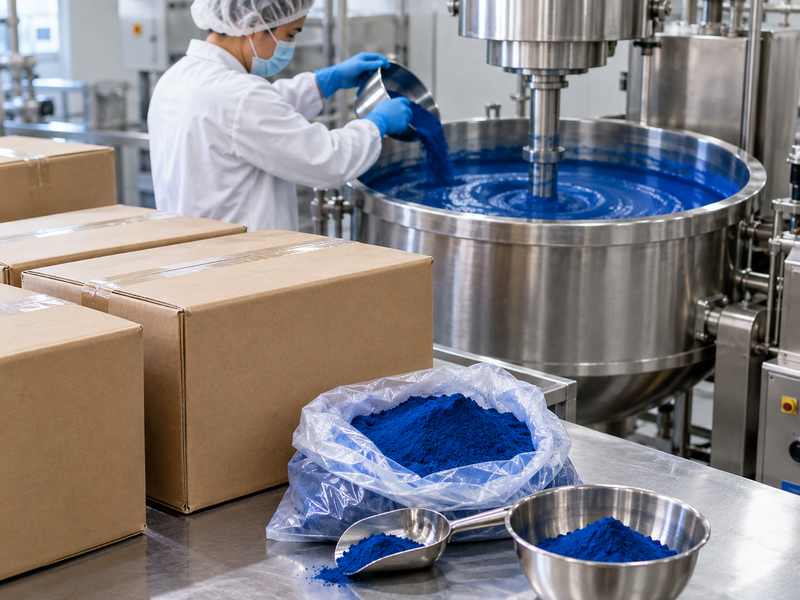
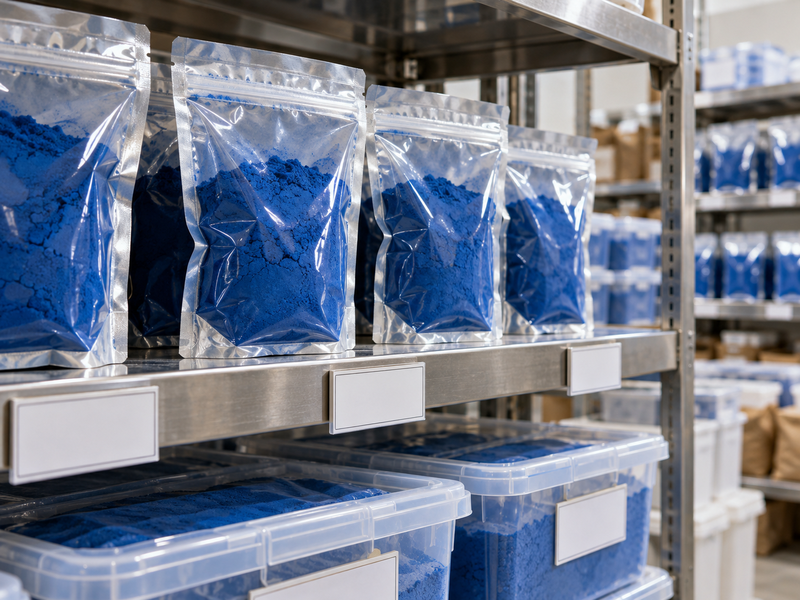
A paid pilot checks commercial packing, lot paperwork, receiving, line handling and the real order-to-release timeline. Laboratory samples often arrive in small hand-packed pouches, while repeat supply may use lined drums. Confirm pack seal, lot marking, net fill, carrier and documentation on the actual pilot. The bulk packaging article gives questions for that review. Record any difference between pilot and proposed routine supply as an open condition rather than treating the pilot as blanket approval.
Time the full route: supplier confirmation, production, transport, customs, receiving tests and QA release. A backup that takes eight weeks to become usable cannot replace a delayed primary lot after three weeks without local inventory. These are scenario intervals, not a supplier promise. Ask whether the alternate can hold qualified stock, and establish who owns it and how shelf life is protected. The pilot should end with a signed pass, conditional pass or fail, plus an exact list of uses it supports.
6. How should lot and document controls be matched?
Set an approved specification and COA format for the alternate, with actual results, methods and unique lot code. Map supplier lot to buyer receipt and finished-product batches. If the two suppliers label color value differently, maintain separate SKU records and acceptance criteria rather than overwriting one master item. The lot traceability guide explains the need for a coherent chain. Warehouse bins, ERP codes and production instructions should prevent operators from taking an alternate pack under a primary label.
Make substitution visible: a changeover order should identify which supplier lot enters which finished-product run. Keep retained samples of both sources for investigations. If an alternate requires a different dose, production instructions must change under document control before material is issued. The buyer may need distinct labels or declarations when carriers differ. A backup is not ready if everyone remembers the difference but the system cannot distinguish it. Build the record path during qualification, while nobody is rushing to rescue a line.
| Control point | Primary | Alternate |
|---|---|---|
| ERP item | Approved code | Separate code if needed |
| Specification | Revision tracked | Revision tracked |
| COA | Lot linked | Lot linked |
| Formula | Dose recorded | Dose recorded |
| Finished batch | Source lot captured | Source lot captured |
7. What changeover trigger should the buyer define?
Write a decision rule before a disruption. The trigger might be a projected stockout before the next primary lot can pass QA, a rejected primary lot without timely replacement, or a planned split of routine orders. Name who can authorize the change and which products are within the alternate’s approved scope. Include the latest date for placing an alternate order and the minimum released stock needed during transit. The trigger should use actual inventory status, not physical stock that is still on hold.
Practice the decision: simulate a delayed primary shipment. Planning provides the next production dates; QA confirms usable lots; procurement checks alternate lead time and pack; R&D confirms approved formula instructions. If the alternate cannot arrive and pass tests before the line stops, the plan needs pre-positioned stock or a different response. Avoid emergency waiver language that pressures quality into accepting an unqualified product. A good trigger is early enough to act while normal controls still fit the calendar.

8. How much backup capacity is credible?
Ask the alternate what monthly quantity, pack format and lead time it can commit under defined notice. A sample offer does not prove production capacity. If its raw material or processing site overlaps the primary, assess whether both can fail for the same reason. Consider the percentage of demand the backup must cover: a partial source may keep core products running even if it cannot support every promotion. Document capacity as confirmed, reserved or merely proposed. These are different degrees of protection.
Use a stress case: an illustrative plant consumes 10 kg monthly. A backup able to deliver 4 kg monthly can cover 40% of that rate, assuming quality release and a matching formula. It may protect a priority SKU but not the full portfolio. Those figures are examples only. Compare capacity with the time before a primary shortage and the amount of usable stock already held. Price matters, yet a low quote from a source that cannot deliver on time has little contingency value.
| Capacity question | Evidence | Decision |
|---|---|---|
| Monthly kg | Written commitment | Coverage share |
| Lead time | Pilot and schedule | Trigger date |
| Pack size | Approved pilot | Warehouse fit |
| Shared upstream source | Site disclosure | Independence |
9. How should two sources stay qualified?
Approval can decay if the alternate has no recent lot data, changes process or lets retained reference material age. Set a periodic review of specification, COA results, supplier performance and change notices. Consider an occasional small production run where the alternate’s capacity claim matters, but balance that against pack economics and product shelf life. A paper-only backup may be acceptable for a low-risk product; a high-dependency line may need routine split orders to keep both routes live. Document the chosen strategy.
Review actual differences: compare shade trends, yield and complaint data by source. Do not average results across suppliers in a way that hides one drifting process. Confirm that intended food-use rules still apply in each market. Maintain current contacts and a quote, because an alternate from two years ago may no longer sell the same grade. A qualification file should state its expiration or review date and the evidence required to keep it active. This avoids discovering during a shortage that the only approved sample has expired.
10. When is the alternate truly ready?
It is ready when supplier review, product specification, formula testing, commercial pilot, lot documents, delivery route and changeover instructions are current and approved. Purchasing should know exactly what SKU to order, in which quantity and where it will arrive. QA should know how to release it. Production should have the correct dose and process instructions. Finance should see the cost difference and any reserved-stock obligation. A name on an approved-vendor list cannot substitute for those connected controls.
Run one tabletop drill: assume the primary lot fails tomorrow and trace the alternate order through arrival and finished-batch release. Record any missing owner or document. Blue spirulina wholesale second source planning succeeds when that drill produces an executable, controlled response. Ask the proposed backup for a lot-matched sample, full specification and a paid pilot route now. That preparation gives your team a genuine option when a supply interruption would otherwise force a rushed choice.
| Readiness gate | Evidence | Owner |
|---|---|---|
| Supplier | Quality approval | QA |
| Material | Exact SKU/spec | QA/R&D |
| Formula | Side-by-side trial | R&D |
| Route | Pilot timing | Procurement |
| Changeover | Approved instruction | Operations |
FAQ
Q1: Does an E18 label make two suppliers interchangeable?
No. Compare methods, composition and product performance independently.
Q2: Can a backup use a different carrier?
Possibly, after formula, labeling and quality review for the intended product.
Q3: Must the alternate cover all demand?
No. A qualified partial source can protect priority production if its limits are explicit.
Q4: Can a free sample qualify commercial packing?
No. Use a paid pilot or equivalent commercial-pack evidence.
Q5: How often should the backup be reviewed?
Set a risk-based review cadence and refresh after material, route or regulatory changes.