
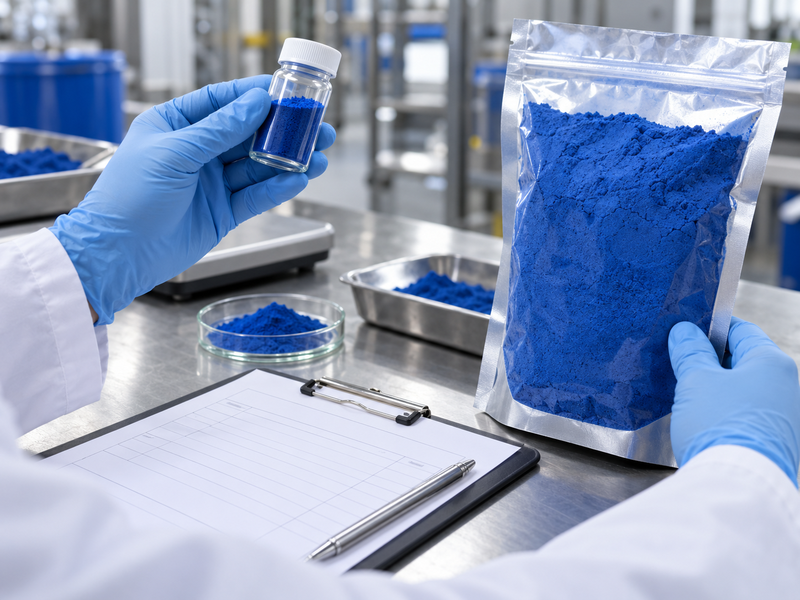
When a customer reports fading, an unmarked jar of old powder tells you very little. Blue spirulina wholesale retained samples become useful only when buyer and supplier can link a sealed portion to a specific lot, pack and storage history. A modest, controlled retain program supports complaint comparisons, method checks and shelf-life review. ISO 22005’s traceability principles provide context; the sample quantities and retention periods must come from the product and your own requirements.
Contents
- Why keep blue spirulina wholesale retained samples?
- Which point in the lot should be sampled?
- How much material should each party keep?
- What belongs on the sample label?
- How should retain packs be sealed and stored?
- When can samples and records be retired?
- What makes a complaint comparison fair?
- What can retained samples reveal about shelf life?
- How should custody and sample depletion be recorded?
- How can buyers audit the retain program?
1. Why keep blue spirulina wholesale retained samples?
Preserve a reference tied to an actual shipment
For example, a retain can reveal a change in incoming powder. It can also point toward a process or storage difference. It also permits a repeat test when a COA result is questioned. The retain cannot prove every drum was identical, and it cannot recreate conditions it never experienced. So its value depends on representative sampling and records. Link supplier and buyer portions to the same manufacturing and packing lot, then keep a record of the shipment and recipient. However, a catalog sample cannot represent a later commercial batch.
Here’s the distinction: a reference sample supports investigation; it does not release a shipment. Receiving still checks pack integrity, lot identity and required documents. The site’s lot-traceability guide connects sample identity to production and shipping records. When a complaint arrives months later, the team needs an unopened, traceable portion plus the original analytical method. Without that context, comparing blue shades may create false confidence. Define the retain’s purpose before choosing how much to store and what tests it must support.
| Purpose | Required link | Limitation |
|---|---|---|
| Complaint check | Lot and shipment | Cannot recreate customer storage |
| Method repeat | Original protocol | Method drift may remain |
| Color reference | Approved trial | Reference can age |
| Dispute | Sealed split | Sampling must be representative |
2. Which point in the lot should be sampled?
Document a plan before opening packs
Supplier retains are often taken during packing or release, while buyer retains are taken from received commercial packs. Those points answer different questions. For example, a supplier sample shows what left the plant. A buyer sample shows what arrived after transit. Define selected package count, selection method, tools, hygiene controls and whether portions are tested individually or combined. For a large lot, one top scoop may miss variation if powder segregates. Then use a documented sampling plan that fits lot size and risk.
An example makes it concrete: for a hypothetical shipment of several sealed drums, quality could select drums across pallet positions and take a recorded portion from each using its approved procedure. Keep package IDs and sample times. If a shipping seal was damaged, take a separate affected-pack sample; do not blend it into the routine composite and hide the condition. Preserve enough material for both an initial test and independent confirmation. The prior sample-testing protocol gives more detail on matching trials and lot records.
| Sampling point | What it represents | Record |
|---|---|---|
| Factory release | Packed-lot condition | Batch/pack log |
| Buyer receipt | Delivered condition | Receipt and seal check |
| Damaged pack | Affected unit only | Exception report |
3. How much material should each party keep?
Size the retain around likely tests
Do not select a sample mass simply because a pouch is convenient. List the tests that may be repeated: identity, color method, moisture, microbiology or an application trial. Add material for confirmatory testing and chain-of-custody transfer. If a test destroys its portion, plan enough independent sealed units to avoid repeatedly opening one container. A beverage trial may require more powder than an optical cuvette test. The amount should also respect the product’s cost and available storage space.
Balance the needs. A supplier and buyer may each keep a matched portion; an independent dispute portion can remain sealed for an independent laboratory. Still, the portions need a common origin and clear allocation. Their sizes may differ. Also record the amount used and the remaining mass. If a complaint arrives after the retain has been exhausted, the team should know that immediately. Never imply a fixed quantity is universally required by FDA or ISO. Specify the quantity in the quality agreement or sampling SOP based on the chosen tests and retention period.

4. What belongs on the sample label?
Give the future investigator enough information
Label the product, SKU, manufacturer and lot. If packing has its own code, add it. Also record source, date, sampler, mass and seal ID. Include a reference to the shipment or PO for a buyer retain. Mark storage conditions and any special handling. For example, a QR code may link to an electronic record. Yet the physical label must still make sense offline. The GS1 traceability standard illustrates why item and lot identification must stay together.
Check the handoff: if two blue powders from the same supplier sit in one cabinet, can an unfamiliar analyst choose the right retain without guessing? Distinguish carrier and grade through the SKU. Do not cover a manufacturer’s original lot mark with a new sticker unless the mark remains recorded. When a portion moves into a smaller vessel, record the parent sample ID and transfer date. A beautiful label that omits the lot number cannot resolve a lot-specific complaint.
| Label field | Why it matters |
|---|---|
| SKU and lot | Identifies exact material |
| Sample source | Factory versus receipt context |
| Date and sampler | Supports custody timeline |
| Seal ID | Shows access history |
| Storage | Directs handling |
5. How should retain packs be sealed and stored?
Protect the sample from the damage being investigated
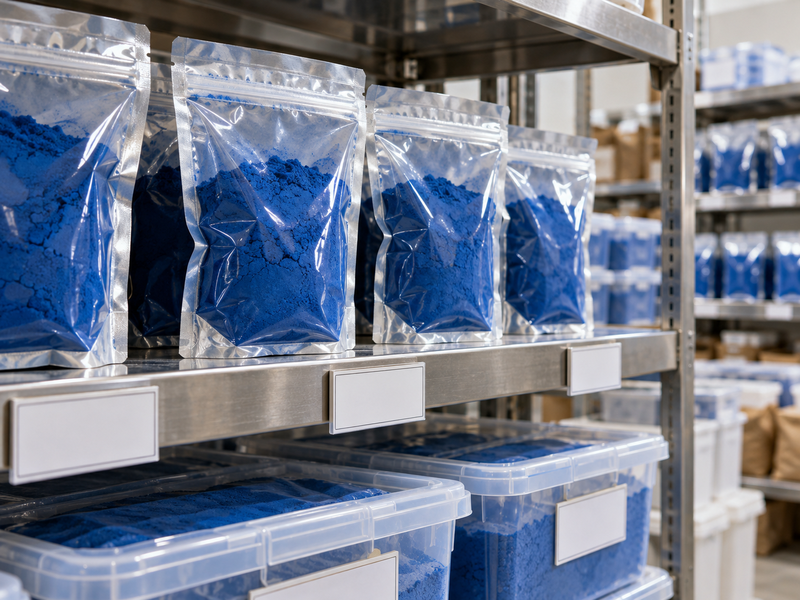
Use a clean, compatible barrier container or sealed portion of the commercial pack. Define light, moisture and temperature protection using stability evidence for the approved SKU. Record cabinet or room conditions and excursions according to the company’s monitoring procedure. For example, sunlight through a clear vial may change the shade under investigation. Instead of opening one container repeatedly, keep several small sealed units for frequent checks. Give access to trained personnel and keep an inventory of movements.
Consider a false complaint trail: a supplier retain kept in an opaque pouch appears vivid, while a buyer’s sample held in a clear jar fades. That difference does not prove the delivered lot was defective. Compare storage records before comparing absorbance or visual shade. The site’s bulk-packaging guide shows why package barrier and sealing matter. If the commercial pack changes, review retain-pack equivalence too. So protect the sample from fresh exposure that could distort later findings.
6. When can samples and records be retired?
Set a product-specific period and document the basis
Consider ingredient shelf life, finished-product shelf life, likely complaint delay, applicable legal record requirements and the buyer’s investigation needs. A powder may be used near the end of its life and then appear in finished food sold for another period. The sample retention period should be long enough for that plausible complaint window if feasible. However, an aged retain may no longer reflect the lot at release. Distinguish storage-life study material from complaint retains and record expiration or review dates.
Do not borrow a number casually. A legal record rule may apply only to certain facilities or files. Also, a marketed shelf life may assume different storage. Quality and legal teams should set the period for their jurisdiction and product. Also keep COAs, methods, deviation records and custody logs long enough to interpret the sample. Destroy or archive according to a controlled procedure, with a disposition record. If the buyer’s quality agreement asks for longer retention, confirm that the supplier can actually provide it before signing.
| Input to retention decision | Question |
|---|---|
| Ingredient life | How long is unopened powder usable? |
| Finished life | How late can complaints arrive? |
| Legal duties | Which facility and record rules apply? |
| Stability | Does retained powder remain interpretable? |
7. What makes a complaint comparison fair?
Compare like with like under one method
When a customer reports a shade problem, collect the complained-about product, its production lot, ingredient lot, formulation, process and storage history. Test buyer and supplier ingredient retains under the same written method, preferably in one laboratory or with a documented method comparison. Next, check seals and storage records before opening. Run a finished-food reference under the original protocol where practical. Even so, matching retains do not dismiss the complaint. Processing or later exposure may explain it.
A useful sequence: confirm identity, inspect condition, photograph seals, split portions, measure and preserve unused material. Agree on how results will be shared and interpreted. The color-measurement guide notes that viewing and instrument conditions matter. If the supplier retain passes but buyer retain fails, investigate transit and buyer storage as well as sample method. Avoid assigning fault from one visual comparison. Keep chronology and original reports so the corrective action targets the actual source of variation.

8. What can retained samples reveal about shelf life?
Use them as evidence with limits
For example, an unopened retain shows how powder behaved under recorded storage conditions. Periodic color or moisture checks may reveal a trend useful for reviewing storage instructions. However, that result cannot predict behavior in every finished formula. Finished-product stability requires trials in the actual formula and pack. Compare like packs or document the limitation before drawing conclusions.
Ask which question is being answered. If a finished drink fades under display light, test packed drink controls and light exposure; an opaque-pouch powder retain may remain unchanged. If a newly opened drum looks dull, compare its receipt retain and supplier retain to assess change during shipment or warehouse holding. Use the original baseline value and method. Do not turn a retain into a retroactive shelf-life extension without a designed study. The best use is a narrower, evidence-based investigation that directs further testing and helps prevent repeated loss.
| Observation | Possible interpretation | Needed follow-up |
|---|---|---|
| Both retains changed | Storage/method issue | Review controls |
| Buyer only changed | Transit/storage exposure | Inspect records |
| Powder stable, food faded | Formula/pack effect | Product stability trial |
9. How should custody and sample depletion be recorded?
Make every opening visible
Log the sample ID, seal condition, person, date, reason, test, amount removed, new seal ID and remaining mass. If an outside laboratory receives material, use a transfer form with shipment condition and receipt acknowledgment. Keep a chain from original lot to split, test and final disposition. This is especially useful when a complaint may become a commercial dispute. A sample with broken custody may still guide troubleshooting. However, it is weaker evidence in a dispute.
Protect the last portion. Meanwhile, routine trend tests should leave material for an independent check. Set a minimum reserve and a process for authorizing its use. If a container is found unsealed, quarantine it as evidence of compromised status and obtain another matched portion if available. Link electronic records to the physical inventory location. Periodic stock checks can catch missing or mislabeled retains before an urgent case begins. This is ordinary quality discipline, yet it saves days when a production team needs a supported answer.

10. How can buyers audit the retain program?
Test retrieval, identity and usability
Choose a recent commercial lot and ask the supplier to retrieve its retain, COA, method, storage record and sample-use log. Confirm the lot matches a real shipment and the container remains sealed and in date. Repeat internally with a buyer retain. For example, the pack label may differ from its COA. The sample may lack a location. Or retention may end before complaints can arrive.
Then close the gap. Update the quality agreement, sample SOP or inventory system and confirm the fix on a later lot. Ask Spirulina CN for its current retained-sample practice during qualification rather than assuming a website description proves it. A well-kept retain gives procurement and quality a common reference when a difficult color complaint arrives. It cannot replace representative incoming checks, but it makes a later investigation faster, fairer and more specific.
Frequently asked questions
Q1. Is a sales sample a retained lot sample? No. A retain must trace to the commercial lot under investigation.
Q2. Can a photograph replace a sealed retain? No. Lighting and device settings limit a photograph’s analytical value.
Q3. Should buyer and supplier retains use the same pack? Comparable protection helps; document any difference and its stability implications.
Q4. What if the retain has been opened? Review custody and exposure; use another sealed portion if available.
Q5. How long must we keep retains? Set a documented period from product life, complaint timing, agreement and applicable rules rather than assuming one universal duration.