
blue spirulina color for sauces and salad dressings is usually a spirulina-derived phycocyanin extract used to create a blue or blue-green appearance. A sauce team can find a beautiful bench shade only to lose it in acid, a yellow base, high-shear emulsification or a hot fill. This guide lays out a controlled formulation and packaged shelf-life trial for manufacturers.
Current US rules explicitly list sauces, condiments, dips and salad dressings for spirulina extract; published pigment studies identify risks to test, not guarantees for a finished recipe.
Contents
- Which sauce applications fit the US listing?
- What ingredient is actually being purchased?
- How should pH be screened?
- What does an emulsion do to blue appearance?
- How should base color be managed?
- Which heat and fill steps need testing?
- How do flavor and texture affect adoption?
- What shelf-life and safety work is needed?
- Which supplier records support scale-up?
- When is a blue sauce ready for production?
1. Which sauce applications fit the US listing?
Match the finished food category
The current 21 CFR 73.530 spirulina extract listing includes salad dressings, condiments and sauces, and dips at levels consistent with good manufacturing practice. That wording supports evaluating these applications, but the actual recipe still needs to meet the color additive’s identity and specifications. Check any standard of identity for the finished food because the listing contains a restriction for standardized foods unless the standard authorizes the color. “Sauce” on a marketing brief may not settle its regulatory classification.
Start with the exact product: identify whether the item is an oil-in-water dressing, aqueous dip, cultured sauce or another category. Record intended market and label requirements. A color permitted in a sauce is not proof it will hold in a vinegar-rich sauce. The regulatory review should precede extensive shelf-life work, while R&D defines the color target and process at the same time. Separate color permission from food-safety controls, nutrition claims and the formulation’s own ingredient statement.
2. What ingredient is actually being purchased?
Check extract identity and carrier
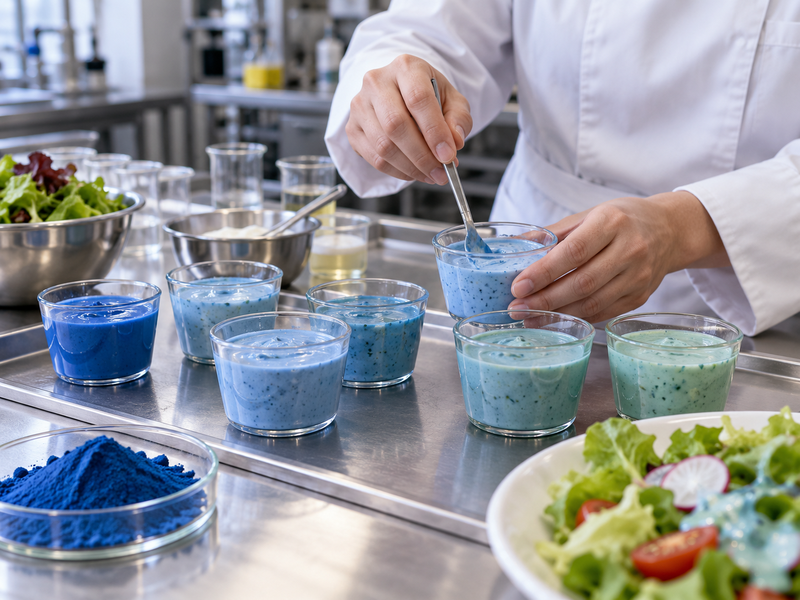
The named US color additive is spirulina extract prepared by filtered aqueous extraction of dried Arthrospira platensis biomass. A supplier may market it as blue spirulina or phycocyanin, yet the actual SKU can differ by pigment strength, carrier, moisture and form. Whole green spirulina powder is a different ingredient with a green color and characteristic flavor. Request the exact composition, color-value method, source organism, regulatory identity and lot certificate before selecting a formulation candidate. Any powder carrier or liquid stabilizer also enters the food formula.
A useful supplier question: will the quoted grade disperse in this specific sauce, and what premix does the supplier recommend? The SpirulinaCN blue spirulina guide distinguishes extract and whole biomass and explains why grade selection depends on the matrix. Test a saleable lot rather than an unlabeled promotional sample. Keep the approved sample and specification revision together; otherwise a later shipment can satisfy a vague product name while giving a different color.
| Ingredient record | What it clarifies | Trial consequence |
|---|---|---|
| Full composition | Carrier and declaration | Formula balance |
| Color-value method | Strength basis | Matched dose |
| Lot COA | Release quality | Repeatability |
3. How should pH be screened?
Test acid after the full recipe is built
Vinegar, lemon juice and fermented ingredients may drive a dressing’s pH below conditions where a particular phycocyanin grade holds its blue. Prepare a small bracket around the intended finished pH and normal production drift. Use the actual acid blend and complete sauce base, not only a citrate buffer. Record pH before pigment addition, after mixing, after filling and through storage. Check color, precipitation, visible particles and flavor at each point. If a stabilizer is proposed, include its sensory and label effects.
Research gives a warning, not a limit: a published phycocyanin acid and heat experiment examined color behavior across defined acidic conditions and a carrageenan complex. Its result cannot set a universal pH cutoff for every extract or sauce. A branded grade might include different helpers, and oil, salt or herbs can change the matrix. Define an acceptable pH band from the finished product’s safety and flavor needs, then ask whether the blue survives inside that band.
Do not shift a safe acid target just to protect the pigment without a full food-safety review.
For a vinaigrette, sample the aqueous layer and the shaken product after standing. A pH measurement taken from a poorly mixed jar can misrepresent the phase that actually holds the pigment. Specify a consistent sampling method and mixing time. That detail helps explain a failure that might otherwise be assigned incorrectly to pigment quality.
4. What does an emulsion do to blue appearance?
Compare water phase and finished dressing
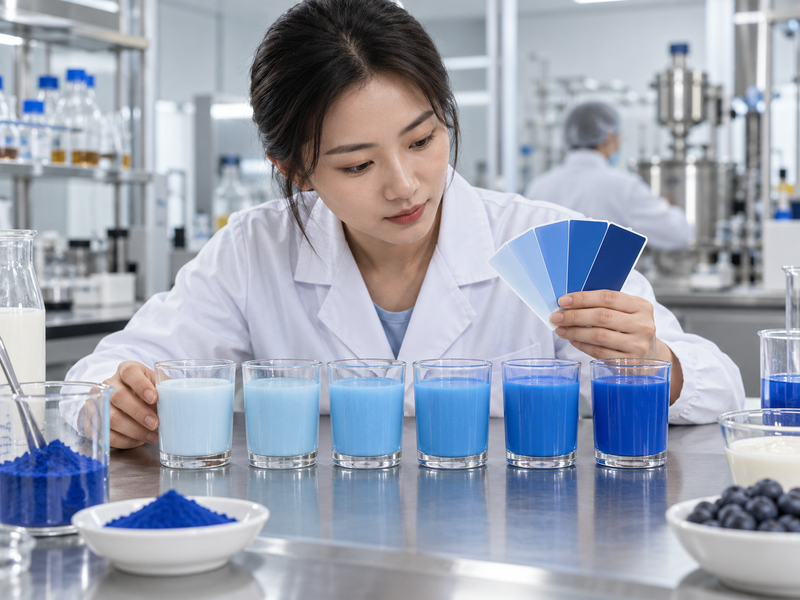
Phycocyanin is water soluble, while many dressings are emulsions of oil droplets in an aqueous phase. Droplets scatter light and can make a clear blue solution look pale, gray or pastel. Add the pigment to a suitable aqueous premix, then process through the real emulsification sequence. Compare the aqueous phase, fresh emulsion and aged packaged dressing. Record oil separation, creaming, pigment concentration in any separated layer and changes after shaking. A stable emulsion can still produce a weak visual blue.
Look for interactions: proteins, gums, salts and emulsifiers can alter both droplet behavior and pigment appearance. A phycocyanin emulsion study shows why those interactions warrant testing, but it does not validate a commercial salad dressing. Measure droplet-size or viscosity changes if the color system alters texture. Use a blind panel alongside instrument readings because an opaque sauce can fool a simple absorbance test. Approve the appearance in the serving context, including after consumers shake or pour the bottle.
| Sample | Key observation | Buyer decision |
|---|---|---|
| Aqueous premix | Dispersion and hue | Addition method |
| Fresh emulsion | Shade and texture | Target dose |
| Aged bottle | Separation and ring | Shelf-life fit |
5. How should base color be managed?
Treat yellow and opacity as ingredients
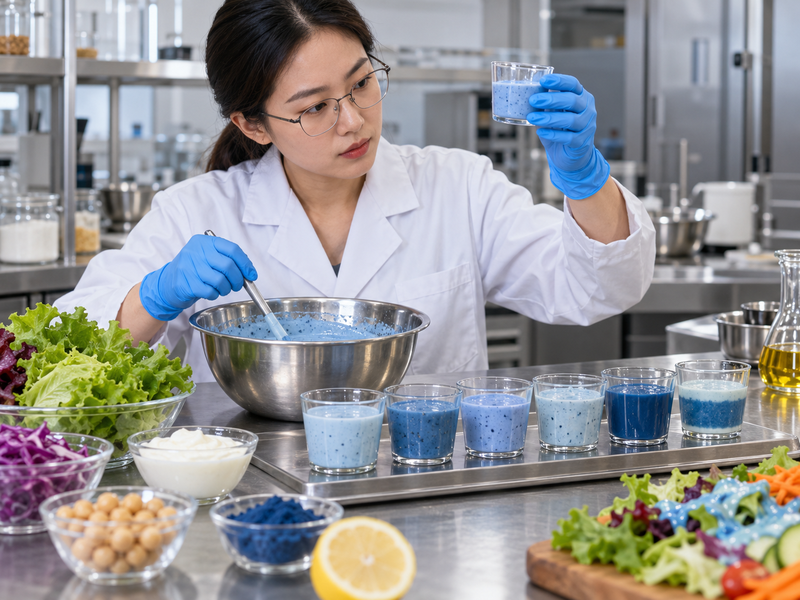
Egg yolk, mustard, olive oil, herbs and spice extracts may bring yellow or brown hues. Blue mixed into yellow can read green; blue in a white opaque base can become pastel. Measure and photograph the uncolored sauce under the same lighting and serving thickness used for the colored candidate. Run a dose ladder in the true base. If the brand wants a saturated blue, decide early whether the existing ingredient set makes that visual target practical.
More pigment may deepen a green cast instead of correcting it.
The useful comparison: put each prototype in its final bottle, on a white plate and on the food where it will be eaten. The same sauce can look different as a thick smear and a thin film. Record visual scores from more than one observer and select a reference sample. If a base ingredient changes seasonally, test representative lots before locking color dose. A strong color plan defines acceptable variation in both the uncolored base and the finished product.
6. Which heat and fill steps need testing?
Follow the actual thermal history
Some sauces are cold-filled, some are cooked and cooled, and others receive pasteurization or hot fill. Record product temperature, hold time, shear and cooling at every step from pigment addition to sealed pack. Test the color before and after each limiting operation. If later addition improves shade, confirm that the changed step still fits validated microbial controls and line capability. A short bench heat exposure cannot predict a long warm tank residence or a slow cool-down in a large container.
One simple trial: compare color added before heat with color added after heat where both routes are operationally permissible. Use identical finished composition, dose basis and packaging. Check color and particulate after 24 hours as well as immediately after fill. Temperature and acidity can act together on phycocyanin, and visible loss may lag behind process exposure. Document whether a filter, homogenizer or pump creates streaks or removes aggregates. Accept the addition point only after the full safety and sanitation workflow is reviewed.
| Process point | Record | Visible failure |
|---|---|---|
| Premix | Temperature and hold | Clumps |
| Heat or fill | Peak and duration | Fading or haze |
| Cooled pack | Shade and separation | Ring or sediment |
7. How do flavor and texture affect adoption?
Score more than hue
An extract used at a coloring dose should still be assessed for flavor in a delicate sauce. Carriers can change solids, viscosity or sweetness. A stabilizer that improves blue retention can change mouthfeel. Run coded sensory comparisons against an uncolored control and a current commercial benchmark, if one exists. Evaluate fresh and aged samples at the intended serving temperature. A product that meets a color number but tastes wrong has not passed a brand trial.
Practical detail: assess pouring, cling and mixing after storage. A thick dressing may hide color inconsistency until it is spread thinly. A dip may show streaks where mixing was incomplete. Measure viscosity or flow at the same temperature and shear method for all candidates. Record ingredient dose required to match the target shade, then calculate its contribution to total solids. If the pigment system forces an emulsifier or flavor change, retest the complete formula rather than treating that change as a minor adjustment.
8. What shelf-life and safety work is needed?
Run parallel but separate programs
Package the selected formula in the intended bottle, pouch or tub. Store under documented normal and reasonably anticipated abuse conditions. Track color, pH, separation, texture, flavor, package staining and light exposure at defined dates. Include an uncolored control. Separately, have a qualified food-safety team determine applicable process, microbial and shelf-life requirements for the specific product. Acid level, water activity, preservatives, thermal history and refrigeration all matter. A stable blue is not evidence that a sauce is microbiologically safe.
The commercial question: what will the customer see on the last saleable day? Evaluate the bottle before and after shaking if instructions permit it. Photograph the dispensed sauce under fixed light and compare with the approved reference. If the package changes from opaque to clear, repeat the light trial. If a new acid source changes pH or flavor, repeat the relevant color and safety checks. A shelf-life claim belongs to the final formulation and package, not to a supplier’s pigment powder.
Take samples from both the top and bottom of a stored package when separation is plausible. A uniform average color number can conceal a pale upper layer and a dark lower layer. Decide whether consumer shaking is a realistic remedy for that product. If it is, put the instruction on the proposed pack and confirm that ordinary shaking actually restores an acceptable sauce.
| Shelf review | Color program | Safety program |
|---|---|---|
| Normal storage | Shade and separation | Product-specific controls |
| Temperature excursion | Appearance and flavor | Hazard assessment |
| Package change | Light and oxygen retest | Seal and process review |
9. Which supplier records support scale-up?
Tie approvals to a commercial lot
Obtain a current specification, full ingredient declaration, color-value method, certificate of analysis, microbial and contaminant criteria, storage conditions and shelf-life basis. Ask about dispersibility in aqueous premixes and recommended addition conditions. Confirm sample provenance, commercial minimum order quantity, lead time and change-control terms. Two lots can reveal whether a promising shade is consistent enough for production. Require notice of carrier, source or process changes that could shift sauce behavior.
A sensible purchase file: store the approved sample, batch sheet, processed-package results and signed lot specification together. The SpirulinaCN factory page describes supplier quality topics; the buyer should obtain actual documents for the quoted grade. Do not assume a color-value certificate predicts emulsion appearance. Verify each incoming lot against a retained standard and investigate any unusual hue before charging a full tank. Repeat the application test if a new grade or form is proposed.

10. When is a blue sauce ready for production?
Apply three release gates
The regulatory gate confirms the actual category, color identity, listing restrictions and label treatment. The technical gate requires acceptable shade, flavor, texture, emulsion appearance and packaged shelf life after the real process. The supply gate confirms repeatable lots, specifications and a change-control path. If one gate remains open, schedule a targeted trial rather than a production order. Define a color dose range and visual acceptance band that operators can use consistently.
Ready to act? send suppliers the sauce base, pH, heat and fill sequence, package and target shade. Request a traceable sample and specification for that application. Review aged samples with marketing and quality before approval. If the blue shifts green in the existing base, revisit the visual target or formula honestly. A dependable product beats a dazzling day-one prototype that cannot survive the customer’s shelf.
| Gate | Required result | Stop signal |
|---|---|---|
| Category | Listed use confirmed | Standard conflict |
| Product | End-of-life pack passes | Fading or separation |
| Supply | Repeat lot plan accepted | Vague composition |
Conclusion
US rules list spirulina extract for sauces, condiments, dips and salad dressings, yet every formula must still prove its own color and quality. Acid, emulsion opacity, original base color and fill conditions can each change the result. Build a matched trial in the final package, keep food-safety validation separate, and approve only a traceable grade that performs through the planned shelf life. That discipline turns an unusual blue concept into a repeatable product.
FAQ
Q1: Is spirulina extract listed for US salad dressings? Yes, subject to the current listing and its restrictions.
Q2: Will blue always look blue in a dressing? No. Yellow ingredients and emulsion opacity can shift the visible shade.
Q3: Can a supplier’s pH claim replace a sauce trial? No. Test the actual formula across its production pH band.
Q4: Does stable color establish food safety? No. The finished sauce needs its own safety and shelf-life program.
Q5: What should a supplier sample include? A lot identity, composition, specification, certificate and handling guidance.