
Blue spirulina in commercial buttercream frosting presents a different problem from coloring a simple water icing. A fat-rich emulsion can leave water-soluble extract in colored streaks, while whipping, room temperature and storage can change the apparent shade. A retail swatch in a small bowl does not predict a production mixer or a depositing line. This guide compares candidate spirulina-extract grades in a real buttercream formula, with decisions based on dispersion, piped appearance, storage and cost.
The SpirulinaCN blue-spirulina range can supply a starting list of grades, but each offered SKU needs a matched batch trial.
Contents
- What must blue spirulina in commercial buttercream frosting achieve?
- Why does the water phase matter?
- Which blue grades deserve a trial?
- How should a bench batch be controlled?
- What changes during commercial whipping?
- How should pastel and deep blue be judged?
- What storage and deposit tests are needed?
- How does the U.S. color listing apply?
- What is the true cost of accepted frosting?
- When should purchasing approve the grade?
1. What must blue spirulina in commercial buttercream frosting achieve?
Specify the frosting system
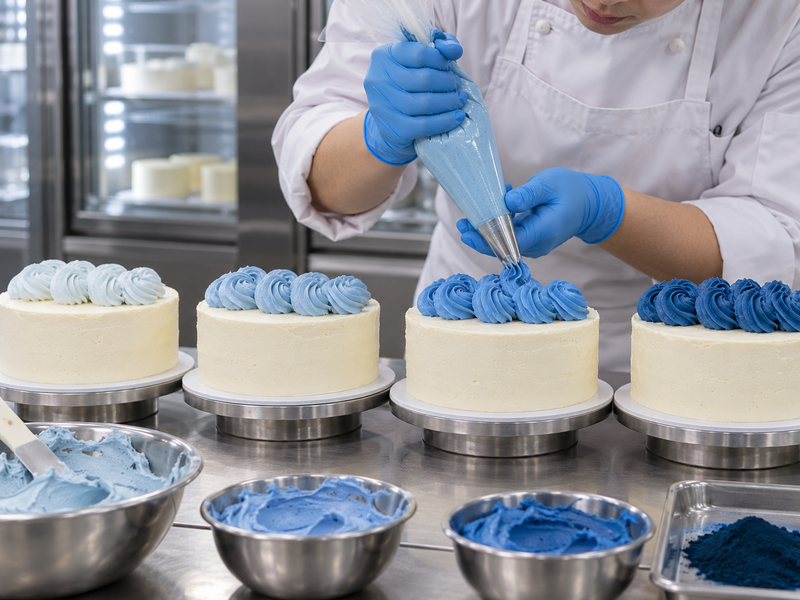
Record fat source and percentage, aqueous ingredients, sugar type and size, emulsifiers, salt, flavor, pH, batch size and mixing temperature. State whether the frosting is deposited, piped, spread or sold in a tub. A shelf-stable shortening frosting and a refrigerated dairy buttercream may look and handle differently, even with the same color addition. Define the product’s target texture, overrun, color and shelf life before supplier samples arrive.
The target shade needs a reference on the actual cake, cupcake or filling surface. A white base can produce a pastel result at low dose; a cream-colored base may mute it. Decide whether a saturated blue is technically necessary or whether a softer blue fits the brand and cost. Include market and ingredient-declaration requirements. “Natural” is a positioning word, not a substitute for checking the exact color-additive permissions and carrier statement for the destination.
| Brief item | Buyer records | Decision affected |
|---|---|---|
| Fat/water ratio | Formula and variability | Dispersion route |
| Base color | White/cream reference | Required dose |
| Process | Mixer, whipping, deposit | Streak and texture risk |
| Route | Temperature, light, shelf life | Color retention |
2. Why does the water phase matter?
Disperse where the pigment can enter
Spirulina extract’s blue phycocyanin is water soluble, while buttercream contains a large fat phase. For a candidate powder, trial pre-dispersion in a measured portion of the formula’s water, milk or other compatible aqueous ingredient before combining with the fat and sugar. For a liquid grade, calculate the added water and dissolved carrier. Mixing dry blue powder directly into fat-rich buttercream may create specks or uneven pockets; it is a comparison arm, not an assumed standard method.
Do not add extra water casually to dissolve the color. It may loosen piping structure, alter microbial controls or change the label and cost. Hold finished formula mass and water content consistent when comparing methods. Observe whether the blue stays with the aqueous phase or migrates into streaks during whipping. Record premix temperature, hold time and mixing order. If the base has very little free water, ask the supplier for an application-compatible option, then validate it in the actual formula.
| Dispersion route | What to watch | Decision |
|---|---|---|
| Powder into water phase | Lumps and hold stability | Premix suitability |
| Liquid into water phase | Added water/solids | Formula balance |
| Direct dry addition | Specks and streaks | Avoid if nonuniform |
3. Which blue grades deserve a trial?
Compare equal finished shades
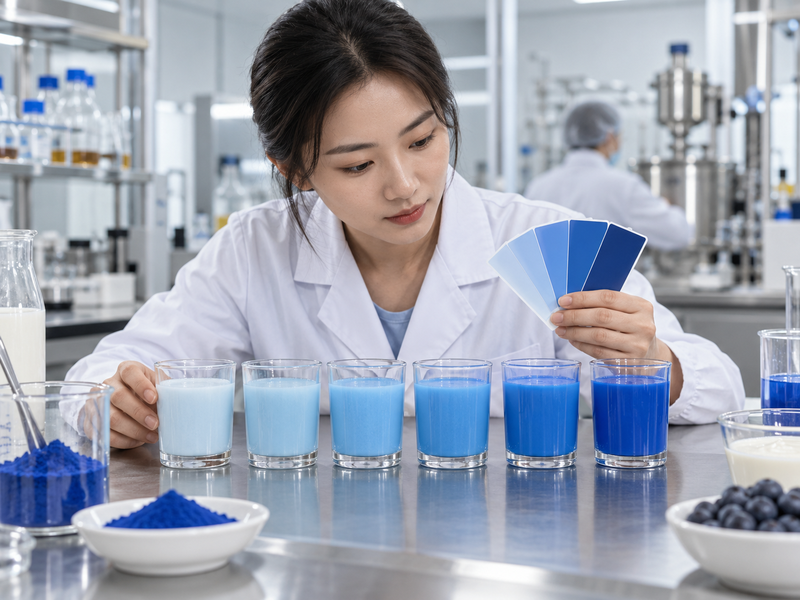
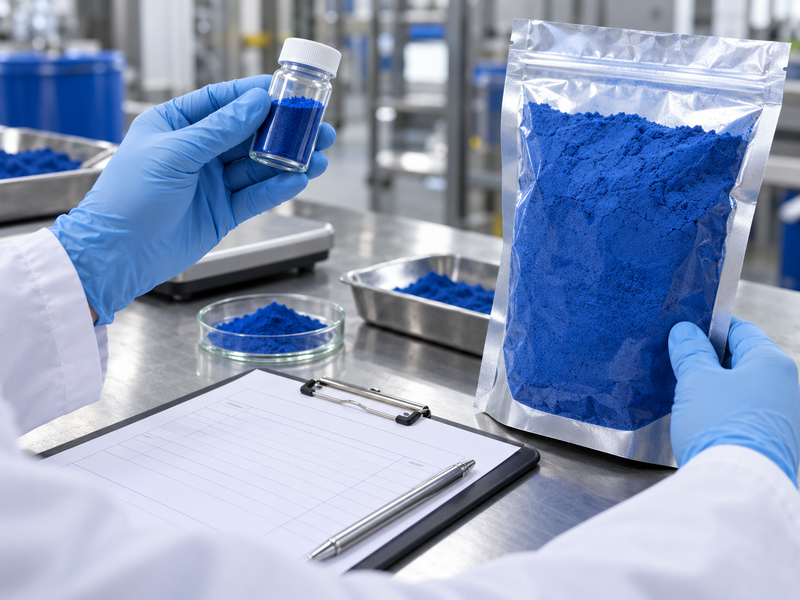
Ask for at least two candidate grades with TDS, ingredient composition, color assay method, lot COA and handling instructions. An E-grade label can indicate a supplier’s color strength but cannot alone predict buttercream color. A concentrated grade may require a smaller dose, while a lower-strength grade can be easier to meter in a large mixer. Compare them at matching finished Lab* values if the plant measures color, or against the same controlled visual reference if it does not.
Include flavor and texture in the screen. A grade that needs a high addition rate may bring carrier, moisture or slight off-notes into a delicate vanilla frosting. A supplier’s blue range describes multiple strengths and application testing; use it to request the actual lot specifications rather than assume all grades share composition. If a grade changes its carrier, reopen the formula and regulatory review even when the color assay number is unchanged.

4. How should a bench batch be controlled?
Build a small, interpretable matrix
Prepare an uncolored control and at least two color levels or grades in the same base batch. Keep ingredient temperatures, mixing order, mixing time and final mass constant. If one arm uses a water premix, balance water in the others so texture and shade differences are interpretable. Sample after mixing and again after the normal rest period. Include a piping or deposit test; a bowl photograph hides flow and streaking problems.
Set pass criteria before opening the coded samples: shade range, no visible specks or streaks, acceptable specific gravity or overrun, deposit definition and sensory fit. Log any temperature rise during mixing. If a bright blue fails because the frosting is too soft, do not approve color independently of the formula. Split the question into whether the extract preparation caused the softness and whether a formula adjustment remains commercially acceptable.
A controlled bench run should lead to a precise scale-up question, not a general statement that the ingredient “works.”
| Bench arm | Held constant | Main question |
|---|---|---|
| Control | Base and process | Baseline texture |
| Candidate A | Formula mass | Initial shade/dispersion |
| Candidate B | Target shade | Grade comparison |
| Method variation | Color mass | Mixing effect |
5. What changes during commercial whipping?
Sample through the full batch
Large mixers change shear, temperature and air incorporation. Record color addition time, mixer speed, batch temperature and whipping endpoint. Take samples near the bowl wall, center, top and discharge; compare their shade and texture. A blue premix that was even in a small bowl may enter a commercial batch too slowly or too locally, leaving streaks after the apparent endpoint. Plan addition through a documented safe access point rather than improvising during operation.
Check specific gravity or the plant’s normal overrun measure. Whipping can lighten the apparent blue by adding air, even when the pigment has not degraded. Compare color at the same overrun and after the frosting rests. Also inspect the first and last deposits from the line. If the color shifts over the run, test whether the cause is temperature, air loss or uneven ingredient distribution. An ingredient quote cannot resolve a mixing-process problem without these observations.
6. How should pastel and deep blue be judged?
Set a realistic reference
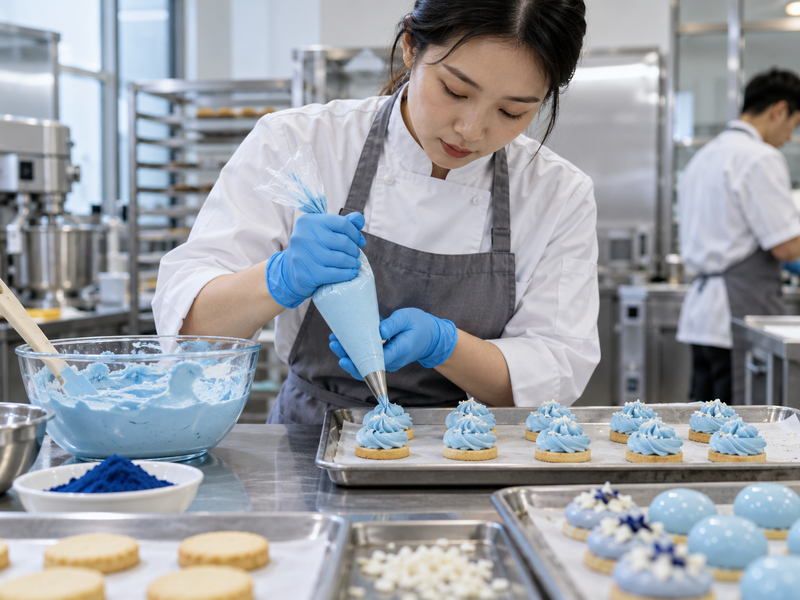
Make a target color board on the actual frosting base and finished substrate. Pastel blue may be achieved at a lower dose, but the white or cream undertone and surrounding cake color can change perception. A deep blue may require more extract than the formula or cost can accept. Do not use a digital rendering as the only standard; screen and lighting differences can hide the real appearance. Save a physical or instrument-based reference with an agreed tolerance.
Measure freshly mixed frosting and after a normal hold, then after piping or spreading. A thick piped ridge casts shadows that can make the same product look darker than a flat smear. For an industrial depositor, compare center and edge of deposits and check tailing or smearing. If a grade creates gray or green undertones at high dose, the solution may be a different base or revised target rather than endless dose increases.
Record the chosen color level as mass per finished batch, not a supplier’s broad usage range.
| Appearance point | Why view it | Acceptance cue |
|---|---|---|
| Flat swatch | Compare hue | Reference match |
| Piped ridge | Real display | No mottling |
| Deposit edge | Process uniformity | No colored streak |
| Stored cake | Consumer endpoint | Stable appearance |
7. What storage and deposit tests are needed?
Follow the frosting to the customer
Test in the intended tub, piping bag or finished bakery package at planned and credible warm-abuse conditions. Check color drift, separation, crusting, moisture change, texture and sensory quality at scheduled times. If the product is displayed under strong light, include that exposure. A stable unopened extract powder does not establish stability in an aerated buttercream. A refrigerated formula still needs a real distribution and service-window assessment.
Run a practical deposit test after normal plant hold time. Count reject deposits, check nozzles for clogging or colored residue, and inspect whether a blue ring forms when frosting contacts a pale cake or filling. If blue migrates at an interface, the problem belongs to the finished product even if the tub of frosting looks uniform. Keep retained samples in actual packaging for comparison. Any material change in fat source, emulsifier or flavor system should trigger a targeted repeat of these checks.
8. How does the U.S. color listing apply?
Check the current frosting permission
The operative 21 CFR 73.530 lists spirulina extract for coloring frostings at levels consistent with good manufacturing practice. It also sets identity, impurity specifications, color-mixture diluent and labeling provisions, plus a restriction for standardized foods. The broader 2026 rule expansion was delayed indefinitely. A U.S. manufacturer should review the exact extract preparation and finished application against the current text rather than rely on a supplier’s general “FDA approved” line.
Request composition and recommended declaration for the exact offered SKU, then have regulatory staff confirm use, carrier and any finished-label claims. A frosting may be sold in several countries with different color rules. The U.S. category does not authorize every export destination. Avoid inferring nutrition or health benefits from a pigment inclusion chosen for color. Keep the dated review and lot documentation with the approved commercial formula.
9. What is the true cost of accepted frosting?
Price the passing batch
Calculate dose at the approved finished shade, then add premix labor, added ingredients, cleaning time and yield loss from streaked or off-shade deposits. A higher-priced concentrated grade may cost less per accepted kilogram of frosting; a low-price grade may lose if it weakens the texture or needs rework. Request comparable volume quotations with pack size, freight term, lead time and quote validity. Do not use a static market price to decide a formulation.
Sensitivity-test the calculation at the high end of the accepted color range and at realistic waste rates. Confirm the lot assay and change-control terms so the recipe does not drift when a new batch arrives. The buyer may choose a slightly less saturated shade to protect cost and product quality, but that should be a brand decision documented before the PO. Put the final dose and price basis in the approval record, not only in a development notebook.
| Cost driver | Trial evidence | Commercial effect |
|---|---|---|
| Dose | Passing shade | Color use per batch |
| Premix | Time and water balance | Labor/formula cost |
| Rejects | Off-shade or soft deposits | Yield |
| Supply | Pack and lead time | Inventory cost |
10. When should purchasing approve the grade?
Lock the production method
Approve the exact extract SKU only after the plant repeats the target shade at commercial scale with acceptable dispersion, whipping, deposit and storage results. Freeze the premix method, addition point, temperature band, assay specification, color reference and finished-product tests. Keep a retained ingredient sample and finished frosting sample under appropriate conditions. Define who can authorize a formula adjustment if a future lot falls near the edge of the shade tolerance.
Ask the supplier how changes to carrier, color assay or production site will be communicated. A new grade that improves shade must pass the same product tests before substitution. If no candidate produces the desired deep blue without harming texture or economics, revise the target or base formulation. An explicit no-go protects the production team from an unworkable launch. The buying decision is a reproducible frosting process and accepted output, not an attractive spoonful from the first bench trial.
Purchase gate: Release a bulk color order only after the finished, deposited frosting passes its normal shelf-life and QA criteria.
The first commercial run should produce a short visual standard for operators: an acceptable premix, uniform mixer sample and finished deposit under the same light. Record how many deposits are checked at start-up and after a normal hold, plus the response to streaks or soft texture. Do not allow a blue shade adjustment to bypass texture sign-off. When a new lot arrives, compare its COA and premix behavior with the approved lot before changing the formula.
This turns a successful development batch into a repeatable bakery process.
FAQ
Q1. Can blue powder be mixed straight into buttercream? Trial it, but water-phase pre-dispersion may reduce specks and should be compared at equal final water.
Q2. Does a higher E-grade always make a deeper blue? It may be stronger under its assay, but the actual frosting base and process decide finished shade.
Q3. Why did the color lighten after whipping? Added air and changed texture can change appearance without necessarily changing pigment concentration.
Q4. Is spirulina extract permitted for U.S. frosting? Frostings are listed in current 21 CFR 73.530, subject to the regulation’s conditions and a product-specific review.
Q5. What belongs in a matched sample request? Base formula, target shade, fat/water ratio, mixing method, batch size and intended market.
Conclusion
Blue buttercream is ready to source when it mixes and deposits evenly and stays attractive through its actual service life. To request a matched E-grade sample and quote, contact SpirulinaCN with the application, target specification and shade, anticipated quantity, destination, fat/water ratio, batch size, mixing and storage conditions. Request the current composition, TDS and lot COA and test the offered grade in the commercial frosting.