
A pilot can approve one blue extract sample while a purchasing team later receives a different carrier, lot or shade. Blue spirulina extract incoming sample reconciliation links the approved bench sample, a sealed retained standard and the first commercial shipment before production releases the ingredient. This article provides a buyer and QA workflow for that comparison. FDA supplier verification resources describe a risk-based supply-chain context; the practical controls below focus on making one material decision traceable and testable.
Contents
- What exactly must be reconciled?
- How should the approved sample be identified?
- What makes a retained standard usable?
- Which documents should arrive with shipment?
- How should warehouse receipt be checked?
- Which analytical comparison is meaningful?
- How should application performance be compared?
- What happens when results disagree?
- Who approves the first commercial lot?
- How is reconciliation sustained after launch?
1. What exactly must be reconciled?
Link three physical materials and one decision
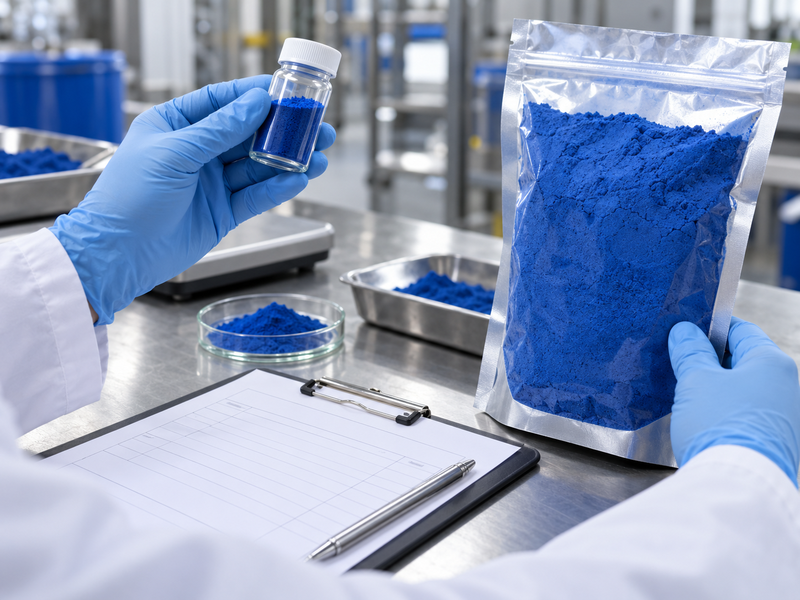
Create a chain from the R&D-approved sample to its sealed retain, the supplier’s commercial production lot and the buyer’s received containers. Record the specification revision and finished-product formula that approved the sample. A matching product name is insufficient: one E-grade may be offered with different carriers or packaging. The buyer needs to know whether the approval meant acceptable powder identity, color value, performance in a particular food, or all three.
Define the comparison before receipt. Set mandatory identity and safety checks, a color method and an application check appropriate to the product. An approved sample may be an early development lot rather than a routine manufacturing lot, so ask the supplier to disclose the relationship. If it cannot be connected to the shipped SKU, use the sample as a development reference and qualify commercial material deliberately. A reconciliation form should record outcomes, reviewer names and disposition rather than a simple “same as sample” tick.
2. How should the approved sample be identified?
Freeze the sample’s full identity
At bench approval, photograph the sealed pack and label, then record supplier legal name, manufacturing site if disclosed, SKU, lot, date, carrier composition, target color value and applicable specification version. Capture sample mass and chain of custody. Attach the exact application test protocol, formula revision and approval report. The site’s blue spirulina product guide explains why color grade, carrier and actual application must be considered together.
Avoid an invisible substitution: a sales representative may send a later “equivalent” sample with the same marketing name but different carrier. Require a documented change assessment before replacing the approved material. If pilot work consumed all powder, retain a prepared application reference where its stability supports it, but do not treat an aged liquid as a permanent powder standard. A digital photo can document hue only under controlled lighting; it cannot replace physical or analytical evidence.
| Approval field | Source | Reconciliation purpose |
|---|---|---|
| SKU and lot | Original label | Proves material identity |
| Spec and carrier revision | Supplier document | Detects composition change |
| Application formula | R&D report | Makes performance comparable |
| Approval sign-off | Quality and development | Shows the decision owner |
3. What makes a retained standard usable?
Protect it from the changes being investigated
Keep at least one unopened, labeled retain in the recommended barrier pack. Log receipt, storage condition, access and planned review or replacement date. A working sample should be separate so repeated opening does not add moisture or light exposure to the standard. If the standard has aged or its pack was compromised, qualify a replacement from an accepted lot rather than quietly resetting the benchmark.
Phycocyanin can lose color under heat and light in original stability work; how fast a commercial powder changes depends on its formulation and storage. Use the retain carefully: a weak result from a degraded standard can make a new lot appear stronger than it is. Compare the standard against its original measured value and investigate any drift. Include reserve material for a supplier dispute or third-party test.
State how long a retain remains valid and what evidence supports that period.

4. Which documents should arrive with shipment?
Match paperwork to physical lot codes
Collect purchase order, specification, certificate of analysis, packing list, shipping documents and any agreed declarations. The certificate should identify the shipped lot and methods used for reported values, not just show generic targets. Reconcile net weights, container counts, pack size, manufacturing or expiry dates, and any split-lot history. If multiple lots share one shipment, inspect and test them as separate units unless a justified procedure says otherwise. Read the methods column: “color value” can differ with solution concentration, wavelength, path length and calculation.
The site’s contact and documentation page describes access to batch COAs and technical dossiers, but a buyer still needs to verify they correspond to the received containers. A food-safety review may require additional supplier verification under the receiving facility’s hazard analysis. Do not assume that a COA alone satisfies every market or customer program.
| Document | Identity to reconcile | Typical mismatch |
|---|---|---|
| Purchase order | Approved SKU and specification | Alternate grade supplied |
| Packing list | Lot, count and weight | Unrecorded split lot |
| COA | Lot and test method | Generic or stale report |
| Container labels | SKU, lot and dates | Relabeling discrepancy |
5. How should warehouse receipt be checked?
Inspect before opening or sampling
Place the shipment in a defined quarantine state. Compare pallet and container labels with the packing list, check seals and liner condition, and note wet, crushed or sun-exposed packs. Record arrival temperature where transport controls call for it, plus receipt date and storage location. Photograph any discrepancy before disturbing the pack. Keep the lot boundary: a warehouse system that assigns an internal number should preserve the supplier lot as a linked field. Do not pool containers from different lots for convenience.
Sample using a written method that prevents contamination and produces a representative unit; document which containers were opened and resealed. FDA’s explanation of traceability lot codes describes how lot identifiers link records for foods covered by that specific rule. Even when that rule does not apply to this ingredient, preserving clear lot links supports practical investigation and recall scope. Release cannot begin until physical identity matches the approved item.

6. Which analytical comparison is meaningful?
Use one method on both old and new material
Prepare the approved retain and received sample side by side with the same weighing, water, dilution, mixing time, filtration and reading interval. Document wavelength, blank, cuvette path length, instrument ID and calibration status. Compare results with the agreed specification and the observed variation of the method. A small numerical difference is not necessarily a material difference if the preparation itself varies. NIST’s spectrophotometry program describes why absorbance and wavelength checks matter to reliable optical measurement.
Make a paired result: run duplicates or replicates under the laboratory procedure, include a known check sample, and investigate implausible drift. Measure moisture or carrier content if the specification uses an as-received basis. Color value alone cannot prove shade in food, safety or compositional equivalence. Keep release tests aligned with the approved specification rather than adding an improvised new limit after seeing the shipment.
| Method element | Standardize it | Risk if ignored |
|---|---|---|
| Solution concentration | Gravimetric preparation | Apparent potency drift |
| Wavelength and path | Verified settings | Noncomparable absorbance |
| Blank and filtration | Written procedure | Background or scattering |
| Replication | Laboratory acceptance rule | Overreacting to noise |
7. How should application performance be compared?
Recreate the approved use test
Use the same finished-product base, extract dose, order of addition, product temperature, pH and hold time used in approval. Test retain and incoming lot side by side under the same equipment settings. Evaluate shade, dispersion, haze, flavor where relevant, and color after a defined stress or storage interval. If the original pilot formula has since changed, state that difference and run a new comparison in the current formula; do not call unlike formulas equivalent.
The practical decision: a new lot can pass an E-value specification and still produce a different finished shade because carrier or matrix behavior changed. Conversely, a slight analytical difference may have no visible product effect within accepted tolerance. The site’s formulation service description can help align sample and technical data, but the receiving manufacturer should keep its application method as the final performance test. Capture photographs under fixed lighting and any instrumental color values with sample age.

8. What happens when results disagree?
Hold, classify and repeat the right test
Keep the received lot on hold while QA checks identity, method, sampling and retain integrity. Classify the mismatch: documentation, physical pack, analytical value or application performance. Repeat a suspect test with a second sample and a check standard before declaring that material failed. If the pack or label is wrong, additional color testing cannot solve an identity gap. If only the application differs, inspect formula and processing records.
Give the supplier a usable case file: lot codes, method, raw data, photographs, sample age and exact failure description. Agree on a split sample or independent test when results remain disputed. Disposition options may include release with documented rationale, restricted use, return or rejection under the buyer’s quality system. Do not silently blend an off-shade lot into acceptable stock. Record whether any finished product has already used the lot and assess its scope promptly.
| Mismatch | Immediate action | Investigation lead |
|---|---|---|
| Label or lot code | Quarantine | Supply and warehouse |
| COA method | Request corrected method detail | Quality |
| Color-value gap | Paired retest | Laboratory |
| Finished shade gap | Recreate application test | Development |
9. Who approves the first commercial lot?
Assign a release owner for each evidence stream
Procurement confirms contractual SKU and commercial terms; warehouse confirms receipt and pack integrity; laboratory confirms specification tests; development confirms application fit; QA records final disposition. The roles can be combined in a small company, but the decision criteria should remain explicit. Release the lot only after open discrepancies have documented outcomes and the traceability link is complete. Build a concise packet: approved sample identity, retain status, shipment documents, incoming test data, side-by-side application result, deviations and signatures.
FDA’s supplier verification overview reminds U.S. businesses that verification activities depend on the hazard analysis; this packet is a practical material-comparison tool, not a claim that every legal requirement has been met. Include the exact finished-product formula revision in the release so a later complaint can be reconstructed.

10. How is reconciliation sustained after launch?
Turn the first comparison into routine controls
Set incoming test frequency and application-check frequency using risk, supplier history and product sensitivity. Define a reference sample replacement procedure and a supplier change-notification agreement covering manufacturing site, carrier, grade, method and packaging. Trend color value and finished-food shade rather than reviewing each lot in isolation. A gradual shift may be invisible when every result sits just inside a broad limit. Close the chain: connect supplier lots to finished production lots and complaints.
When a new grade or process change is proposed, run a bridging trial against the current approved material before changing purchase orders. Periodically verify that COA methods still match the buyer’s method and that retains are stored properly. A supplier can help with batch documentation and sample requests, while the buyer’s quality system owns release and change control. This routine prevents the first commercial success from becoming a one-time exception.
| Ongoing control | Trigger | Record |
|---|---|---|
| Reference refresh | Validity date or pack damage | Replacement qualification |
| Method alignment | Supplier method revision | Paired method check |
| Application bridge | New carrier or grade | Controlled formula comparison |
| Trend review | Scheduled quality review | Lot and shade chart |
Conclusion
Incoming reconciliation works when an approved sample, protected retain and received shipment can be compared under one identity and one test method. Check documents and seals before color, then compare both analytical value and finished-product performance. Assign clear release ownership and preserve the lot link. A disciplined first-shipment review gives procurement confidence that the ingredient arriving at scale matches what development actually approved.
FAQ
Q1: Is a matching COA enough to release the first lot? No. Check physical identity, pack condition and application performance under the approved plan.
Q2: What if the approved retain has faded? Investigate storage and original values, then qualify a replacement reference before judging a new lot against it.
Q3: Should every container be sampled? Follow a risk-based written sampling plan; keep different supplier lots separate.
Q4: Can two grades with the same E-value be equivalent? They may differ in carrier, hue or application behavior. Run a controlled comparison.
Q5: Who decides final disposition? The buyer’s designated quality authority should record a decision after procurement, laboratory and development evidence is reviewed.