
A blue cereal piece may leave a coater evenly colored but become tacky, patchy or dull after drying. Blue spirulina extract cereal coating trials test color delivery while protecting crunch, flow and pack stability. This guide gives cereal manufacturers a pilot sequence from coating design to finished-product approval. Original work on coated puffed wheat shows that a coating process can affect attrition and product quality; phycocyanin adds a color variable that requires its own temperature and moisture checks.
Contents
- Which cereal and coating route are in scope?
- What extract evidence should be reviewed?
- How should the coating trial matrix be built?
- Where should the blue enter the coating line?
- How can operators measure coverage?
- Which moisture and texture checks matter?
- How should fines and handling losses be counted?
- What happens when cereal meets milk?
- How should packaged stability be tested?
- What supports a commercial coating decision?
1. Which cereal and coating route are in scope?
Identify the base and the application step
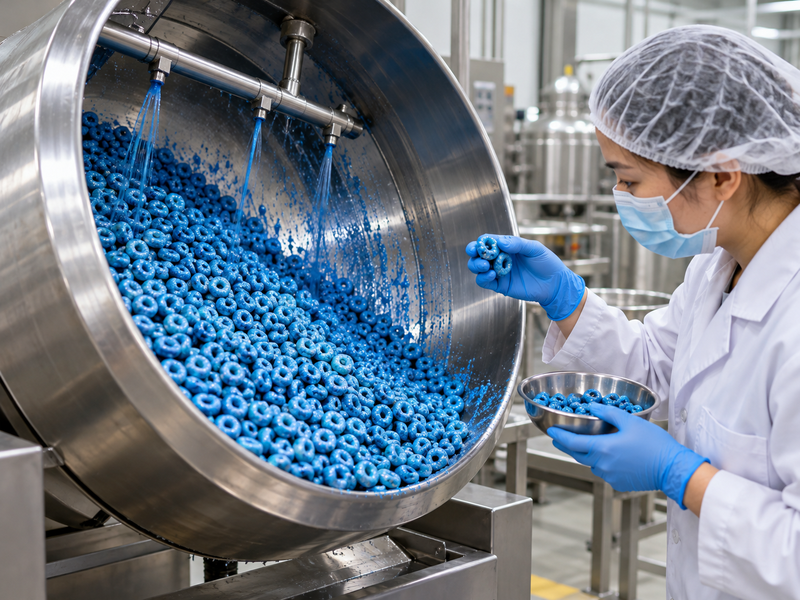
State whether the base is a flake, puffed grain, ring, cluster or mixed cereal, and record its size distribution, porosity, starting moisture and breakage. The same blue coating may cover a smooth flake yet pool in a rough cluster. Specify whether color enters a sugar syrup, a cool binder, or a later topical layer. Do not assume color will survive a downstream drying step without measurement. Draw the exact route: base production, coating application, drying, cooling, blending, conveying and packing. This route also frames regulatory review. In the United States, the existing FDA spirulina extract listing historically distinguished ready-to-eat cereals from extruded cereals, while a 2026 expanded-use order had a delayed effective date. The regulatory team must confirm current permitted use for the specific cereal and process before launch. A product name alone does not answer that question.
2. What extract evidence should be reviewed?
Tie every pilot result to one purchasable lot
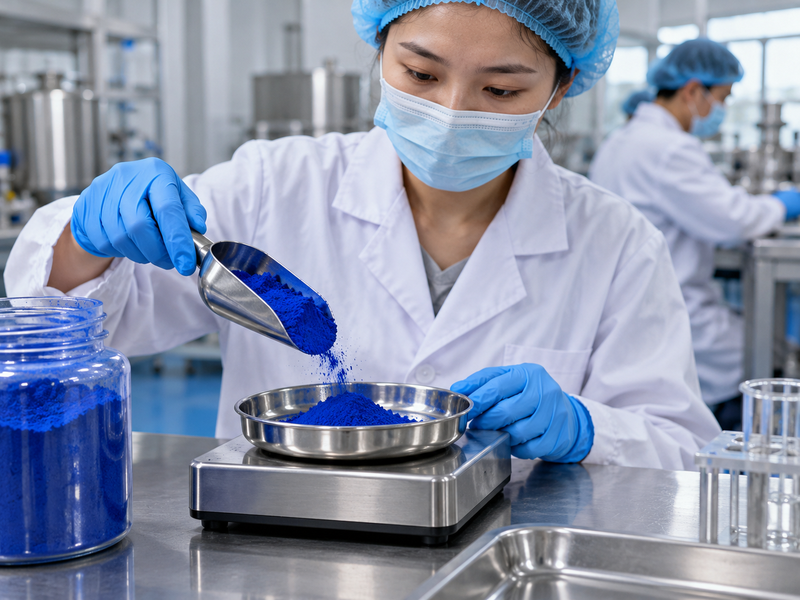
Request the exact blue extract SKU, carrier list, color-value method, moisture result, microbiological and contaminant evidence, packaging, and recommended storage. Compare a sealed sample with the production pack; a small laboratory vial may not represent later handling. Ask whether the extract dissolves fully in the proposed coating vehicle and how the supplier defines color value. The site’s blue spirulina product guide emphasizes evaluating shade and dispersion in the final matrix. Keep ingredients straight: whole green biomass powder contains cells and behaves differently from a phycocyanin-rich blue extract. If a carrier contributes solids, include it in coating mass balance and label review. Retain powder from the trial lot, a prepared standard solution and finished cereal from each pilot arm. A future commercial lot can then be tested against a meaningful benchmark instead of a photograph or an old certificate.
| Incoming evidence | Buyer question | Pilot use |
|---|---|---|
| SKU and lot | Is this purchasable supply? | Trial traceability |
| Carrier composition | What enters the coating? | Formula and label review |
| Color-value method | Are results comparable? | Dose calculation |
| Storage and pack | How is color protected? | Retain control |
3. How should the coating trial matrix be built?
Separate color dose from water load
Begin with an uncolored base and a base coating control. Then run several blue doses at equal coating-solids target, application mass and process settings. If the extract solution adds water, remove an equivalent amount elsewhere or state explicitly that the arm tests both water and pigment. A factorial screen can follow once the basic dose response is clear: for example, compare two coating solids levels at a fixed color dose. The useful question: which variable changed the finished color and which changed crunch? Record input cereal mass, coating mass, recovered product, fines and material left on equipment. Use a consistent visual standard for finished pieces. Avoid selecting a dose from a supplier photo because base color, sugar crystallization and air spaces affect perceived blue. Run enough material to reach stable spray operation; a tiny bowl coating may miss nozzle and residence-time effects. Capture the actual line speed and drum fill level.
4. Where should the blue enter the coating line?
Compare feasible thermal exposure
Map the temperature of syrup preparation, colorant addition, spray reservoir, cereal bed and dryer discharge. A hot coating solution may wet well but damage blue; a cooler solution may thicken and spray unevenly. Test a late, cooler addition when process design allows it, and track whether a downstream dryer still exposes the pigment to damaging heat. Phycocyanin color stability varies with heat and pH in original experimental work, but that paper does not set a cereal-line temperature limit. Use the actual time profile: record peak product temperature and residence time, not only heater setpoint. If a two-stage coating protects color, compare its equipment burden, added moisture and yield with the one-stage process. Coordinate any altered drying program with food-safety and shelf-life validation. A visually stronger blue cannot justify releasing a cereal that leaves the line too wet.
| Process point | Measure | Decision |
|---|---|---|
| Coating tank | Product temperature and pH | Pigment addition feasibility |
| Spray nozzle | Flow and pressure | Uniform distribution |
| Dryer | Bed temperature and time | Color versus moisture |
| Cooling discharge | Product temperature | Safe packing readiness |
5. How can operators measure coverage?
Judge uniformity across pieces and within a piece
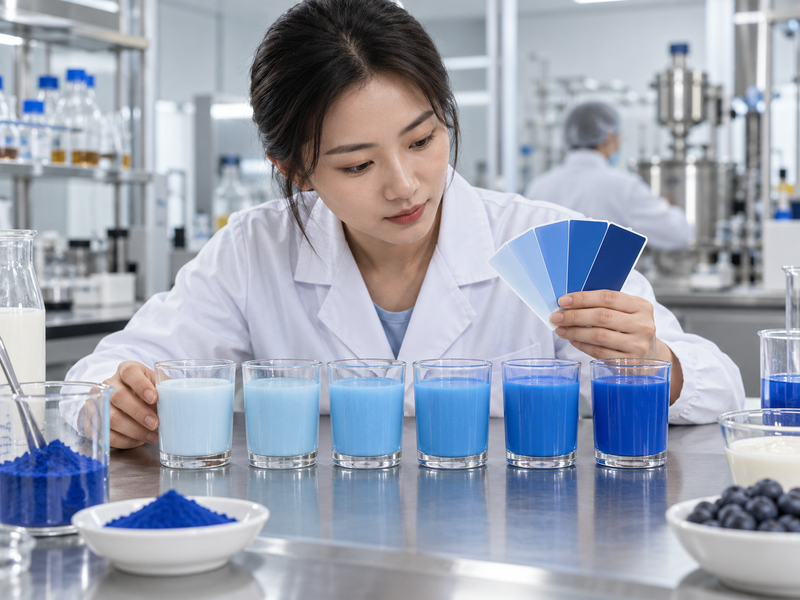
Pull timed samples from the coater after stabilization, then separate representative pieces for standardized photography or colorimetry. A mean color reading can conceal a mix of pale and dark pieces. Score the percentage of visibly undercoated pieces and check streaks, pooled color and uncoated backs. Use consistent orientation for flat flakes. Watch the distribution: a dark sample from the first minute can reflect excess syrup before flow stabilizes, while pale pieces near the end may follow reservoir depletion. Keep nozzle pattern, drum speed, bed depth and atomization settings with each sample. If color concentration rises while syrup evaporates in a warm tank, a later sample may darken without a dose change. State whether acceptable coverage is judged before or after final drying and blending. The packaged cereal is the commercial reference, but intermediate samples help locate the cause of failure.
6. Which moisture and texture checks matter?
Link blue shade with retained crunch
Measure base moisture, post-coating moisture, final moisture or water activity, and texture after equilibration in the intended pack. A coating that looks bright immediately may carry enough water to soften cereal during storage. Compare instrumental fracture or crunch tests with a trained sensory check. State the timing of each result; a piece cooling at the dryer exit may feel different the next day. Published research on breakfast cereal coatings evaluated coating effects on bowl life, which illustrates why surface treatment can change eating behavior independently of color. Do not borrow its target values: product geometry and recipe determine acceptable texture. Track stickiness and clumping in a bulk container, since pieces can adhere even when a small hand sample seems crisp. If more drying is needed, repeat color measurement after the additional thermal exposure.
| Quality point | Check | Failure interpretation |
|---|---|---|
| Base cereal | Moisture and breakage | Starting condition |
| Dryer exit | Moisture and color | Immediate process result |
| Packed equilibration | Water activity and clumps | Migration risk |
| Serving bowl | Crunch and color bleed | Consumer experience |
7. How should fines and handling losses be counted?
Reconcile material after the coater
Weigh base input, applied coating, saleable output, fines, line deposits and samples. Calculate yield on a consistent dry-mass basis when moisture changes materially. A blue trial may appear expensive because product breaks during a newly adjusted drum speed, rather than because extract dose is high. Count visible blue dust on conveyors and packs; it can create an untidy presentation and signal weak adhesion. Trace the loss point: sample after coating, after cooling, after conveying and at the filler. A sudden rise in fines points toward mechanical handling or a brittle coating. Evaluate whether a binder change improves adhesion without raising water activity or muting color. Original coated puffed wheat research links coating method with attrition and quality, but commercial acceptance depends on the plant’s equipment. Use yield and acceptable-piece count in cost-in-use calculations, not only extract price per kilogram.

8. What happens when cereal meets milk?
Test the serving, not only the dry piece
Prepare servings with the milk or plant beverage specified for consumer research. Record liquid temperature, cereal mass, liquid volume and viewing time. Observe whether blue migrates into the bowl, becomes greenish against a yellow base, or disappears as pieces soften. Measure bowl life by texture and color at several practical intervals. A coating that releases some blue may be a desired design effect, but accidental heavy bleed can make cereal appear poorly made. Set the design intent first: does the brand want blue pieces that stay blue, a colored milk effect, or a mixed appearance? Blind sensory review can catch flavor and mouthfeel changes from the coating carrier. Repeat with realistic liquid variations if the product is sold for broad use. The dry-pack standard and prepared-bowl standard should remain separate; neither can substitute for the other during approval.
| Serving condition | Observation | Decision |
|---|---|---|
| Dry pieces | Shade and coverage | Shelf presentation |
| Initial milk contact | Bleeding and halo | Immediate appearance |
| Mid-bowl hold | Texture and liquid color | Eating quality |
| End of typical serving | Remaining crunch | Bowl-life target |
9. How should packaged stability be tested?
Use the actual liner and display condition
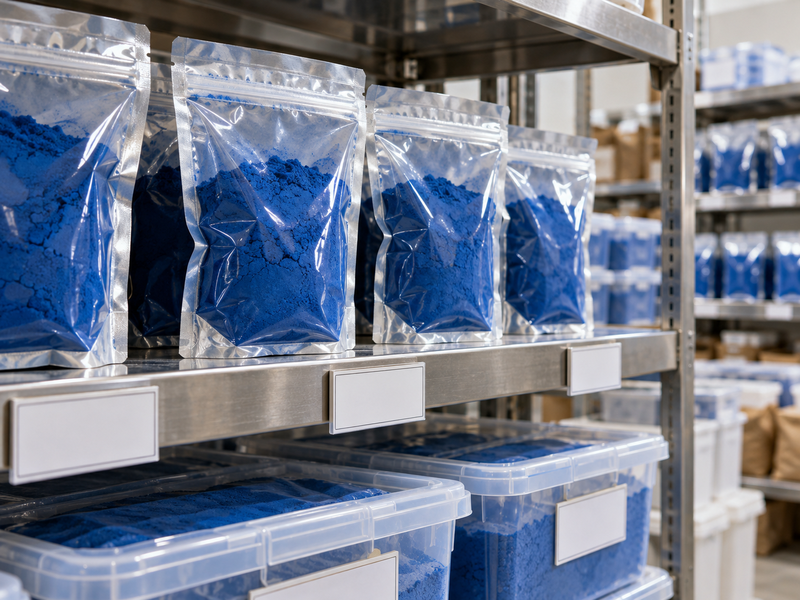
Fill commercial or equivalent barrier packs and store them at expected conditions. Add justified humidity, warmth or light challenges where the sales route creates those exposures. At each pull, test shade distribution, moisture or water activity, clumping, fines and crunch. Use unopened packs for each pull to avoid altering the exposure. Phycocyanin’s response to light, heat and pH means initial color cannot stand in for shelf-life evidence; a storage study on extracted phycocyanin found temperature-dependent loss in its own system. Keep the conclusion specific: a stress test can rank pack or coating options, but a labeled shelf life needs product-specific real-time evidence and safety review. Photograph cereal with the same light and background at every interval. Investigate color loss alongside moisture change and package integrity rather than assigning one cause without a comparison.
10. What supports a commercial coating decision?
Approve a process and a product together
Compile extract identity, formula revision, spray recipe, temperature and residence-time trace, finished moisture, color distribution, yield, bowl-life and storage results. Define which result triggers rework, hold or rejection. QA should separately approve the food-safety plan and market-specific colorant use. The site’s formulation and OEM overview can support sample and specification handoff, while plant owners must lock equipment settings and acceptance tests. Make change control practical: a different base cereal, sugar system, nozzle, dryer profile or extract carrier deserves an impact assessment before the next run. Compare pilot economics using saleable kilograms, not theoretical input. If color passes but moisture or attrition fails, the trial has found the constraint to solve rather than a product ready for launch. A documented operating window makes supplier discussions and scale-up faster.
| Release question | Evidence required | Decision owner |
|---|---|---|
| Is blue uniform? | Piece distribution and reference | Development |
| Is cereal still crisp? | Moisture, texture and bowl life | Quality |
| Is yield viable? | Fines and saleable mass | Production |
| Is use permitted? | Current market review | Regulatory |
Conclusion
A sound blue cereal coating trial measures shade alongside spray coverage, moisture, crunch and yield. Define the cereal form and permissible use, test a traceable extract through the real coating line, and judge both dry pieces and cereal in milk. Take the resulting limits into the first production batch sheet. That gives the team a blue product consumers can recognize and a process the factory can repeat.
FAQ
Q1: Can blue extract be added before a hot dryer? It can be screened, but approval needs measured color retention and final moisture at the actual temperature-time profile.
Q2: Does average color prove uniform coating? No. Count pale and dark pieces and examine piece surfaces as well as the mean.
Q3: Is whole spirulina powder the same as blue extract? No. Whole biomass contains cells and has different color, flavor and dispersion behavior.
Q4: Why measure cereal in milk? The serving can reveal pigment bleeding, color shift and loss of crunch invisible in a dry sample.
Q5: What should be retained? Keep extract, coated cereal from each trial arm, pack samples, process records and fixed-light color references.