
A blue product may match its pilot reference at filling and fade before customers see it. A blue spirulina extract color loss investigation locates where the change happened and tests competing causes before changing supplier or dose. This guide gives food and beverage teams a sequence for containment, comparison and corrective action. Original phycocyanin stability research demonstrates interactions with pH, heat and light; a commercial investigation must still measure its own product, process and pack.
Contents
- What should happen when fading is reported?
- How should the color loss be defined?
- Which lots and records define the scope?
- Could the measurement itself have changed?
- How should raw extract be compared?
- Which process exposures deserve priority?
- How can formula and pack effects be separated?
- What experiments identify a likely cause?
- How should corrective action be proven?
- What closes the investigation?
1. What should happen when fading is reported?
Contain affected stock and protect evidence
Record who observed the problem, product identity, lot, date, storage condition and exact appearance. Place potentially affected finished goods on a defined quality hold while QA assesses scope and food-safety implications. Preserve unopened complaint units, plant retains, raw extract retains and production samples with chain-of-custody records. Do not remake a faded sample from memory or move it into a different pack before documenting it. Start with a timeline: was blue weak immediately after blending, only after heat treatment, or after warehouse or retail exposure?
A color complaint can also involve precipitation, haze or package transfer, so describe the failure visibly rather than calling every change “degradation.” Separate aesthetic nonconformance from any potential safety or labeling concern under the company’s quality system. Tell procurement and the supplier which lots are under review, but avoid assigning blame until paired evidence exists.
2. How should the color loss be defined?
Compare like samples at like ages
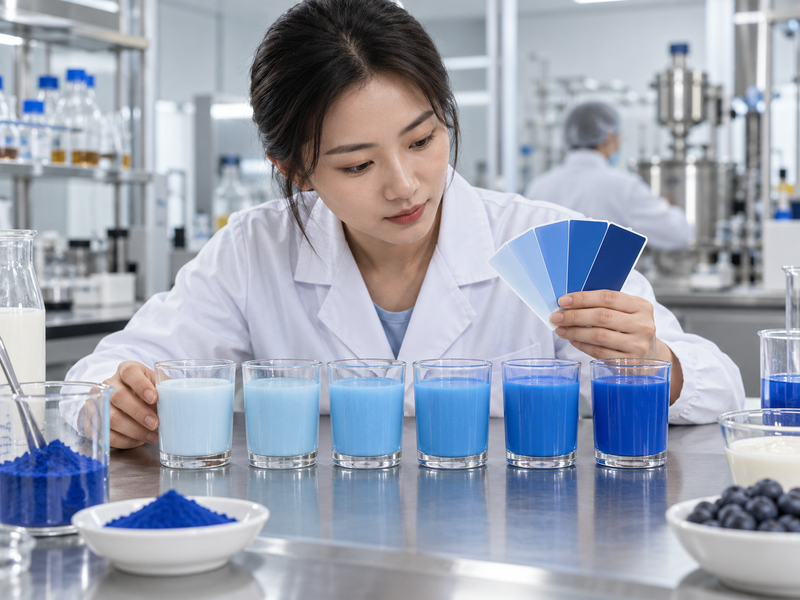
Select the approved reference and prepare a fixed viewing setup: light source, background, container, fill depth and sample temperature. Record instrumental color if the product permits it, plus a clear visual description of intensity, hue and uniformity. In clear drinks, absorbance may help; in opaque products, a colorimeter may be more suitable. Measure pH and haze alongside color because a shift in scattering can resemble pigment loss. Use a time axis: compare at fill, after any process hold, at pack release and at complaint age.
One faded consumer pack compared with a fresh laboratory cup confounds age, pack and preparation. State the scale of change against a product-specific acceptance range, including method variability. If no standard existed, document the current difference and establish a provisional investigation threshold without pretending it was an original release limit. The goal is a reproducible failure definition that experiments can test.
| Description | Measurement | Interpretation to test |
|---|---|---|
| Pale but clear | Color or absorbance | Pigment loss or underdose |
| Greenish hue | Hue and pH | Matrix or pigment change |
| Cloudy blue | Haze and color | Aggregation or scattering |
| Uneven color | Spatial samples | Mixing or settling |
3. Which lots and records define the scope?
Build a linked batch genealogy
Connect finished lots with raw extract lots, formula revisions, process lines, packaging lots, production dates and distribution routes. Include other products that used the same extract, even if no complaint was filed. Compare an unaffected control lot made near the same time. Ask whether new extract packs were opened mid-run, whether rework was added, and whether a line stop changed hold time.
FDA’s traceability-lot-code explanation describes how linked lot information supports tracing for foods covered by that rule; similar clear links make this investigation practical regardless of the product’s legal classification. Look for a boundary: if only one filler shift is affected, investigate equipment and handling before treating every supplier lot as suspect. If multiple plants using one extract lot show the same failure, raw material rises in priority. Record the basis for each hold expansion or release.

4. Could the measurement itself have changed?
Audit method before declaring chemistry
Confirm instrument calibration, wavelength or color geometry, blank, sample concentration, cuvette path length, viewing light and operator technique. A clear drink measured with a different dilution can appear weaker without any change in finished product. A cloudy sample can scatter light and distort an absorbance result. Re-measure approved and suspect retains side by side under one protocol, with duplicates and a control material. NIST’s molecular spectrophotometry work explains the role of wavelength and absorbance references in reliable measurements.
Do not stop at a number: review visual appearance too. If both methods agree that color changed, continue to material and process tests. If only one method changed, investigate preparation, calibration and sample handling. Document the raw readings and calculations, not merely the pass/fail line. A method correction should be controlled and applied consistently to past and future lots.
| Method risk | Quick check | Evidence to retain |
|---|---|---|
| Dilution error | Independent gravimetric prep | Weigh records |
| Instrument drift | Reference standard | Calibration result |
| Haze interference | Visual and turbidity check | Photographs/readings |
| Lighting change | Fixed light booth | Setup record |
5. How should raw extract be compared?
Use sealed retains and an agreed standard method
Inspect current and approved extract packs for seal damage, moisture uptake, caking, unexpected odor, and mismatched labels. Verify SKU, carrier and specification revision before comparing E-value or application shade. Prepare both powders with the same method and read them in one laboratory session. Use sealed supplier retains where available to separate transit or warehouse exposure from manufacture. A paired application test helps: add each powder to the same fresh base formula at equal intended dose.
If powder values differ but finished color does not, the raw difference may be within practical use tolerance. If powder values match but only commercial product faded, process or pack becomes more likely. The site’s blue spirulina guide emphasizes color performance in the actual matrix. Ask the supplier for its retained-lot data and any documented carrier or packaging changes. Do not treat a COA alone as proof that every container stayed equivalent after shipment.
6. Which process exposures deserve priority?
Reconstruct actual product conditions
Plot product temperature against time from pigment addition through filling and cooling. Add pH, mixing hold, air incorporation, filtration, cleaning carryover and light exposure at each stage. A heat treatment may be unchanged on paper while a line stop lengthened pigment residence time. Probe actual product temperature rather than jacket setpoint. Phycocyanin’s heat and pH response in experimental work suggests useful hypotheses, not a universal failure threshold.
Follow the break: compare samples before and after each unit operation if retains exist, or reproduce those operations in a controlled trial. If fading begins after a filter, check whether the pigment adsorbs or aggregates; if it appears after filling, examine pack and storage. Review CIP records for abnormal residual cleaning agent because a changed local pH can matter. Keep the investigation open to dose and blending errors as well as chemical instability.
| Process stage | Record to review | Diagnostic sample |
|---|---|---|
| Color addition | Weigh and mixing log | Post-addition blend |
| Heat exposure | Product time-temperature trace | Before/after heat |
| Filtration | Filter change and pressure | Feed and filtrate |
| Fill and cool | Hold, light and pack data | Early/late packs |
7. How can formula and pack effects be separated?
Compare controlled swaps
Check formula revisions for acids, minerals, flavors, preservatives and carrier changes. Measure the pH of complete finished product, not only the base before extract addition. Then prepare a small matrix using approved and suspect formula bases with the same extract lot. A difference between bases points toward an interaction, while a difference between extract lots in the same base points toward material. Separately, pack one formula in the old and new container and compare under the same storage exposure.
Watch hidden changes: a new clear bottle may increase light exposure; a different cap may change seal integrity; a new headspace may change product appearance over time. Published phycocyanin storage research found temperature-dependent loss in its tested extract, so actual warehouse logs belong in the comparison. Do not infer a complete mechanism from a single stressed bottle. Use unopened replicates at each pull.

8. What experiments identify a likely cause?
Test one hypothesis at a time
Use a short plan with controls: same extract across two pH values, same formula with and without the suspect heat hold, or identical product in two pack types. Choose conditions based on recorded plant ranges, not extreme exposures that could make any blue fail. Include replicates and randomize evaluation order when practical. Record fresh color and change over a specified time. A decisive test predicts the observed pattern: if only suspect production lots faded after a longer hold, reproduce both actual holds and compare results.
If light is suspected, equalize temperature and compare light versus dark storage. A result that merely shows phycocyanin can fade under harsh conditions does not explain this complaint. Use a simple cause matrix to track evidence for and against each hypothesis. Repeat the most promising result at pilot scale before changing production.
| Hypothesis | Controlled contrast | Result that supports it |
|---|---|---|
| Excess heat hold | Recorded normal versus suspect profile | Matching color-loss gap |
| Formula pH shift | Old versus new base | Loss follows base |
| Pack light exposure | Same product, two packs | Loss follows exposure |
| Raw lot difference | Two extracts, one base | Loss follows extract |
9. How should corrective action be proven?
Verify the fix under production conditions
Translate the identified cause into one controlled action: a later addition step, tighter hold limit, revised pH control, new pack, improved line mixing or supplier change. Do not increase dose as a default response; overdosing may mask fading at fill while leaving the failure mechanism intact and raising cost. Run a pilot or monitored production trial using the corrected condition and an unchanged comparison. Measure color at fill and throughout a justified storage interval, with food-safety and sensory checks where relevant.
Define success before the run: require an agreed finished-product color range, acceptable variability and no adverse effect on texture, clarity or shelf life. Update batch sheets, training, specifications and change-control records. If the action changes thermal processing or preservation, the food-safety team must validate that system independently. The supplier may support sample and technical-data review through its contact page, while manufacturer QA owns final release.

10. What closes the investigation?
Document disposition, cause and monitoring
Write a final report that states affected lots, hold decisions, confirmed failure definition, evidence tested, most likely cause, corrective action and verification results. If evidence supports multiple contributors, describe each rather than forcing one simple explanation. Record the disposition of held stock and any customer communication under the company’s quality procedure. Keep the watch period: trend color from several later production lots and normal storage pulls to confirm the fix persists. Assign owners and dates for supplier feedback, procedure revision and operator training.
A separate regulatory review may be necessary when color loss changes a label claim or market-specific product specification; avoid assuming color is only cosmetic. Close the case when the chosen correction is implemented, verified and linked to routine controls, not when a single replacement sample looks blue. Retain the paired materials and data so a repeat event can be recognized quickly.
| Closure item | Proof | Owner |
|---|---|---|
| Affected lot disposition | Hold and release record | QA |
| Cause conclusion | Controlled comparison | Investigation lead |
| Corrective action | Pilot and storage verification | Process owner |
| Continued monitoring | Later lot trend | Quality |
Conclusion
A disciplined color-loss investigation contains affected product, defines the change, and compares raw material, process, formula and package under controlled conditions. The strongest cause is the one that reproduces the observed failure pattern. Prove the correction at production scale and keep measuring during normal storage. This turns an unsettling blue-color complaint into a documented improvement the supplier and factory can both support.
FAQ
Q1: Should the team raise extract dose immediately? No. Identify where loss occurs and test its cause before changing dose.
Q2: Does a passing COA clear the supplier lot? No. Compare sealed retains and performance in the actual food matrix.
Q3: Can a packaging change cause fading? Yes, if it changes light, moisture or storage exposure; prove the link with paired packs.
Q4: What if only instrument data show loss? Audit preparation, calibration, haze and viewing conditions before concluding the product changed.
Q5: When is the case closed? After lot disposition, cause assessment, verified corrective action and a defined monitoring period are documented.