
A blue edible ink can look excellent in a cup yet clog a printhead or bleed across a wafer. A blue spirulina extract edible ink trial tests the complete ink, printer and food surface together. This guide gives production and development teams a controlled screen for jetting, image quality and color after drying. Research on edible inkjet ink performance reports that viscosity and surface tension affect print quality; phycocyanin adds its own sensitivity to the formulation and storage conditions.
Contents
- What printing job should the brief define?
- Which blue extract can enter an edible ink?
- How should the liquid vehicle be screened?
- What must be checked before using a printhead?
- How do food substrates change print quality?
- Which print metrics should operators capture?
- How should color be assessed after drying?
- What controls keep the ink usable during a shift?
- How should printed foods be stored and tested?
- What evidence supports line approval?
1. What printing job should the brief define?
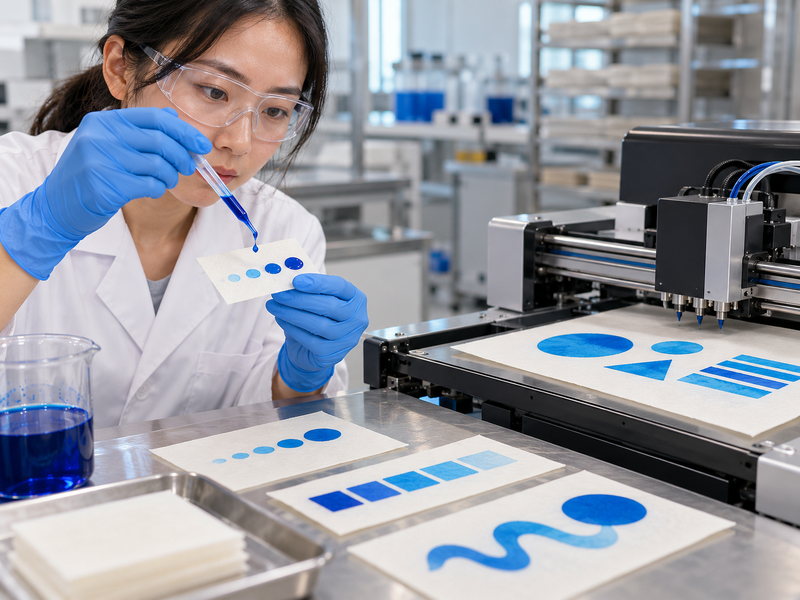
Specify the mark and the food surface
Begin with the actual job: a logo on a wafer, a date on an icing sheet, or a decorative mark on a coated confection. Record image dimensions, minimum line width, production speed, allowed color spread and the appearance required at dispatch. A broad blue fill is easier to judge visually than small type that must remain legible. Name the substrate supplier and surface condition, including moisture, temperature and coating. Set acceptable yield and cleaning frequency, not only a photograph target.
The practical boundary: a colorant powder is an ingredient, not a ready-made ink. Printer compatibility depends on a formulated liquid and the equipment maker’s permitted fluids. A trial that proves a bench syringe can draw blue liquid has not established safe, repeatable printing. Define whether the intended item will be consumed, since direct printing on food requires a review of every ink ingredient and its permitted use in the destination market.
2. Which blue extract can enter an edible ink?
Qualify the ingredient before formulating fluid
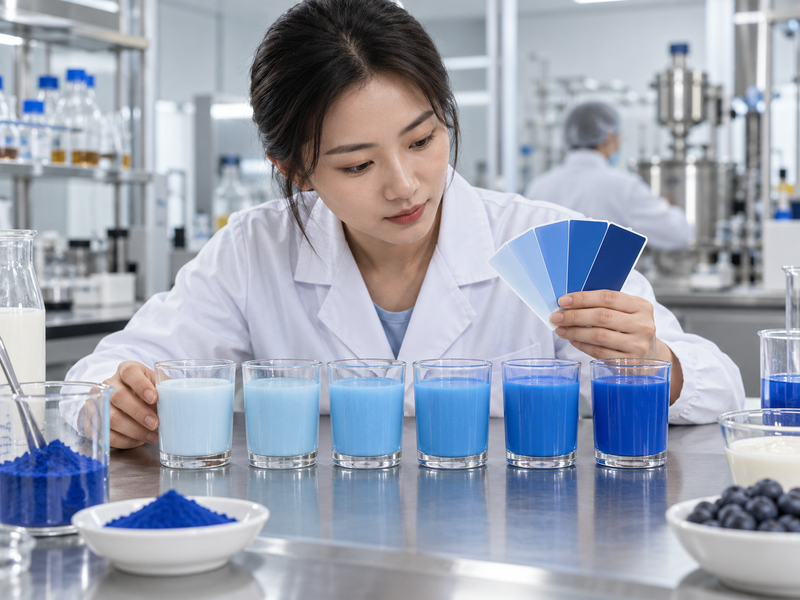
Request the exact SKU, traceable commercial lot, carrier declaration, color-value method, particle or insoluble-matter information, microbiological data and storage guidance. A water-soluble phycocyanin-rich extract may be a candidate; whole green spirulina powder brings cellular solids and is a different print challenge. The supplier’s blue spirulina guide distinguishes these categories and recommends checking the finished application. Keep a sealed retain and compare incoming lots with a defined reference solution.
Do not equate food-grade with printer-ready. A food-grade carrier can still leave residue in a nozzle or shift viscosity. Ask the ink formulator to document every added humectant, solvent and preservative. Regulatory review should cover the complete formula and the specific food category, not just a certificate for blue extract. In the United States, FDA color-additive guidance explains that listed uses and restrictions matter.
| Ingredient evidence | Review question | Trial use |
|---|---|---|
| Extract lot and retain | Is supply traceable? | Reference for later lots |
| Carrier statement | What else enters the ink? | Formula and label review |
| Insoluble-matter result | Could solids affect flow? | Filtration decision |
| Color-value method | Is shade comparable? | Incoming check |
3. How should the liquid vehicle be screened?
Build a small formulation matrix
Prepare a limited set of vehicles that vary only one parameter at a time: extract concentration, permitted humectant level, water quality or pH adjustment. Measure viscosity at the printer’s operating temperature, surface tension, pH, conductivity if relevant, and visible insolubles. Use the printhead manufacturer’s fluid window as a design constraint. A number from another printhead is not a universal target. Record the mixing order and filter type; a filter can remove clumps but may also reduce color strength if pigment is retained.
Look for change over time: measure the fluid again after the planned production hold, not just at fresh preparation. Phycocyanin is sensitive to pH, temperature and light in experimental research, so an attractive fresh vehicle needs an aged-fluid check. If acidity needed for preservation damages shade, treat that as a design conflict requiring reformulation or another color system.

4. What must be checked before using a printhead?
Protect equipment and food hygiene
Ask the equipment supplier or qualified ink specialist to approve a narrow fluid-screen protocol before charging the head. Check material compatibility, allowable viscosity and surface tension, filtration, cleaning method and whether the head has ever held nonfood ink. Use equipment dedicated and controlled for food production. Start with a small, measured volume, perform nozzle checks at a defined interval and record misfires, streaks and cleaning cycles.
Stop for evidence: a clogged nozzle should prompt inspection of fluid age, filter integrity, precipitation and head conditions before increasing pressure or repeatedly purging. Capture printer temperature and waveform settings, since changing them can mask a weak formulation. Do not claim that blue extract alone is compatible with any printer. Original edible-ink research identifies viscosity and surface tension as print-quality variables; actual acceptance must come from the chosen hardware and complete ink formulation.
| Pre-print check | Evidence | Failure response |
|---|---|---|
| Equipment status | Food-use and cleaning record | Hold until cleared |
| Fluid window | Measured properties at use temperature | Reformulate or reject |
| Filtration | Filter rating and pressure trend | Inspect solids |
| Nozzle check | Pattern and misfire count | Investigate before run |
5. How do food substrates change print quality?
Compare at least two relevant surfaces
Print the same test image on the intended substrate and a controlled reference sheet. Record surface moisture, temperature, coating, roughness and time since manufacture. A porous wafer may wick liquid and widen a line; a smooth sugar coating may resist wetting and produce beads. Repeated passes can deepen blue but increase bleeding or slow drying.
A study of printable edible films evaluated distinct substrate materials; that work illustrates why the surface belongs in printability testing, though its exact ink and equipment do not define this application. The approval unit is the food plus ink. If the food surface changes between suppliers or lots, inspect whether the old print setting still works. Include a realistic surface after normal storage, not only a freshly prepared ideal sheet.
A decorative mark should remain readable after downstream handling and packaging.
6. Which print metrics should operators capture?
Make visual quality measurable
Choose a simple test pattern containing fine lines, a solid patch, registration marks and a representative logo. Scan or photograph each under fixed settings, then measure line width, edge spread, missing dots, patch uniformity and color. Count rejects per defined number of pieces rather than saying the run “looked good.” Log printer speed, head gap, pass count and substrate conditions. Separate failure types: faint blue can reflect a low pigment dose, an under-delivering nozzle or poor surface holdout.
A blurred border may reflect excess liquid even when color is strong. Compare the metrics with an approved reference and agree tolerances based on customer readability and plant capability. Include operators from production and quality in the assessment; a design team may prefer darker color while a line team needs stable jetting and fast drying. Capture ink usage per acceptable print so procurement can calculate true cost.
| Metric | How to capture it | Decision it supports |
|---|---|---|
| Line width | Fixed-resolution image | Legibility |
| Missing dots | Nozzle/test-pattern count | Head reliability |
| Solid-patch uniformity | Visual and color reading | Shade consistency |
| Reject rate | Pieces rejected per run | Economic feasibility |
7. How should color be assessed after drying?
Measure fresh and settled prints
Record color immediately after printing, after the normal drying interval and after the food is packaged. Use the same instrument geometry or fixed-light visual setup each time. A wet print can appear deeper than a dried one; an absorbent substrate may pull pigment below its surface. Compare patch color with the actual finished-food standard, not only an extract solution. Measure the substrate’s unprinted background because a cream or yellow base shifts perceived blue. The critical comparison: check hue and edge quality together.
Increasing ink laydown to compensate for a pale dried patch might make lines bleed. If a lighter background is necessary for brand blue, the substrate or primer may be the design variable. Phycocyanin’s light sensitivity means display exposure belongs in the later study, but avoid assigning every color change to light before checking pH, moisture and print uniformity.

8. What controls keep the ink usable during a shift?
Define preparation, hold and discard rules
Issue a batch sheet for the complete edible ink with weighed ingredients, mixing order, filter step, covered hold, container ID and use-by time justified by testing. Sample from the reservoir at shift start and near the end. Track viscosity or a validated quick surrogate, pH, shade, nozzle checks and microbiological controls under the food-safety plan. Limit exposure to heat and direct light where supported by trial data. Plan for stoppages: an open reservoir can concentrate through evaporation while idle, changing viscosity and dose.
State whether operators may recirculate, top up or reuse returned ink, and require a recorded approval for any rework. The site’s OEM and formulation services page describes documentation and sample coordination; translate those inputs into controlled plant instructions. A supplier extract certificate cannot replace in-process control of the formulated ink.
| Shift event | Check | Record |
|---|---|---|
| Fresh ink release | Identity, pH and flow properties | Ink batch sheet |
| Printer start | Nozzle pattern and image | Start-up log |
| Line stop | Reservoir age and evaporation | Stop/restart record |
| End of use | Quantity and disposition | Reconciliation |
9. How should printed foods be stored and tested?
Follow the print through distribution
Pack the printed food in its commercial wrap and run a study at intended storage conditions. Compare a justified light or humidity challenge when those exposures are plausible. At each pull, check color, line edge, transfer to wrapper, surface tack and food quality. Include food-safety testing dictated by the product’s hazard analysis. A crisp image at the end of the printing shift does not answer whether it survives a warehouse or retail shelf.
Keep samples independent: opening and resealing one pack every week changes its exposure. Use separate units for each pull. If an ink ingredient changes water activity at the surface, assess the consequence in the finished food rather than inferring it from bulk product alone. A stress test can reveal a weakness but cannot by itself set the shelf-life date. Write a failure description precise enough to guide reformulation: fading, bleeding, transfer and background discoloration need different actions.
10. What evidence supports line approval?
Approve one defined system
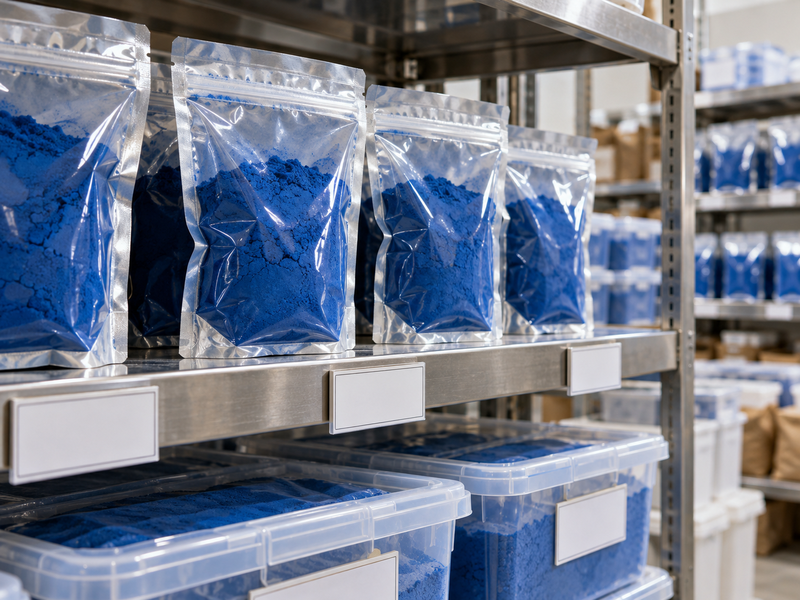
Collect the complete ink recipe, extract lot and carrier statement, substrate specification, printer model, approved settings, cleaning method, sample images, reject data and packaged stability results. The regulatory lead must verify every ingredient’s permitted use on the intended food in each market. For U.S. use, check the current FDA spirulina extract listing and restrictions; the 2026 broadening had a delayed effective date according to FDA’s color-additives update.
Keep change control explicit: a new substrate coating, printhead, carrier or extract grade may alter wetting and color even when the image file is unchanged. Set a small verification run after such changes. A production release should state the accepted appearance, test method, operating window and owner for deviations. Only then does a promising blue sample become a manageable commercial printing process.
| Change proposed | Minimum impact check | Release owner |
|---|---|---|
| Extract or carrier | Flow, shade and regulatory review | QA and development |
| Printhead | Nozzle and cleaning qualification | Engineering |
| Substrate coating | Wetting and dry image | Product team |
| Pack | Transfer and color retention | Quality |
Conclusion
Edible printing succeeds when the blue extract, liquid vehicle, printhead and food surface operate as one qualified system. Measure jetting and image quality on the real substrate, then follow color through drying and packaged storage. Ask the supplier for a traceable extract sample and complete composition, and build the pilot around your printer’s fluid limits. That approach protects both the design and the production line.
FAQ
Q1: Can blue extract powder be poured into a cartridge? No. An edible ink requires a qualified complete formulation and equipment-compatible fluid properties.
Q2: Does “food-grade” mean an ink is approved for every printed food? No. Review each ingredient and the specific food use in the destination market.
Q3: Why does a logo bleed on wafer but not icing? Surface moisture, porosity and coating change droplet spread and drying.
Q4: What if color looks pale after drying? Check substrate background, ink laydown and measured pigment delivery before raising the dose.
Q5: Which retain matters most? Keep sealed extract, complete ink and printed finished-food samples linked to one documented trial.