
The same blue pigment can look different in a sugar glaze, an icing, a panned shell and a fat-rich coating. Each system has its own water content, application temperature, drying path and substrate color.
This guide treats blue spirulina confectionery coating as a process choice. It focuses on whether a named phycocyanin grade can be introduced into the coating, applied uniformly and kept attractive in the retail pack. Phycocyanin is water soluble and sensitive to conditions including pH, temperature and light, as a peer-reviewed review explains. That chemistry informs the trial; it does not make every coating matrix interchangeable. A confectionery trade report shows the commercial context, while the buyer’s own formula test must settle the specification.
Contents
- Which coating system is being colored?
- How does the pigment enter a water or fat matrix?
- What should be recorded about the substrate?
- Where does temperature affect the coating?
- How can the powder be dispersed evenly?
- How should the target shade be judged?
- What defects appear during application?
- How can drying and storage alter the finish?
- What should a pilot run measure?
- What belongs in the purchase specification?
1. Which coating system is being colored?
Name the medium before choosing a grade
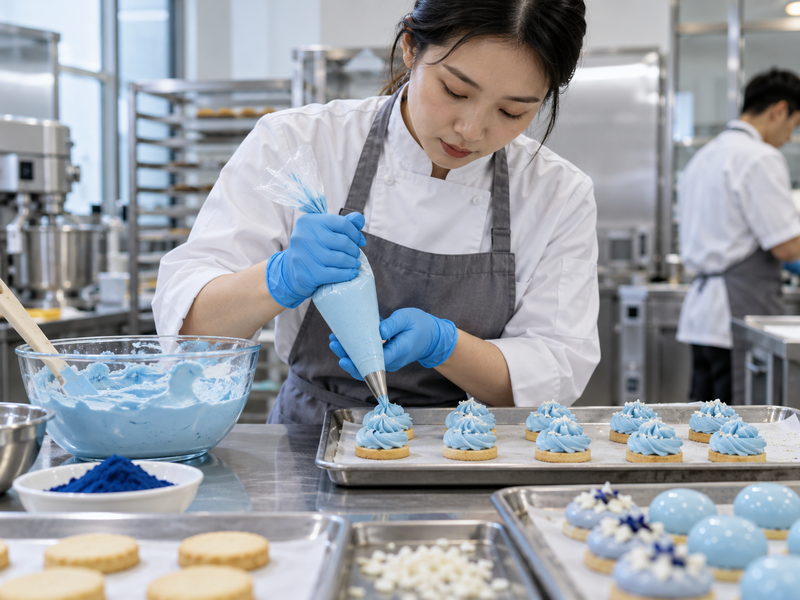
Sugar glaze, water-based icing, panned shell, compound coating and chocolate-style enrobing have different continuous phases. A water-soluble blue ingredient may enter an aqueous glaze readily but require a different incorporation strategy in a fat-rich system. Do not approve a grade from a generic “confectionery” sample. Record the actual coating recipe, viscosity range, solids, process equipment and finished product. If the product has several colored layers, name which layer contains the pigment.
Keep the substrate and coating thickness fixed when comparing suppliers. A blue film over a yellow base can appear greenish even if the coating itself is blue. Include an uncolored coating and a current color reference. State whether the brand needs a transparent wash, opaque blue shell or marbled effect, since each calls for a different visual acceptance test.
| Coating field | Record | Why it matters |
|---|---|---|
| Continuous phase | Water-rich or fat-rich | Governs incorporation trial |
| Substrate | Color and surface | Alters apparent shade |
| Target thickness | Application range | Changes color intensity |
| Finish | Gloss, matte or opaque | Changes light response |
| Pack | Material and light exposure | Affects stored appearance |
2. How does the pigment enter a water or fat matrix?
Test compatibility before scaling the color dose
Phycocyanin is described as water soluble in the stability literature. That property does not mean a commercial powder will distribute evenly in an anhydrous fat coating. The powder may contain carriers, and a water premix could alter coating viscosity, flow or shelf behavior. Ask the supplier for the full as-sold ingredient declaration and a formulation recommendation for the exact medium. Then verify it under your process rather than assuming a demonstration for icing applies to enrobing.
For water-rich coatings, watch for wetting, foam and residual specks. For fat-rich coatings, record whether the proposed incorporation method leaves particles, changes temper-like behavior or produces a separated phase. Any emulsifier or added water is a formula change for R&D and quality to review. A failed fat-system trial does not mean the pigment is generally poor; it means the grade or incorporation method did not meet this coating’s requirements. Keep the test result tied to a named supplier lot and formula version.
| Medium | Primary trial question | Potential defect |
|---|---|---|
| Aqueous glaze | Does powder wet and disperse? | Specks or foam |
| Icing | Does blue remain uniform as it sets? | Streaks |
| Fat-rich coating | Is the incorporation route feasible? | Particles or separation |
| Panned shell | Is color even across cycles? | Mottling |
3. What should be recorded about the substrate?
Measure the base product separately
The coated product starts with a surface color, texture and moisture level. A white center, brown chocolate base and yellow baked piece will display the same blue coating differently. Record the substrate lot and inspect its color before coating. Use pieces of similar size and surface roughness in a supplier comparison. Otherwise the buyer may attribute an appearance difference to the pigment when the base was the real variable.
Check whether the coating adheres and covers the surface uniformly. A rough piece can leave thin spots that show the underlying color; a smooth piece may produce a more even blue at the same dose. If the base can exchange moisture with the coating, monitor that interaction during storage. Keep an uncolored coated control to reveal changes from the coating formula itself. The product developer can use a cut piece or cross-section photograph to separate surface coverage from pigment hue. The acceptance target should describe the retail piece, not the color of a pooled coating sample.
4. Where does temperature affect the coating?
Map mixing, application and drying exposure
Record product temperature through coating preparation, holding, spraying or enrobing, and drying or setting. A powder added to a cool premix may later spend a long period in a warm coating tank. A brief laboratory brush application will not reproduce that hold. Phycocyanin temperature sensitivity has been studied under several conditions, but the published review does not supply one universal limit for every commercial grade and coating matrix.
Prepare samples before application, after application and after final set. If the shade changes, compare the stage samples before changing the pigment dose. A late color addition may reduce exposure but also create distribution or hygiene issues. Process and food safety staff should approve any revised order. Include a normal production stop in the pilot if held coating is common on the line. The hold sample may reveal fading or settling that a continuous short run misses.
| Stage | Record | Sample to retain |
|---|---|---|
| Premix | Temperature and mixing time | Wet coating |
| Tank hold | Time and agitation | Held coating |
| Application | Product temperature | Fresh coated piece |
| Dry or set | Air/product conditions | Finished piece |
| Pack | Time after setting | Retail sample |
5. How can the powder be dispersed evenly?
Match the plant’s addition sequence
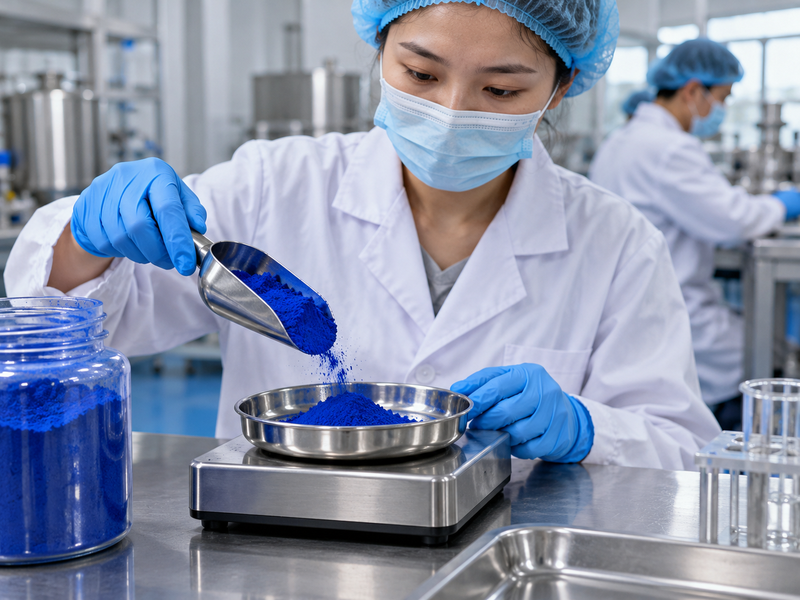
Test a weighed dose with the production mixing tool and batch size, or the closest practical pilot setup. Record addition rate, premix medium, shear and time. Watch for dry powder on the tank wall, color streaks and material left in transfer lines. A high-shear bench test may make a grade appear easy to use while the plant’s lower-shear process leaves visible flecks. If a premix improves dispersion, include its preparation and hold conditions in the manufacturing instruction.
Avoid adding a new carrier or solvent during the test without documenting it. A supplier may send a ready-made liquid sample that does not represent the quoted powder. Compare the same as-sold grade that procurement will order. Take coated pieces from multiple points in the run to test distribution, not only a pooled sample. If the blue concentrates toward the end of a tank, the problem may be settling or incomplete mixing rather than pigment strength. The process should yield the same appearance after routine operator changes and line stops.
6. How should the target shade be judged?
Compare finished pieces at fixed thickness
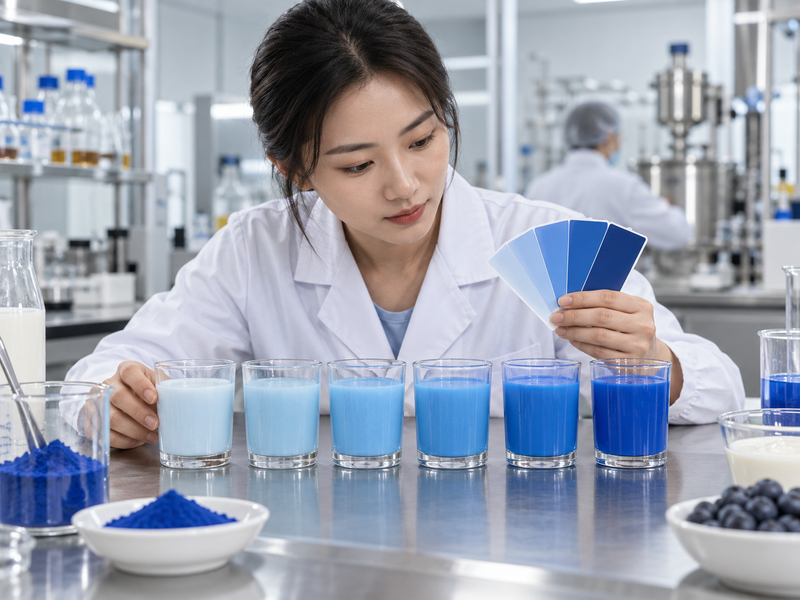
Prepare a small dose ladder at the intended coating thickness and inspect after the finish has set. A thicker coating can deepen color without a stronger pigment, so measure coating pickup or another plant control. Review the product under consistent lighting and background. Where instrumental measurement is used, document the method and sample presentation; curved, glossy confectionery surfaces can challenge a simple flat-sample reading. Keep a physical approved reference in its retail pack.
Record hue, lightness, mottling and visible base show-through separately. An average color value may look acceptable even when individual pieces vary badly. Count defects using a defined sample plan. Procurement should compare cost at the dose and pickup that meet the finished-piece target, including process loss. Do not use the powder’s E grade alone to predict a blue shell. The grade is an input to the trial; the finished product establishes whether it is commercially useful.
| Color measure | What it shows | What it can miss |
|---|---|---|
| Approved reference | Brand target | Lot variation |
| Instrument reading | Repeatable coordinate | Local streaks |
| Coverage inspection | Base show-through | Subtle hue drift |
| Coating pickup | Applied mass | Pigment distribution |
| Defect count | Piece-to-piece quality | Flavor |
7. What defects appear during application?
Name the defect before changing the formula
Streaks can follow poor mixing or uneven flow. Specks may be undispersed powder. A thin edge or pale patch can reflect coverage rather than phycocyanin loss. Blue bleeding into another layer may come from moisture movement. Photograph the defect at the stage it first appears and retain affected pieces. A description such as “color unstable” is too broad for a supplier or process engineer to act on.
Run an uncolored coating control and a reference-color batch through the same line when feasible. Record nozzle or enrober settings, pan cycle, application rate, product temperature and drying conditions. Change one factor at a time in the next trial. A higher pigment dose can hide mild coverage gaps but may worsen cost or alter the coating formula. If defects appear only after packing, review moisture and package exposure. The troubleshooting record should direct the team to mixing, application, drying or storage rather than repeatedly replacing the ingredient without evidence.

8. How can drying and storage alter the finish?
Keep the retail pack in the trial
Compare pieces immediately after coating, after drying or setting, and after packaged storage. Record air and product conditions during finish, then store sealed packs under the intended distribution setting. Light and temperature can affect phycocyanin appearance, while moisture movement can change gloss, texture and surface color. The food safety and packaging teams own moisture and shelf-life controls; a color adjustment should not silently weaken them.
Inspect shade, gloss, sticking, cracks, bloom and blue transfer onto the wrapper. Use separate packs for destructive checks. A clear pack may expose the surface to more retail light than an opaque pouch; test the actual options instead of extrapolating from a covered tray. If the blue changes only on the surface while a cut interior retains color, focus on coating exposure and package behavior. Document the actual storage condition rather than calling a cabinet “ambient.” Do not infer an end-of-life claim from a single accelerated observation.
| Checkpoint | Color observation | Other observation |
|---|---|---|
| Fresh coat | Initial hue and coverage | Flow and streaks |
| After set | Final working shade | Gloss and texture |
| Early storage | Surface drift | Transfer or sticking |
| End of target life | Retail acceptability | Pack and moisture |
9. What should a pilot run measure?
Capture variation across equipment and lots
Use the exact supplier SKU and commercial-lot sample proposed for purchase. Run a pilot at representative coating load, speed, hold time and application settings. Pull pieces from the beginning, middle and end, including after a normal stop if that occurs in production. Record coating pickup, color distribution, defects and process loss. A second pigment lot should be checked before a large recurring contract where possible.
Retain uncoated base pieces, wet coating, finished pieces and sealed packs under labeled conditions. If the pilot differs from the bench, find the first stage where the result changed. Check base color, addition method, tank residence and drying before concluding that the powder is inconsistent. A revised formula or coating path creates a new trial version. The final approval should identify the matrix and process tested, so a different product line cannot reuse the color result without review. Production needs a written control it can sample and measure on every shift.

10. What belongs in the purchase specification?
Tie the blue grade to the coating use
List supplier, SKU, full as-sold composition, color-value method, lot COA, packaging and change-notification terms. Attach the application trial with coating formula, substrate, dose, addition route, process settings and finished-pack target. A generic “blue spirulina” line item could allow a carrier or grade substitution that does not work in the approved matrix. Quality should retain an ingredient sample and a finished coated-piece reference for later investigations.
Regulatory staff should verify intended market, food category and labeling before release. In the United States, the current spirulina extract rule must be read for the actual use; the ingredient’s attractive appearance does not expand permitted categories. Process and food safety teams should separately approve any modified coating preparation. Once those checks are signed, procurement can buy the tested grade and receiving can compare incoming lots with a document that describes the material and its approved application.
Frequently asked questions
Q1. Can the same grade color icing and a fat-rich coating? Test each matrix. Water solubility does not establish fat-system performance.
Q2. Does a higher E value solve streaks? Streaks usually need a process investigation before a dose change.
Q3. Should color be judged in the wet coating? Record it, then approve the set and packed piece.
Q4. Can a package change protect blue? It may, but test color and moisture performance in the intended pack.
Q5. What should a supplier sample include? Request a named commercial lot, full carrier declaration, specification and COA.
Request a coating-specific sample
Tell Spirulina CN the coating medium, substrate, application temperature, finish and package. Request the exact grade and commercial-lot documents. Compare the sample in a controlled pilot run before approving the purchase specification.