
For Arthrospira platensis vs maxima spirulina extract US color projects, the first purchase gate is source identity. The operative U.S. color-additive rule describes spirulina extract as filtered aqueous extract of dried Arthrospira platensis biomass, with phycocyanins as principal coloring components. A separate FDA GRAS notice 424 discusses a phycocyanin-enriched water extract from A. maxima or A. platensis, but its FDA response says some uses may require a color-additive listing.
The notice does not rewrite 21 CFR 73.530. The 2026 foods-generally expansion was delayed indefinitely. Buyers should verify organism and process before a color trial or regulatory sign-off.
Contents
- What is the source-identity decision?
- What does the operative U.S. color rule actually name?
- Why does GRAS notice 424 mention both species?
- Which supplier organism records should be requested?
- How should extraction and filtration be checked?
- What about carriers and as-sold composition?
- How should lots be traced through production?
- Does species identity settle the finished-food use?
- How should an alternative source be handled?
- What should the buyer approve before ordering?
1. What is the source-identity decision?
The question is narrow: does the proposed blue color SKU match the source organism and manufacturing identity of the U.S. spirulina-extract color listing? Do not use “spirulina” as the sole material description. Ask for the taxonomic name on the supplier’s controlled specification and its relationship to cultivation, biomass and extract records. Product pages may use familiar marketing names while legal rules use precise names. The buyer must know which organism actually entered the extraction process for the lot to be shipped.
A material can be attractive, high in phycocyanin and still need a different regulatory analysis if its source is not the one named in the listing.
Keep separate questions for ingredient safety, color-additive identity and finished-food category. They are not interchangeable. A source identity check is an upstream gate that should happen before R&D spends money optimizing hue. If an offered SKU is from a different organism, pause its use as a U.S. spirulina-extract color pending a qualified regulatory review; do not make a sweeping statement about whether that species can ever be used as food. The decision is about this specific color rule and specific technological function.
| Gate | Buyer question | Needed evidence |
|---|---|---|
| Organism | Which Arthrospira species? | Controlled species declaration |
| Process | How was color extracted? | Process-flow summary |
| Function | Why is it added? | Finished formula/use statement |
| Destination | Which rule applies? | Regulatory review |
2. What does the operative U.S. color rule actually name?
The 2025 codified §73.530 text states that spirulina extract is prepared by filtered aqueous extraction of dried Arthrospira platensis biomass and contains phycocyanins as principal coloring components. The text also covers specifications, allowed food categories, conditions of use and labeling. It does not name A. maxima as an alternative source for that listed color additive. Read the whole section, not an isolated line from a color supplier’s brochure.
Verify the regulation at the transaction date, especially for a launch planned after the article’s September 2026 display date.
The February 2026 order for broader food uses and revised specifications was delayed indefinitely in March 2026, so it should not be treated as operative for these September articles. That delay does not erase existing listed categories; it means buyers must use the currently effective section rather than the delayed expansion. Do not describe all foods or all dosage forms as permitted. The extract’s identity and its use both need to fit.
If the supplier has an internal U.S. compliance statement, request the exact regulatory version and SKU to which it applies.
| Rule element | Operative question | Frequent error |
|---|---|---|
| Source | Dried A. platensis? | Treating “spirulina” as enough |
| Extraction | Filtered aqueous route? | Ignoring process identity |
| Specifications | Lot meets listed limits? | Assuming blue shade proves purity |
| Uses | Exact food category listed? | Citing delayed broad expansion |
3. Why does GRAS notice 424 mention both species?
The FDA GRAS notice 424 inventory entry, closed in 2012, concerns a C-phycocyanin-enriched water extract of A. maxima or A. platensis for specified food-ingredient uses. Its displayed FDA response is “FDA has no questions; some uses may require a color additive listing.” The notice concerns a particular notifier’s conclusion and intended conditions, not every producer’s SKU.
Critically, it does not grant a blanket exemption from color-additive rules when the material is used to color food. The 2013 Federal Register color rule separately established the A. platensis identity for the listed color additive.
Do not claim A. maxima is generally prohibited in food. The point is narrower and more useful: an A. maxima extract cannot simply be called the listed U.S. spirulina extract color on the strength of GRN 424. Ask regulatory counsel to evaluate any alternative material and purpose under the applicable framework. This distinction matters when supplier teams cite a GRAS entry in a color-sales deck. Procurement should keep a copy of the exact notice, use description and FDA response with the regulatory decision.

4. Which supplier organism records should be requested?
Request a signed species statement for the production SKU, cultivation source records, biomass lot IDs and a description of identification controls. Ask how the supplier prevents mixing of A. platensis with other organisms or grades in sourcing, extraction and packaging. The level of analytical confirmation should reflect the company’s risk assessment; a buyer should not invent a universal DNA-testing requirement. If identification relies on supplier strain records, cultivation controls and incoming acceptance, document that chain and the reviewer who accepted it.
Marketing labels such as “Spirulina maxima blue” or “spirulina blue” are signals to ask more questions, not conclusive taxonomy.
Check whether taxonomic synonyms appear in documents and reconcile them with the rule’s wording. A TDS may say Spirulina platensis while the regulatory text says Arthrospira platensis; the supplier should explain its nomenclature and show that the actual organism is the intended one. Do not assume a name discrepancy is fraud or harmless. Keep the signed statement attached to a SKU and manufacturing site, not merely a brand family.
A change in biomass supplier or strain should trigger review before the material is used in a U.S. color project.
| Record | Match to | Why it matters |
|---|---|---|
| Species declaration | TDS and regulatory statement | Identity consistency |
| Cultivation lot | Extract batch | Source genealogy |
| Biomass supplier | Change-control file | Source changes |
| Site records | Quoted SKU | Commercial repeatability |
5. How should extraction and filtration be checked?
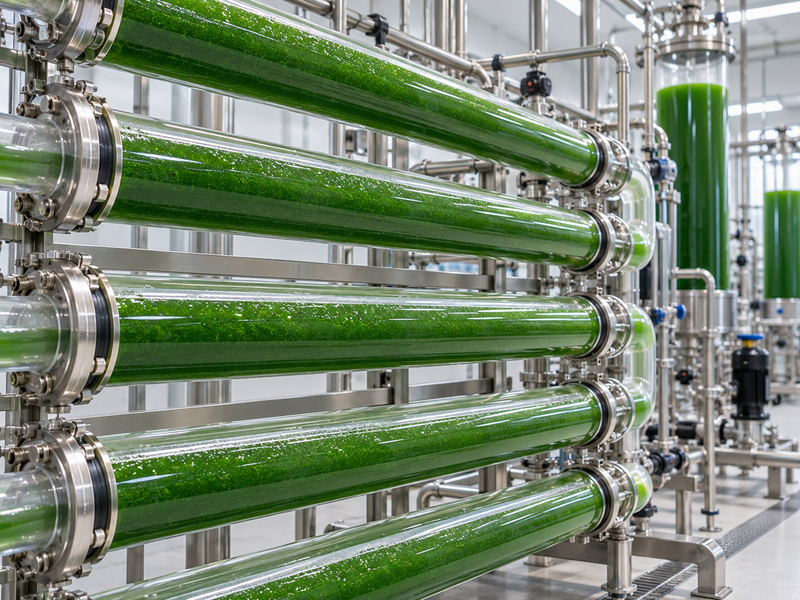
Ask for a process-flow description from dried biomass to finished extract. Confirm the extraction medium, filtration step, concentration or drying steps and any relevant added substances. A filtered aqueous extract is the identity described in §73.530. Whole green biomass powder is not the same thing simply because it came from A. platensis. Nor should a materially different extraction route be assumed covered without review.
A supplier can protect proprietary parameters while still providing enough controlled information for a regulatory identity assessment.
Connect the process description to the commercial lot and site. A laboratory demonstration of aqueous extraction does not prove the production SKU is made that way. Ask what the filtration removes, how the supplier controls consistency, and whether the process can change between lots. Obtain the as-sold composition after any carrier addition. If a supplier offers both liquid and powder grades, evaluate each product form rather than assuming the dried material inherits every statement made about the liquid concentrate.
Keep the signed process summary and revision date in the supplier dossier.

6. What about carriers and as-sold composition?
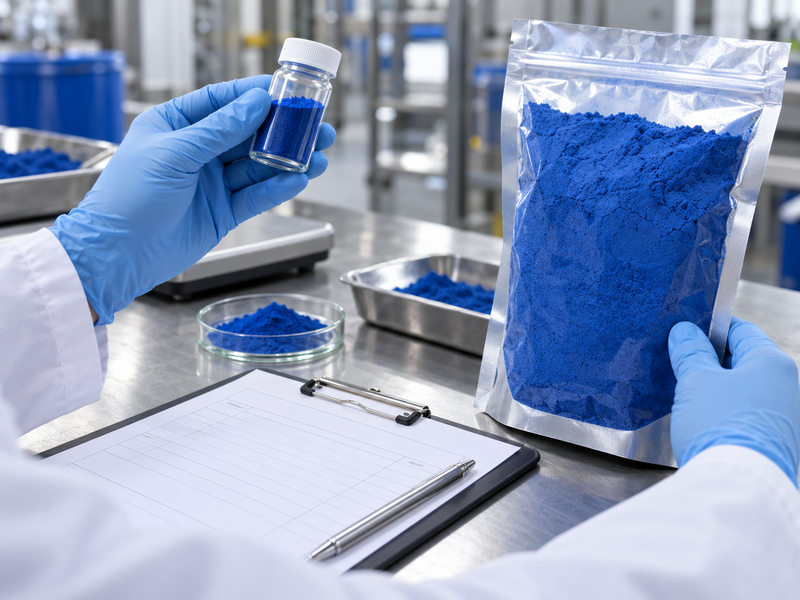
The U.S. rule also addresses color-additive mixtures and suitable diluents. Ask for the full as-sold composition and carrier identity; a blue extract sold as a formulated powder may not be 100% pigment. Review each component for the intended market and label. The buyer needs the composition to calculate dose, compare color strength and understand what appears on the finished product’s ingredient statement. A high phycocyanin assay is not a substitute for disclosure of other components.
If the supplier cannot give a public formula, arrange confidential disclosure to the brand’s regulatory reviewer.
Compare the sample, TDS, COA and quote: they should refer to the same mixture and color-value method. A supplier might supply a higher-strength lab grade for a trial and quote a lower-strength production blend. That would make the initial color result and cost calculation unreliable. Set specification boundaries for carrier and color value, plus change notice for any revised formulation. Reassess whether the altered mixture still fits the legal and sensory requirements.
This is a standard material-control decision, not an assumption that one carrier is always preferable.
| As-sold detail | Buyer use | Requalification trigger |
|---|---|---|
| Carrier identity | Regulatory and label check | Carrier substitution |
| Pigment/color value | Dose and price comparison | New assay range |
| Form | Mixing and shelf stability | Liquid-to-powder change |
| Pack | Traceability and storage | New packaging route |
7. How should lots be traced through production?
Ask for the relationship among biomass lot, extraction batch, concentrated or dried intermediate, carrier lot, finished color lot, pilot sample and commercial shipment. The COA should be issued for the finished lot being offered, with methods and limits for the agreed specification. If several biomass lots are combined, document the blend records and release logic. A source-organism statement for the company is not enough if the offered production lot could use a different feedstock.
Retain sample IDs through the food manufacturer’s pilot so a successful trial can be repeated with a defined material.
At receiving, compare package labels and packing list with the lot COA and purchase order. Ask for the supplier’s change-control practice covering organism, cultivation site, extraction site, process and carrier. The brand should decide which changes require full requalification and which need a limited check. Good genealogy also supports recalls and investigations if a color or quality problem arises. Without it, a buyer cannot distinguish a genuine lot problem from a switch in material identity.

8. Does species identity settle the finished-food use?
No. After organism and process identity pass, check the exact U.S. food category listed in the operative §73.530, its good-manufacturing-practice condition and the restriction for foods with standards of identity. The list includes specified desserts, beverages and other categories; it is not an all-foods approval. If the product is sold in multiple jurisdictions, review each market separately. A color legally suitable in one matrix or destination may need a different basis elsewhere.
The buyer should give the supplier the intended application while the brand’s regulatory reviewer owns the finished-product conclusion.
Also check whether the extract is added for color or another asserted purpose. A GRAS notice for an ingredient use cannot simply be pasted into a color application. Record the function in the formula and marketing materials consistently. Do not proceed to launch because a supplier says “FDA approved” without a citation tied to source, process and category. If the category is uncertain, seek a qualified interpretation before purchasing production volume. This prevents a technically excellent blue from being applied to an unsupported use.
| Finished-use question | Evidence | Stop condition |
|---|---|---|
| Exact food category | Formula and product name | Category not established |
| Technological function | Formulation record | Inconsistent rationale |
| Use level | GMP justification | Excessive dose without need |
| Standard of identity | Applicable standard | Added color not allowed |
9. How should an alternative source be handled?
If the supplier proposes A. maxima or another organism, label it as an alternative material and request a separate regulatory assessment. Do not force it into the A. platensis color-additive description or reject it with an unsupported claim that the organism is universally banned. Ask for its source, process, composition, intended function and evidence for the exact destination and finished food.
The FDA GRN 424 entry may be relevant background to a particular ingredient question, but its explicit note about possible color-additive listings demands a separate color review.
Keep the alternative out of the approved purchasing code until that review is complete. If it is eventually suitable under another applicable route, qualify its color, stability, microbiology and cost from scratch. Do not transfer a pilot result from A. platensis automatically; pigment strength and as-sold mixtures may differ. A documented alternative can improve supply resilience, but only if the legal and technical evidence actually supports the intended use.
Record the alternative under a separate purchasing code so it cannot be substituted into an approved lot without review.
10. What should the buyer approve before ordering?
Build a one-page identity checklist linked to the complete supplier dossier. Require the controlled A. platensis source declaration for the proposed U.S. spirulina-extract color SKU, filtered aqueous extraction statement, full as-sold composition, lot genealogy, TDS, COA, color assay and change-control terms. Have regulatory staff sign off the exact finished category and destination. Then run a production-relevant color trial with the traceable sample.
A pass on one gate does not replace the others: species identity is necessary for this listing but does not prove shelf performance or market permission by itself.
Send the supplier the product use, target specification, destination, anticipated quantity and pack needs. Ask for documents before comparing price so quotes refer to comparable materials. If a dossier is incomplete, state precisely whether the missing point is source, process, lot, quality or category. That creates a solvable request and a defensible hold decision. The result is a purchasing file that explains why the selected SKU fits the intended U.S. color project.
File the GRAS notice and color rule as separate records, with a short note explaining their different scopes. Train receiving staff to flag any lot label that changes species name, extract description or manufacturing site. This simple escalation prevents an otherwise routine warehouse substitution from undoing the source-identity review.
FAQ
Q1. Does §73.530 name Arthrospira maxima? No. The operative U.S. spirulina-extract color identity names dried A. platensis biomass.
Q2. Why does GRN 424 include both species? It concerns a separate notified ingredient and conditions; FDA’s response notes that some uses may need a color-additive listing.
Q3. Is A. maxima generally prohibited as food? That conclusion does not follow. The question here is whether it fits this specific U.S. color identity.
Q4. Is an A. platensis label sufficient? Ask for source, process, as-sold composition and lot-linked records.
Q5. Does the February 2026 foods-generally order control? Its effective date was delayed indefinitely; review the operative listed categories.
Next step: Contact SpirulinaCN with your finished-food category, destination, target color specification, annual quantity and packaging needs. Request a named blue spirulina color SKU’s source-organism declaration, filtered aqueous extraction statement, full composition, lot COA and traceable sample before a U.S. color pilot.