
Blue spirulina chocolate uses a blue extract from spirulina as a color ingredient in a chocolate product, coating, or filling. A striking bench sample can still fail when the powder meets cocoa butter, the coating thickens, or the blue changes during storage. Food developers need a trial that separates color appearance from process fitness. The questions below give confectionery teams a way to design that trial, request supplier documents, and decide where a water-soluble phycocyanin powder belongs.
Contents: 1 · 2 · 3 · 4 · 5 · 6 · 7 · 8 · 9 · 10.
1. What exactly does blue spirulina color in chocolate?
Define the colored phase
Blue spirulina usually refers to a phycocyanin-rich extract rather than whole green spirulina biomass. Its pigment is associated with a water-soluble protein. Chocolate, especially a white chocolate coating, is predominantly a fat-continuous system. Those two facts explain why a powder that makes water brilliant blue may be awkward in molten chocolate. Start with the phase: identify whether the intended colored part is solid chocolate, a water-containing ganache, a cream filling, or a frozen-dessert coating. Each has a different route for incorporating a water-soluble powder.
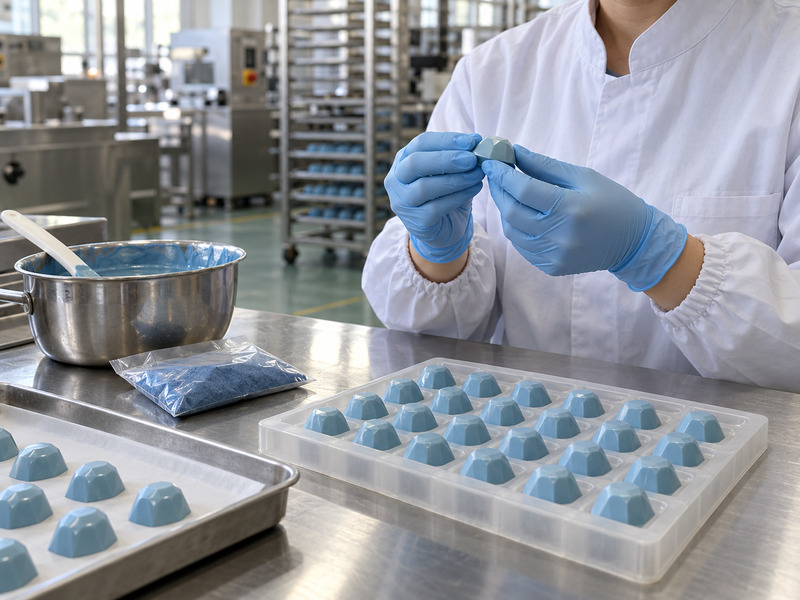
A recipe for blue spirulina chocolate-covered berry popsicles shows an actual white-chocolate application. It is an application example, not evidence that every bulk powder will disperse into every chocolate line. A development team should state what it wants customers to see: a blue shell, blue streaks, blue inclusions, or a blue filling. Photograph the intended format under retail lighting before choosing a dose. A darker milk-chocolate base will conceal much of the blue even if the ingredient disperses well.
| Product part | Continuous phase | Opening question |
|---|---|---|
| Molded white chocolate | Mainly fat | Can the blue disperse without specks or excess viscosity? |
| Ganache or cream | Water and fat | Which phase receives the color premix? |
| Frozen coating | Mainly fat, cold set | Does the color survive the coating process and freezer? |
| Colored filling | Formula dependent | Will migration stain the neighboring shell? |
2. Which confectionery formats are worth screening first?
Screen viable confectionery designs
A pale base is the sensible starting point because it lets a moderate blue shade show. White chocolate, cocoa-butter-rich coatings, coconut fillings, and pale creams give different visual effects. The first screening should compare formats rather than assuming one successful swatch transfers to all of them. A useful shortcut: make small control samples without blue, then add the same ingredient lot by a documented method to each base. Compare shade, graininess, flow, and taste side by side.
Avoid treating a photographed novelty as a shelf-ready specification. Molded bars need snap and bloom control. Dipped pieces need consistent coating thickness. A filled confection needs separation between phases and a packaging plan. If a formulation uses a separate blue aqueous filling, the development question shifts from direct fat dispersion toward microbiology, water activity, and migration. The commercial brief should identify whether the blue is the main selling cue or a limited seasonal accent.
3. Why can a water-soluble powder form specks in fat?
Check water and fat compatibility
A dry pigment powder does not automatically wet in cocoa butter. Fine particles may cluster, leave blue dots, or raise apparent viscosity. A producer might add more shear and see a smoother appearance, but excessive shear can change a coating’s working properties or introduce air. Check the cause: inspect a drawdown under magnification and compare it with a control made using the same base and processing time. If a preparation contains carriers, ask for their identities and test whether those carriers behave acceptably in the target system.
Our confirmed supply range is blue spirulina/phycocyanin powders labeled E3, E6, E18, E25, E35, and E40. Those names are not universal pigment percentages or proofs of fat compatibility. Obtain the specification and a batch certificate for the exact grade. If direct addition repeatedly fails, a formulator may need a suitable application-ready preparation or a design that places the color in an aqueous portion. Do not present another supplier’s liquid or fat-dispersible system as one of our current products.
| Observation | Plausible cause to test | Next bench action |
|---|---|---|
| Blue dots | Poor wetting or agglomerates | Compare premix method and particle inspection |
| Thick coating | Added solids or changed flow | Measure viscosity through the working range |
| Gray blue | Base color or low effective color | Compare on a pale reference base |
| Color rubs off | Surface or crystallization issue | Evaluate temper and set, not pigment alone |
4. How should a pilot team compare grades and addition methods?
Use one controlled pilot matrix
Create one base batch and divide it into equal trial portions. Keep the same chocolate, vessel, mixing tool, and temperature history across portions. A blank control reveals changes caused by normal processing. For each blue spirulina grade, record the powder mass, batch identifier, mixing sequence, and time until appearance stops changing. Keep the comparison honest: do not compare one sample at a higher loading and declare it the stronger grade. A color reading, if available, should use a fixed sample thickness and lighting condition.
Test a direct-powder addition only if it matches the line’s feasible procedure. A premix may improve distribution, but the premix medium must belong in the finished product and comply with its label. Observe flow from the kettle, through any screen or depositor, and after setting. Collect material from the start and end of a run; streaking may appear only after a holding period. Ask production to note cleaning and blue carryover, because a color that takes an extra shift to remove can change the economics of a small seasonal order. Keep sensory evaluation blinded when comparing the colored samples.
5. What can heat and tempering do to the blue?
Observe processing temperature
Phycocyanin can respond to heat, acidity, and other matrix conditions. A confectionery plant has its own temperature curve: melting, mixing, tempering, depositing, and sometimes rework. The relevant exposure is the entire curve, not a single peak temperature printed on a supplier slide. Run the real cycle: photograph samples before heating, after the longest planned hold, immediately after setting, and again during storage. If the blue fades, compare reduced hold time with an alternative placement of color before changing the ingredient dose.
Tempering deserves a separate measurement. A mottled or bloomed surface can make the blue seem dull even when the pigment itself remains. Use the plant’s ordinary temper test and record flow, set time, gloss, and snap. Do not compensate for poor temper with more powder. For products that require aggressive heat or long warm rework, a water-soluble blue may prove unsuitable. That is a valid pilot result. It is less expensive than launching a color promise the line cannot reproduce.
| Trial point | Record | Decision it supports |
|---|---|---|
| After mixing | Shade, specks, viscosity | Whether incorporation works |
| End of warm hold | Shade and flow | Whether the hold is acceptable |
| After set | Gloss, bloom, color uniformity | Whether temper remains sound |
| After rework | Color and texture | Whether rework can be permitted |
6. How do inclusions and fillings change the formulation?
Test each inclusion interface
Blue against white chocolate looks different from blue beside berries, biscuit crumbs, or cocoa-colored inclusions. Acidic fruit pieces may create localized color shifts where moisture touches a blue filling. A crisp inclusion also changes the way customers judge a product: softness that would pass in a plain confection may appear as a defect when a biscuit is supposed to snap. Look at the interface: cut finished pieces after storage and inspect the border between blue material and its neighbor.
For a ganache, record water activity, pH, and the exact ingredient sequence. The blue powder may disperse into the aqueous ingredient before emulsification, but this needs a full food safety and texture trial. In a coconut bar covered with chocolate, blue can be confined to the center while the chocolate remains conventional. That creates a different design brief from tinting the coating itself. A purchasing team should therefore ask which component needs blue before requesting a bulk sample. The answer determines whether powder solubility, fat dispersion, or migration is the main technical risk.
7. What belongs in a chocolate shelf-life study?
Store finished units in real packs
Use the final pack, not an open laboratory tray. Light, oxygen, temperature changes, humidity, and transport vibration can all affect how the confection looks at the end of its proposed life. One package is not enough: include normal storage, a realistic warm excursion, and the retail display condition. Inspect shade under the same lights each time. Check bloom, cracking, oil migration, filling separation, and odor alongside color. A blue surface can hide a small defect at first and make it conspicuous after storage.
Set acceptance criteria before the trial begins. A panel can judge whether color remains within an approved visual range, while objective color readings may help track drift. Keep photographs with a color standard in frame. Record the lot numbers of both chocolate and blue powder, because base-color variation could be mistaken for pigment variation. If a bar uses transparent film, compare it with a light-protective option without claiming that either pack guarantees a particular shelf life. Packaging selection belongs to the complete finished-food validation.
| Shelf-life check | Why it matters | Evidence to retain |
|---|---|---|
| Fixed-light photographs | Visible shade drift | Dated images and reference swatch |
| Surface inspection | Bloom and cracking | Scored defects |
| Cut-section inspection | Filling migration | Cross-section images |
| Sensory review | Off-notes or changed texture | Panel notes tied to lot |
8. How should cost and dosing be compared?
Calculate accepted-unit cost
The lowest price per kilogram of blue powder may be the most expensive option in a finished confection if it requires a high addition level or causes scrap. Compare ingredient cost per saleable piece. Include dose, line yield, rework policy, extra mixing time, and packaging changes. Put a number on waste: weigh rejects during the pilot and state whether rejected pieces can safely be reworked under the plant’s own controls. Do not infer a commercial loss rate from a few handmade samples.
The visible shade should be judged on a standard piece, not a spoonful of pigment. A small shift in color strength may require a different dose between lots; procurement needs a method to approve that adjustment. Ask suppliers for lot-specific documentation and several samples if possible. Quote quantities and lead times only after discussing them with the supplier. Our E-series powder codes alone do not define a chocolate-use grade, dosage, or price. A buyer can use the table below as a quotation worksheet without turning its blank fields into invented specifications.
9. Which labeling and market checks come before launch?
Approve the exact market use
Color-additive permission depends on the sales market, exact ingredient, and finished-food category. In the United States, the FDA’s color-additives information notes that a 2026 expansion of spirulina-extract uses had its effective date delayed. Check the current rule: ask regulatory staff to verify the applicable entry in 21 CFR and the product’s standard of identity before a chocolate or coating claim goes to artwork. A recipe online is not legal approval for a commercial pack.
Review the complete ingredient declaration, carrier ingredients, allergen controls, and any “natural color” language under local rules. Chocolate identity terms can carry specific compositional requirements. Claims about immunity, energy, detoxification, or other health outcomes do not follow from blue appearance and should not be copied from consumer recipe pages. Use the supplier’s current technical specification and batch certificate for analytical claims. A quality team should also confirm how the powder is named in purchase specifications and how that name maps to the finished label.
| Gate | Owner | Required evidence |
|---|---|---|
| Color use and food category | Regulatory | Current market rule and product classification |
| Ingredient declaration | Label team | Full formulation and carrier statement |
| Allergen control | Quality | Supplier documents and plant assessment |
| Color claim | Marketing plus regulatory | Approved wording for target market |
10. What should a buyer send with a sample request?
Provide a testable purchasing brief
Send a short product brief that a formulator can act on. Describe the base as molded white chocolate, coating, filling, or another named component. State the planned process, target shade, intended market, desired shelf life, pack type, and whether the project is a seasonal run or a permanent listing. Make the first reply useful: ask for the technical specification, current batch certificate, ingredient statement, sample quantity, and available application guidance for a powder in that exact matrix.
Keep the request open to a negative answer. If a water-soluble phycocyanin powder cannot meet the line’s fat-dispersion or heat requirements, supplier honesty saves months of troubleshooting. Ask for a pilot method and agree on pass criteria before discussing annual volume. Blue spirulina chocolate can be a distinctive product when the blue sits in a compatible component and survives the full process. A defensible purchase decision comes from matched trial samples, the finished pack, and current market approval—not a single bright photograph.
FAQ
Q1: Is blue spirulina the same as whole spirulina in chocolate? No. A blue phycocyanin-rich extract and whole green biomass differ in appearance and composition; confirm the exact ingredient on the specification.
Q2: Can the powder be mixed directly into cocoa butter? Do not assume so. Test wetting, specks, flow, and color in the actual fat-rich base.
Q3: Does a blue sample prove shelf life? No. Use final packaging and the intended storage conditions to validate color, texture, and surface quality.
Q4: Which E-series code should a chocolate maker buy? The code alone cannot answer. Compare the technical specifications and pilot results for available lots.
Q5: Can a brand make health claims because the chocolate is blue? Color does not establish a health benefit. Regulatory staff must review any proposed claim in its sales market.
Final thoughts
Set the chocolate component, process, target shade, and market rule before requesting a bulk quote. Ask for a grade-specific specification and run the pilot through setting and packaged storage. Keep the formulation that produces a repeatable saleable piece, even if a brighter laboratory sample looks better on day one.