
Spirulina vs chlorella is an ingredient choice that starts with the intended formula. Spirulina and chlorella often sit side by side on greens labels, but they are different organisms with different formulation behavior. A useful comparison starts with whole-biomass identity, a realistic serving and an intended food. This guide focuses on choices a consumer or product team can verify instead of ranking one algae as universally healthier.
A fair ingredient comparison also needs equivalent samples. If one supplier sends a fresh fine powder and another sends an old coarse sample, the result will mainly test sample condition. Ask for current commercial-grade lots, store them the same way and prepare them under one protocol. Record whether the vendor’s quoted material is identical to the trial sample. Those mundane details often determine whether a promising bench result survives the first purchase order.
Contents
- What are spirulina and chlorella biologically?
- Do their protein numbers reliably differ?
- What does cell-wall processing change?
- How do color and flavor compare?
- Is one a better source of vitamin B12?
- What about iron and other minerals?
- How should quality and contaminant checks compare?
- Which one suits a nutrition blend?
- Which one suits tablets or capsules?
- What is the best procurement decision?
1. What are spirulina and chlorella biologically?
Start with different organisms
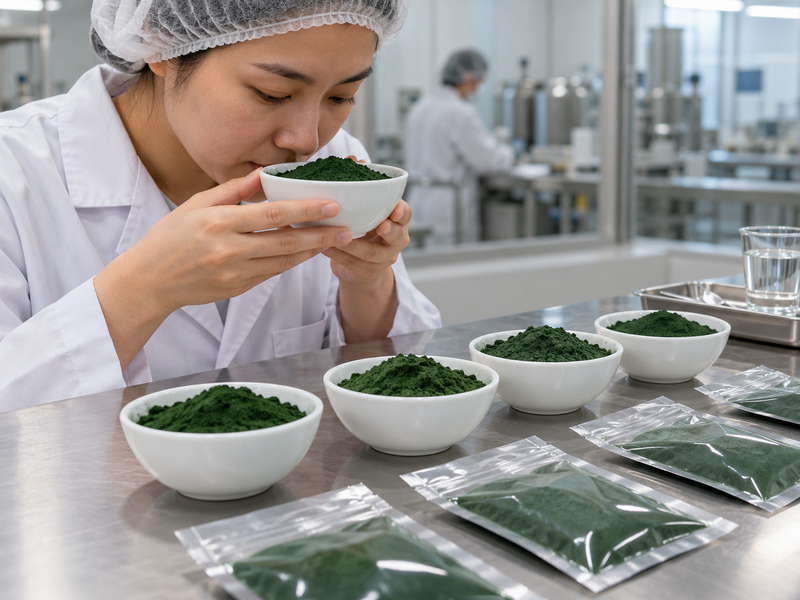
Commercial spirulina usually refers to dried Arthrospira biomass, a cyanobacterium commonly called blue-green algae. Chlorella is a single-celled green alga. Their categories matter because cell structure, pigments and processing differ. Both may be sold as powder, tablets or blends; the front label alone does not reveal species or processing. A spirulina product may also be a blue phycocyanin extract rather than whole green biomass, which changes the comparison entirely. Ask for scientific identity and a current specification.
The aim is to compare whole spirulina with whole chlorella when the intended use is nutrition, and to compare extracts separately when color is the goal.
A useful next step
Put species, whole-biomass or extract status, cultivation site and ingredient declaration in the first four rows of a comparison sheet. Reject a comparison that mixes a blue extract with a whole green powder.
2. Do their protein numbers reliably differ?
Compare tested lots, not category slogans
A study of commercially available samples found wide variation in composition and reported similar average protein content for chlorella and spirulina in its sample set, with differences in measured protein quality and digestibility. The original comparison study is useful evidence that supplier and lot matter; it is not a guarantee that one new purchase matches the study averages.
A brand should request measured protein and method for both candidate lots, then calculate the amount contributed at the finished serving. “Higher protein algae” is too broad unless a specific comparison and sample basis are named.
Cost comparisons need the same discipline as nutrition comparisons. Price per kilogram of raw powder is easy to quote, but the meaningful number may be cost per accepted finished serving. A slightly cheaper ingredient can become expensive if more is needed to achieve the target green shade or if its flavor requires additional masking ingredients. Keep the sensory and nutrition targets constant while calculating use level. This is a product-development inference, not a published ranking of the two organisms; the outcome depends on the tested grades.
A useful next step
Compare grams of protein per finished serving under the same inclusion level. Confirm moisture basis and analytical method. If the difference is small relative to flavor or price, weigh those practical factors more heavily.
| Comparison field | Spirulina check | Chlorella check |
|---|---|---|
| Identity | Arthrospira species | Chlorella species |
| Protein | Lot assay | Lot assay |
| Moisture | Dry basis | Dry basis |
| Serving | Grams used | Grams used |
3. What does cell-wall processing change?
Ask how each powder was prepared
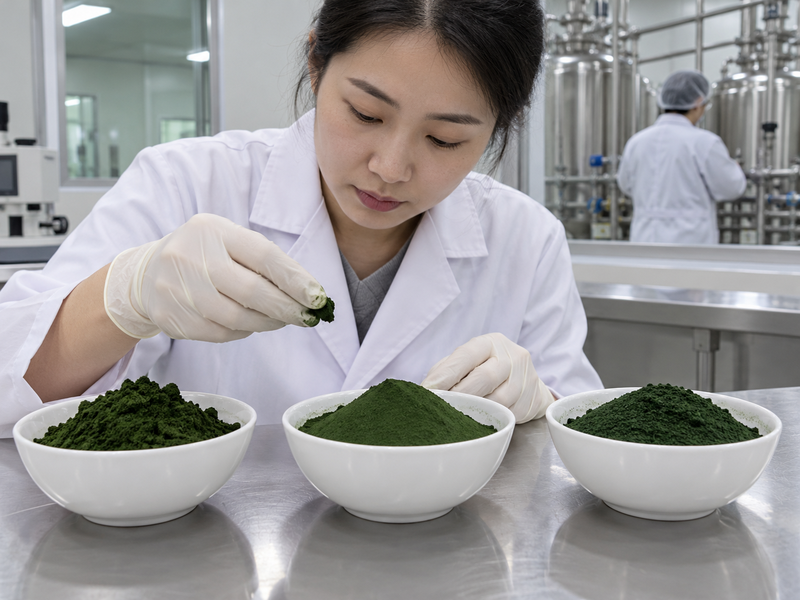
Chlorella’s cell wall can be a formulation and digestibility consideration, which is why some products emphasize broken-cell processing. But a “broken-cell” claim is not a measured nutritional outcome by itself. Request the disruption method, test method for the claimed rate and evidence that the process does not create undesirable oxidation or sensory change. Spirulina has different cell-wall structure and often disperses differently in a drink. Both powders are still particulate biomass, not necessarily fully soluble.
A product team should evaluate mouthfeel and sediment at a matched use level rather than assume that more aggressive milling always produces a better drink.
A useful next step
Set a simple dispersion protocol with liquid, temperature, mixing time and observation intervals. Compare sediment, grit and color. Keep both suppliers’ particle-size methods and samples on file.
4. How do color and flavor compare?
Test in the intended food matrix
Spirulina can produce a blue-green to dark-green appearance and a characteristic marine note. Chlorella may give a darker green with a different vegetal or grassy profile. These are tendencies, not reliable judgments for every grade, because drying, milling, freshness and dose alter sensory results. A pale yogurt makes both color and odor obvious; a savory herb dip can integrate them differently. The same powder can look attractive in a dry blend and muddy in a berry beverage.
Build side-by-side samples in the finished food at the same inclusion level and use a control with neither ingredient.
A useful next step
Ask tasters to rank color, aroma, aftertaste and texture separately, using coded samples. Repeat after expected storage. Select the ingredient that performs in the actual food, not the one with the prettier raw powder photograph.
| Application | Likely question | Trial |
|---|---|---|
| Smoothie | Sediment and aroma | Cold blend |
| Yogurt | Hue and flavor | Chilled storage |
| Savory dip | Herb integration | Taste panel |
| Tablet | Flow and odor | Compression |
5. Is one a better source of vitamin B12?
Do not choose either by a generic B12 promise
An original analysis of algae products found inactive pseudovitamin B12 predominated in the spirulina tablets tested, while its chlorella samples contained more true B12. That does not mean every chlorella lot is a reliable B12 source. Biological composition and assay method vary, and brands need active-form testing if they wish to make a B12 statement. Consumers, particularly vegans, should use established reliable B12 sources rather than assume any green algae product covers the requirement. A color or “superfood” label is not a vitamin specification.
A useful next step
Request a method that distinguishes active cobalamins from analogues and a lot-specific result at the actual serving. Without that evidence, leave B12 out of comparative marketing copy.
6. What about iron and other minerals?
Use per-serving amounts and diet context
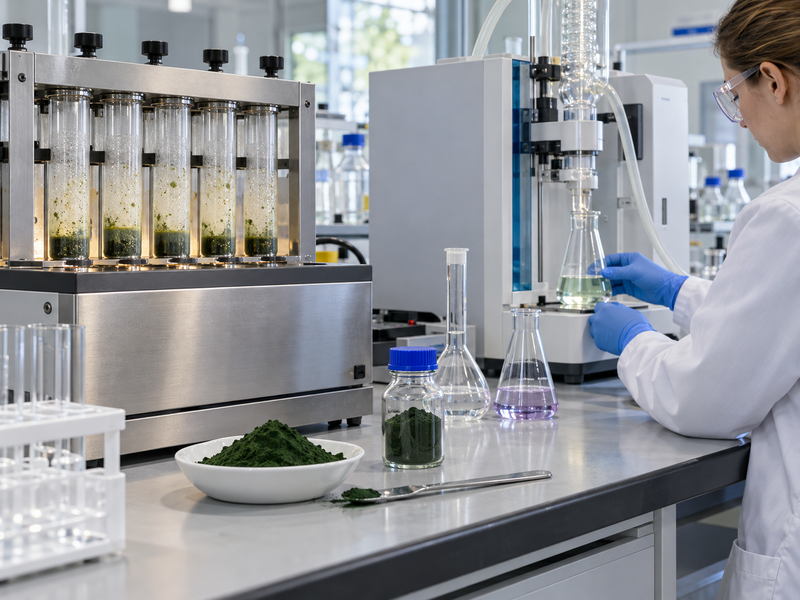
Both ingredients may contain minerals, but production conditions and serving size can change the amount a person receives. The NIH iron fact sheet explains that nonheme iron absorption depends partly on the rest of the meal. A 100-gram algae table is a poor substitute for a tested retail portion. Chlorella and spirulina should each be assessed by current lot assay and the intended finished formula.
Do not claim that a modest sprinkle treats iron deficiency; that is a clinical issue. If iron is a selling point, examine labeling thresholds and a finished-product analysis.
A useful next step
Compare milligrams of iron per actual portion, not only concentration per 100 grams. Record variability across lots and include other ingredients’ contribution. Leave clinical outcomes out of ingredient copy unless separately substantiated.
| Nutrient issue | Evidence | Decision |
|---|---|---|
| Iron amount | Lot assay | Per-serving math |
| Absorption context | Food matrix | Qualify wording |
| Mineral variation | Several lots | Label basis |
| Claim threshold | Market rule | Approve copy |
7. How should quality and contaminant checks compare?
Apply the right controls to each supply chain
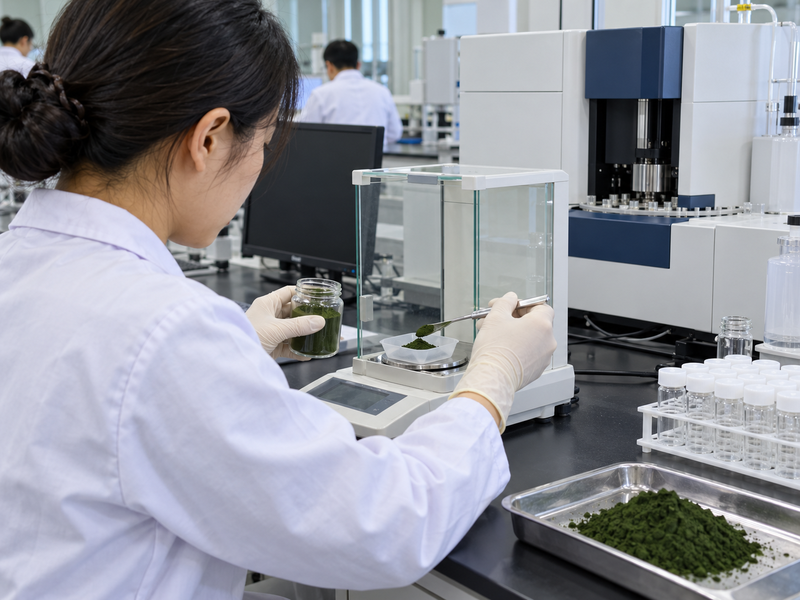
The FDA information on blue-green algae and microcystins explains a toxin issue relevant to some cyanobacterial products. That does not mean chlorella can skip quality control or that all spirulina has the same risk. Both ingredients need identity, microbial and relevant contaminant specifications based on their growing and processing systems. Ask whether the sampled lot on a certificate matches the shipment and whether test methods can detect the named hazards.
A supplier’s organic badge does not replace a batch record or a validated laboratory result.
A useful next step
Create separate hazard reviews for each ingredient, then place comparable lot results side by side. Ask for manufacturing-site details and change notification. Hold material whose identity or test status cannot be reconciled.
8. Which one suits a nutrition blend?
Formulate for the whole serving
For a greens blend, the choice depends on flavor, texture, target color, nutrient contribution, cost and supply consistency. Combining the two is possible, but adding another ingredient increases supplier and label complexity. If the blend includes vegetables, fruit powders or vitamins, a claim about the finished serving cannot simply be assigned to either alga. Run a control formula, spirulina version, chlorella version and combination version using the same base. Consumers may prefer one even if a spreadsheet shows similar nutrient concentrations.
No ingredient comparison compensates for a recipe people will not drink.
When testing a combined algae blend, vary one factor at a time. Start with a control and single-ingredient versions, then use the combination only if it gives a result the individual powders cannot achieve. Review the combined ingredient statement and the test coverage of each supplier; a certificate for one powder cannot release the other. Watch for a darker hue or stronger aroma after storage, because the mixture may not look like an average of its components. Record the decision in the formula file so later reformulation does not silently change the comparison.
A useful next step
Score each trial on taste, dispersion, nutrient contribution and cost per finished portion. Keep source lots fixed during initial comparison. Check the final product after the expected preparation and storage period.
| Candidate | Potential strength | Watch |
|---|---|---|
| Spirulina | Distinct blue-green hue | Marine note |
| Chlorella | Deep green visual | Texture |
| Combination | Layered appearance | More suppliers |
| Neither | Simple formula | Lost algae identity |
9. Which one suits tablets or capsules?
Evaluate manufacturing behavior
Tablets need flow, compressibility, friability and acceptable odor, while capsules need reliable fill weight and low clumping. Those properties may differ more by grade and milling than by algae category. A powder that tastes good in a smoothie is not necessarily the easiest to compress. Request particle-size distribution, bulk density, moisture and current test data, then make small pilot lots. Confirm that any binders or anti-caking agents appear in the final ingredient declaration.
If a consumer wants a convenient format, the label still needs to say how much of each algae is present per recommended serving.
A useful next step
Run a line trial with both candidates under matched conditions. Record rejects, dusting, fill variation and finished-tablet integrity. Select the grade that meets quality and consumer-use targets, not merely the lowest raw price.

10. What is the best procurement decision?
Require comparable evidence from both suppliers
Write the product purpose first: nutrient positioning, green color, convenient dose form or a specific sensory profile. Then ask both suppliers for equivalent documents: identity, composition, contaminants, manufacturing method, packaging and lead time. The original comparison study shows why generic category statements are too weak. A buyer should test actual lots and calculate cost per acceptable finished serving. A new supplier’s sample may differ from its routine production, so preserve a retained reference and compare the first commercial shipment.
The chosen algae should solve the product problem reliably and transparently.
A useful next step
Use a weighted scorecard for taste, label contribution, safety documentation, supply and total formula cost. Document the trade-off. Repeat the comparison if a supplier changes process or source.
| Decision factor | Evidence | Pass criterion |
|---|---|---|
| Product fit | Application trial | Target sensory result |
| Nutrition | Per-serving assay | Claim requirement |
| Safety | Current lot COA | Hazard controls |
| Supply | Capacity and change rules | Reliable orders |
Frequently asked questions
Is spirulina the same organism as chlorella?
No. Spirulina products commonly use Arthrospira cyanobacteria; chlorella is a green alga. Verify the exact species on the specification.
Which has more protein?
It depends on the measured lots and serving. A published sample comparison cannot rank every commercial product.
Is broken-cell chlorella always better?
Processing can affect access and texture, but the claim needs a defined measurement and a relevant finished-product benefit.
Can either replace a B12 supplement?
Do not assume so. B12 forms and amounts vary; use reliable B12 sources and appropriate testing.
Can I blend both?
Yes, if the taste, label, quality and supply requirements work. Test the combined product rather than adding their brochure claims.
Conclusion
Spirulina versus chlorella is a product-design choice, not a contest with one universal winner. Compare identified whole-biomass lots at realistic serving levels, test sensory behavior in the finished food, and verify nutrients and safety with current documents. The better ingredient is the one that fulfills the actual application consistently.
For ingredient documentation, compare the whole spirulina range, the chlorella product page and the factory portfolio. These product pages can start a supplier discussion; final nutrition and safety statements still require the chosen lot and finished-product evidence.