
Spirulina powder for plant based meat manufacturers is a formulation choice with visible and measurable trade-offs. Whole green biomass can change a pea, soy or lupin mix; it is not a drop-in protein isolate, and its performance depends on the protein base and process. A 2019 high-moisture extrusion study found that spirulina concentration and extrusion settings affected texture, cooking yield and expressible moisture in lupin-based analogues. Its experimental levels should not become a recommendation for another product.
The buyer’s decision is whether a named whole spirulina powder lot passes the finished analogue’s texture, color, taste and yield gates at a commercially useful addition.
Contents
- What role will whole spirulina play in the meat analogue?
- Which base and process must the supplier sample match?
- How should the bench inclusion ladder be set?
- What extrusion settings belong in the trial record?
- How will texture and cooking yield be compared?
- When is green color a product advantage?
- How should savory flavor be evaluated?
- What nutritional and regulatory evidence is needed?
- How do buyers calculate usable formulation cost?
- Which result triggers a bulk order?
1. What role will whole spirulina play in the meat analogue?
Decide whether the ingredient is there for a recognizable plant ingredient story, green appearance, a modest nutrient contribution or a specific functional effect demonstrated in your formula. These purposes need different acceptance limits. If the analogue is meant to resemble browned meat, strong green color may be unacceptable; if the product is a green vegetable patty, it may be welcome. Calculate protein contributed per serving from the actual inclusion and lot assay.
Replacing a large mass of pea or soy isolate with whole biomass changes protein concentration and the balance of fat, fiber, mineral ash and water-binding solids. Make the substitution explicit in the recipe rather than adding powder on top of an unchanged base and calling the arms comparable. Establish the control product’s defining attributes before the first spirulina trial.
| Intended role | Evidence to collect | Stop condition |
|---|---|---|
| Ingredient story | Ingredient identity and serving amount | Unacceptable consumer perception |
| Color | Cooked cross-section and surface | Off-target shade |
| Protein contribution | Lot assay and full recipe calculation | No meaningful label contribution |
| Process fit | Yield and line observations | Unmanageable losses |
2. Which base and process must the supplier sample match?
Send the supplier a description of the actual protein system, not merely “meat substitute.” Record pea, soy, lupin or blended proteins; binder and fat sources; target moisture; salt and flavor system; and whether the product is high-moisture extruded, low-moisture texturate, sheared, molded or formed from pretextured pieces. Specify the process stage at which spirulina could enter.
The Hannover research studied lupin high-moisture extrusion with variables including feed water, temperature and screw speed; its findings are not direct evidence for a cold-formed pea burger. Ask for a food-grade whole-biomass sample tied to a named lot, TDS and COA. Confirm particle size and odor in the unopened sample before spending pilot time. If the supplier proposes a decolorized fraction or protein isolate, treat that as a different ingredient requiring a new identity and label review.
| Brief field | Example of useful detail | Why it matters |
|---|---|---|
| Protein base | Exact supplier and dry composition | Controls structure and flavor |
| Process | Extruder or forming sequence | Controls heat and shear |
| Target product | Patty, mince or fibrous strip | Sets texture standard |
| Market | Countries of sale | Sets label and safety review |
3. How should the bench inclusion ladder be set?
Begin with the commercial control and two or three small, internally chosen additions that bracket the likely sensory limit. The purpose is to locate a feasible range, not to copy a research percentage. Keep total solids, protein-base replacement and added water documented for each arm. If spirulina displaces another solid, show the mass balance; otherwise any change in bite could be caused by a higher dry load. Mix under the same time and temperature, with randomized run order if equipment warms during repeated batches.
Retain raw premix and cooked product from every arm. Let both R&D and sensory teams score anonymous samples before revealing the formula. An early no-go on color or flavor can spare a costly extruder trial; a promising bench result is still only permission to pilot.
| Arm | Biomass addition | What stays fixed | Decision |
|---|---|---|---|
| Control | None | Base recipe | Reference |
| Low | Buyer-selected | Total mass and process | Detect first effects |
| Middle | Buyer-selected | Same measurement plan | Seek feasible window |
| High | Buyer-selected | Same measurement plan | Expose failure threshold |
4. What extrusion settings belong in the trial record?
For an extruded analogue, log powder addition point, premix moisture, feed rate, barrel zone temperatures, screw speed, die geometry and actual product temperature if measured. Note pressure or torque changes that could signal process stress. Record cooling, cutting and any subsequent hydration or cooking. A single “extruded at 160°C” line omits the water and mechanical energy that determine structure. The 2019 study explicitly varied spirulina concentration and several extruder settings, which is why its results support testing interactions rather than assuming one universal dose.
If the product is cold-formed from textured protein, replace extrusion variables with hydration time, mixing work, forming pressure and cook profile. Use the equipment settings that the commercial line can sustain. A laboratory setting that makes an attractive strip but halves throughput is not a purchasing success.
5. How will texture and cooking yield be compared?
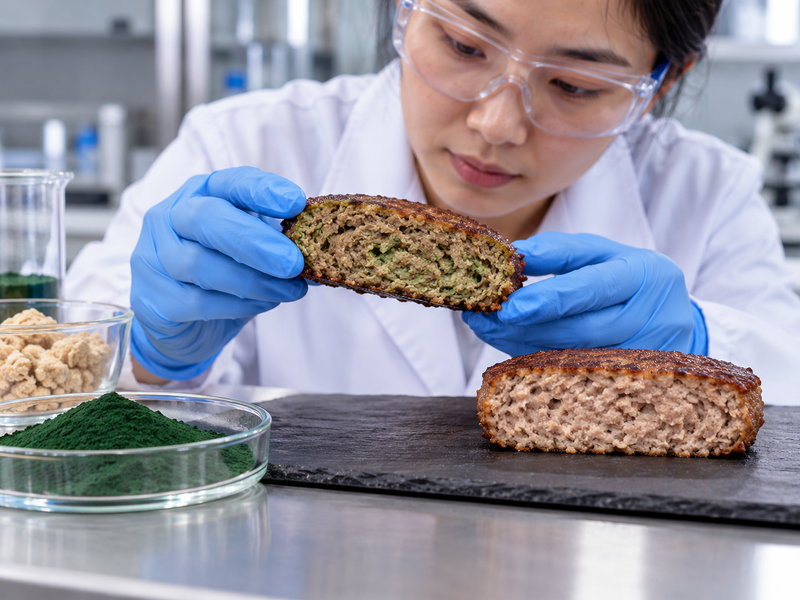
Define objective metrics around the intended product: cut force or texture-profile measurements, fibrousness where relevant, cooked yield, expressible moisture and consumer bite. Weigh raw portions and cooked portions under one standardized cook method to calculate yield. Photograph cross-sections and note whether fibers align, tear or crumble. For a burger, binder retention and pan loss may matter more than fibrous alignment; for a pulled-style strip, the reverse may be true. Use the same storage time before measurement because hydration continues after production.
Report means and variation, not a single best-looking sample. Do not infer “improved texture” from a publication’s different formulation. An observed gain in water retention is only useful if it survives cooking, packing and reheating.
| Measure | Method to freeze before testing | Purchase implication |
|---|---|---|
| Cooked yield | Same portion, pan and endpoint | Cost and consumer size |
| Bite | Instrument and trained panel | Product identity |
| Expressible moisture | Defined compression test | Juiciness and pack purge |
| Structure | Standard cross-section images | Fibrous or crumbly target |
6. When is green color a product advantage?
Judge color against the intended product promise rather than a generic “natural” ideal. Photograph the uncooked premix, formed item, cooked surface and cut interior under fixed lighting. If color is a contractual target, record instrument readings and a tolerance window. Browning can hide green on a surface while a sliced interior remains visibly green; the consumer encounters both. Evaluate refrigerated and frozen storage plus reheating if those are part of the route to market.
Spirulina color is tied to whole biomass and cannot be specified as a blue colorant grade. If a buyer truly wants blue color, the site’s blue spirulina category concerns an extract with different composition and regulatory questions. A green appearance can work in a vegetable-forward product, but that must be validated with the brand’s sensory panel and consumer brief.
7. How should savory flavor be evaluated?
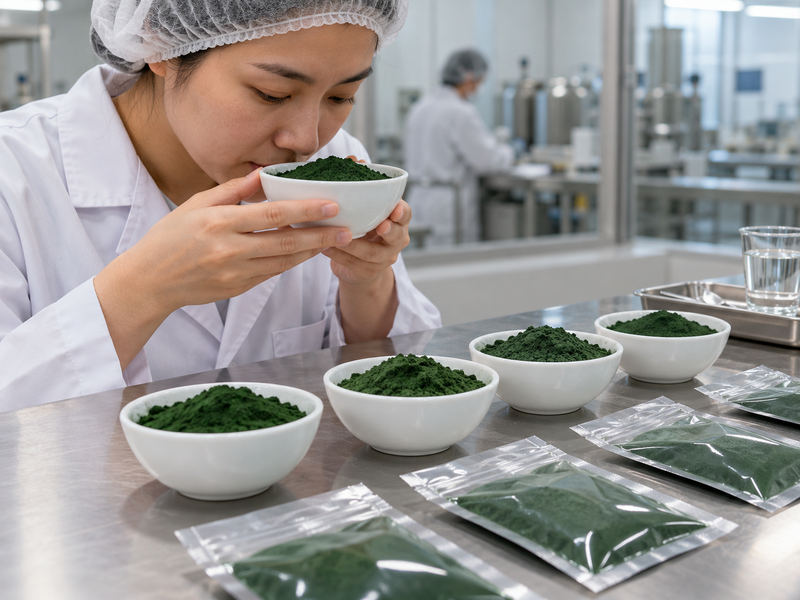
Use the final flavor system and cook method. Salt, smoke, yeast extracts, onion and fat can alter the impression of whole spirulina; water-only tasting is a poor proxy for a seasoned analogue. Ask a blind panel to score opening odor, first bite, lingering notes and flavor after reheating. Include a control cooked on the same equipment, and avoid telling panelists which arm contains algae before scoring. Determine whether added flavoring needed to mask the ingredient changes cost or ingredient-list acceptability.
Some ingredients appear milder in a hot pan sample but stronger in a chilled prepared meal. Test both the immediate cook and intended shelf-life point. Set a rejection threshold before the trial to prevent a nutrition story from overruling an obvious sensory problem. Supplier descriptions such as “mild” are starting points for screening, not evidence that a specific lot will pass your recipe.
8. What nutritional and regulatory evidence is needed?
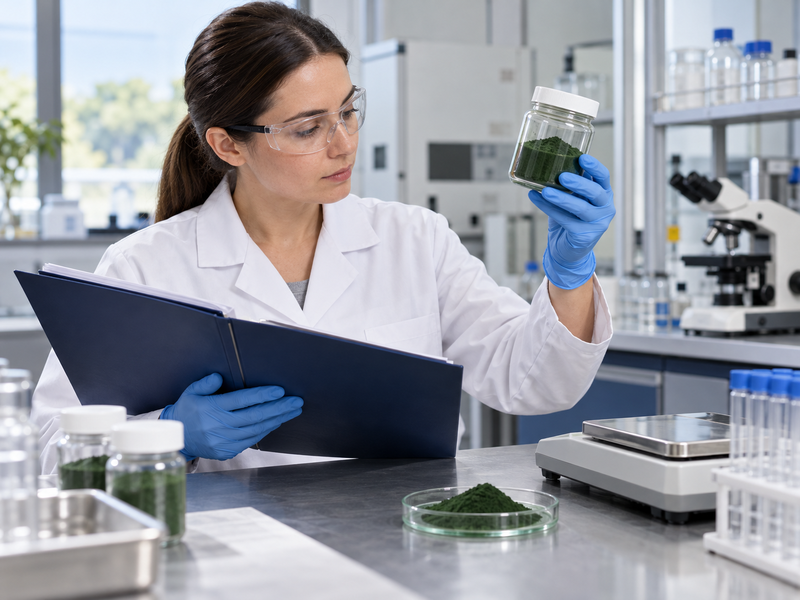
Request identity, ingredient declaration, current TDS, lot COA, microbiology and contaminant results, plus any voluntary certification relevant to the destination. Clarify the protein test method and moisture basis. Calculate finished-food nutrition from the complete recipe, then verify claims under the country’s rules and appropriate finished-product testing. Whole biomass is not purified protein; the percentage in an ingredient sheet cannot be transferred to a finished patty label. The manufacturer remains responsible for its own specifications and hazard analysis.
For a supplement-style claim, do not borrow evidence from a conventional food study, and do not suggest medical benefit. Keep the source and quantity of spirulina on the formulation record, with a change-control step if the ingredient grade or supplier changes.
| Document | Check | Limitation |
|---|---|---|
| TDS | Species and grade | May describe target, not lot |
| COA | Sample and shipment lot | Does not prove finished-product nutrition |
| Process declaration | Whole biomass and aids | Must match ingredient policy |
| Market review | Identity and claims | Destination-specific |
9. How do buyers calculate usable formulation cost?
Compare delivered cost at the volume, destination and Incoterm actually proposed. Multiply the quoted ingredient cost by the approved addition per product unit. Then add the formulation changes needed to preserve protein and taste, additional water or binding ingredients, lost throughput, rejected units and yield differences. A quote per kilogram of spirulina alone can be misleading. If the trial improves cooked yield, quantify that in sellable portions; if it reduces yield, charge it to the same calculation.
Ask whether the sample is representative of commercial supply and what pack sizes or call-off schedules are available, but treat availability and lead time as written quote items. Model a sensitivity range using the measured pilot variation. A decision remains fragile if a small lot-to-lot color shift moves the product beyond its label or sensory threshold.
| Cost line | Input | Output |
|---|---|---|
| Ingredient | Delivered quote × approved dose | Cost per unit |
| Reformulation | Added flavors and binders | Incremental recipe cost |
| Yield | Raw-to-cooked weights | Sellable units |
| Line | Throughput and rework | Conversion cost |
10. Which result triggers a bulk order?
Create a release sheet that names the approved spirulina SKU and lot, addition range, base-protein system, process settings and finished-product thresholds. Require acceptable texture, cooked yield, color, sensory score, ingredient quality and economics at pilot scale. Attach the raw data and retained controls. A second lot trial is prudent where a narrow color or flavor band determines success. Set the retest trigger for changed protein suppliers, binder, flavor or extruder settings.
If the brand cannot accept visible green color or the nutrient contribution is negligible at the sensory limit, do not force the ingredient into the formula. The correct outcome may be a different application or no spirulina purchase. This is a purchasing decision grounded in the product that will actually be sold.
Make the scale decision with representatives from formulation, operations, quality and procurement at the same table. R&D can report a preferred prototype while operations records that it required unusually low throughput; quality can confirm a good sensory result while identifying an unapproved post-process addition. Capture those disagreements in the release sheet instead of averaging them into a vague “pass.” A conditional approval should name the remaining experiment, its owner and the date by which it will be resolved.
When buying a future lot, run a short confirmation cook with the approved control alongside it, because a paper match in protein and mesh cannot guarantee identical color or flavor in the analogue.
Keep the approved photograph, cooked-yield worksheet and sensory scorecard together so a repeat lot is compared with the same product standard.
FAQ
Q1. Can spirulina replace pea protein one for one? No. Compare composition and process behavior in the actual formula; whole biomass is not an isolate.
Q2. Does the 2019 lupin study establish a recommended inclusion? No. It demonstrates that inclusion and extrusion settings matter in one studied system.
Q3. Should the first test use a full production run? Use a controlled bench screen before a pilot to expose obvious color and flavor problems.
Q4. What is the most useful yield measure? Raw-to-cooked yield under the same cook protocol, alongside texture and pack purge.
Q5. Can the ingredient COA substantiate a patty protein claim? No. Evaluate the full recipe and verify the finished-product claim for the destination.
Next step: Contact SpirulinaCN with your protein base, process or extruder profile, target inclusion, sensory limits, anticipated quantity and destination. Request a food-grade whole-biomass sample, its TDS and lot COA, and a bulk quote tied to a successful pilot rather than a generic replacement percentage.