
“Blue spirulina” can describe an extracted phycocyanin color, a formulated powder containing carriers, or, in loose sales language, whole algae. Those are not interchangeable commercial descriptions for customs. Spirulina blue customs HTS classification with carriers starts by identifying the imported material as sold: its ingredients, proportions, manufacturing process, intended function, and evidence for each fact. A buyer needs that brief before treating any tariff line as settled or accepting a landed-cost quote.
The SpirulinaCN blue spirulina page describes a water-soluble phycocyanin extract line with carrier options; its whole spirulina page describes green biomass. A 2022 U.S. Customs and Border Protection ruling, HQ H324168, analyzed one formulated spirulina blue powder. It is a useful case study in how classification turns on exact facts, not a tariff code to copy for every blue product.
Contents
- What physical product will cross the border?
- Why do carriers change the classification question?
- What did CBP actually decide in H324168?
- Which facts should the supplier give the broker?
- How should the manufacturing process be described?
- How do invoice and label descriptions affect review?
- When should a buyer seek a binding ruling?
- How should tariff uncertainty enter a landed-cost model?
- What other import checks remain separate?
- What must be confirmed before the order is released?
1. What physical product will cross the border?
Specify the merchandise at the moment of U.S. importation. Is it dried whole Arthrospira biomass, an aqueous-extracted blue fraction, or a prepared color powder where extract has been blended with trehalose, maltodextrin, citrate, or other ingredients? The answer must reflect the actual SKU, not a category page or a sample supplied for preliminary trials. Ask whether the same ingredient name covers different carrier recipes or concentrations at different order quantities.
Attach the current TDS, ingredient declaration with percentages or defensible ranges, process flow, intended use, and a representative sample. Include an exact commercial description such as “spray-dried spirulina extract preparation with specified carriers for food coloring,” if that is accurate for the product. Do not call an extract “spirulina powder” merely because both begin with algae biomass. Customs classification applies to the imported article, not its raw source alone.

| Imported article | Defining fact | Broker question |
|---|---|---|
| Whole green biomass | Cells remain as the food material | Which heading fits the actual biomass? |
| Spirulina extract | Phycocyanin-rich fraction separated | How is extracted color classified? |
| Formulated color preparation | Extract plus carriers or stabilizers | What do ingredients and legal notes imply? |
| Finished retail blend | Additional ingredients and presentation | Is classification changed by preparation? |
2. Why do carriers change the classification question?
Carriers can improve handling, protect color, or help standardize strength, but they also change what is being imported. A carrier may form a significant share of the powder by weight. Its identity and purpose become relevant to a customs analysis that considers heading text, section and chapter notes, and the character of the preparation. A buyer who omits carriers from the broker brief risks comparing a ruling on one formulation with a materially different one.
The supplier should disclose each ingredient’s common and technical name, approximate or exact percentage as requested by the broker, function, origin where relevant, and whether any are optional by SKU. Separate moisture, residual process aids, and intentional formulation ingredients. Ask if the quoted grade can change carrier to meet a customer’s taste or labeling preference. If yes, treat the revised formulation as a new classification review until the broker confirms otherwise.
Do not assume that a small amount of carrier always changes the heading or that any carrier automatically forces one code. The legal result depends on the whole product and applicable tariff text. The first practical decision is whether the supplier’s formulation disclosure is detailed enough for a broker to analyze.
| Composition field | Why the broker asks | Procurement action |
|---|---|---|
| Extract share | Defines active color portion | Match SKU and sample |
| Carrier identity/share | Reveals the nature of preparation | Obtain formula statement |
| Stabilizer identity/share | May affect heading analysis | Record purpose and amount |
| Optional substitutions | Creates potential new merchandise | Require advance notice |
3. What did CBP actually decide in H324168?
In HQ H324168, CBP examined a named product, CA2786 Spirulina Blue Colour, described as water-soluble color powder. Its stated ingredients were spirulina-derived phycocyanin extract, trehalose, and sodium citrate. CBP considered headings for inactive microorganisms and coloring matter and explained why the extraction and formulation facts did not fit those candidate headings in that ruling. It classified that subject merchandise under subheading 3824.99.92 of the 2020 HTSUS. The document itself says duty rates are for convenience and may change.
That decision is narrower than “all blue spirulina uses 3824.” It concerned one formula, process description, and tariff schedule year. A powder with a different carrier, extract proportion, process, or presentation requires an independent analysis. Even if the buyer’s product appears similar, the broker must use the current HTSUS text, legal notes, applicable rulings, and actual documentation. The buyer should not publish the ruling’s historical duty rate in a live quote without checking current measures.
This ruling also shows why marketing health language is unhelpful on an invoice. CBP assessed the described product’s color use and composition; broad benefit claims did not determine its heading. Keep the commercial description factual and tied to the import item.

4. Which facts should the supplier give the broker?
Ask the supplier for a classification packet, not an unsupported single-line code. At minimum, obtain the precise SKU, ingredient percentages, manufacturing narrative, function of each carrier, form at import, pack format, intended industrial use, and product label or TDS. Include photos or a sample if the broker requests them. Verify that the packet describes the same grade in the quote; do not attach a convenient TDS for a different color value.
The broker may need origin facts separately from classification facts. If the extract, trehalose, and other components come from different countries, record each origin and where extraction, blending, and drying occur. Origin determination is a separate legal question; mixed origin facts must be supplied accurately rather than collapsed into a single “made in” phrase. Likewise, food-use clearance and tariff heading are separate questions.
Use a change log. If a carrier is substituted after classification review, send the revised formula back to the broker. A supplier’s internal grade label may stay the same while the imported article changes materially.
| Packet item | Acceptable detail | Red flag |
|---|---|---|
| Formula | All intentional ingredients with proportions | “Natural blue blend” only |
| Process | Extraction, separation, drying, blending | “Made from spirulina” only |
| Use | Food color or other exact application | Several incompatible uses combined |
| Pack | Bulk powder size and presentation | Retail/industrial forms confused |
5. How should the manufacturing process be described?
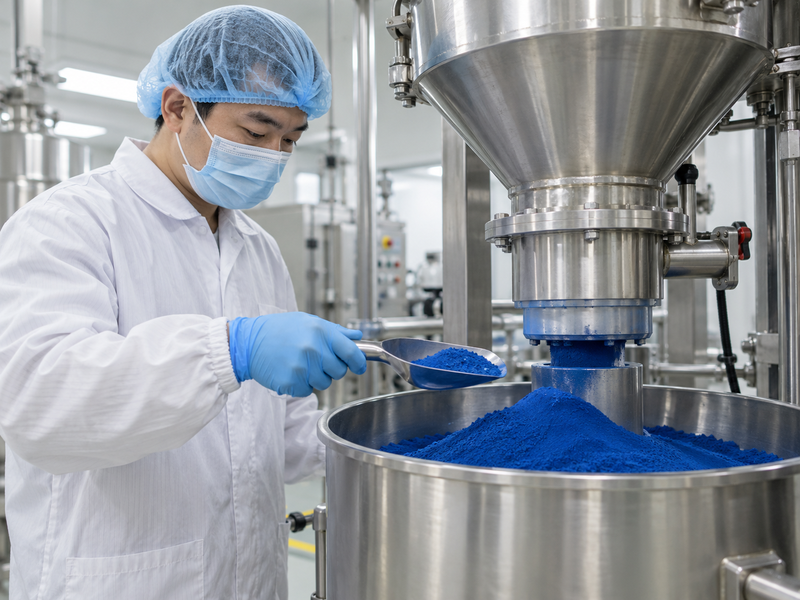
Have the producer describe the transformation in chronological steps. Begin with biomass identity; then state whether phycocyanin is extracted with water, how solids are separated, whether concentration or filtration follows, how the extract is dried, and when each carrier is added. The point is to show what remains of the original organism and what has become an extracted or prepared material. The CBP ruling analyzed precisely this kind of process detail.
Avoid disclosing a confidential formula to a broad distribution list if a direct broker or ruling request can protect it appropriately. But do not replace needed facts with vague descriptions. A broker cannot reliably analyze a heading from “100% pure blue spirulina” if the commercial powder actually contains a substantial carrier share. Ask the supplier how it can provide proprietary details to the appropriate reviewer under confidentiality arrangements.
Check whether the process flow and ingredient statement agree. If the flow lists trehalose added after drying but the declaration omits it, pause classification. If the brochure describes extract but the COA calls the item whole biomass, resolve identity before the purchase order.
6. How do invoice and label descriptions affect review?
The commercial invoice should describe the article accurately enough to match the broker’s classification file. State the product name, grade, composition concept, use, pack size, quantity, and country information as directed by the broker. “Food coloring powder” may be insufficient if it hides an extracted algae fraction and added carriers; “spirulina biomass” may be wrong if no whole biomass remains. Consistency across invoice, packing list, TDS, PO, and container labels reduces clarification cycles.
Do not put a proposed HTS number on supplier paperwork as if it were an official determination. The importing party is responsible for classifying the entry under the applicable rules, with help from its broker and, when useful, a CBP ruling. Keep a file note showing who approved the final description and code and what product facts the approval assumed.
If a quote is based on a particular description, ask the seller to confirm that the production lot and invoice will use the same wording and recipe. A last-minute carrier change can affect more than the customs code: it can change nutrition labeling, allergen review, color performance, and product cost.
| Document | Match to classification packet | Owner |
|---|---|---|
| Commercial invoice | Exact article and quantity | Exporter/broker |
| TDS/formula statement | Ingredient and process facts | Manufacturer |
| PO | Approved SKU and no-substitution term | Buyer |
| Entry instruction | Current broker-approved code | Importer/broker |
7. When should a buyer seek a binding ruling?
If the classification is material to landed cost and the broker finds genuine ambiguity, consider a ruling request before a recurring program is priced. CBP explains its electronic binding-ruling request process. The request should disclose the actual product, its ingredients, production method, and proposed use; an incomplete or hypothetical formulation undermines the value of the answer. Ask counsel or the broker whether a ruling is appropriate for the transaction and who should submit it.
Do not treat a competitor’s ruling as binding for your product. H324168 is evidence of how CBP reasoned about one preparation, and it may help frame questions. It does not resolve a different formulation by analogy alone. A classification review should also check whether subsequent rulings or tariff changes affect the reasoning.
Timing matters. If the buyer can tolerate classification uncertainty for an exploratory sample but not for a multi-container annual contract, place a firm decision gate before the larger commitment. Record the assumptions in quote comparisons so procurement does not mistake an unconfirmed duty line for a guaranteed landed price.

8. How should tariff uncertainty enter a landed-cost model?
Build the worksheet from the physical SKU price, freight, insurance, brokerage, destination charges, and a tariff scenario that the broker can support. Use the current USITC HTSUS and current applicable measures, not the 2020 duty figure printed in H324168. If two plausible classifications produce different duties, show both scenarios until the importer resolves the code. This makes the uncertainty visible in the buying decision.
Keep classification separate from the price of the carrier. A lower-cost carrier-heavy grade may have a different price per kilogram and a different color-use rate. For a food color program, compare the cost per unit of accepted finished color as well as landed cost per kilogram of imported powder. A quote that looks inexpensive at the border can use more material in the finished application.
Do not use the customs worksheet as evidence of legal food use. The food regulatory reviewer must independently determine whether the exact preparation and intended use are permitted in the destination market.
| Cost line | Input source | Uncertainty to note |
|---|---|---|
| Product price | Supplier quote for exact grade | Formula or MOQ changes |
| Freight and terms | Forwarder and Incoterm | Route and timing |
| Duty/tariff | Broker using current HTSUS | Classification and current measures |
| Application use rate | Pilot formulation | Shade and yield variation |
9. What other import checks remain separate?
An HTS classification is one piece of an import file. Separately confirm food color authorization, ingredient labeling, importer food-safety duties, applicable prior notice, facility information, organic claims if any, and origin marking or trade measures as relevant. For U.S. food colors, the current 21 CFR 73.530 lists permitted uses and specifications for spirulina extract; a tariff heading does not expand that list.
The broader 2026 amendment linked on that page was delayed indefinitely, so use the current text.
The phrase “with carriers” also matters to regulatory review. The color-additive rule addresses suitable diluents in food color mixtures. Have regulatory staff review the actual carrier set rather than treating a blue pigment authorization as an automatic clearance of every formulated powder. A customs broker can answer entry-classification questions but should not be asked to approve the finished product’s food labeling or use.
Keep an issue tracker with one owner per question. When the same SKU enters multiple countries, start a destination-specific review; a U.S. HTS ruling does not establish an EU tariff code or food color permission.

10. What must be confirmed before the order is released?
Set a release gate: complete formula disclosure to the broker, production process description, current TDS, accepted invoice wording, final classification decision for the exact SKU, current landed-cost calculation, and regulatory approval for the intended application. The PO should name the approved grade and require notice before any carrier or process change. File the broker’s reasoning with the source documents so a later shipment can be checked for consistency.
If information remains confidential, agree on a controlled exchange among supplier, importer, and broker. If classification remains open, state that explicitly in the commercial approval and avoid presenting an estimated duty as fixed. This is especially useful when comparing blue grades whose pigments may be similar but formulations differ.
FAQ
Q1. What HTS code applies to all blue spirulina? There is no defensible universal code. Classification depends on the imported article and the current tariff schedule.
Q2. Did H324168 classify every phycocyanin powder under 3824.99.92? No. It decided the classification of a named preparation on stated facts under the tariff schedule used in the ruling.
Q3. Is whole green spirulina classified like a blue extract? Do not assume so. Whole biomass and an extracted, carrier-formulated color are different merchandise.
Q4. Should the supplier choose the final U.S. code? The importer should have its broker or customs counsel review and confirm the entry classification using supplier facts.
Q5. Can a carrier substitution wait until after import? Treat a changed formula as a new review trigger before entry, because it can affect classification and other approvals.
Next step
For spirulina blue customs HTS classification with carriers, contact SpirulinaCN with the color application, target specification, expected quantity, U.S. destination, and desired grade. Request the exact ingredient breakdown, process description, TDS, and representative sample so your broker can review the actual SKU before the landed-cost quote is finalized.