
Spirulina blue EU colouring food classification is a product-specific decision, not a label that comes automatically with an algae origin. Buyers often receive a vivid blue powder and a “natural colour” sales sheet without the extraction details needed for EU review. The solution is to request source-material, process, and enrichment records, then apply the EU guidance on food extracts with colouring properties.
This guide explains the decision points for a particular SKU and why final wording needs market-specific regulatory review.
Contents
- What are colouring foods in the EU?
- Why does extraction selectivity matter?
- What is an enrichment factor?
- Which source-material records are needed?
- Which process records should buyers request?
- How are carriers and blends assessed?
- What happens if the extract is an additive?
- Does E18 mean an EU E-number?
- How should a brand review its finished food?
- What is a defensible import decision?
1. What are colouring foods in the EU?
Classification depends on how a food-derived color is made
“Colouring food” is an industry and guidance term for food ingredients with colouring properties that are not classified as food additives under the relevant EU framework. The question is not whether the pigment came from a natural organism. It is whether the material was obtained through a process that selectively extracts or enriches the colouring constituents relative to its source. The EU guidance provides a decision tree and checklist for that analysis.
A concentrated blue spirulina-derived SKU therefore needs its own evidence file; its appearance and source name cannot settle classification.
Start with the exact material: whole green biomass, a crude preparation, and a phycocyanin-rich blue extract may have very different compositions. A whole spirulina powder product is not interchangeable with a blue extract in a classification memo. Ask the supplier which material the sales sheet actually describes. A brand should then confirm its classification for each market where the finished food will be sold, rather than rely on a broad “EU compliant” badge.

2. Why does extraction selectivity matter?
Examine what the process removes and concentrates
The EU guidance distinguishes selective extraction from non-selective extraction. A process that preferentially enriches pigment while removing substantial non-colouring constituents may point toward additive classification. A process that retains a composition more comparable to the source material may support a colouring-food argument, subject to the guidance’s criteria. The classification cannot be inferred from the word “water extracted” alone. Filtration, concentration, fractionation, precipitation, and other steps can change the balance of pigment and nutritional constituents even when the initial solvent is water.
Ask for a process map: list every material input, extraction condition, separation step, concentration step, and drying stage. Then ask what each stage does to phycocyanin and to non-colouring matter. A supplier may protect detailed know-how under confidentiality terms, but a buyer still needs enough data for legal classification. A statement such as “chemical free” is not a substitute for process records. Reviewers should document how the actual process fits the EU guidance instead of deciding from marketing terminology.
| Process feature | Classification question | Record |
|---|---|---|
| Water extraction | What dissolves? | Process description |
| Filtration | What is removed? | Mass balance |
| Concentration | Which fractions rise? | Composition before and after |
| Drying | Are carriers added? | Final formula |
3. What is an enrichment factor?
Compare pigment with representative source composition
The EU guidance uses an enrichment-factor concept to assess whether colouring constituents became selectively enriched compared with the source material. This is more informative than simply reporting a high blue color value. Calculation requires suitable analytical data for the source and the extracted product, including a basis for non-colouring components. It also requires a defensible reference for the starting material and a clear understanding of changes during processing. A number without methods, sample identity, or calculation steps cannot support a reliable classification conclusion.
Review the comparison carefully: a supplier might test pigment on a dry-weight basis while reporting other nutrients on an as-sold basis. Moisture and added carriers can distort the comparison. Ask for source-biomass and finished-extract analyses, the methods used, and an explanation of any assumptions. If reference values are used, verify that they suit the actual organism and grade. A brand should not invent an enrichment threshold from a competitor brochure or assume that all blue powders with similar visual strength have the same legal status.

4. Which source-material records are needed?
Identify the organism and its food history
Request the scientific identity, cultivation origin, harvesting controls, and specification for the biomass used to make the blue material. The source must be identified precisely enough to connect it with the process and the finished SKU. Ask how lots are traced from biomass through extraction. Without that chain, an enrichment calculation may compare different source and product populations. Obtain representative composition data and explain any seasonal or strain variation. A generic certificate for “spirulina” may be too broad if several grades feed the factory.
Keep claims grounded: organic certification or a clean contaminant test may be commercially useful, but neither establishes colouring-food status. Those records answer different questions. Classification requires evidence about extraction and composition. A supplier’s factory information can introduce traceability practices, yet the buyer needs the actual lot chain and process dossier. The purchasing contract should identify which grade and manufacturing route are approved for the EU project, with notification if either changes.
| Source record | Why request it | Gap it closes |
|---|---|---|
| Species identity | Connects source to extract | Generic “algae” claim |
| Biomass specification | Defines reference material | Unclear starting composition |
| Lot trace | Links stages | Unmatched samples |
| Origin and cultivation | Supports due diligence | Unverified history |
5. Which process records should buyers request?
Follow the material through each transformation
A usable process dossier includes a flow diagram, extraction medium, separation operations, concentration steps, drying method, carriers, processing aids, and a mass balance where available. Ask for pigment and non-pigment measurements at meaningful points. The goal is to understand whether processing mainly transfers the source food’s colouring properties or selectively isolates pigment. A safety data sheet or one-page sales specification rarely gives enough detail. Under a confidentiality agreement, a supplier may provide technical evidence directly to a regulatory reviewer.
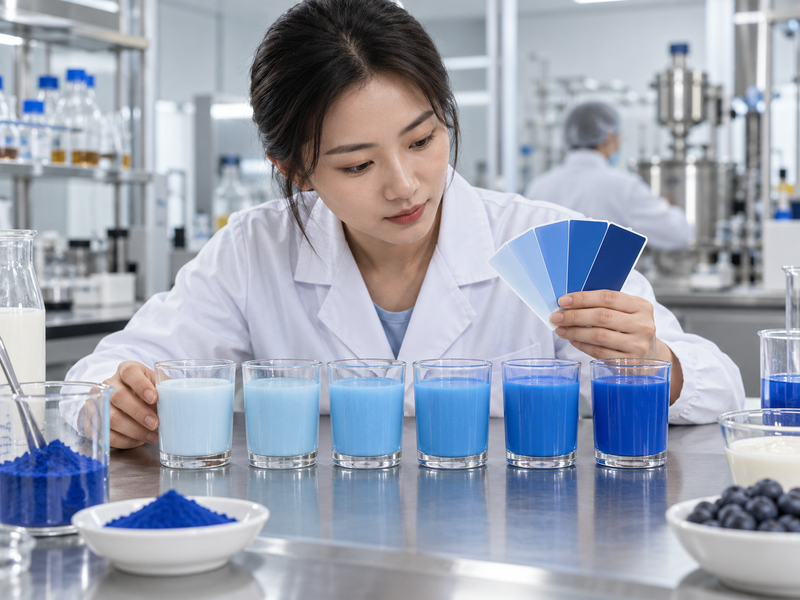
Do not stop at the finished powder: two blue powders with the same color value can result from different routes. One may retain more source constituents; another may be a highly purified fraction diluted to a target strength. Classification depends on that history as well as final composition. If the process changes after approval, rerun the evaluation. Build a change-control clause around extraction and carrier changes rather than treating a constant shade as proof that the legal status stayed constant.
6. How are carriers and blends assessed?
Review the entire supplied ingredient
Commercial blue powders can contain carriers chosen for handling, concentration adjustment, or stability. A carrier changes the final material’s composition and can affect how an enrichment calculation should be interpreted. It also raises finished-food ingredient-list questions. Request complete composition, not only the phycocyanin specification or color strength. Review whether any added ingredient has its own restrictions for the target EU food category. A blend should not be described as pure extract if substantial non-pigment material has been added after extraction.
Keep two calculations distinct: dilution after a selective extraction does not necessarily undo the selectivity of the extraction route. A low color-value blend could still originate from a selectively extracted pigment. Conversely, a visually intense material is not automatically an additive without examining the process. This is why the guidance looks beyond finished shade. Brands should avoid making a classification decision from a carrier-adjusted commercial grade number alone. Give the reviewer the pre-blend extract data where available.
| Mixture component | Document needed | Review purpose |
|---|---|---|
| Blue fraction | Process and composition | Classification |
| Carrier | Identity and amount | Labeling and calculations |
| Processing aid | Use and residual status | Compliance |
| Finished blend | Lot specification | SKU control |
7. What happens if the extract is an additive?
Check the EU positive list before use
If the specific material is classified as a food additive color, its use must fit the EU authorization system. The European Commission’s food-additive rules page explains that additives must appear on the Union positive list with conditions of use. Classification as an additive is not itself an authorization. The brand then needs to identify the permitted additive, relevant food category, specifications, and labeling requirements.
It cannot simply relabel an unlisted material as a colouring food because the color came from an edible organism.
Pause before scale-up: ask regulatory counsel to document whether the exact blue SKU qualifies as a food ingredient or falls under additive rules. If additive classification applies and no authorization covers the intended use, reformulation or another color route may be needed. The consequence belongs in feasibility work, before export volumes and EU artwork are committed. A supplier’s authorization in another country does not answer the EU question; U.S. spirulina extract rules, for example, do not transfer across borders.

8. Does E18 mean an EU E-number?
Keep commercial strength codes separate from law
No. In blue spirulina commerce, designations such as E18 can describe a color-value grade or supplier specification. They are not automatically EU E-numbers. A letter followed by a number can look like an additive code to a non-specialist, so artwork and procurement teams should clarify the supplier’s notation. Ask how color strength was measured, on what basis, and whether the grade contains carriers. Do not place a commercial grade code into an EU ingredient declaration as if it were an authorized additive identifier.
Check the source of every code: a specification sheet may use its own naming convention, while EU law uses formal additive designations in its positive list. The two systems serve different purposes. A strong color-value grade can be a useful formulation input but says little by itself about extraction selectivity. A buyer should keep commercial performance, safety specification, and legal classification in separate fields of the approval sheet. That avoids a confident but unsupported leap from a supplier shorthand to market authorization.
| Term | What it may describe | What it does not prove |
|---|---|---|
| E18 | Commercial color strength | EU E-number |
| Phycocyanin percentage | Pigment content | Colouring-food status |
| “Natural blue” | Marketing source | EU authorization |
| “Food grade” | Supplier quality intent | Specific category approval |
9. How should a brand review its finished food?
Combine ingredient status with product rules
Even after an ingredient classification is settled, the finished food needs its own EU assessment. Review where the product will be marketed, how the blue material functions, how much is used, and what the final ingredient statement communicates. If a color additive is involved, check the relevant category and conditions in the Union list. If the material qualifies as a colouring food, review ordinary food-ingredient labeling and whether the name accurately describes the product. Evaluate all carriers and any special product-standard or consumer-information requirements.
Use the sold SKU as the unit of review: a blue beverage premix, dairy alternative, and confection may differ in rules and technical performance. A single supplier statement that the ingredient is “EU ready” cannot approve all three. Preserve formulation version, supplier dossier, legal analysis, and artwork proof in one file. If a brand exports to several EU countries, coordinate the interpretation with knowledgeable counsel and relevant authorities where needed. Translation should follow an approved legal name, not lead it.
10. What is a defensible import decision?
Require enough evidence to reproduce the classification
Ask the supplier for source identity, biomass composition, process flow, selective-extraction analysis, enrichment calculation, full blend composition, and batch trace. Have a qualified EU regulatory reviewer apply the guidance to that specific SKU and document the result. Then check the finished food’s category, use, and label. A purchase decision can proceed with confidence when another reviewer could follow the same evidence trail and understand why the conclusion was reached. A vague certificate saying “colouring food” without underlying data is a weak basis for export planning.
Put change control in the contract: require notice of source, extraction, carrier, and grade changes. Reassess when the formula or EU rules change. For a buyer, this reduces the risk of building a product around an uncertain legal status. For a supplier, a complete technical dossier makes commercial conversations more efficient and specific. The objective is not a universal verdict on all spirulina blue products; it is a defensible decision for one material in one finished-food use.
| Approval gate | Needed evidence | Decision |
|---|---|---|
| Source | Identity and biomass data | Reference is valid |
| Process | Extraction and enrichment file | Status supported |
| Blend | Carriers and final specification | SKU defined |
| Finished food | Category, formula, artwork | Market use reviewed |
FAQ
Q1: Is every blue spirulina extract a colouring food in the EU? No. Classification depends on the specific source, extraction process, and enrichment evidence.
Q2: Does water extraction settle the question? No. Later filtration and concentration can still selectively enrich pigment.
Q3: Is E18 an EU additive number? No. It can be a commercial color-value grade and must not be treated as legal authorization.
Q4: Can a U.S. approval establish EU status? No. EU classification and permitted-use rules must be checked separately.
Q5: What document should I request first? Request the full process flow and composition data for the exact SKU, then assess enrichment.
Closing decision
Spirulina blue’s EU status follows its manufacturing history and measured composition. Get the source, process, and enrichment records before choosing a label or signing an import order. A product-specific review gives brands a credible route to a compliant blue food and gives suppliers a clear evidence request.