
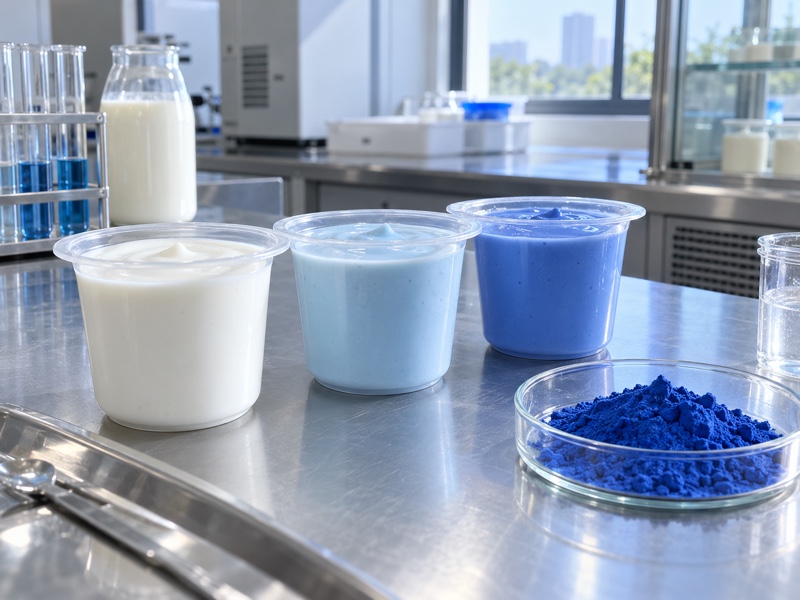
Phycocyanin yogurt can look striking in a prototype cup and dull by the time a shopper opens it. Dairy teams have to manage a protein-based blue color inside an acidic, light-exposed, chilled product while protecting texture and flavor. A bench photo answers only the first question. This guide lays out a controlled trial from base selection and dosing through packaged shelf life, with the checks a buyer should require from the ingredient supplier.
1. What should the yogurt team define before sampling?
Fix the product brief and target shade
Specify whether the product is stirred, set, drinkable, dairy-free, flavored, or layered. Record fat, protein, sweetener, fruit preparation, target pH, heat process, packaging, and shelf life. Each factor can alter how a blue color appears. An opaque high-protein base may need a different dose from a thinner drinkable yogurt, and a yellow fruit layer can shift the perceived hue toward green. Set the target with a physical sample or a controlled color reading rather than a phone image.
Define the intended market and label plan before selecting a powder. A supplier may offer several blue phycocyanin grades, but a grade name alone does not establish suitability or legal status. The current portfolio lists E3, E6, E18, E25, E35, and E40 powders; their composition and performance need the individual technical sheet and batch COA. Ask for a representative commercial sample, not a handpicked laboratory jar. The first trial should answer whether that exact material can reach an acceptable shade without disrupting yogurt texture and flavor.
2. When should the blue extract be added?
Compare realistic process points
Yogurt production usually includes a substantial heat treatment of the milk base before fermentation. A sensitive blue protein may fare differently if added before that step, after cooling, or during post-fermentation blending. The process choice must also respect hygienic handling and the plant’s food safety plan. A color addition after heat treatment cannot be accepted solely for better shade if it introduces an uncontrolled contamination route.
Run small trials at process points that the factory could genuinely use. Record temperature, hold time, shear, oxygen exposure, and mixing order. Compare immediate color with color after fermentation and after filling. A study on phycocyanin and phycoerythrin in refrigerated yogurt and cream cheese shows that these pigments are active research subjects in dairy matrices; it does not determine the best process for another recipe. The buyer needs plant-specific trials and a documented microbial control for the selected addition stage.
| Addition point | Potential benefit | Required check |
|---|---|---|
| Before base heating | Simple early mixing | Heat survival and loss |
| After cooling | Less direct heat exposure | Hygienic addition control |
| Post-fermentation | Color adjustment near filling | Shear, uniformity, microbiology |
3. How does yogurt acidity affect color?
Measure the real pH trajectory
Phycocyanin’s protein structure and appearance can respond to acidic conditions. Yogurt pH is not a single fixed value: it moves during fermentation and may drift in refrigerated storage. Measure it at ingredient addition, end of fermentation, after blending, at filling, and at shelf-life pulls. If a supplier describes a broad “stable pH range,” ask which material, concentration, buffer, temperature, and time were tested.
Start with the current yogurt base, not a specially adjusted laboratory buffer. Check whether fruit acids or a flavored syrup create a localized low-pH pocket when added. Add the pigment under controlled mixing so the team can identify streaking or temporary exposure to concentrated acid. A review on phycocyanin degradation discusses pH and temperature as stability factors. Use it to design the trial, then let the actual cups supply the decision. A color that survives one day may still fail at the intended refrigerated expiry.
4. What dose gives the target shade without harming sensory quality?
Use a measured dose ladder
Prepare several doses in the same base and process them identically. Measure color under standardized light and record the dose in grams per kilogram of finished yogurt. Add a control with no blue ingredient. If fruit or flavor is present, include it in the trial. The desired shade may require enough powder to affect flavor, mouthfeel, or ingredient cost. A supplier’s “recommended dosage” is a starting point, not a validated limit for your product.
Check visual uniformity after mixing and after filling. A powder may wet poorly and leave blue specks, while a concentrated pre-dispersion may create a different microbial or hold-time question. Use the same hydration method for every candidate grade. Ask a small trained panel to describe color and off-notes without telling them which supplier made each sample. The team should select the lowest dose that meets both initial and end-of-life color targets, rather than the deepest blue in a fresh cup.
| Dose level | Color result | Sensory result | Next step |
|---|---|---|---|
| Low | Below target | Acceptable | Keep as cost baseline |
| Mid | Within target | Acceptable | Advance to storage |
| High | Too intense or off-note | Review | Reject or lower dose |
5. Does the protein base change phycocyanin behavior?
Test the complete matrix
Yogurt contains proteins, fat, minerals, sweeteners, and sometimes stabilizers. These components can change pigment appearance and dispersion. A study of whey-protein interactions with phycocyanin under acidic conditions illustrates why a water trial cannot predict every dairy outcome. It does not give a ready-made formula for commercial yogurt. Run the test in the actual milk, cultured base, and fruit system planned for launch.
Observe separation, visible particles, and texture as well as shade. Instrument color can be useful, but a consumer sees the entire cup: fruit streaks, air bubbles, whey separation, and package reflections all influence perception. If a stabilizer improves color but changes spoonability, the team must evaluate both effects. Write down solids, protein level, and pH for each trial batch so that an apparently better result can be reproduced. When comparing several blue grades, do not change the yogurt base between them.
6. Which package and light conditions need testing?
Follow the real cold chain
Test the proposed cup, lid, sleeve, and retail display conditions. A clear package can expose the pigment to more light than an opaque one. The headspace and sealing process may also affect color or appearance. Store finished units under the planned refrigerated condition and include realistic light exposure when the product will sit in a display case. Record temperature excursions if the supply chain can reasonably encounter them.
Take repeated measurements from unopened cups, not only from one sample that is opened and returned to storage. Use several units at each time point to detect normal cup variation. Assess visible shade, instrument color if available, pH, texture, whey separation, odor, and the microbiological criteria in the food safety plan. A short hot-room test may help compare formulations, but yogurt’s real refrigerated shelf life needs direct evidence. Keep retained ingredient and yogurt samples so a future complaint can be investigated by lot.
| Storage variable | Why it matters | Trial control |
|---|---|---|
| Cup opacity | Light exposure | Test final package |
| Display lighting | Visible fade | Simulate retail conditions |
| Headspace | Oxidation opportunity | Use production fill |
| Chilled duration | Consumer experience | Pull to proposed expiry |
7. How should ingredient suppliers be compared?
Score performance in the yogurt, not only in water
Send each supplier the same brief: yogurt type, pH, process, expected dose range, package, target shade, and market. Request full composition, specification, recent commercial-lot COA, safety tests, storage instructions, and change-control policy. Ask whether the sample comes from a production lot. A powder with a stronger standard-solution color may still perform worse after fermentation or in the packaged dairy base.
Compare cost per acceptable cup after dose and process loss. Include labor or equipment needed for pre-dispersion, production rejects from streaking, and any package change required to retain color. Keep the analytical method consistent when comparing phycocyanin values. If one supplier quotes an E-grade code and another quotes a percentage, do not treat those as equivalent measurements. A common pilot protocol turns the discussion from adjectives into evidence: which lot reached the target color at the accepted dose through the proposed shelf life?
8. What food safety and legal checks belong in the file?
Review source, lot, and destination
Request lot-linked tests for relevant contaminants and microbiology, along with source traceability and the complete ingredient statement. The FDA’s guidance on blue-green algae and microcystins makes the source review concrete. The yogurt factory also needs to validate the stage at which the color is added so the finished product remains under its food safety controls. A pleasing color cannot compensate for an uncontrolled post-heat addition.
Legal status must be checked for the exact blue ingredient, yogurt category, and sales market. The United States has a specific listing for spirulina extract as a food color, with conditions in the rule. Have the regulatory team read those conditions and evaluate the formulation. Do not assume a supplier’s “food grade” label settles every country or every claim. Store the decision beside the formulation record so future flavor extensions are reviewed deliberately.
| File item | What it proves or supports |
|---|---|
| Source and composition | Material identity |
| Lot COA | Measured batch properties |
| Contaminant tests | Defined safety controls |
| Process validation | Hygienic addition |
| Market assessment | Permitted use and label |
9. How do you avoid a misleading launch photo?
Photograph the product at the end of its life
Marketing teams often photograph the best fresh bench cup. Instead, review cups from the first production pilot and from the proposed shelf-life endpoint under the same lighting. Compare the color with the planned online and package imagery. If the product fades from bright blue to gray before expiry, the launch image sets an expectation the product cannot meet. The problem belongs in formulation or packaging, not photo editing.
Use a controlled color standard and record camera conditions when photos are part of the approval process. Get feedback on real cups from people who have not seen the target rendering. Ask them to describe color, texture, and any off-notes. A change in fruit preparation, dairy base, or package can invalidate earlier color evidence; mark those as re-test triggers. The approved reference should be a physical production sample with lot and date, not a web image detached from the recipe that produced it.
10. What is a defensible yogurt approval decision?
Link the supplier lot to the finished cup
Approve a specific ingredient grade and composition for a specific recipe and process. The decision file should name the supplier, lot, full specification, dose, addition point, mixing method, package, market review, and storage results. State color and sensory limits before the first commercial batch. Use the same criteria to release later ingredient lots and monitor the finished yogurt. A substitution in blue powder should trigger a controlled trial, even if both suppliers call their products “phycocyanin.”
Keep a practical escalation route. If a later cup loses color, compare a retained ingredient sample, the production record, pH, package, and cold-chain data. Ask the supplier for a cause analysis tied to the lot, not a generic assurance. The strongest approval is a result that can be repeated on a factory line and still looks acceptable when the consumer opens the cup near expiry.
| Approval gate | Evidence |
|---|---|
| Ingredient | Spec and commercial-lot COA |
| Bench | Dose ladder and sensory notes |
| Pilot | Process and hygienic controls |
| Shelf life | Packaged cup results |
| Release | Agreed limits and retained samples |
The whey-protein interaction guide gives a closer look at one dairy matrix question.
FAQ
Q1: Can phycocyanin be added before yogurt pasteurization? Test the real heat profile. Color survival and food safety controls must both support the chosen stage.
Q2: Why does blue yogurt sometimes turn dull? pH, heat, light, matrix interactions, or storage may contribute. A controlled trial is needed to isolate the cause.
Q3: Does a stronger blue powder always need less product? Not necessarily in the finished yogurt. Compare accepted shade and stability at measured doses.
Q4: Is a clear cup suitable? It may be, but test light exposure in the actual package through the intended shelf life.
Q5: Which sample should a buyer approve? A representative commercial ingredient lot tested in the production yogurt recipe and final package.