
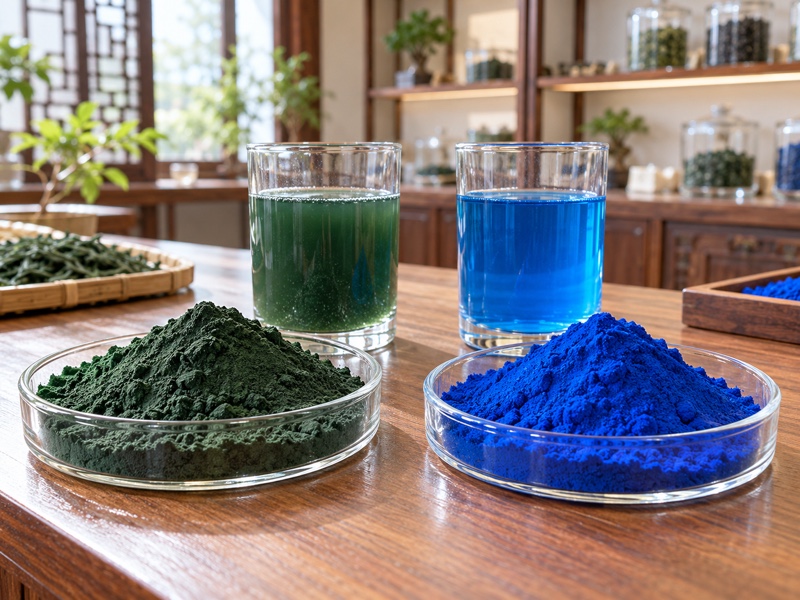
The phycocyanin vs spirulina choice can send a buyer in two directions when a product brief says “use spirulina for natural blue.” Whole spirulina powder carries the full dried biomass and usually looks green to blue-green. A phycocyanin-rich extract targets the blue fraction. They support different visual, taste, nutritional, labeling, processing, and cost decisions. The right choice is the ingredient that passes the actual product brief, with the correct documents for its market.
1. What is the relationship between phycocyanin and spirulina?
One is a component, the other is biomass
Phycocyanin is a blue light-harvesting pigment protein present in spirulina, a common commercial name for cultivated Limnospira. Whole spirulina powder contains that protein along with many other constituents. Extracting and concentrating the blue fraction changes composition and often appearance. A phycocyanin preparation may also include carriers that help drying or use in food. Therefore a gram of blue extract and a gram of whole spirulina do not deliver the same material.
The review of phycobiliproteins provides the biological background. For a purchase, ask what form is offered and how it was made. The current range includes whole spirulina powder and tablets plus several E-coded blue powders. Request each grade’s specification instead of reading the code as a percentage. If the marketing copy says “spirulina,” the ingredient declaration must still reflect the actual product used under the destination market’s rules.
| Attribute | Whole spirulina | Blue extract |
|---|---|---|
| Main concept | Dried biomass | Selected blue fraction |
| Typical color | Green/blue-green | Blue |
| Other biomass components | Retained | Reduced or changed |
| Buyer question | Biomass quality | Extract grade and carrier |
2. Which works better for a clean blue product?
Compare finished-product shade
An extract is the logical starting point when a brand wants a bright, relatively clean blue. Whole spirulina’s other pigments and solids often push the appearance toward green and may add turbidity. That does not make whole powder inferior; it serves a different design. A smoothie sold as a green algae product may welcome the whole-biomass appearance. A pale-blue frosting may not.
Prepare both ingredients in the exact base formula. Test dose ladders, mixing time, sediment, flavor, and shade after processing. Hold units in the intended package through shelf-life checkpoints. A blue extract can still fail if the product’s acid, heat, or light environment degrades its color. The review of phycocyanin degradation supports testing those conditions. Whole spirulina can also change appearance during processing. Judge each candidate against the same visual target and use level, not against a photograph of raw powder.
3. How do flavor and mouthfeel differ?
Let a blinded sensory trial decide
Whole biomass brings more of the organism’s flavor and texture into a recipe. A blue extract may offer a cleaner sensory profile, but its carrier and process can still affect taste or mouthfeel. The difference will be obvious in a clear drink and less obvious in a strongly flavored bar. Dosage matters: a low amount of whole powder may be unobtrusive, while a high color dose may dominate the product.
Use a controlled tasting protocol with a no-color control, candidate doses, and identical flavoring. Note aroma, aftertaste, grittiness, haze, and sediment. Record whether the product meets its intended consumer promise. If a brand wants “whole spirulina” on the front of pack, reducing the dose until its sensory impact disappears may also undermine the intended nutritional story. If a brand needs a nearly flavorless blue, test an extract grade designed for that application. Do not let procurement choose solely by price before sensory approval.
| Product format | Likely sensory concern | Trial measure |
|---|---|---|
| Clear drink | Haze and aftertaste | Turbidity and panel |
| Yogurt | Color and protein interaction | Cup stability |
| Bar | Earthy note and spots | Cut surface and taste |
| Tablet | Dose and swallowability | Finished-unit evaluation |
4. Do they support the same nutrition claims?
Verify composition and legal claim basis
Whole spirulina contains a broad biomass composition; an extract concentrates a fraction and may contain carriers. Neither name alone establishes the amount of protein, vitamins, or phycocyanin in a serving. Request a current composition analysis and calculate the contribution at the actual dose. If the proposed label makes a nutrient or function claim, qualified reviewers must check the market’s rules and the evidence for the finished product.
Avoid borrowing a study on purified phycocyanin to describe whole spirulina, or a nutrient figure for whole biomass to promote a blue extract. The evidence may concern different material, dose, and population. A food-application review describes possible uses, but it does not validate every commercial claim. A color-use ingredient can have a very low dose, making a broad nutritional promise especially questionable. Build claims from measured composition and relevant evidence rather than the ingredient’s reputation.
5. What does the manufacturing process do to each?
Test the production sequence
Whole powder may need dispersion and suspension management. A blue extract may dissolve more readily but lose color under unsuitable heat, acid, or light exposure. Carriers and particle size can change how quickly a powder wets. The plant’s actual shear, hydration time, and order of addition can matter as much as a laboratory solubility claim.
Run a pilot using the proposed production line or a faithful simulation. Sample before and after heat, filling, and storage. Note residue on equipment and color variation between units. If the recipe needs a change to accommodate one ingredient, include that change in the approval and cost model. A post-heat addition might preserve blue but require a new food-safety and process review. Do not use a room-temperature beaker result as permission to reorder commercial quantities for a hot-filled product.
| Process step | Whole biomass check | Extract check |
|---|---|---|
| Hydration | Lumps and suspension | Wetting and streaks |
| Heat | Flavor and appearance | Blue retention |
| Filling | Settling | Dose uniformity |
| Storage | Sediment and oxidation | Color stability |
6. How should quality specifications differ?
Write specifications around the material
For whole spirulina, review source identity, biomass composition, microbiology, heavy metals, relevant cyanotoxins, moisture, and physical properties. For an extract, add defined pigment or color assays, carrier identity, dispersion behavior, and stability criteria. Both need traceability and lot-specific certificates. The exact test panel should follow a documented hazard assessment and the destination market.
The FDA’s microcystin information for blue-green algae products is a reminder that blue or green appearance is no safety test. Ask for methods and numerical results. An extract’s absorbance ratio is not automatically its weight-percent phycocyanin content, and a whole powder’s protein percent does not establish the blue fraction. Make sure the quoted grade, sample, COA, and shipped lot all refer to the same product. If the supplier changes its source or process, reevaluate the approved application.
7. Are their regulatory uses identical?
Match the exact ingredient to the market
No. The legal category can depend on composition, process, intended function, use level, and jurisdiction. The FDA has a specific listing for spirulina extract as a color additive with conditions for certain US uses. Do not treat that listing as blanket approval for whole spirulina, every blue extract, every food, or another country. A supplement and a color additive may also be handled differently.
Ask regulatory specialists to review the actual supplier dossier and proposed label before choosing an ingredient. The name a supplier uses in a brochure may differ from the legally required declaration. Keep records for each target market. If the business later expands to another country or product category, reopen the review. It is easier to do this before design and packaging are finalized than to change labels after the first production run.
8. Which has the lower real cost?
Price the acceptable finished unit
Whole spirulina may have a lower price per kilogram than a blue extract, but it may require a higher dose to achieve a shade it was not designed to deliver. An extract may cost more per kilogram yet use less powder and create less flavor interference. Neither conclusion is automatic. Use trial doses, landed quotations, process loss, test costs, waste, and packaging changes to calculate cost per accepted unit.
If the product’s core proposition is whole spirulina, the extract may not serve the brand story even if it looks attractive. If the proposition is blue color, whole powder might force additional flavor or filtration work. Include shelf-life failure in the model; units that turn an unacceptable shade are costly regardless of the ingredient’s opening price. Ask suppliers for quantity tiers and lead times only after technical qualification narrows the choices. A price comparison without a common product outcome is a spreadsheet exercise, not a purchasing decision.
| Cost input | Trial or document |
|---|---|
| Dose at target shade | Formula trial |
| Waste and loss | Pilot record |
| Quality testing | Release plan |
| Packaging | Shelf-life result |
| Landed price | Supplier quotation |
9. What should a sample request contain?
Give the supplier the intended use
State product type, target market, pH, heat process, target shade, desired label story, annual volume estimate, and package. Ask for one or more grades that fit those conditions, with full composition, specification, COA, safety documentation, storage instructions, and recommended trial range. A supplier may suggest whole powder for a nutrition concept and extract for a color concept. The buyer should be able to test both on a common protocol where the brief permits it.
Request samples from the intended commercial process, not a special laboratory batch. Record the lot numbers and keep retained samples. Ask whether the offered E-coded blue grade contains a carrier and what the code denotes in that supplier’s specification. For whole spirulina, ask whether the powder or tablet has any added ingredients. The quality team should agree on how changes will be communicated. A precise brief gives the supplier a chance to propose a useful product rather than sending whichever blue sample is easiest to ship.
10. Which ingredient should the team choose?
Decide from the product’s main job
Choose whole spirulina when the product intentionally contains the whole biomass and its green-blue appearance, flavor, composition, and label fit the brief. Choose a phycocyanin-rich extract when the main job is a defined blue color and the extract passes process, shelf-life, safety, and legal checks. Some products may use both for separate functions, but each needs its own specification and dose rationale.
Write the approval decision in one page: candidate, source, grade, target use, accepted dose, sensory and color result, safety panel, local-use review, cost in use, and change triggers. Confirm the first commercial lot against the pilot. A buyer who can explain those records has made a stronger choice than one who chose between two ingredient names in a search result.
| Product goal | Starting candidate |
|---|---|
| Whole-algae concept | Spirulina biomass |
| Clean blue shade | Blue extract |
| Nutrition claim | Material with verified contribution |
| Heat/acid process | Whichever grade passes trial |
The chlorophyll guide explains why whole biomass and a blue fraction can look different.
FAQ
Q1: Is blue spirulina the same as whole spirulina? Often “blue spirulina” refers to an extract; confirm the supplier’s exact composition.
Q2: Does whole spirulina contain phycocyanin? Yes, but its concentration and appearance differ from a blue extract.
Q3: Is the extract always more stable? No. Stability depends on grade, formula, process, package, and storage.
Q4: Can I use the same claims for both? No. Base claims on the actual material, dose, evidence, and local rules.
Q5: What determines the purchase? Finished-product performance, batch quality, legal use, and cost per acceptable unit.