
The most useful answer about phycocyanin sources is a lot traceability record. The pigment occurs in several photosynthetic organisms, but a commercial buyer needs the particular organism, cultivation site, extraction route, and shipment lot behind a proposed powder. Those details determine which identity checks, contaminant controls, and market-use reviews belong in the approval file. They also help explain why two blue samples perform differently in the same food.
1. Which organisms naturally contain phycocyanin?
Start with photosynthetic biology
Phycocyanin is a phycobiliprotein used in light harvesting by many cyanobacteria and some other algae. Cultivated Limnospira, historically marketed as spirulina, is a familiar commercial source. That does not mean every blue-green organism is suitable for food production. Species, growing conditions, contaminant risks, extraction practices, and legal status differ. A scientific list of organisms containing the pigment should not be read as a supplier list.
The phycobiliprotein review describes the protein family and biological context. For purchasing, ask the supplier to state the exact source organism and its identification method. Confirm whether the ingredient is made from cultivated biomass, a wild-harvested source, or purchased intermediate material. If the source is described only as “blue algae,” the buyer lacks enough detail to assess lot consistency. A qualified supplier should be able to connect the finished powder to a controlled source without disclosing every proprietary process setting.
| Source description | Useful? | Follow-up |
|---|---|---|
| “Blue algae” | Too broad | Ask for species |
| “Spirulina extract” | A start | Confirm organism and process |
| Named culture plus site | Better | Review controls and lots |
| Batch traceability chain | Best | Audit supporting records |
2. Is spirulina powder a source or a finished phycocyanin ingredient?
Distinguish biomass from extract
Whole spirulina powder is dried biomass. It contains phycocyanin alongside proteins, other pigments, minerals, and additional constituents. A blue extract is a processed fraction enriched for the desired color. The two ingredients can have different appearance, taste, dispersibility, composition, and use level. A label or marketing brief should state which material is actually being purchased.
The supplier’s current range includes whole spirulina powder and tablets as well as several E-coded blue powders. The E codes require written specifications; their numbers should not be treated as measured pigment percentages. If a buyer needs a clean blue color, a whole green powder may miss the visual target. If a buyer wants whole biomass for a nutrition-focused concept, an extract may not support the same ingredient story. Request samples of the proposed commercial grade and test them in the intended product before writing claims or setting a dosage.
3. How is the biomass cultivated?
Review controls at the growth stage
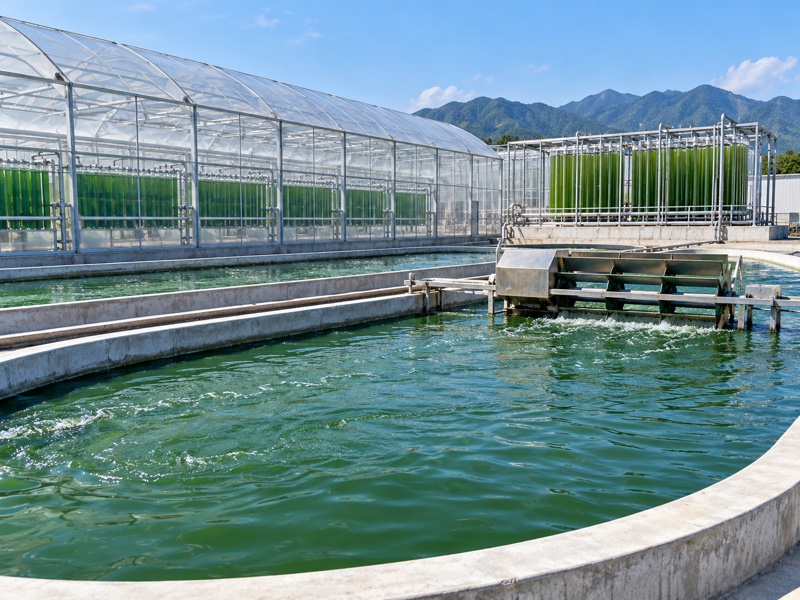
Cultivation methods can include managed ponds or enclosed systems, each with operational choices for water, nutrients, light, harvest, and contamination control. A source story should name the production site and describe how the operator monitors culture identity and water quality. Ask how it prevents intrusion by unwanted organisms and how it handles a failed culture. A photograph of a green pond does not answer these questions.
Request records appropriate to the supplier relationship: site and culture identification, water and input controls, harvest records, batch coding, and relevant testing. Ask whether biomass is processed promptly after harvest and how storage is controlled. Pigment quality can change before extraction if wet biomass sits too long or sees unsuitable conditions. The buyer does not need to dictate every cultivation parameter, but it should understand which controls protect the approved ingredient. A site change or outside biomass purchase should trigger notice and requalification.
| Cultivation record | Decision it supports |
|---|---|
| Source culture | Identity |
| Water and input monitoring | Hazard control |
| Harvest batch code | Traceability |
| Biomass hold time | Quality consistency |
| Deviation record | Incident response |
4. What happens between biomass and blue powder?
Follow the material through extraction
A typical process may disrupt cells, extract water-soluble proteins, remove solids, concentrate the colored fraction, and dry or formulate it. The sequence varies by source and intended grade. A review of phycocyanin extraction from Limnospira outlines techniques and their trade-offs. A research method chosen for high purity may be unsuitable for a food supplier’s scale, cost, or regulatory requirements.
For each offered powder, request a process description covering extraction aids, purification or concentration, carrier ingredients, drying method, and final packaging. Ask how the plant connects a raw biomass lot to finished batches if material is pooled. If extraction is performed by a contract manufacturer, confirm responsibility for quality release and change control. A clean blue appearance does not reveal what carrier, residual processing aid, or moisture level the product contains. Composition and process documentation make the ingredient usable in formulation and label review.
5. Can another cyanobacterium be an equivalent source?
Test identity, safety, law, and performance anew
The presence of phycocyanin in another organism does not make its extract equivalent to a cultivated Limnospira preparation. Organisms can differ in associated pigments, toxins, other constituents, and manufacturing history. An alternative source may be technically promising but needs its own risk assessment. The FDA’s information on microcystins in blue-green algae products illustrates why source control and appropriate testing matter.
If a supplier proposes a source substitution, request updated identity and safety documents, a full composition review, and a representative sample. Check legal status in each destination market. Run the sample through the same finished-product tests used for the original grade, including shade, taste, process survival, and shelf life. The brand may also need to change the ingredient declaration or customer communication. “Same blue molecule” is too narrow a basis for approving a different commercial preparation.
| Equivalence check | Why it must be repeated |
|---|---|
| Source identification | Different organism |
| Contaminant panel | Different hazards |
| Regulatory review | Source-specific permissions |
| Formula trial | Different composition |
| Label review | Different declaration |
6. How can a buyer verify claimed origin?
Reconcile documents across the chain
Begin with the supplier’s legal entity and manufacturing site, then connect purchase order, finished batch number, production record, biomass lot, and relevant test results. Request a sample trace exercise during qualification. It should show how quickly the supplier can identify upstream material and downstream shipments. The exact degree of disclosure may depend on commercial confidentiality, but the chain must be auditable.
A country-of-origin statement is useful only when it defines whether it refers to cultivation, extraction, blending, or packing. A powder grown in one country and blended in another needs a clear account. Ask whether the named factory is the actual manufacturer or a trading office. A quality agreement can set notification requirements for changes in source, site, carrier, and process. Retained samples from approved lots help investigate later color drift. A website photo cannot replace linked batch records.
7. Which tests belong to a source-specific review?
Combine identity, quality, and safety
The right panel depends on the organism, cultivation, process, intended use, and market. Typical questions include species identity, pigment assay under a defined method, moisture, microbiology, relevant cyanotoxins, heavy metals, and other contaminants indicated by the risk assessment. A current certificate of analysis should identify the shipped lot and show results against specification limits. If a report says only “pass,” ask for the numerical result where it matters.
Analytical methods need scrutiny. An absorbance ratio may describe pigment purity under one method, but it is not automatically a weight percentage in a carrier-containing powder. Ask for sample preparation, wavelengths, dilution, and calculation. Compare two suppliers under a common method when the choice depends on a number. The buyer should also inspect the physical material for color, odor, flow, and dispersion. Laboratory identity cannot substitute for a finished-product trial, and a pleasing color cannot substitute for safety testing.
| Test area | Buyer question |
|---|---|
| Identity | Is this the stated source and fraction? |
| Assay | What does the number measure? |
| Contaminants | Does this lot meet the agreed panel? |
| Microbiology | Is it fit for intended use? |
| Application | Does it work in the recipe? |
8. Does origin determine whether a food use is legal?
Review the exact material and application
Source can be a central part of a permitted-use definition. The FDA’s spirulina extract color-additive listing should be read with its conditions when a US team proposes that use. It should not be generalized to every phycocyanin source, product type, or jurisdiction. A supplier’s “food grade” assertion does not determine permission for a particular market and application.
Ask qualified regulatory staff to review organism, manufacturing process, composition, intended function, use level, and label. Retain the outcome in the product file. If the brand sells in several countries, conduct a separate review for each. A market expansion can make a previously acceptable ingredient unsuitable without any change in the material itself. Procurement should know which countries the qualification covers so a repeat order is not assumed to be globally cleared.
9. How should source changes be managed?
Set triggers before a change occurs
Changes may include a different culture, farm, extraction plant, carrier, drying method, or outside supplier. Each can affect safety, analytical profile, color, cost, and labeling. Require written notice and classify which changes need documents only, which need a new sample, and which require full requalification. The supplier should not ship a substituted material under the same internal code without informing the buyer.
Compare a new sample against a retained approved lot under the same methods and finished-product process. Review updated COA, source trace, and regulatory position. If the change affects appearance at shelf-life end, update the approved standard or reject the substitution. Document the decision and effective lot. Change control is cheaper than discovering a new source after production units look different on shelf.
10. What is a useful source-approval decision?
Approve a traceable material for one use
A defensible approval names the organism, production route, grade, carrier, specification, lot tests, source site, destination market, and finished-product application. It links the approved commercial sample to a pilot and a shelf-life result. It also states what change will trigger a new review. This is more valuable than a blanket statement that phycocyanin is “from spirulina.”
Keep the initial purchase small enough to verify first commercial-lot performance. Compare that lot with the pilot’s reference sample. If results diverge, investigate the source chain before adjusting a formulation blindly. A well-kept record allows procurement, quality, and R&D to ask the supplier the same specific questions when a problem appears.
Before signing an annual supply agreement, request one completed trace exercise for an actual shipped lot. The supplier should be able to identify the culture or biomass inputs, processing batches, retained samples, test reports, and customers who received the lot. Record how long the exercise took and whether it found any gaps. This is more revealing than a generic promise of “full traceability.” If the business later investigates an unexpected shade or contaminant result, the trace should support a decision within the time the product remains in distribution. A buyer can also ask which records are kept digitally and how long they are retained. Those details make the origin claim operational rather than decorative.
| Approval item | Recorded detail |
|---|---|
| Biology | Species and culture source |
| Production | Site and process summary |
| Quality | Specification and COA |
| Use | Product and market |
| Change | Notification and re-test trigger |
The origin-evidence guide lists records that can support a source claim in an export purchase.
FAQ
Q1: What food naturally contains phycocyanin? Whole spirulina biomass contains it, but commercial foods usually use a defined biomass ingredient or blue extract.
Q2: Is every blue-green algae source safe for food? No. Each source needs identity, hazard, manufacturing, and legal review.
Q3: Can I determine the source from the powder’s blue shade? No. Ask for organism and batch traceability documents.
Q4: Does a country-of-origin label identify the farm? It may refer to cultivation, processing, blending, or packing. Ask for a stage-by-stage record.
Q5: What change should trigger requalification? A new source organism, farm, process site, carrier, or other change that could affect composition or performance.