
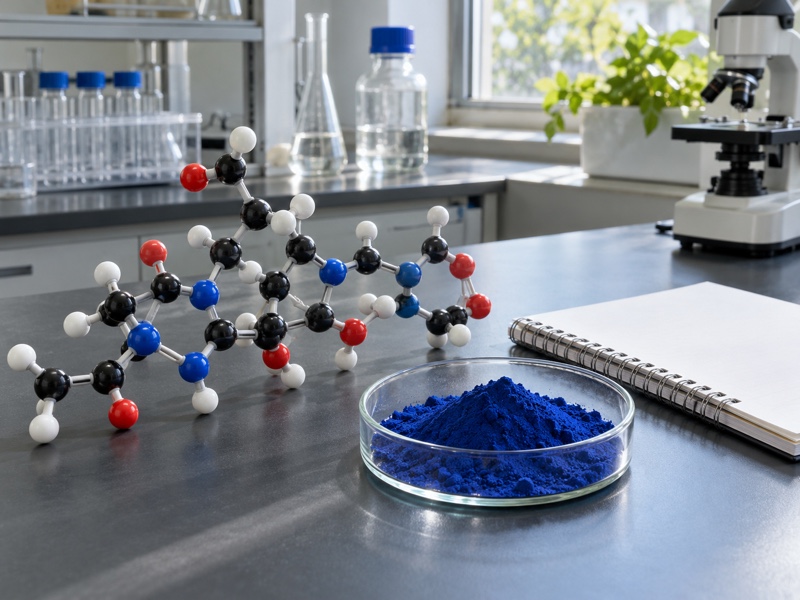
A request for the “phycocyanin formula” sounds straightforward until the buyer has to decide what is being specified. Phycocyanin is a family of pigment-protein complexes, not a small molecule sold under one useful fixed formula. Its subunits, chromophores, assembled form, source, and preparation all matter. A commercial powder may also contain carrier and water. For purchasing, the better question is which identity and performance measurements define the exact ingredient offered.
1. Why is there no single practical chemical formula?
Recognize a protein complex
Proteins are chains of amino acids, and phycocyanin includes protein subunits with covalently attached chromophores. The assembled pigment can vary by organism and state. A simple elemental formula like the one used for a small purified compound would not describe the commercial powder, especially if it contains carriers or other extracted material. A catalog number or mass estimate may identify a research preparation but does not define every food grade.
The review of phycobiliproteins describes related structures and characterization. A buyer should ask what the supplier means by “phycocyanin”: C-phycocyanin, a broader blue fraction, whole spirulina, or a formulated spirulina extract. These distinctions affect assays, color, cost, and label review. Avoid copying an isolated molecular formula from an online listing into a food specification. It can create false precision while omitting the material’s actual composition.
| Term on a document | What it may describe |
|---|---|
| Molecular mass | A subunit or assembly |
| Empirical formula | A particular model or sequence |
| Purity ratio | Spectral measurement |
| Pigment content | Method-defined concentration |
| Blue powder | Commercial preparation |
2. What are the protein and chromophore parts?
Separate the scaffold from the light-absorbing group
Phycocyanin’s protein subunits hold phycocyanobilin chromophores. The chromophores account for the distinctive light absorption, while the protein environment influences optical behavior and stability. Related phycobiliproteins have different structures and spectra. This is why two blue preparations can show different color or fluorescence after a change in pH or temperature even when their product names match.
For a technical dossier, ask the supplier to identify the source and analytical basis rather than promise one universal molecular diagram. If a research team needs sequence or mass-spectrometry detail, it should specify that need separately from a food buyer’s color requirement. Food procurement needs to know that the commercial lot performs and is safe under defined conditions. A drawing of a chromophore does not answer whether a powder has a carrier, how much color it supplies per kilogram, or how it behaves in a drink.
3. Do all organisms make identical phycocyanin?
Expect source-dependent differences
The phycocyanin family is found in different photosynthetic organisms. Sequence, associated pigments, and extraction yield can vary. Commercial grade also depends on process and formulation. A scientific result from one species cannot automatically specify material from another. Ask for taxonomic identity, cultivation source, and lot traceability. If a supplier changes organisms, conduct a new identity, safety, regulatory, and application review.
In the current portfolio, blue powders are sold under E3, E6, E18, E25, E35, and E40 codes. Those are commercial grade labels whose meaning must come from the supplier’s specification. They are not molecular formulas or self-evident percentages. Whole spirulina powder is another product. A buyer comparing prices should normalize to the same source description and defined measurement method, then test the grades at matched finished-product performance.
| Source question | Why it matters |
|---|---|
| Which organism? | Identity and risk |
| Which cultivation site? | Traceability |
| Which extraction route? | Composition |
| Which carrier? | Label and dose |
| Which lot? | Reproducible testing |
4. What does molecular mass tell a buyer?
Read the unit and the measured object
A published molecular mass may refer to an alpha subunit, beta subunit, combined unit, or higher assembly. Conditions used for measurement can alter the apparent size. A buyer who copies one number into a supplier specification may reject acceptable material or accept an unrelated result. Ask the laboratory to name the measured species and technique. Gel electrophoresis, chromatography, and mass spectrometry answer different structural questions.
For routine food purchasing, molecular mass is rarely the leading performance criterion. It may help a laboratory investigate identity or process damage, but color, stability, safety, and composition have more direct commercial value. If a supplier claims a special “low molecular weight phycocyanin,” request its definition and method, then ask why the difference helps the target product. Do not treat a change in reported mass as a health benefit without suitable evidence.
5. How is “purity” commonly measured?
Keep spectral ratios in their lane
Research literature often uses an absorbance ratio around the pigment’s visible absorption region and a protein-related UV wavelength as one purity indicator. The exact method, wavelengths, buffer, path length, and calculation must be stated. A ratio is dimensionless. It is not automatically percent phycocyanin by mass in a commercial powder. Carrier, other proteins, and matrix components can affect the reading.
Ask for the original method and a current COA. If mass fraction is important, request a validated method that measures it with clear units and recovery. Run two suppliers’ samples under one method if a numerical comparison will drive a contract. A review of extraction from Limnospira shows why isolation and purification choices change the analytical profile. The most purified laboratory sample may not be the best ingredient for a particular food because dispersion, cost, and stability still matter.
| Reported number | Do not assume it means |
|---|---|
| A visible/UV ratio | Weight-percent pigment |
| Protein percent | Blue pigment percent |
| E-grade number | Measured concentration |
| Color value | Health effect |
6. Can a formula predict color in food?
Use application testing instead
The molecular structure explains why a pigment can absorb and emit light, but it cannot predict its appearance in every recipe. pH, heat, light, other ingredients, solids, package, and storage change the observed color. The review of physicochemical degradation identifies relevant variables. A supplier’s bench solution may look blue while an acidic finished drink fades before expiry.
Prepare the actual formula at several doses. Measure shade after mixing, processing, packaging, and storage. Record taste, sediment, and haze. Compare color at the shelf-life endpoint, not only on day zero. If a grade requires an unacceptable dose or package, its attractive molecular story has no practical value for that SKU. Put the finished-product color criteria into the approval file alongside the analytical specification.
7. What should a commercial specification contain?
Describe the lot a plant can buy
Start with source organism, product form, full composition, intended use, grade, physical description, packaging, and storage. Add validated identity and assay methods, color or application test, moisture, microbiology, and a risk-based contaminant panel. The FDA’s microcystin information shows why source-related safety tests deserve a place. Set acceptance ranges that reflect both supplier capability and product need.
Require a lot-specific COA and change notification. Specify whether the supplier may alter a carrier, raw biomass source, or extraction process under the same code. If the material is proposed for US food color, have qualified reviewers check the spirulina extract color-additive listing and its conditions; other markets need their own review. A molecular formula cannot replace any of these documents.
| Specification field | Practical purpose |
|---|---|
| Source and process | Identity and consistency |
| Composition | Formula and label |
| Assay and method | Lot comparison |
| Safety panel | Hazard control |
| Color trial | Finished-product fit |
8. How should a research team request structural data?
State the experiment, not a vague formula request
If a laboratory needs phycocyanin for spectroscopy, fluorescence, binding studies, or another assay, define the required source, purity method, buffer, concentration, storage, and acceptable contaminants. Ask whether the supplier characterizes subunits, chromophore attachment, aggregation, and spectral profile. Request raw or method-level data where the experiment depends on them. A commercial food COA may be insufficient for such work.
Conversely, a research reagent specification may be overbuilt for a beverage color trial and cost far more. Keep procurement categories distinct. If a food company commissions research with its commercial grade, send that exact lot to the lab and document any preparation steps. A result from a different high-purity reagent should not be described as a finding on the finished product. This boundary helps both scientists and marketers avoid false equivalence.
9. Which questions should buyers send suppliers?
Ask for definitions behind each number
Request the exact grade name, source organism, manufacturing site, carrier, composition, assay method, color value method, current COA, safety panel, storage, shelf life, and sample from routine production. Ask what the supplier means by “purity” and whether the reported number is a ratio, mass fraction, or concentration in solution. Ask how changes will be communicated and whether prior lots are retained for comparison.
Send the target product’s pH, heat, package, and color goal. Suppliers can then recommend a grade based on application rather than an impressive molecular number. Compare samples under one internal trial. If a supplier refuses to define its test units or composition, do not solve that ambiguity by inventing a formula from a search result. A clear purchase specification is less elegant than a single equation but far more useful.
10. What should replace the formula in a purchase decision?
Use an identity and performance profile
Approve a named commercial preparation from a named source, made by a defined process, with a current lot COA and finished-product trial. Record assay methods, safety results, target dose, shelf-life color, and market-use review. The profile should be detailed enough for a second buyer or quality manager to reproduce the decision. If any component changes, decide whether to requalify.
A small-molecule formula answers a chemistry question about a defined molecule. A phycocyanin purchase involves a biological complex in a commercial mixture. The right document is therefore a specification plus a tested application, not a copied elemental formula.
If a customer asks for a chemical formula on a technical questionnaire, do not leave the field blank without explanation or insert a formula for phycocyanobilin as if it described the whole powder. State that the commercial material is a pigment-protein preparation, give the source and composition, and attach the relevant specification and analytical method. If the form requires a molecular identifier, ask the customer’s technical reviewer which component or research standard they mean. That exchange can prevent a customs, safety, or laboratory record from misidentifying the ingredient. Keep the answer consistent across sales sheets, COAs, and the product’s regulatory dossier.
For research purchases, the request can be narrower: state which subunit or assembly is required, the acceptable spectral profile, and the buffer or storage form. For food purchases, state the accepted color, dose, contaminants, and shelf life. The two requests may refer to related chemistry, yet they require different proof. Writing those needs explicitly is more accurate than assigning one formula to both.
| Purchase decision | Evidence |
|---|---|
| Identity | Source and method |
| Composition | Full preparation details |
| Quality | COA and trend |
| Performance | Product trial |
| Permission | Market-specific review |
The SDS-PAGE guide explains one structural test that a research team may request.
FAQ
Q1: What is the chemical formula of phycocyanin? No single small-molecule formula usefully describes all phycocyanin protein complexes and commercial powders.
Q2: Is phycocyanobilin the same as phycocyanin? No. It is a chromophore associated with the protein complex.
Q3: Does an E-grade number state pigment percentage? Do not assume that. Ask the supplier for its definition and method.
Q4: Is a purity ratio a percent by weight? No. It is a method-defined ratio unless validated as another measure.
Q5: What should a food buyer specify? Source, composition, assay method, safety, legal use, and finished-product performance.