
Phycocyanin fluorescence is useful in controlled analytical work. It is also easy to overinterpret. A fluorescence reading can change with concentration, pH, protein structure, other pigments, and instrument settings. It does not by itself prove that a powder is pure, safe, legally usable, or stable in a finished food. This guide helps ingredient buyers decide when fluorescence adds evidence and when another test is needed.
1. Why does phycocyanin fluoresce?
Follow absorbed light to emitted light
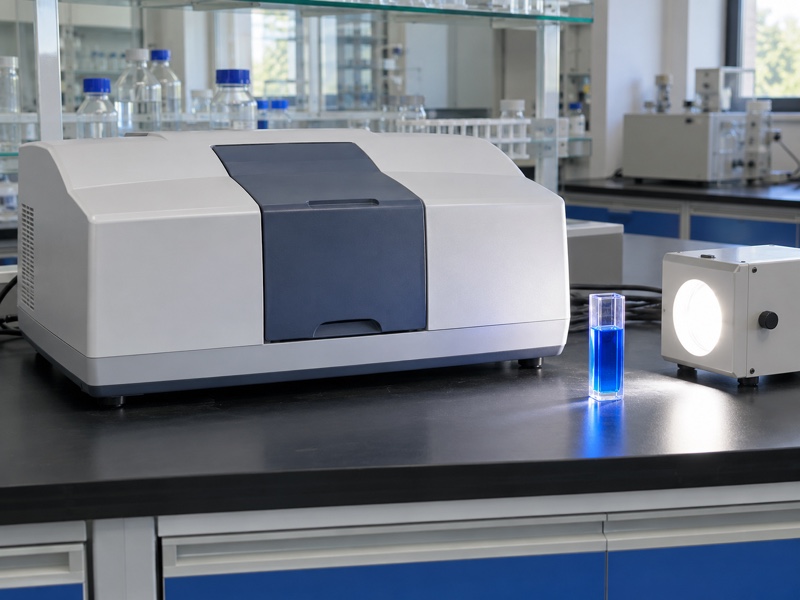
Phycocyanin contains chromophores bound to protein subunits. When they absorb light at suitable wavelengths, part of that energy can be emitted at a longer wavelength as fluorescence. The spectral behavior reflects both the chromophore and its protein environment. A review of phycobiliprotein characterization describes the family and its analytical uses. The exact measured peak depends on the sample and instrument conditions.
Fluorescence is different from the blue a customer sees in normal lighting. Visible color is affected by absorption, scattering, concentration, and the food matrix. A fluorescent sample can fail a color target, and a visually acceptable blue food can give a complicated fluorescence measurement. For a buyer, the first question is the test’s purpose: identity, concentration estimate, environmental monitoring, or research characterization. Each needs its own method and acceptance rule.
| Question | Useful measurement |
|---|---|
| Is expected pigment present? | Spectral identity with controls |
| How much is present? | Calibrated assay in defined matrix |
| Is food the target blue? | Finished-product colorimetry and vision |
| Is the lot safe? | Contaminant and microbiological tests |
2. Which instrument settings change the result?
Record enough detail to repeat the test
Excitation and emission wavelengths, bandwidths, gain, detector response, cuvette geometry, path length, blank, scan speed, and dilution can all affect fluorescence readings. If a supplier provides a number without these details, another laboratory may not reproduce it. A high signal could reflect a concentrated sample rather than a higher-grade ingredient. At very high concentration, self-absorption or other nonlinear effects can make the response less straightforward.
Ask for a written method and reference standard. Run a dilution series to find a range where response is suitably proportional to concentration. Use the same vessel and preparation for comparison lots. Record instrument calibration and sample temperature. If different suppliers report different fluorescence units, do not rank them from brochures; bring the samples into one controlled method. A spectral graph is helpful for investigation, but the buyer still needs a defined acceptance limit tied to its own use.
3. Can fluorescence identify phycocyanin in a mixture?
Check what else emits or absorbs
The expected spectral pattern can support identity, but a mixture may contain other pigments, proteins, flavors, or fluorescent compounds. Their signals can overlap or alter the measured intensity. Food matrices also scatter light and change the optical path. A blue beverage containing multiple colors is not equivalent to a clean buffer solution. Confirm identity with an appropriate combination of spectral, chromatographic, or protein-based methods when the decision requires specificity.
Use a matrix blank and a known positive control. Spike-recovery or standard-addition tests can reveal whether the matrix suppresses or enhances the signal. If a supplier changes a carrier, reassess the method rather than assuming the old calibration still applies. The lab report should state whether it measured a purified sample, an extract, or the finished food. A claim such as “fluorescence confirms 40% phycocyanin” is not credible without a validated concentration method and clear calculation basis.
| Control | Purpose |
|---|---|
| Solvent blank | Baseline instrument signal |
| Matrix blank | Food interference |
| Reference material | Expected spectrum |
| Dilution series | Response range |
| Spike recovery | Matrix effect |
4. Does a stronger signal mean better quality?
Separate signal strength from purchase quality
A stronger reading may come from more pigment in the measurement cell, a different protein state, a changed pH, or higher instrument gain. It does not automatically mean the lot has higher pigment mass fraction or better shelf-life performance. A deteriorated sample may show a changed spectral shape rather than a simple decrease. Always compare under the same sample preparation, concentration basis, and instrument settings.
Quality also includes source identity, composition, safety, moisture, microbiology, sensory impact, dispersion, legal use, and lot consistency. A powder with excellent fluorescence can be unsuitable for food if it lacks relevant contaminant data. A carrier-rich preparation can give a lower per-gram signal yet perform well at an economical dose. Define the business decision before choosing the test. For a blue beverage, finished-product color and stability matter more than maximizing a bench fluorescence number.
5. How do pH and temperature affect the signal?
Test the conditions of the method
Phycocyanin is a protein complex, so changes in pH and temperature can alter its structure and optical behavior. The review of physicochemical degradation covers several environmental effects. A signal measured in a buffered laboratory solution may differ from one measured after a low-pH beverage process. Heat can change both the pigment and the matrix around it. Do not translate a fluorescence drop directly into a consumer-visible color loss without measuring both.
Set a sample preparation that fixes pH, dilution, and temperature for routine release testing. If the analytical question concerns stability, deliberately vary one condition at a time and include controls. Take readings at defined intervals after preparation; delayed measurement may produce drift. Record any precipitation because scattering can distort the result. For a customer application, test the actual formulation and package alongside the laboratory sample. The lab method explains a mechanism; the product trial determines commercial acceptability.
| Variable | Method control |
|---|---|
| pH | Defined buffer and measured value |
| Temperature | Equilibrated sample |
| Time after dilution | Fixed measurement window |
| Turbidity | Clarification or matrix validation |
| Light exposure | Controlled handling |
6. Can fluorescence monitor algae in water?
Use it as a proxy with field limits
Field sensors can measure phycocyanin fluorescence as one indicator related to cyanobacterial presence. That is a different task from approving a purified food ingredient. Water conditions, species, light history, suspended particles, and other pigments affect the sensor response. A fluorescence reading is not a cell count or a toxin test by itself. The YSI discussion of phycocyanin monitoring addresses common interpretation errors in that context.
For source-water monitoring, define calibration, local validation, sampling depth, and confirmatory tests. For ingredient purchasing, do not use a field sensor’s units to compare a powder COA. The shared molecule name hides two different analytical questions. If a supplier mentions water monitoring as proof of ingredient quality, ask how the measurement links to its actual finished lot. A source-control program may include culture or water monitoring, but final release still requires material-specific tests.
7. What is the difference between fluorescence and absorbance?
Match the optical method to the question
Absorbance measures how much light a sample removes at selected wavelengths; fluorescence measures emitted light after excitation. Both can help characterize phycocyanin under defined conditions. Neither is automatically a direct measure of purity in a formulated powder. Literature often reports absorbance ratios for protein preparations. These ratios are method-specific and should not be silently converted into mass percent or a finished-product shade score.
Ask which method appears on the COA and why. For a pigment concentration report, require the calibration and calculation. A reported ratio should keep the word “ratio” and its method. A color-value report should state whether it measures a solution or a finished matrix. Review spectra when a lot deviates, then confirm with the appropriate orthogonal method. Analytical clarity saves time: many supplier disputes come from comparing numbers that use different wavelengths, dilutions, or denominators.
| Reported value | Ask for |
|---|---|
| Fluorescence intensity | Settings and reference |
| Absorbance ratio | Wavelengths and preparation |
| Pigment content | Calibration and units |
| Color value | Matrix and viewing method |
8. How should a buyer validate a lab method?
Fit validation to the decision risk
For a routine lot-release test, establish specificity, precision, working range, sample stability, and the response to known variation. For a concentration claim, add accuracy and recovery in the actual material. A method intended for clean standards may fail when applied to a carrier-containing commercial powder. If the buyer outsources testing, agree on the preparation and reporting format before comparing results with the supplier’s COA.
Run approved and borderline lots when available. See whether the method separates them in a way that predicts product performance. If it does not, the test may still be useful for identity but should not be used as the sole purchase gate. Document the method version and reference material. A supplier process change can alter matrix interference, so review validation after meaningful changes. Quality teams should know what an out-of-range fluorescence result triggers: retest, investigation, hold, or rejection.
9. Which other tests must accompany the signal?
Build a complete release package
Fluorescence should sit beside source identity, composition, relevant pigment assay, physical properties, contaminant panel, microbiology, and application results. The FDA’s microcystin information illustrates a safety question optical pigment tests cannot answer. Legal use is another separate gate; the FDA’s spirulina extract color-additive listing requires application-specific review where relevant.
Keep records tied to the same lot. A beautiful fluorescence curve from a research sample does not qualify a different commercial batch. For finished food, run shade and shelf-life trials in the proposed package. The decision file should explain what each method establishes and what it leaves unresolved. This prevents a single easy-to-measure number from standing in for a complete ingredient assessment.
| Gate | Evidence |
|---|---|
| Identity | Defined spectral or other method |
| Quantity | Validated assay |
| Safety | Contaminant and microbial panel |
| Performance | Formula and stability trial |
| Legal use | Destination-market review |
10. When is fluorescence worth specifying?
Use it when it changes a decision
Specify fluorescence when a validated method helps confirm identity, detect a process shift, or investigate a lot that behaves differently. Keep the sample preparation and units fixed across lots. If the buyer only needs a stable blue shade in yogurt, a routine fluorescence limit may add complexity without improving the decision. Test the finished yogurt instead, while maintaining appropriate identity and safety checks.
When a fluorescence method is useful, put its version, acceptance range, reference, and response to failure in the quality agreement. Ask the supplier to notify method changes. Compare the first commercial lot with the approved pilot. A good analytical result then has a clear job in the purchasing process, and a weak one cannot hide behind an impressive-looking spectrum.
When two laboratories disagree, exchange the same retained lot and method in a controlled comparison. Check dilution, pH, instrument gain, blank subtraction, cuvette, and calibration before declaring either result wrong. Report raw signal and the calculated value, with units and uncertainty where the method supports it. If a disagreement still affects release, use an agreed referee laboratory and hold the affected material until the discrepancy is resolved. This process is more useful than asking one side to repeat the test until the numbers match. It also identifies whether the acceptance range was set tighter than the method can reliably measure.
The phycocyanin purity-test guide compares other analytical choices used in supplier review.
FAQ
Q1: Does phycocyanin fluoresce? Yes, under suitable excitation and measurement conditions.
Q2: Can fluorescence prove a powder is food safe? No. Safety needs relevant contaminant, microbiological, and manufacturing evidence.
Q3: Does a higher signal always mean more phycocyanin? No. Concentration, matrix, pH, and instrument settings can change intensity.
Q4: Can a water sensor value be used for a food extract? No. The methods and questions are different.
Q5: What should be on a fluorescence report? Sample preparation, settings, controls, calibration, units, result, and method version.