
Phycocyanin color can look convincing in a clear blue solution on a laboratory bench. The same ingredient may turn grey, green, or faint after it meets a finished food’s acid, heat, protein, light, and package. Buyers should approve the color in the product they intend to sell. This guide sets out a practical trial, the supplier information needed to interpret it, and the decisions a team should record before choosing a grade.
1. What gives phycocyanin its blue color?
Start with the pigment protein
Phycocyanin is a blue phycobiliprotein found in photosynthetic organisms, including the cultivated cyanobacterium commonly sold as spirulina. Its protein subunits carry phycocyanobilin chromophores. The assembled structure absorbs and emits light in a way that gives an extract its characteristic blue. This is different from an insoluble mineral pigment that simply disperses as particles. Changes to the protein’s environment can change the appearance or destroy the useful color.
A supplier may call a powder “blue spirulina,” “spirulina extract,” or “phycocyanin.” Those labels do not establish identical composition. Ask whether the offered material is an extract, a carrier-containing blend, or whole algae powder. The current product range includes several E-coded blue powders; the code alone does not specify a pigment percentage. Request each grade’s specification and test method. A review of phycobiliproteins explains why protein structure and chromophore identity matter when comparing color materials.
| Material description | Likely appearance | What to confirm |
|---|---|---|
| Whole spirulina powder | Green to blue-green | Biomass identity and composition |
| Blue extract | Blue | Pigment assay and carrier |
| Diluted color preparation | Variable blue | Full formulation and dose basis |
| Laboratory standard | Defined spectral behavior | Intended analytical use |
2. Which color target should a food team define?
Use a finished-product reference
“Bright blue” is too loose for supplier approval. Select a physical or measured reference for the finished food, under a specified light source and package. Decide whether the desired result is cyan, sky blue, turquoise, or a deeper blue. Record how much change is acceptable between manufacture and end of shelf life. A reference that looks right in a transparent drink may be unsuitable in opaque yogurt, where whiteness and protein scattering alter the apparent shade.
Make a small reference batch without the color ingredient and one with the target color. Photograph them under controlled lighting, but retain a physical sample or instrumental reading for comparisons. Phone pictures change with white balance and exposure. If the company uses CIELAB values, state the instrument, illuminant, sample holder, and target tolerance. The point is repeatability: two technicians should reach the same decision from the same lot. Include flavor and visual defects in the acceptance criteria. A vivid blue that requires a dose causing unwanted taste is not a useful target.
3. How should two phycocyanin grades be compared?
Fix the base recipe and vary only the dose
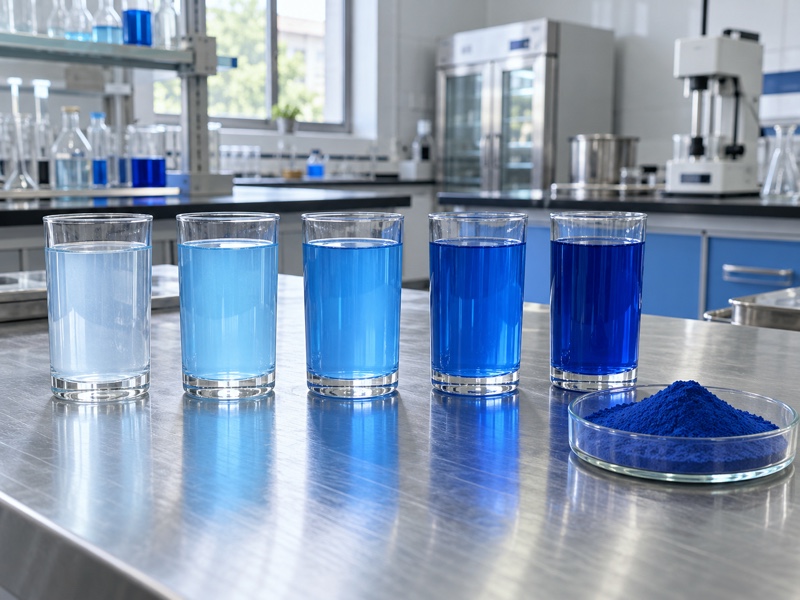
Request representative commercial samples with a current certificate of analysis. Prepare a dose ladder in one batch of the actual base recipe. Keep mixing order, hydration time, temperature, pH, container, and observation time constant. Compare the grades at matched visual endpoints, not only at equal powder weights. A carrier-rich blend may require more grams to reach the same shade; a concentrated material may be harder to disperse without spots.
Run at least three useful dose levels around the likely commercial target. Record dose by finished-product mass, not by the volume of a preliminary concentrate. Evaluate immediately after mixing, after the actual manufacturing step, and during storage. The review of phycocyanin degradation supports attention to pH, temperature, and light. It cannot predict the exact loss in your recipe. Only your process trial can do that.
| Variable | Hold constant in comparison | Record |
|---|---|---|
| Base formula | Same production batch | pH and solids |
| Dose | Ladder for each grade | Grams per kilogram |
| Dispersion | Same mixing protocol | Clumps and foam |
| Process | Same heat and shear | Color before and after |
| Package | Same material and fill | Headspace and light exposure |
4. What does pH do to the blue shade?
Test the recipe’s real pH range
Phycocyanin color and structure can respond strongly to acidity. A beverage with a low pH may behave differently from a near-neutral dessert. Ingredient claims about “acid stability” are useful only when they name the pH, buffer, time, temperature, and acceptance method. A test in water at one pH does not prove performance in a carbonated drink with flavors, preservatives, and minerals.
Measure pH after all ingredients have equilibrated, not just in the mixing tank before flavor addition. Test the normal target and the upper and lower limits allowed by manufacturing. If the product drifts during shelf life, include those conditions. Note any precipitate or haze as well as loss of blue: a blue solution with visible sediment may still fail product standards. Do not change a safe acid target merely to retain color without revalidating microbiological control and product identity. When a matrix remains incompatible, a different color system or product concept may be the practical answer.
5. How much heat can the color tolerate?
Measure the whole thermal history
An ingredient may survive brief warm mixing yet lose color during pasteurization, baking, or prolonged hot filling. Temperature alone is insufficient; time at temperature, the order of addition, cooling rate, and matrix also matter. Run a trial that copies the actual plant process. Sample before heat, immediately after heat, and after storage. If a process allows color addition after the main heat treatment, assess whether that step is operationally and microbiologically acceptable.
Avoid quoting a universal maximum temperature. Published experiments use different buffers, protein concentrations, and exposure times. They are good for identifying likely failure mechanisms, not approving a commercial line. If a high-heat process destroys the color, increasing the initial dose may produce an odd starting shade and still fail at expiry. Decide with R&D whether to change the processing sequence, choose a compatible alternative, or abandon the blue concept. Document the result so purchasing does not order a grade based on a room-temperature sample.
| Process point | Color check | Decision |
|---|---|---|
| After dispersion | Initial shade and specks | Mixing fit |
| After thermal step | Retained shade | Process fit |
| After filling | Package appearance | Launch reference |
| At expiry | Final shade and defects | Shelf-life fit |
6. Why do light and packaging matter?
Test the package the consumer will see
Light exposure can reduce color or change its appearance. A clear bottle on a retail shelf gives the ingredient a different environment from an opaque carton in a dark warehouse. The physicochemical degradation review identifies light among the variables worth testing. Oxygen, headspace, and interactions with other ingredients may also affect a particular formula. The relative effects need measurement in the final product.
Fill trial units in the proposed package at the intended fill level. Store control units in the dark and exposed units under a defined retail-light condition. Measure appearance at planned intervals and compare the same sample temperature each time. Photograph the package next to a retained launch standard, but keep the instrument data and sensory observations. If an opaque package solves color loss, include its label and merchandising implications in the decision. Packaging is part of the color system, not an afterthought for procurement.
7. Can an absorbance number predict visible color?
Use the number for its stated method
Suppliers may report an absorbance ratio, color value, or phycocyanin content. These are not interchangeable measures. A ratio such as absorbance near 620 nm to absorbance near 280 nm has been used in pigment work as a purity indicator, but it does not automatically state the percentage of pigment in a commercial powder or the blue strength in yogurt. Ask for the precise wavelength, sample preparation, path length, dilution, calculation, and units.
Use an analytical result to confirm lot consistency under one method. Use the finished product to judge visible color. A colorimeter reading can give objective change over time, while visual review catches specks, sediment, uneven dispersion, and a shade that consumers would describe differently from the numerical target. If two suppliers use different assay methods, request samples and run them under one in-house method before ranking them. Never infer the strength of E3, E6, or another E code from the number in the name.
8. What should a color-stability study include?
Separate screening from shelf-life approval
Start with a short screen to reject obvious failures. Then make pilot batches with representative lots and the intended plant conditions. Include the normal and worst expected temperature, light exposure, and product pH. Use enough time points to see whether loss is immediate, gradual, or linked to a process event. Compare both instrument readings and human-visible samples against the pre-agreed acceptance limits.
Accelerated storage can reveal risk, but it does not automatically predict the exact shelf life of a refrigerated or ambient product. Confirm with real-time packaged studies. Record microbial results where the product program requires them. A sudden color change might reflect a formulation or packaging issue; investigate before attributing it to a poor pigment lot. The approved specification should include what was actually measured and the conditions under which the material passed, not a generic supplier phrase such as “stable in beverages.”
| Study arm | Purpose | Minimum record |
|---|---|---|
| Day-zero product | Baseline shade | Recipe and lot |
| Processed product | Immediate loss | Time-temperature profile |
| Dark storage | Non-light change | Temperature and interval |
| Retail-light storage | Light sensitivity | Exposure and package |
| Real-time shelf life | Saleable appearance | Final acceptance result |
9. Which documents should accompany a color lot?
Tie the visual result to a traceable batch
Request a specification, ingredient composition, recommended storage, shelf life, lot COA, and method behind each color or assay claim. Obtain contaminant and microbiological information suitable for the source and destination market. The FDA’s information on microcystins in blue-green algae products explains why source and test controls matter. Confirm local permitted uses before treating an attractive blue powder as a lawful color in a specific product.
Record which supplier lot was used for each successful trial. A later production lot should be checked against the approved visual standard and analytical release criteria. If the supplier changes the biomass source, carrier, extraction, drying, or site, ask for notification and a bridging sample. Shade consistency is a supply-chain requirement. Retained samples help distinguish a material change from a process change when a commercial run comes out too green or too pale.
10. When is phycocyanin the wrong color choice?
Stop when the product fails its real conditions
Reject a grade when it cannot reach the target shade without off-flavor, sediment, excessive cost, or unacceptable fading. If all tested grades fail the required pH or heat process, the formulation team must change the product design or choose another permitted color. Do not hide a failure by judging only day-zero laboratory cups. The consumer buys a finished unit after distribution and storage.
For a passing grade, write the purchase specification around the tested product: source identity, composition, analytical methods, acceptable shade, dose range, packaging, and stability conditions. Repeat the critical checks on the first commercial lot. A practical approval decision can then be explained to R&D, quality, procurement, and the supplier using the same evidence.
| Decision | Evidence needed |
|---|---|
| Approve | Color, safety, legal use, and shelf-life pass |
| Rework | Specific process or package change to trial |
| Reject | Documented failure against a fixed limit |
The phycocyanin stability test guide gives a detailed plan for heat, pH, and shelf-life checks.
FAQ
Q1: Is phycocyanin color the same as whole spirulina powder? No. Whole biomass contains other components and usually appears green or blue-green; an extract can produce a cleaner blue.
Q2: Will it keep its blue in an acidic drink? Test the exact recipe and packaged shelf life. Performance depends on pH and the full product system.
Q3: Can a supplier’s color value replace a trial? It helps compare lots under one method, but it cannot establish the shade in a finished food.
Q4: Why did a clear bottle lose blue faster than a carton? Light exposure may contribute. Run controlled package and storage comparisons before assigning the cause.
Q5: What should a buyer approve first? Approve a representative lot only after the finished product passes shade, process, stability, safety, and market-use checks.