
Phycocyanin and phycoerythrin belong to the same broad family of light-harvesting proteins, but they are not interchangeable colors. One supplies a blue direction; the other is associated with red to pink. The organisms, extraction routes, purity measures, stability limits, and permitted uses may differ. An ingredient team comparing the two should begin with the finished-product brief and then request evidence for the exact grade offered.
1. What are phycocyanin and phycoerythrin?
Place both in the phycobiliprotein family
Phycobiliproteins capture light for photosynthesis in cyanobacteria and some algae. Their protein structures carry colored chromophores. C-phycocyanin is commonly discussed in connection with cultivated spirulina, now classified in the genus Limnospira. Phycoerythrin occurs in various red algae and some cyanobacteria. The names identify pigment-protein families, not one standardized commercial ingredient in a uniform package.
The phycobiliprotein review explains related pigments and their characterization. A supplier’s “red algae extract” or “blue spirulina” label still needs a species, material description, and test method. Commercial products can contain carriers or other fractions. For a fair comparison, request the same basic information for both options: biological source, extraction process, composition, grade, assay, batch COA, shelf life, and intended use. Research-grade proteins and food-color preparations should be evaluated in separate purchasing categories.
| Question | Phycocyanin | Phycoerythrin |
|---|---|---|
| Typical color direction | Blue | Red to pink |
| Commonly discussed source | Limnospira/spirulina | Red algae or cyanobacteria |
| Commercial form | Extract or formulated color | Extract or formulated color |
| Essential buyer check | Grade and method | Species and grade |
2. How does their color behavior differ?
Judge both in the same finished matrix
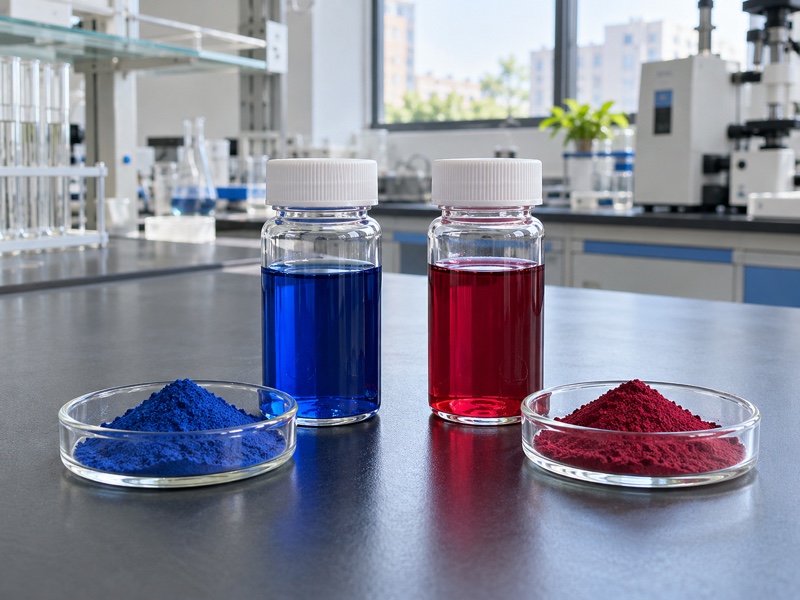
A jar of dry powder does not predict the shade in a beverage, yogurt, or gel. Protein concentration, pH, light, temperature, and surrounding ingredients change the visible result. Phycoerythrin’s pink-red appearance may be useful where a gentle hue is wanted. Phycocyanin provides blue, which can be mixed with other permitted colors for different hues. Neither guarantees a fixed shade at any dose or throughout shelf life.
Prepare dose ladders in the actual base product. Compare the samples against a target under controlled lighting at time zero, after processing, and at expiry. Record haze, precipitation, odor, and flavor as well as hue. A transparent beverage can reveal particles that an opaque dessert hides. A clear color target prevents purchasing from picking the material that looks most dramatic in a beaker. If the two pigments are being considered for different SKUs, set separate targets and cost-in-use calculations instead of forcing one ranking.
3. Do they have the same biological source?
Ask for the organism and production site
No. The families appear across different photosynthetic organisms, and the commercial supply chain can start with different species. A phycocyanin product derived from cultivated Limnospira is not evidence that a phycoerythrin product came from the same culture. Different organisms bring different cultivation, contaminant, and traceability questions. Even two suppliers offering the same named pigment can use different feedstocks and extraction methods.
Ask for taxonomic identification, culture or harvest location, biomass controls, and a lot-level traceability path. If the source changes, require notification before accepting a supposedly equivalent color. The review of production and characterization is a useful technical foundation, but it is no substitute for a supplier’s current documents. For food buyers, the organism can also affect market-specific legal status. Regulatory review should describe the actual source and process, not only the pigment’s common name.
| Source record | Why it matters |
|---|---|
| Species identification | Confirms material identity |
| Cultivation or harvest site | Supports risk assessment |
| Biomass lot | Connects extract to source |
| Extraction batch | Enables investigation |
| Change notification | Protects approved formula |
4. Can the same extraction method make both pigments?
Map the process without assuming equivalence
Both are water-soluble protein pigments, so extraction discussions may share broad operations such as cell disruption, aqueous extraction, clarification, concentration, and drying. The optimal conditions and yields are source- and protein-specific. A method reported for one organism cannot be transferred to another without verifying recovery, purity, safety, and stability. Purification steps for a diagnostic reagent are also different from the cost and documentation needs of a food color.
Ask suppliers to describe the process sufficiently for quality review: extraction medium, concentration route, drying, carriers, processing aids, and controls against contamination. Proprietary details can remain confidential, but the ingredients in a finished preparation and the tests used for release must be clear. A food technologist should also ask how the powder disperses under normal plant conditions. Lab solubility after prolonged stirring may not represent the mixing time on a production line. Compare actual performance using representative commercial lots.
5. What do spectral measurements tell a buyer?
Read the full method and purpose
Phycobiliproteins absorb and fluoresce at different regions of the spectrum, so absorbance and fluorescence can help distinguish or quantify materials in controlled settings. However, a peak wavelength alone does not establish commercial purity, food safety, or color retention. Solvent, pH, dilution, protein state, and instrument settings affect the measured signal. A quoted “purity” ratio may be a defined spectrophotometric ratio rather than mass percent of a powder.
Request the wavelength, blank, path length, sample preparation, calculation, units, and acceptance range. If comparison is central to the purchase, run both samples under one laboratory method. A buyer can use spectral data to check identity and lot consistency, then use finished-product trials to judge suitability. A food-color sample with a lower laboratory ratio could still work better in a particular formulation because of dispersion or carrier design. Conversely, a beautiful spectrum does not make a raw material legal or safe for the proposed food use.
| Measurement | Useful question | What it cannot prove alone |
|---|---|---|
| Absorbance spectrum | Is the expected pigment signal present? | Regulatory fit |
| Fluorescence | Does the sample emit as expected? | Finished-food shade |
| Purity ratio | How does a defined method compare lots? | Mass percentage without method |
| Colorimetry | Did the food meet its color target? | Ingredient identity |
6. Which is more stable in a product?
Test the particular grade and recipe
There is no universal winner. Stability depends on source, purification, carrier, pH, heat, light, oxygen, and the finished matrix. A comparative statement from one research experiment applies to its conditions. It does not establish the shelf life of a commercial drink or cosmetic cream. The food-application review describes why processing and formulation conditions matter for phycobiliprotein use.
Build a trial with the proposed package and manufacturing path. Measure immediately after production and at scheduled storage points. Include a light-exposed arm if the package will be displayed in clear containers. Confirm microbiological and sensory requirements for the product. If color degrades, investigate whether the pigment, process, other ingredients, or package drives the result. Avoid approving one pigment from a supplier’s generic “stable” claim while making the other prove its performance; apply the same acceptance protocol to both.
7. How should a buyer compare prices?
Calculate cost at the accepted shade
Price per kilogram is meaningful only after both offers describe comparable forms and use cases. A concentrated pigment may need a smaller dose, while a formulated preparation may disperse faster and create less waste. A quote may include different tests, package sizes, freight terms, and minimum orders. Food, cosmetic, and analytical grades can differ by orders of magnitude because their specifications and market volumes differ.
For each approved formula, multiply the landed ingredient price by the dose needed at shelf-life end. Add measured process loss, waste, and any packaging change needed for color retention. Include quality testing and reorder conditions. A buyer considering blue for one SKU and red for another should compare each against its own target and alternatives. The cheaper pigment on paper might not be available in the required regulatory category or may fail the actual process. Report those facts before a commercial negotiation.
| Cost input | Evidence source |
|---|---|
| Landed unit price | Dated supplier quotation |
| Accepted dose | Finished-product trial |
| Process loss | Pilot-batch record |
| Stability loss | Packaged shelf-life study |
| Test and package cost | Quality and operations teams |
8. Do food rules treat both as interchangeable?
Review each ingredient in its destination market
No buyer should infer approval for one pigment from the status of another. In the United States, the FDA has a specific color-additive listing for spirulina extract, with stated conditions. That listing should be checked against the actual proposed ingredient, application, and current rule. It does not automatically cover every phycoerythrin preparation or every use. Other countries may classify and limit ingredients differently.
Request the supplier’s regulatory dossier, but have qualified specialists verify the use, permitted source, composition, labeling, and claim language for the target market. “Natural” is a marketing description, not a substitute for legal analysis. Keep the grade intended for food separate from a research reagent even if the names are identical. Food safety documents should address the source organism and potential contaminants. For cyanobacterial materials, the FDA’s microcystin information is relevant to the risk review.
9. Which questions belong in a supplier request?
Send one comparison brief
Name the target application, market, desired shade, pH, process, package, shelf life, and expected volume. Ask for source species, full composition, specification, analytical methods, COA, safety panel, use guidance, storage conditions, lead time, and change-control procedure. Request a commercial-grade sample from the intended manufacturing route. If the supplier offers several blue or red fractions, ask them to identify which one they propose and why.
Record answers in one matrix rather than a stack of brochures. A claim that a pigment is “high purity” needs a numerical definition and method. A claim that it is “food grade” needs documentation relevant to the destination market. A claim that it is “stable” needs time, pH, temperature, and light conditions. These questions are equally fair for phycocyanin and phycoerythrin. They reveal which material is ready for a controlled trial and which is still a research sample.
10. When should a team choose each pigment?
Start from color and finish with evidence
Choose a phycocyanin grade when the product needs a blue direction and the chosen grade passes formulation, safety, legal, and supply checks. Consider phycoerythrin when a red-pink direction fits the design and the actual commercial preparation passes the same checks. Neither pigment should be chosen solely because both appear in an algae brochure. Their source, spectral properties, and practical performance are different.
Record the approved formula, sample lot, target shade, batch-release tests, and package. Confirm the first commercial lot against the pilot. If a supplier changes its source or carrier, rerun the relevant tests before assuming interchangeability. The final decision should be a short technical record that another buyer could reproduce, not a claim that one pigment is categorically superior.
| Decision gate | Required result |
|---|---|
| Color | Target shade at expiry |
| Technical | Process and package pass |
| Quality | Source and batch tests pass |
| Regulatory | Proposed use confirmed |
| Supply | Commercial lots available |
For a closer look at blue-grade procurement, read the phycocyanin pigment buyer guide.
FAQ
Q1: Are phycocyanin and phycoerythrin the same substance? No. They are related families of pigment proteins with different color and spectral behavior.
Q2: Can I use a phycoerythrin result to predict phycocyanin stability? No. Test each commercial grade in the intended matrix and package.
Q3: Does a higher absorbance ratio mean better food color? It describes a defined lab measurement; the finished-food trial decides color performance.
Q4: Is every algae pigment approved for food? No. Verify the specific ingredient and intended use in each destination market.
Q5: What should I ask a supplier first? Ask for source identity, composition, grade specification, test methods, current COA, and a representative sample.