
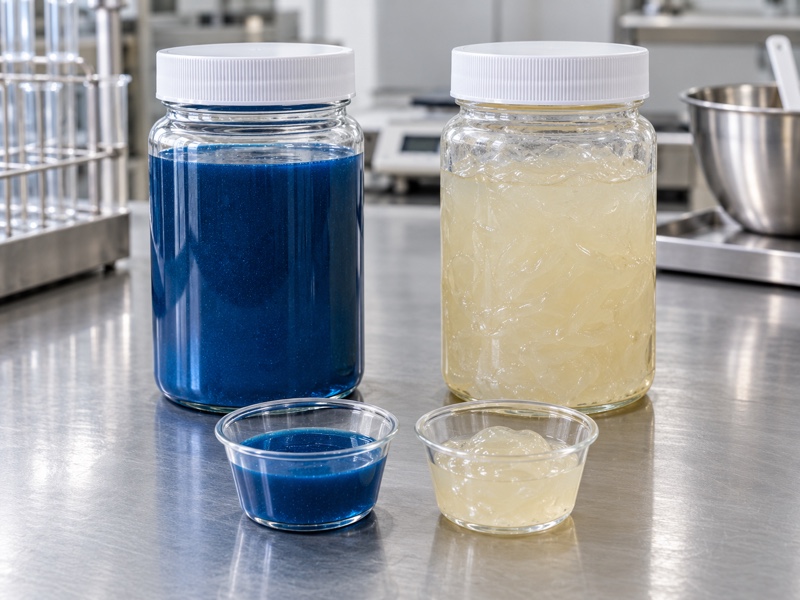
A blue spirulina vs sea moss comparison starts with their jobs in a formula. Both appear in wellness drinks, but buyers need different specifications for each. Blue spirulina is generally a phycocyanin-rich extract from cultivated spirulina biomass, used chiefly for blue color. “Sea moss” is a loose trade name for several marine red algae sold as dried material, gel, powder, or extracts. A buyer who treats them as interchangeable may get the wrong color, texture, nutrient profile, and label. This comparison focuses on the documents and product tests that matter to food and beverage makers.
Contents: 1 · 2 · 3 · 4 · 5 · 6 · 7 · 8 · 9 · 10
1. What are blue spirulina and sea moss?
Commercial blue spirulina usually refers to an extract containing phycocyanin, the blue pigment protein from spirulina, now commonly classified among Arthrospira or Limnospira organisms. Sea moss is a market term that can refer to different red algae, including Chondrus crispus and species sold under other names. Ask for the scientific name on every sea-moss offer. Ingredient identity is the first control because different species, harvest methods, and processing steps can produce different composition and behavior.
For the blue ingredient, the blue spirulina extract guide explains how extract grades are specified. Sea-moss identity needs a separate species and preparation check.
Why does the name matter to a buyer?
“Blue spirulina” describes a visual ingredient category, not a guarantee of phycocyanin concentration. “Sea moss” describes an even broader trade category. A product brief should identify the exact source organism, part or extract, carrier, physical form, country of origin, and intended use. The final ingredient declaration depends on the actual material and market. A social-media recipe may call both “algae,” but that category is too broad for a purchase specification or nutritional claim.
| Question | Blue spirulina extract | Sea moss material |
|---|---|---|
| Main purchase reason | Blue color | Texture, ingredient positioning |
| Source | Cultivated spirulina biomass | Marine red algae |
| Common form | Powder or liquid extract | Dried, gel, powder, extract |
| Key identity check | Phycocyanin content | Species and preparation |
Start with the supplier's technical file, not a nickname on a product listing.
2. Do they have the same function in food?
No. A phycocyanin-rich blue extract is often selected for its color. Depending on its composition, sea moss can contribute body or gelling behavior when hydrated and processed. A sea-moss gel will not replace a blue colorant, and a blue extract will not automatically thicken a drink or dessert. Some sea-moss products may be used mainly for marketing or nutrition positioning rather than a strong textural effect at their actual dose. Test the exact commercial grade in the complete formula.
How should a formulator separate the functions?
Write the target outcome before selecting an ingredient: color, viscosity, mouthfeel, suspended particles, or label story. Make a plain control, one version with blue extract, one with sea moss, and one with both if the concept calls for it. Measure the variable each is expected to change. In a beverage, compare shade, viscosity, sediment, flavor, and stability. In a spoonable product, add texture and syneresis. If both ingredients are used, each needs its own justified dose and supply specification.
| Desired outcome | Ingredient question |
|---|---|
| Bright blue shade | Which blue grade and dose? |
| Thicker texture | Which sea-moss form and hydration? |
| Clear ingredient story | Can claims be supported? |
| Repeatable batches | Are specs measurable? |
The two can coexist in a formula, but one does not perform the other's job by default.
3. How do their colors compare?
Blue spirulina extract can give a blue or turquoise shade when the base, dose, and process suit it. Sea moss is generally not bought as a bright blue ingredient; its color depends on species and processing and may be pale, brown, or purple. A beige sea-moss gel could mute a blue extract added to the same drink. The finished color also depends on milk, fruit, acidity, and package lighting. Photograph each test in the final vessel under consistent lighting.
What should a shade trial control?
Use one base lot and one serving size. Record dose by weight, pH, mixing sequence, process temperature, and storage conditions. Compare the shade immediately and after the planned shelf life. A bright blue sample in water may turn gray in a protein drink or a sea-moss gel. Keep an approved reference sample and an uncolored control. If a blue appearance is central to the product, build the formula around a stable base rather than increasing pigment endlessly to overcome an incompatible matrix.
Phycocyanin is sensitive to conditions such as heat and acidity, as shown in a published stability study. The exact product still needs its own testing.
4. Are their nutrition profiles comparable?
They should not be assumed comparable. A color-grade blue extract may be used at a low dose, so whole-spirulina nutrition figures cannot be copied to the final product. Sea moss composition varies by species, growth environment, preparation, and serving amount. Any mineral or iodine statement needs analysis of the exact purchased material and the finished serving. A recipe with a tablespoon of gel cannot be evaluated from figures for dry seaweed unless the water content and preparation are known.
Which documents support a nutrient claim?
Request a specification with nutritional data for the relevant lot or grade, then calculate and, where required, verify the finished serving. Identify whether nutrient figures are measured on dry material, hydrated gel, or finished food. Check stability through the product's shelf life if a claim depends on a sensitive component. Regulatory staff should review the applicable thresholds and permitted wording. Do not describe a colored drink as a meaningful protein source simply because it contains a blue pigment protein.
| Data point | Why it is needed |
|---|---|
| Ingredient form | Dry-to-gel comparisons differ |
| Actual use level | Determines per-serving amount |
| Lot analysis | Natural material varies |
| Finished serving | Basis for consumer claim |
The commercial question is what the customer receives in one serving, not what an ingredient contains in isolation.
5. What safety and quality issues differ?
Both ingredients need identity, microbial, contaminant, allergen, and traceability controls appropriate to the product. A cultivated blue extract requires specifications for pigment strength and purity. A marine seaweed supply can vary with harvest location and environmental conditions, so the buyer should pay close attention to identity and relevant mineral or contaminant analyses. Request lot-specific COAs and methods. A supplier's marketing page is not a substitute for a qualified food-safety review.
What should a purchasing checklist include?
For each ingredient, obtain scientific name or source identity, full composition, manufacturing flow summary, country of origin, specification, COA, test methods, shelf life, and change-control policy. Ask how suppliers control batch variability and store retains. For a sea-moss gel, review the preparation and preservation process; a gel's water content creates different handling needs from dried seaweed. For a blue liquid extract, review its carrier and microbiological controls. Validate the finished food as its own product.
| Control | Blue extract focus | Sea moss focus |
|---|---|---|
| Identity | Pigment source and grade | Species and preparation |
| Composition | Carrier and color strength | Dry matter and minerals |
| Storage | Pigment retention | Moisture and microbiology |
| Variability | Shade between lots | Harvest and species variation |
Neither ingredient should be bought only by appearance.
6. Which one is easier to formulate into drinks?
It depends on the desired drink. A well-dispersing blue extract may be convenient for a cold beverage, although acidity, heat, and light can challenge its color. Sea moss may require hydration, cooking, blending, or filtration, depending on the form and the texture target. That process can change mouthfeel and throughput. A ready-made gel can save preparation time but brings its own preservation and shelf-life questions. Run a line trial before promising a manufacturing schedule.
What should the pilot measure?
Record preparation time, equipment, dose, viscosity, sediment, color, sensory response, and cleaning effort. Check the drink after filling and after distribution. If the product is carbonated or acidic, test those conditions explicitly. If sea moss is included for texture, define a viscosity range at the served temperature. If blue extract is included for appearance, define a shade range at the end of shelf life. Both ingredients may fail for different reasons in the same drink.
The right ingredient is the one that meets the defined outcome within the plant's actual process.
7. How do heat and acidity change the choice?
Phycocyanin's blue color can weaken under unfavorable heat and pH conditions. A sea-moss ingredient may need heat to hydrate or develop the desired texture, depending on its preparation. This creates a process-sequencing problem if the formula includes both. A developer might process the sea-moss component first and add the blue ingredient later, but only if the plant's validated safety and mixing procedures allow it. Never skip a necessary kill step solely to protect a color.
What comparison should be run?
Trial the actual manufacturing sequence with temperature probes and timed sampling. Compare color before and after each stage, and texture before and after cooling. Include the plain base, one-ingredient controls, and the combined formula. Record pH and any added fruit acid. If the blue fades, evaluate whether a different processing sequence, base, or product concept is feasible. A claim that one ingredient is “heat stable” should refer to a defined matrix and time, not to a blanket promise.
| Process stage | Blue question | Sea-moss question |
|---|---|---|
| Hydration | Is pigment present yet? | Is texture developed? |
| Heating | Does shade decline? | Does viscosity change? |
| Cooling | Can blue be added uniformly? | Does gel set as intended? |
| Storage | Does color hold? | Does texture remain stable? |
The process has to protect both the food and the advertised experience.
8. How should claims and labels be handled?
Use the exact ingredient names required by the sales market. “Sea moss” may not be enough to identify a species or form for a technical file. “Blue spirulina” is common marketing language but does not replace the precise declaration for the purchased extract. Claims about detoxification, immunity, or disease treatment require special caution and should not be borrowed from articles about whole algae. The FDA color additives guidance provides a starting framework for US color use, while the spirulina extract listing identifies the substance.
What should legal and regulatory review receive?
Provide the full formula, intended market, serving size, ingredient specifications, proposed package, and every claim or visual. A photograph of a blue sea-moss drink can imply that sea moss caused the blue color when the pigment comes from another ingredient. Make that distinction clear in copy. Review iodine or mineral claims using finished-serving data, not generic seaweed values. Confirm whether a supplier has changed the seaweed species or blue-extract carrier since the pilot.
Accurate wording gives customers a fair description and keeps procurement aligned with the approved formula.
9. Which ingredient is more economical?
There is no useful answer from price per kilogram alone. A blue extract may be used at a small color dose, while a sea-moss gel can contain substantial water and need a much larger inclusion level. Compare each at the dose that meets its function. Add preparation labor, waste, testing, freight, storage, and the cost of rejected batches. A dried seaweed may be cheap to buy but expensive to prepare consistently; a concentrate may be expensive to buy yet efficient in each serving.
How should quotes be normalized?
Calculate cost per finished unit at the approved color or texture. For sea moss, record dry-equivalent amount and gel yield. For blue extract, record color-strength method and pigment dose. Include packaging and shelf-life costs if one option needs more protective handling. Use the same quality and compliance requirements for competing suppliers. A low quote with weak documentation can create later reformulation and recall risk that is not visible on a price sheet.
| Cost line | Why it matters |
|---|---|
| Functional dose | Fair ingredient comparison |
| Preparation | Labor and energy |
| Yield | Gel and blending losses |
| Testing | Lot and finished-product checks |
Choose by cost of a compliant, saleable product.
10. How should a brand decide whether to use one or both?
Choose by function. Validate a blue extract for color and a specified sea-moss material for texture. Use both only after full-process and shelf-life trials. Each ingredient needs its own purchasing, label, and quality controls.
What are the go/no-go questions?
Can suppliers prove identity and consistency? Does the product meet its color and texture targets through shelf life? Does it taste good at the functional doses? Are claims supported for the finished serving? Can the plant reproduce the process at planned volume? Record the answers against a plain control. If one ingredient adds cost without a measurable benefit, remove it from the next pilot. If both earn their place, set separate acceptance criteria for each.
FAQ
Q1: Is blue spirulina a type of sea moss?
No. They come from different organisms and are sold in different forms. Commercial blue spirulina is commonly a spirulina extract rich in phycocyanin; sea moss refers to certain marine red algae.
Q2: Can sea moss turn a drink blue?
Do not rely on it for a bright blue shade. If blue is the target, test a suitable color ingredient in the finished formula.
Q3: Which ingredient contains more iodine?
Do not answer from a generic chart. Seaweed species and products can vary, and a blue extract is a different preparation. Request current lot and finished-serving analyses before making an iodine statement.
Q4: Can they be used together?
Yes, if each ingredient is permitted for the intended product and the combined formula passes processing, stability, safety, sensory, and label review.
Q5: Is either ingredient automatically a health supplement?
No. Product category and claims depend on the complete formula and market rules. A color or texture use does not establish a health benefit.