
Phycocyanin pulsed electric field (PEF) processing is one way to make spirulina biomass easier to extract. Brief electrical pulses can increase membrane permeability before blue phycocyanin is recovered in water. That description is useful, but it does not tell a buyer what the resulting bulk color ingredient will contain, whether its shade survives processing, or whether the plant can repeat a laboratory result.
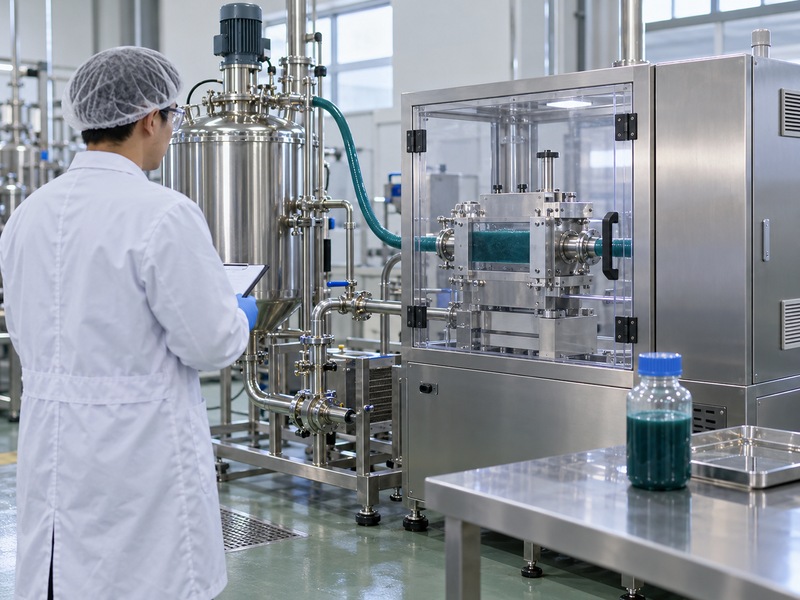
This guide focuses on PEF as an upstream release step and on the downstream evidence a food manufacturer needs before approving a commercial powder. It does not treat PEF as a preservation claim or assume that an experimental yield applies to a supplier’s current grade.
Contents
- What does phycocyanin pulsed electric field treatment do to biomass?
- Where does PEF sit before the final blue powder?
- Which feed properties change the result?
- How should release and recovery be measured?
- What happens to temperature and color during treatment?
- Can PEF replace every other extraction step?
- What must be checked before scaling the equipment?
- How should a buyer compare PEF with another route?
- Which supplier records make a PEF claim credible?
- When is a PEF-produced grade worth qualifying?
1. What does phycocyanin pulsed electric field treatment do to biomass?
PEF sends short electrical pulses through biomass held between electrodes. The purpose in this context is to make cellular structures more permeable so water-soluble compounds, including phycocyanin, can move out more readily during extraction. The original Food Research International study investigated this approach on fresh Arthrospira biomass. It supports PEF as a promising release method, but a study of one feed and machine cannot define another producer’s yield or final ingredient.
Permeabilization is an intermediate event. It does not by itself isolate the blue pigment, remove solids, control contamination, or create a shippable powder. A buyer should ask what the producer measures after PEF: pigment in the aqueous extract, pigment recovered after clarification, and usable blue in the finished grade. Those three results can differ, especially when later operations remove or degrade material.
| Term | Meaning in this workflow | Buying implication |
|---|---|---|
| PEF treatment | Electrical pulse exposure of feed | Evidence is needed for this feed and line |
| Permeabilization | Easier movement out of cells | Does not equal recovered pigment |
| Aqueous extraction | Pigment moves into water | Requires clarification afterward |
| Finished powder | Dried commercial grade | Must be tested in the customer’s food |
2. Where does PEF sit before the final blue powder?
A typical process starts with selected biomass and a suitable liquid feed. PEF may precede a holding or mixing step that allows soluble material to enter the water. The extract still has to be clarified, sometimes concentrated or fractionated, then dried and packed. Any one of those later stages can change color strength or yield. Ask for a process map that connects the pulse unit to the delivered lot.
If the supplier only offers a laboratory graph of pigment release, it has not shown how much color remains after separation and drying. The sequence also helps a buyer distinguish PEF-assisted release from a separate use of electrical pulses for microbial control in foods. Such a control claim would require its own validation; it should not be inferred from a pigment extraction study.
A good qualification sample comes from the same commercial sequence intended for future orders.
3. Which feed properties change the result?
Biomass condition, solids content, liquid conductivity, temperature, and the way the feed flows through a chamber can affect how electrical energy is delivered and how readily pigment is released. Fresh and dried biomass should not be assumed equivalent. Clumps or a changing solids level may make treatment uneven. Different strains or harvest conditions can alter the amount of pigment available before any process begins.
Start comparisons with the same feed basis. Ask the supplier whether its trials used fresh, frozen, or rehydrated biomass, and how it measured starting phycocyanin content. If two routes are compared on different harvest lots, a higher recovered amount may reflect the feed rather than the pulse treatment. For a recurring bulk purchase, the relevant control is consistency across normal feed variation, not the best result from one ideal laboratory batch.
| Feed factor | Why it matters | Supplier question |
|---|---|---|
| Biomass state | Cell condition and water content differ | Which state feeds the commercial unit? |
| Solids level | Changes flow and exposure | How is feed concentration controlled? |
| Conductivity | Affects electrical behavior | Is the medium measured each run? |
| Starting pigment | Sets recoverable amount | What is the input assay? |
4. How should release and recovery be measured?
An increase in pigment measured in an extraction liquid is useful process evidence, yet it is not the same as more saleable ingredient. Material can remain with solids, be lost in filtration, adsorb to equipment, or change during drying. A fair process comparison measures the starting biomass, extracted liquid, rejected streams, and final powder with consistent methods. Use one mass balance and one color method across candidates.
Request the denominator behind each yield figure: dry biomass, initial pigment, total extracted protein, or finished ingredient mass. A publication may report improved extraction relative to a particular control; that relative figure should not be transferred to a different supplier or customer process. For buying, also compare color delivered per gram of finished powder and the dose needed for a target shade in the actual food.
That connects engineering performance to an ingredient decision.
| Measurement | Sample point | What it can answer |
|---|---|---|
| Starting pigment | Feed before treatment | Was the input comparable? |
| Dissolved pigment | Liquid after extraction | Did release improve? |
| Lost pigment | Solids and process waste | Where did usable blue go? |
| Powder color strength | Saleable lot | Is the buying grade stronger? |
| Finished-food shade | Customer trial | Does the difference matter? |
5. What happens to temperature and color during treatment?
PEF is often described as a nonthermal technology, but the actual process can still warm because of electrical energy, feed conditions, and surrounding operations. Temperature can also change during holding, pumping, clarification, and drying. Phycocyanin’s color is sensitive to the combined exposure it receives, so “nonthermal” should not be treated as a promise of unchanged shade. Ask for the temperature history of the product stream, not only the nominal pulse setting.
A primary study on pulse polarity and mild heating shows why process conditions need to be considered together. A buyer can compare a PEF sample and a control at matched pigment dose, then observe shade after the normal customer process and storage. If the PEF route gives more extracted pigment but a duller finished color, the process may still need redesign before it offers commercial value.
6. Can PEF replace every other extraction step?
No single release method eliminates the need to separate soluble pigment from the rest of the biomass and make a stable, acceptable ingredient. A supplier might combine PEF with mixing, pressing, clarification, membrane treatment, or drying. It may use PEF to reduce the intensity of another disruption step rather than replace it entirely. Evaluate the whole production route. Ask which operations are different from the supplier’s conventional grade, which are unchanged, and where extra pigment is retained.
A PEF unit also does not automatically create a higher-purity fraction; that depends on the composition of the released extract and the downstream separation. In some cases more cell material released could make clarification harder. A useful pilot asks whether the new route improves finished powder strength, composition, handling, or consistency after all steps, not whether PEF alone makes a visibly bluer liquid in a small vessel.
7. What must be checked before scaling the equipment?
An industrial pulse chamber has to handle a steady feed while maintaining the intended exposure, flow, hygiene, and safe operation. Electrode geometry, residence time, feed uniformity, cleaning, and throughput can differ sharply from a laboratory setup. A successful bench trial is a reason to run a pilot, not a purchase specification. Ask for representative commercial-run data from the same equipment family, including operating interruptions, cleaning verification, and how the producer handles out-of-range feed.
Check whether the final ingredient is made on a qualified food line and whether process changes are recorded. If the supplier plans to outsource treatment or move the unit, request a new bridging sample. The buyer need not know proprietary electrical settings, but it should know that the method has been validated for the offered volume and yields a repeatable saleable grade.
| Scale-up concern | Possible effect | Evidence to request |
|---|---|---|
| Uneven feed flow | Variable exposure | Run-to-run samples |
| Electrode or chamber change | Different treatment | Change-control record |
| Longer holding | Color drift | Time and temperature logs |
| Cleaning burden | Reduced capacity | Validated cleaning and schedule |
8. How should a buyer compare PEF with another route?
Use the same intended food, target shade, and processing conditions. Obtain commercial-grade samples from the PEF route and the existing route with lot COAs and full composition declarations. Match the starting blue by measured dose; a darker powder at a higher addition level does not prove a better route. Check dispersion, off-notes, visible particles, processing losses, and appearance through the product’s planned storage period.
Count the total cost per accepted finished unit. This includes ingredient dose, handling time, rejects, freight, and any extra step needed to use the powder. A process route that uses less mechanical disruption but adds costly purification may still be useful, but the reason should be explicit. If only prototype samples are available, record the result as a development observation and repeat it with commercial material before signing a bulk specification.
9. Which supplier records make a PEF claim credible?
Request a stage-level process description, the exact grade specification, current lot COA, carrier and additive declaration, and representative results from the intended production line. Ask how the supplier compares starting biomass with finished pigment recovery, and whether the pulse step is routinely used for the supplied grade. Quality documents should cover identity, relevant contaminants and microbiology, traceability, and process change control.
Separate research references from supplier evidence. The 2017 PEF paper and later 2024 kinetic study help a technical team ask informed questions; neither certifies a particular vendor’s current lot. Confirm that the final ingredient and its use meet applicable rules in the destination market. A claim about electrical processing does not replace ordinary food-safety and regulatory review.
| Claim | Useful evidence | What it cannot prove alone |
|---|---|---|
| “PEF-assisted” | Commercial process map | Better final color |
| “Higher yield” | Comparable mass balance | Better food performance |
| “Gentler process” | Product temperature history | No color loss later |
| “Ready to scale” | Repeated commercial lots | Compliance in every market |
| “Stable grade” | COA series and food trial | No future process changes |
10. When is a PEF-produced grade worth qualifying?
PEF is worth the qualification effort when it produces a measurable advantage in the exact powder the buyer will use: stronger blue at an acceptable dose, better batch consistency, improved handling, or a supply economics benefit that survives a finished-food trial. It may also be attractive when a producer can explain how the upstream release step fits its broader process and show repeated commercial results.
Define acceptance before asking for samples. Set the food matrix, shade target, mixing and heat conditions, packaging, observation times, and document requirements. Ask for a representative lot rather than a laboratory showcase sample, and keep a retained control. If the producer later changes feed state, pulse equipment, clarification, or drying, retest the bridged grade. Purchase decisions should rest on the finished ingredient’s performance and reliable supply, with PEF serving as the process explanation behind a proven outcome.
| Approval gate | Buyer evidence | Owner |
|---|---|---|
| Grade identity | Specification and lot COA | Quality |
| Process basis | Stage map and change control | Technical procurement |
| Delivered color | Matched-dose food trial | R&D |
| Supply repeatability | Representative lot history | Operations |
| Commercial value | Total delivered cost | Procurement |
FAQ
Q1: Does PEF itself produce phycocyanin powder? No. It can help release soluble compounds from biomass. Clarification, recovery, finishing, and drying are separate stages.
Q2: Is PEF processing always cold? No. Actual product temperature can change during treatment and adjacent steps. Ask for measured process history.
Q3: Does a higher extract yield guarantee stronger blue powder? No. Downstream losses and carrier content affect the finished ingredient. Compare final grade and food performance.
Q4: Can a PEF extraction study prove food preservation? No. Extraction and microbial control are different claims with different validation needs.
Q5: What should trigger a new trial? A change in feed biomass, pulse equipment, downstream separation, drying, or carrier should prompt a bridging sample and application test.
Sources and next step
For related ingredient context, see the blue spirulina extract guide.
The original PEF extraction study, pulse-condition study, and kinetic study frame useful process questions. For a bulk inquiry, ask the supplier to identify the exact PEF-produced commercial grade, provide its COA and composition, and supply enough material for a matched-dose finished-food trial.