
Does blue spirulina have iodine? A food brand needs a lot-specific answer before approving a label, a low-iodine product brief, or a supplier switch. Whole spirulina nutrition tables cannot answer that question for phycocyanin extract. This guide shows B2B buyers how to request an iodine result, interpret its units, and decide whether any nutrient statement is supportable without inventing a number for a supplier grade.
Contents: answer · difference · sources · testing · units · label · low · variation · docs · decision
1. Does blue spirulina have iodine?
Require a measured answer
A specific blue spirulina powder may contain measurable iodine, a level below a laboratory's reporting threshold, or a value influenced by its source and formulation. No general answer can establish the number for an unknown lot. Blue spirulina in this purchasing context means a phycocyanin-rich extract powder, not whole dried Arthrospira biomass.
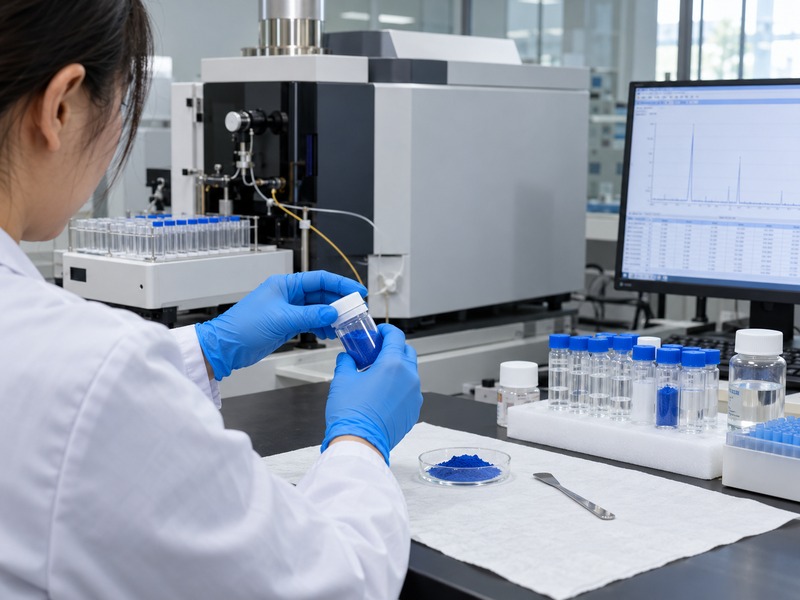
Ask for the exact lot result. If iodine matters to a customer's formula or claim, request an assay of the grade and lot being offered, with the laboratory method, unit, reporting limit, and measurement basis.
A sales reply saying “algae contain minerals” does not quantify iodine. Nor does a statement that the material came from freshwater prove iodine-free status; mineral input and process details still matter. The proper B2B answer is conditional: use the measured result for the defined powder, then calculate the contribution at the actual dose in the finished product. Until that evidence exists, leave numerical claims and “iodine free” language out of sales copy.
| Buyer question | Evidence needed | Unsafe shortcut |
|---|---|---|
| Is iodine detectable? | Lot test with reporting limit | Inferring from blue color |
| How much per serving? | Powder result and actual dose | Copying whole-algae table |
| Can a claim be made? | Finished-food calculation and rule | Treating assay as label approval |
2. Why can't whole spirulina data answer the question?
Compare the right materials
Whole spirulina powder includes the complete dried biomass. Blue extract production separates a phycocyanin-rich fraction through a different process, and commercial powder may include other intentional components. Mineral levels in one material cannot be carried mathematically into the other without extraction yields and analytical data. Keep the comparison honest. Published nutrition tables often report iodine for a particular whole spirulina sample, sometimes on a dry-weight basis. Such a figure is neither a universal Arthrospira constant nor a result for a blue pigment powder.
A research article on commercial edible algae found variation by species and product, which reinforces the need for sample-specific data. A buyer should also avoid assuming that a blue extract is “iodine free” because it contains less whole-biomass material. Trace amounts could remain or enter through water, ingredients, or handling. Request separate specifications for whole spirulina powder, tablets, and each blue powder grade. A single company catalog may sell all three without their nutrient profiles being interchangeable.
| Product | Material basis | Iodine decision |
|---|---|---|
| Whole spirulina powder | Dried biomass | Test that powder |
| Spirulina tablets | Biomass plus possible excipients | Test or calculate tablet formula |
| Blue phycocyanin powder | Extracted ingredient | Test exact grade and lot |
3. Where could iodine enter an extract supply chain?
Potential iodine sources include cultivation water, nutrient inputs, source biomass, intentional formulation components, and environmental contact. The contribution of any route depends on actual supplier practices. Trace before you speculate. Ask where cultivation occurs, how water and inputs are controlled, whether raw biomass from multiple sites is pooled, and what materials are added after extraction.
A product called “blue spirulina” does not reveal these answers. Iodine chemistry also complicates assumptions: different chemical forms may behave differently during processing and analysis. For a buyer, that does not require a full process disclosure; it does require a result that measures the relevant total iodine or specified species for the intended decision.
If a supplier claims no iodine was intentionally added, record that statement, but do not equate it with a below-threshold analytical result. A change in source water or carrier can justify a new qualification test. If iodine is a controlled attribute in the customer's product, add it to the change-notice agreement rather than asking only during the initial sample trial.
Separate input facts from finished results
A farm location and a water certificate are useful context. The finished blue powder result remains the direct evidence for a formulation calculation.
4. How should a buyer test iodine in blue powder?
Specify the assay
The laboratory should use a method validated for the strongly colored powder and the expected concentration range. The report must identify the analyte, preparation, instrument or method reference, limit of quantitation, result, unit, uncertainty where relevant, and whether the value is on an as-received or dry basis.
Match sensitivity to the business question. A method that reports “less than 10 mg/kg” cannot support a customer limit of 1 mg/kg. Ask the laboratory whether total iodine or a specific iodine species is needed; those are different tests.
A buyer may use an independent accredited laboratory where a claim or sensitive customer specification warrants it, but accreditation scope and method suitability should be checked rather than assumed. Sample handling matters as well: use a representative sealed lot sample and protect its identity through the chain of custody. If the initial result conflicts with a supplier COA, compare methods and sample bases before declaring either report wrong. Avoid naming ICP-MS as a guaranteed answer without checking the lab's validated iodine preparation.
| Laboratory field | Buyer check | Consequence if missing |
|---|---|---|
| Analyte definition | Total iodine or specified form | Results may answer different questions |
| Quantitation limit | Below decision threshold | “Not detected” may be unhelpful |
| Sample basis | Dry or as received | Incorrect conversion |
| Lot code | Matches shipped material | Result cannot release shipment |
5. How do you convert a powder result into a serving?
Use the real dose
For a powder result in milligrams per kilogram, the same numeric value is micrograms per gram. Multiply that value by grams of blue powder used in one serving to estimate micrograms of iodine from that ingredient. This is a unit conversion, not a claim that any particular powder contains a stated amount.
Write the dose beside the result. For example, if a hypothetical laboratory reports 2 mg/kg and the hypothetical formula uses 0.05 g powder per serving, the ingredient would contribute 0.1 microgram per serving before accounting for measurement uncertainty or other ingredients.
That example illustrates arithmetic only; it is not a supplier specification. A finished food can contain iodine from salt, dairy, seaweed, or other ingredients, so the blue powder contribution is not the total. If the formula changes dose, recalculate. When an assay is reported as “less than” a quantitation limit, use a conservative upper-bound calculation where the customer's risk assessment calls for one. Record the source lot, test date, and formula revision so the calculation can be audited.
| Calculation input | Example only | Where it comes from |
|---|---|---|
| Powder iodine | 2 mg/kg = 2 µg/g | Hypothetical lab report |
| Powder dose | 0.05 g/serving | Hypothetical formulation |
| Ingredient contribution | 0.1 µg/serving | 2 × 0.05 |
| Finished-food total | Not given | Requires full formula or test |
6. When can a finished food make an iodine statement?
A nutrient statement belongs to the finished product and its destination-market rules, not merely to an ingredient brochure. NIH's Office of Dietary Supplements notes a US Daily Value of 150 micrograms for adults and children age four and older, and discusses Nutrition Facts treatment of iodine. FDA's current Nutrition and Supplement Facts guidance gives the same Daily Value. Do the full-product review. Calculate contributions from every ingredient, account for processing and analytical uncertainty, and check whether a finished-product test is needed to support the label.
A trace iodine result in blue powder does not automatically support an “iodine source” claim. Conversely, a low ingredient result does not prove the finished food is suitable for a medically prescribed low-iodine diet. Ask regulatory staff to review exact wording, threshold, serving size, and target market. Health claims about thyroid function add another evidentiary and legal question; do not attach them to blue spirulina simply because iodine is a known nutrient. The supplier can provide material data, while the brand owns its finished-product statement.
Keep ingredient and claim files separate
Store the lot assay in the quality file and the claim rationale in the finished-product regulatory file. Link them by formula revision so a later supplier change triggers review.
7. What if a customer requires low iodine?
Set a numerical threshold
A low-iodine brief needs a numerical decision limit and a method capable of measuring below it. “No added iodine” is a process statement; it does not mean zero iodine. “Iodine free” is a different claim that needs legal review and adequate analytical support. Ask the customer to define the threshold. Record whether it applies to powder, ingredient contribution per serving, or total finished food.
Then request a method with a quantitation limit below that threshold and test representative lots. If the customer will use the product in a controlled medical diet, the brand's clinical and regulatory experts should set the criteria; a supplier should not improvise medical suitability from a generic COA. Consider other formula ingredients and cross-contact controls before approving the finished food.
Where a supplier cannot quantify iodine low enough for the requirement, either qualify another material or leave the requirement unmet. Do not turn a non-detect result with a high reporting limit into a zero in the spreadsheet.
| Phrase in brief | What to clarify | Evidence |
|---|---|---|
| No added iodine | Intentional formulation input | Supplier statement |
| Low iodine | Numerical limit and basis | Suitable assay and formula |
| Iodine free | Legal claim definition | Regulatory approval and data |
| Medical diet suitability | Clinical specification | Product-level review |
8. How should lots and grades be compared?
Compare results measured by the same or demonstrably comparable method and reported on the same basis. A value from a whole spirulina tablet cannot rank a blue extract powder. Nor can one result from E3 establish the range for E40. Build a grade-by-lot record.
Capture the supplier's E3, E6, E18, E25, E35, and E40 offerings as distinct identities, then add iodine results only where actual tests exist. If procurement switches grade for price or color strength, rerun the nutrient contribution calculation using the new dose and result.
Watch for changes in carrier or water source that could change iodine independently of color. A trend chart across several lots can support a sampling-frequency decision, but it should not replace testing where a customer requires every-lot evidence. If two laboratories disagree, check sample identity, extraction method, measurement basis, and reporting limits. Set an agreed referee method before an urgent shipment creates pressure to choose the favorable value.
Compare the delivered dose
A powder with a higher result per kilogram may contribute less per serving if the customer's color target requires a smaller dose. Use the actual formula, then verify all other requirements.
9. Which documents should a supplier provide?
Request a current grade-specific specification, batch COA with iodine if iodine is controlled, full method or method summary, composition declaration, manufacturing lot link, and change-notice commitment. A typical analysis from a sales deck can guide a conversation but cannot release an individual shipment. Check every document against the purchase order. The product name, E-grade, batch code, units, and acceptance criterion should match. If iodine is reported only as “complies,” ask for the numeric result or a less-than value with a reporting limit.
If the supplier claims it does not test iodine because the product is a color additive, the buyer can still specify iodine as a customer requirement where the finished formula needs it. Do not confuse iodine testing with the heavy-metal panel; different analytes and methods may apply. The supplier should also disclose intentional ingredients so the customer's regulatory team can review the formula. Keep results for whole spirulina products in a separate file.
Make change notice specific
Ask the supplier to notify you before changes in source biomass, cultivation water, carrier, test method, or site when those changes could affect an agreed iodine limit.
10. What is a defensible purchase decision?
Approve the exact blue powder grade only after its iodine evidence matches the customer's numerical requirement, method sensitivity, dose calculation, and destination-market review. Leave unknown values blank. A buyer can still order a powder for color development while iodine remains an open question, but it should not release a low-iodine claim or a sensitive formula on inference. Write the grade, assay, reporting limit, units, sample plan, and change notice into the purchase specification.
Ask for a representative pre-shipment sample and retain it with the COA. Then calculate the maximum expected contribution at the intended dose and review all other iodine sources in the finished product. If the data do not support a claim, use accurate color-focused copy and request further testing. That approach gives a supplier a clear route to qualify and gives the brand a record it can explain to a customer or auditor.
Further reading
The nutrition facts guide compares whole biomass with blue extract. Review the NIH iodine professional fact sheet, the FDA Daily Value guide, and a study of iodine in commercial algae. None supplies a result for an untested blue extract lot.
FAQ
Q1: Is blue spirulina always iodine free?
No. That cannot be established without a suitable test on the relevant product and lot.
Q2: Can a whole spirulina nutrition table be used for blue extract?
No. Extraction and formulation change the material, so request separate data.
Q3: What does “iodine not detected” mean?
It means the tested sample was below the method's stated detection or reporting limit, not necessarily zero.
Q4: Does an E-grade code indicate iodine content?
No. The code is a product identifier. Check the grade specification and lot result.
Q5: Who approves an iodine nutrient claim?
The finished-product brand's regulatory team should review the full formula, serving size, data, and destination rule.