
A powder can pass a supplier’s “fine mesh” claim and still bridge in a hopper or leave visible specks in a drink. Chlorella powder particle size is useful only when a buyer knows what was measured, how the sample was taken, and which process outcome matters. This guide turns a vague fineness request into a measurable purchasing and trial plan. ISO 13320 and ISO 14488 provide sound starting points for measurement and sampling; neither supplies a universal Chlorella limit.
Contents
- What does particle size mean for Chlorella powder?
- How do mesh and laser diffraction differ?
- Which distribution figures should buyers request?
- How should a representative powder sample be collected?
- What can milling change besides fineness?
- How does particle size affect flow and dosing?
- How does it affect dispersion in beverages?
- Which pilot trials show whether a grade works?
- How should a particle-size specification be written?
- What evidence should accompany a supplier offer?
1. What does particle size mean for Chlorella powder?
Start with the particles your process encounters
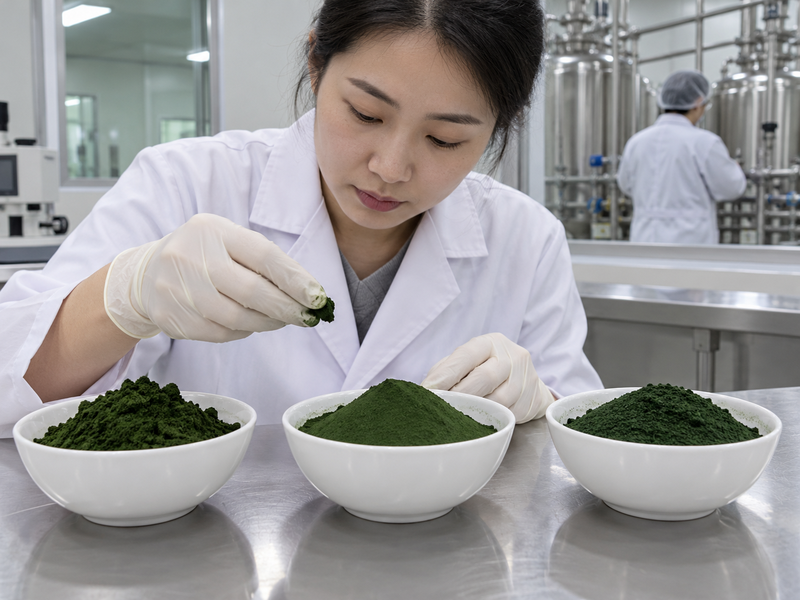
“Particle” can mean an individual dried cell, a cell fragment, or an agglomerate of smaller pieces. Handling and liquid mixing may break weak agglomerates; a dry test and a wet test can therefore describe different states of the same lot. Specify whether a result refers to as-packed powder or material after a defined dispersion step. Without that distinction, two laboratories may both produce correct data that answer different commercial questions. A microscope image can help explain a surprising result, though it cannot replace a distribution measured on a representative sample.
Here is the useful distinction. An upper size tail can matter more than an average when a customer sees specks or a fine screen blocks. For a tablet press, packing and flow may matter more than the tiniest fraction. Milling history, residual moisture, storage and transportation can also change the apparent distribution. Ask the supplier to describe the physical grade offered, then connect each measurement to a real operation. Avoid a single “best micron size” claim. The appropriate window depends on drink viscosity, hopper design, target dose and consumer expectations.
2. How do mesh and laser diffraction differ?
Treat them as different tests, not interchangeable labels
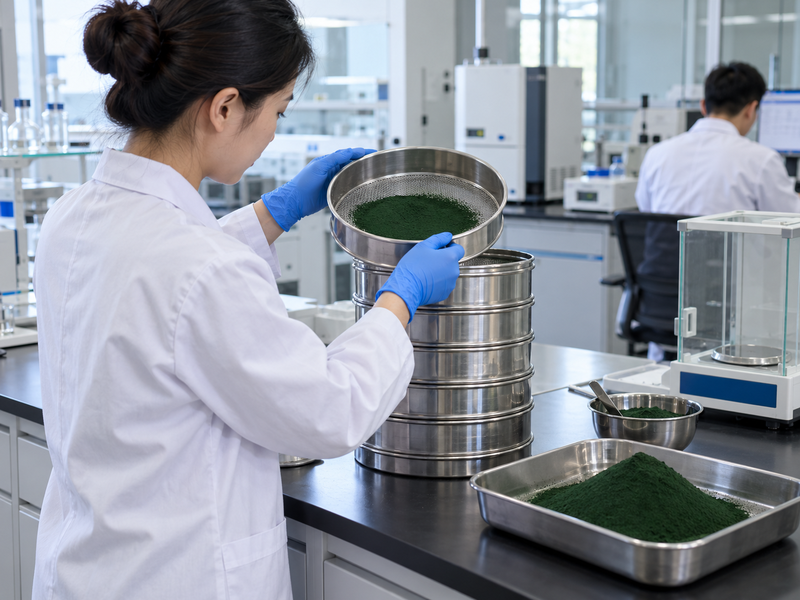
A sieve separates material according to what passes a specified opening under specified conditions. “Mesh” commonly refers to a screen count, yet a count alone does not fully identify aperture size or wire geometry. Request the opening in micrometers, sieve standard, dry or wet method, run time and mass retained. ISO 2591-1 describes general principles for test sieving. A pass statement is useful for limiting coarse material, but it does not reveal the complete fine-particle distribution.
Laser diffraction infers a volume-based size distribution from scattered light. ISO 13320 covers instrument qualification, sample presentation and measurement; it also notes that its optical model reports equivalent spherical sizes. A Chlorella fragment or irregular agglomerate does not become spherical merely because the instrument prints a number. Wet dispersion medium, sonication, refractive settings and obscuration can shift results. Put the method beside every number. A “95% through 100 mesh” claim and a laser D90 of 100 micrometers are not equivalent specifications. Use a matched method when comparing suppliers or lots.
| Question | Sieve result | Laser diffraction result |
|---|---|---|
| What is observed? | Mass passing or retained at an aperture | Modeled volume distribution |
| Strong use | Coarse tail and screen control | Full distribution and changes in fines |
| Key method detail | Aperture, time, dry or wet procedure | Dispersion, optical settings, instrument |
| Buyer caution | Pass fraction hides the rest | Equivalent diameter is model dependent |
3. Which distribution figures should buyers request?
Read D10, D50 and D90 together
In a volume-based laser report, D10, D50 and D90 mark sizes below which 10%, 50% and 90% of measured particle volume falls. D50 is a median, not an arithmetic mean. D90 signals the broad upper tail, though a small number of very large agglomerates can still sit beyond it. Ask for a plotted distribution, measurement repeats and the method description rather than copying one D50 into a purchasing contract. If the powder contains a mix of fine fragments and agglomerates, one median may conceal two process behaviors.
Look beyond the headline value. Compare the as-received powder with a sample dispersed under your production mixing conditions. If the wet D90 drops sharply, weak agglomerates may break readily in a beverage. If the dry material generates many fines, dust and flow could be a concern even while a drink looks smooth. For a visible-fleck complaint, inspect the coarse tail and a representative finished drink. For tablet weight variation, pair distribution data with density and flow tests. A useful report identifies lot, date, sample location, replicate count and any sample preparation. It should never silently convert between sieve and laser values.
4. How should a representative powder sample be collected?
Control sampling before discussing decimal places
Particle segregation can occur during filling, vibration and discharge. Scooping the top of one drum may overrepresent fines or coarse agglomerates. Define the lot, container selection, sampling positions, number of increments and splitting method before asking a laboratory for precision. ISO 14488 addresses obtaining representative test samples from bulk particulate material, including powders. Its principle is especially relevant when a supplier offers one neat sample from a much larger shipment. Record any handling that can crush or deagglomerate the material.
A simple receiving plan works better than a perfect instrument on a poor sample. For an initial qualification, sample several packed units across a commercial lot and keep each unit identified. Test a composite for the overall estimate, then individual units if variability could cause a line problem. Retain sealed material for a dispute. If samples come from a bag, use a suitable sampling tool and manage contamination risk. An agreed independent laboratory can split a jointly collected sample for cross-checking. The comparison is fair only when both parties use the same preparation and reporting basis.
| Sampling decision | Practical record | Failure it helps prevent |
|---|---|---|
| Lot boundary | Packing date and linked production lot | Mixing unlike runs |
| Container selection | Randomized drum or bag IDs | Showcase sampling |
| Increment locations | Depth and position | Segregation bias |
| Splitting and storage | Divider, seal, conditions | Handling drift |
5. What can milling change besides fineness?
Evaluate the process, not only the final curve
Milling can break agglomerates or cell structures and can create a wider fine fraction. It may also generate heat, increase exposed surface area, change bulk density or increase dust. These effects depend on equipment and settings; they should be measured on the offered grade rather than inferred from a machine name. Ask whether the supplier controls feed moisture, mill temperature, screen condition, metal detection and cleaning between runs. A change from one mill to another may alter more than a COA particle-size line.
The tradeoff appears downstream. A finer grade may look smoother after mixing yet handle poorly during bulk transfer. A coarse grade may flow acceptably but settle quickly or clog a nozzle. Assess color, odor, moisture, microbiology and relevant contaminants alongside physical data after a process change. Research on drying Chlorella shows why processing and analytical presentation need to be described together; its experimental results are not a purchase specification for every powder. Request a pre-change and post-change comparison from several lots before approving a substitution.
6. How does particle size affect flow and dosing?
Measure behavior in the actual feed system
Fine particles can cohere, carry static charge and bridge across a hopper outlet. Coarse or mixed particles can segregate during transfer. Neither behavior follows a simple universal size threshold. Measure loose and tapped bulk density, observe discharge and trend dose variation at production speed. USP <1174> Powder Flow describes multiple ways to characterize flow, while USP <616> covers density testing. These methods inform trial design; they do not promise that a powder will run on a particular filler.
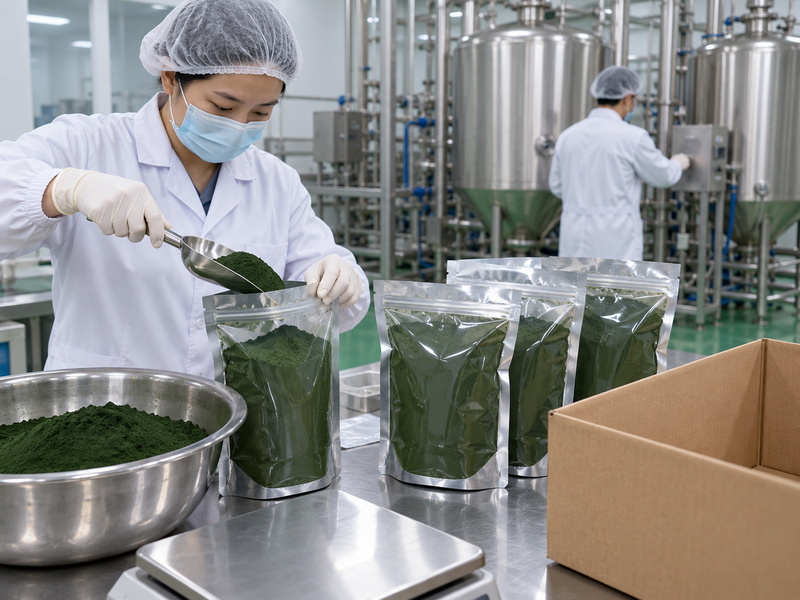
Run the hopper from full to low. A powder that meters steadily for ten minutes may bridge after vibration, humid air exposure or a low fill level. Record feed rate, interruptions, weight variation, dust loss and cleaning time. For capsule filling, actual fill mass also depends on shell volume and powder packing. For sachets, dust and sealing contamination may dominate. Set a size limit only after identifying which measured attribute predicts a real failure. If a flow aid or granulation is considered, calculate its effect on ingredient declaration and Chlorella per serving before treating it as a routine fix.
| Process symptom | Size-related hypothesis | Confirming trial |
|---|---|---|
| Bridging | Fine, cohesive fraction | Low-hopper discharge trend |
| Variable fill | Segregation or changing density | Start/middle/end unit weights |
| Dust at seal | Excess mobile fines | Sachet reject and dust count |
| Screen blockage | Coarse agglomerates | Retained mass and screen inspection |
7. How does it affect dispersion in beverages?
Separate wetting, breakup and suspension
Particle size influences how fast dry powder wets and how a mixed drink feels, but it does not make whole Chlorella biomass truly soluble. A powder may disperse into fine suspended particles and still form a sediment ring after standing. Large agglomerates can create visible specks even when a laser result on a heavily sonicated laboratory sample looks fine. Compare results under realistic water temperature, pH, solids level and mixer energy. Use your own beverage matrix and target serving size for acceptance.
Watch the glass after mixing stops. Record wetting time, floating islands, lump count, visual uniformity and sediment at several hold times. Check mouthfeel and color in the actual bottle, not just in a beaker. A published Chlorella soy-beverage experiment illustrates that beverage matrix and processing need definition before interpreting a result. Its formula does not prove that another grade will stay suspended. If a finer powder improves initial uniformity but increases foaming or darkens appearance, the launch decision must include those effects.
8. Which pilot trials show whether a grade works?
Design trials around a measurable failure
Select at least two commercial-lot samples for each shortlisted grade and use a reference lot already known to run well, if one exists. Keep dose, process order, mixer, water composition, line speed and operator instructions fixed. For a beverage, measure wetting, visible specks and settled volume after defined holds. For capsules or sachets, record fill-weight distribution, interruptions and reject rates. If pilot scale differs from production, identify which variables may not transfer. Agree on pass criteria before seeing results.
Make the trial discriminating. A gentle bench stir may miss lumps that a high-shear mixer removes; the opposite can also happen if production has a short residence time. Run a realistic worst case such as the lowest planned mixing energy or longest product hold. Randomize sample order for sensory review where practical. Compare total usable yield, not only powder price. Preserve photos and raw data with sample IDs. A trial that says “mixes well” without timings or observations cannot support a purchase decision or resolve a later quality dispute.
| Application | Controlled challenge | Recorded outcome |
|---|---|---|
| Ready-to-drink | Standard dose and mixer cycle | Specks, sediment, mouthfeel |
| Sachet blend | Transfer and packing speed | Dust, seal rejects, uniformity |
| Capsule | Full-to-low hopper run | Fill spread, stops, yield |
| Dry blend | Shipping vibration simulation | Segregation and re-mix time |
9. How should a particle-size specification be written?
Write a reproducible requirement with a commercial purpose
State species and grade, the relevant size parameter, numerical range or upper limit, method, sample preparation, sampling plan and action when a result falls outside the range. If sieving is used, identify the aperture and retained-mass criterion. If laser diffraction is used, identify wet or dry presentation, dispersion conditions, instrument settings and reported D-values. Agree on a method transfer or referee laboratory for disputes. A bare line such as “200 mesh” cannot carry all these decisions.
Avoid false precision. Derive limits from successful line trials and normal variation across several lots. A specification tighter than analytical repeatability creates noise and rejected material without improving product performance. Pair particle size with moisture, density or application tests where those better predict problems. Changes in milling, drying or packing should trigger a review even if a new lot technically passes an old size limit. ISO 13320 explicitly concerns the measurement method, not a Chlorella acceptance value. That acceptance value belongs in the buyer’s validated product brief.

10. What evidence should accompany a supplier offer?
Ask for comparable lot data and a usable sample
An RFQ should state the application, planned dose, equipment and target market. Request the test method, full distribution or sieve record for at least three recent commercial lots, sampling description and a sample tied to one of those lots. Obtain moisture, bulk and tapped density, lot-specific COAs and change-notice terms. Where a supplier proposes a special milling grade, ask whether it is routine production or a one-off laboratory preparation. Samples from a different grade will make a successful pilot misleading.
Close the purchasing loop. Use the line trial to decide which attributes enter the contract and which remain monitoring trends. Check whether the supplier can hold the agreed range at forecast volume, then place a trial order with retained samples and defined rejection steps. Do not let a compelling size graph displace identity, food-safety or destination-market checks. FDA’s food and supplement CGMP overview explains why finished-product controls depend on the product category. Chlorella powder particle size becomes valuable when its measurement, physical behavior and commercial outcome are linked.
| RFQ item | Evidence to attach | Buyer decision |
|---|---|---|
| Grade and lot | Sample ID and COA | Traceable trial material |
| Size method | Procedure and full result | Comparable measurement |
| Physical behavior | Density and line notes | Process feasibility |
| Change control | Milling and pack notice | Requalification trigger |
What to do next. Agree on a representative sampling plan, compare sieve or laser results under one defined method, and run the offered lot on the intended line. Write only performance-linked limits into the purchase specification. That gives production a defensible answer when the next delivery looks different from the approval sample.
FAQ
Q1: Is mesh the same as particle size in micrometers? No. Mesh identifies a sieve construction or count; the actual opening and pass criterion must be stated.
Q2: Does a lower D50 guarantee a smoother beverage? No. Agglomeration, wetting, dose and beverage matrix also affect visible texture and sediment.
Q3: Can one supplier COA establish a permanent size range? No. Use several representative commercial lots and a line trial before setting acceptance limits.
Q4: Should the laboratory test Chlorella dry or wet? Choose the presentation that answers your process question, and document preparation so results remain comparable.
Q5: What sample should a buyer retain? Keep sealed, identified material from the tested commercial lot under agreed storage conditions.