
A green beverage can look uniform at the mixer and show a dark layer in the bottle hours later. Chlorella powder dispersibility describes several different behaviors, so a single “mixes easily” claim rarely predicts commercial performance. This guide gives beverage developers a practical test sequence for wetting, breakup, suspension and sensory acceptance. Published Chlorella beverage research demonstrates why the recipe and process must be described together; its results cannot substitute for a trial in your own formula.
Contents
- What does dispersibility mean for Chlorella?
- Why is dispersion different from solubility?
- Which powder properties affect the first mix?
- How should a bench wetting test be designed?
- Which beverage ingredients change suspension?
- How should mixing equipment be compared?
- How can sedimentation be measured fairly?
- Which sensory and appearance checks matter?
- What belongs in a production-scale pilot?
- How should a buyer specify dispersibility?
1. What does dispersibility mean for Chlorella?
Define observable stages instead of one adjective
Dispersibility can refer to dry powder entering liquid, individual particles spreading, or a mixed suspension remaining reasonably uniform. Those stages have different causes and remedies. A powder that sinks quickly may form a stubborn paste at the bottom. Another may float briefly but break apart cleanly under mixing. A third may disperse at once and settle during storage. Record each observation separately. Then tie the acceptable behavior to your product: an instant sachet, chilled ready-to-drink bottle and thick smoothie do not need identical performance.
Start at the customer moment. If users shake a bottle for ten seconds, a laboratory vortex for two minutes is an irrelevant success test. If a factory uses a premix tank and high shear, a hand-stirred cup can reject a workable grade. Define dose, temperature, mixing energy, hydration time and acceptable sediment before comparing powders. Keep the species and physical grade traceable to a commercial lot. “Dispersible Chlorella” should be a tested application description, not an assumed universal ingredient property.
2. Why is dispersion different from solubility?
A suspended particle remains a particle
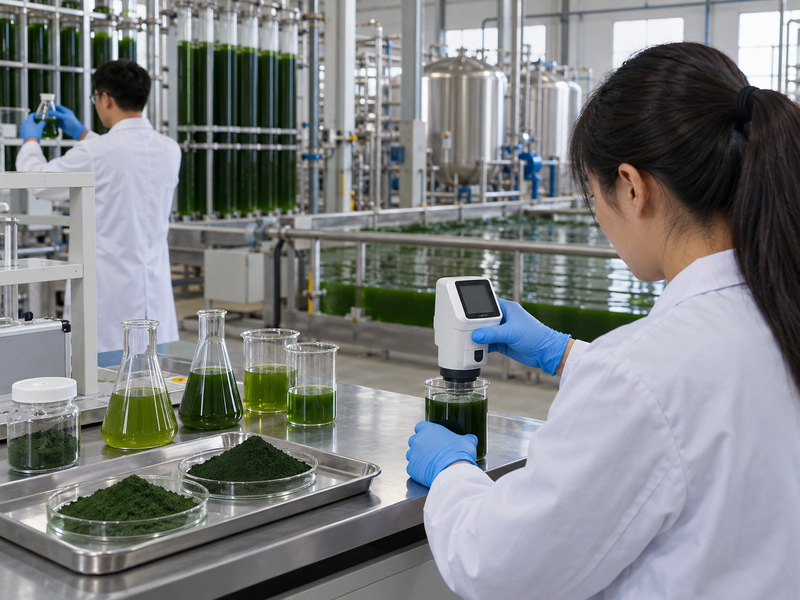
Whole Chlorella powder consists of biomass particles containing many components. Some constituents may dissolve or extract into water, but the entire powder does not become a molecular solution. A green drink can appear evenly colored because particles are suspended, even while material collects at the bottom over time. Use “dissolves” only for a measured soluble fraction or a product specifically processed and tested for that claim. Otherwise describe wetting, dispersion and suspension stability. This wording helps procurement compare like with like and prevents a misleading brief.
Here is the practical test. Mix a known powder mass in a fixed liquid volume, then inspect or quantify material remaining after an agreed separation step. Centrifugation, filtration and standing measure different things; report the method rather than calling every supernatant “solubility.” A study of Chlorella processing and protein quality explicitly defines its experimental preparation before measuring soluble material and particle distribution. Its conditions are research conditions, not a general beverage claim. For a consumer drink, appearance and redispersibility may matter more than a soluble-solids figure.
| Term | What to observe | Common misread |
|---|---|---|
| Wetting | Time until dry surface disappears | Fast wetting proves stability |
| Dispersion | Lumps and visible particle spread | Uniform color means dissolved |
| Suspension | Change during a stated hold | No early sediment means no later sediment |
| Redispersibility | Shakes needed after settling | Sediment is always irreversible |
3. Which powder properties affect the first mix?
Connect physical grade with handling history
Particle-size distribution, agglomeration, moisture and surface behavior influence how a powder meets water. Fine material may have a large surface area yet clump as an outer layer hydrates. Coarser granules can flow and wet differently. A dry powder’s bulk density affects how it floats or sinks during addition. Storage humidity can turn an approved free-flowing grade into hard lumps. Ask suppliers for the physical-grade description, particle-size method, moisture data, packing format and recent commercial-lot variation. A color or protein COA alone cannot predict mixing.
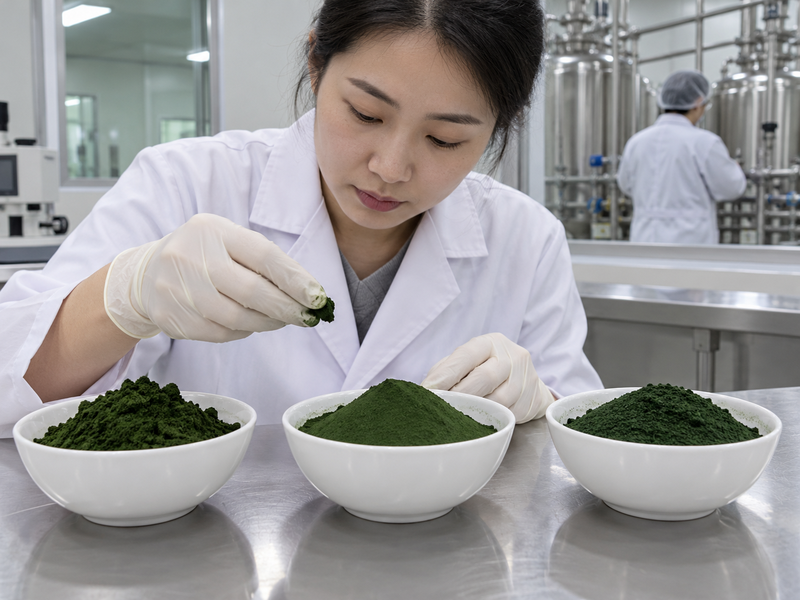
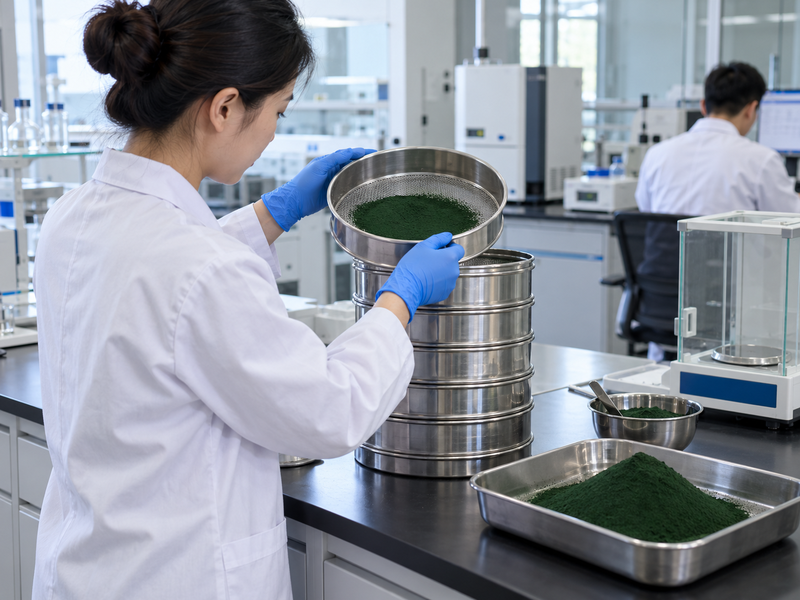
Do not assume finer always wins. High-shear mixing might break soft agglomerates without additional milling, while a fine powder could introduce dust or foam. ISO 13320 explains the scope and limitations of laser diffraction particle-size measurement, including the need to define sample presentation. Compare an as-received result with a result after your standard wetting protocol if size appears relevant. Keep one retained reference lot that performed well in the formula. When a new shipment behaves differently, compare moisture, coarse tail and mixing observations before changing the recipe.
4. How should a bench wetting test be designed?
Fix dose, liquid and addition order
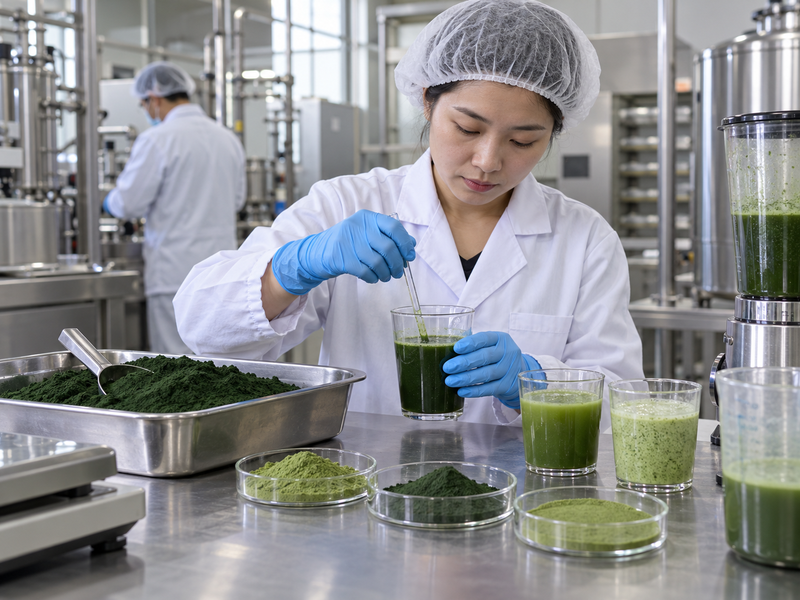
Start with the intended use concentration and a representative liquid, not water alone unless consumers will mix in water. Fix liquid volume, temperature, vessel shape, stirrer, mixing speed and time. Add the powder in the same manner every run: slowly into a vortex, all at once, or as a dry premix. Record whether powder stays on the surface, forms dry-centered lumps, adheres to the wall or sinks before wetting. Use at least two lots per grade and repeat observations. Photograph the same vessel under stable lighting.
Keep the test simple enough to repeat. A time-to-wet result may be the moment no dry powder remains visible, but observers should agree on that definition beforehand. Record energy input or mixer setting rather than describing agitation as “vigorous.” When screening several grades, blind sample codes can reduce expectations about price or supplier. A low-shear test reveals consumer mixing behavior; a high-shear test reveals manufacturing potential. Do both only if both pathways matter. For a long beverage hold, move beyond the wetting test and measure sediment separately.
| Fixed variable | Example entry in a trial sheet | Why record it? |
|---|---|---|
| Dose | Grams per liter | Concentration changes clumping |
| Liquid | Formula and pH | Matrix changes wetting |
| Addition | Powder into liquid, timed | Order changes lump formation |
| Mixing | Device, speed, duration | Energy determines breakup |
| Observation | Time, lump count, photos | Makes grades comparable |
5. Which beverage ingredients change suspension?
Test the full matrix, not a green water demo
Sugar, acid, proteins, fibers, oils and hydrocolloids can change viscosity, particle interactions and apparent stability. A thick smoothie may hold Chlorella particles longer than a thin drink, yet create an unpleasant texture. Acidification may change color or flavor independently of settling. Heat treatment can alter viscosity or form deposits. An ingredient supplier’s dispersion demonstration in water therefore proves only that particular demonstration. Your pilot must use the final ingredient order and intended processing steps.
Small changes can shift the outcome. Compare a low-solids and a high-solids version if the product range permits both. Run a control without Chlorella to distinguish general formula separation from algae-specific sediment. In a fermented soy beverage study, investigators defined the soy matrix, Chlorella addition and flow behavior as one experimental system. Use that as a design lesson rather than copying its stability conclusion. If a stabilizer is considered, check label, sensory and cost effects alongside reduced settling. A stable bottle that customers dislike is not a successful formulation.
6. How should mixing equipment be compared?
Compare delivered process conditions
Hand stirring, rotor-stator mixing, inline high shear and homogenization do not apply the same forces. Equipment selection affects breakup, temperature rise, foam and throughput. Define a bench process that reasonably models the planned line, then repeat with production-scale equipment. Record powder addition point, recirculation time, tank level and whether the material waits before filling. A perfect sample drawn directly from a high-shear outlet may not represent product at the end of a long holding tank.
Measure the whole run. Samples at start, middle and end can show whether a line keeps solids evenly distributed. Inspect transfer hoses, filters and nozzles for buildup. Record yield lost in tanks or screens. If a dispersion aid is proposed, compare it with an equipment adjustment using the same powder lot. The lowest-cost solution may be a better powder feed point, while a new ingredient may introduce labeling work. FDA’s human-food CGMP overview is a reminder that process controls and records belong to the applicable finished-product framework; a bench result alone cannot qualify a production process.
| Mixing route | Likely advantage | Check in pilot |
|---|---|---|
| Hand shake | Mirrors consumer use | Lumps after stated shakes |
| Tank agitator | Commercially scalable | Dead zones and hold drift |
| Inline high shear | Breaks agglomerates | Heat, foam, throughput |
| Homogenization | Fine distribution | Texture, wear, cost |
7. How can sedimentation be measured fairly?
Choose a hold that matches distribution
Fill identical transparent containers with the same mixed batch and leave them undisturbed at planned storage temperatures. Record visible sediment height or volume, clarity gradient, floating material and time to first visible separation. Photograph against a fixed background. If settling is subtle, take standardized samples from top and bottom and measure solids or optical density with a defined method. Do not shake one bottle before inspection and compare it with an untouched bottle. Replicate containers help distinguish a real trend from filling variation.
The timing matters. A powder may remain uniform for one hour yet settle during a shelf-life study. Review after processing, after transport simulation and at relevant storage intervals. A short pilot cannot establish full shelf life; it screens risk and informs formal stability work. Check whether a settled layer redisperses after a realistic number of shakes or forms a hard cake. Record texture and flavor after redispersion. Any claim such as “no settling” must be supported under defined conditions. A more honest specification may allow a small, readily redispersible layer with clear consumer instructions.
8. Which sensory and appearance checks matter?
Let the target customer define acceptable uniformity
Visual dispersion matters because consumers judge the bottle before they taste it. Inspect under retail-like lighting and through the actual package. Record green intensity, specks, ring formation and color change during storage. Mouthfeel can reveal grit even when a sample looks smooth. Use a trained internal panel for screening, then a suitable consumer study if the launch risk justifies one. Keep evaluation blinded where practical and record preparation, serving temperature and elapsed time after shaking.
Do not hide a defect behind viscosity. A thick base may delay settling but feel slimy or mask the desired flavor. A smaller Chlorella dose may improve appearance while weakening the intended ingredient positioning. In a Chlorella-fortified beer experiment, changing addition level affected sensory outcomes in that specific beverage. It supports testing dose in the target matrix, not adopting the study’s scores for another product. Pair sensory notes with measured physical outcomes so formulators know whether a complaint relates to coarse particles, flavor, color or packaging.
| Attribute | Practical method | Acceptance question |
|---|---|---|
| Visible specks | Fixed-light bottle photo | Would a buyer reject this look? |
| Mouthfeel | Blind coded tasting | Is grit noticeable at use dose? |
| Color | Reference sample comparison | Does color stay on brand? |
| Redispersion | Defined shake count | Can a customer restore uniformity? |
9. What belongs in a production-scale pilot?
Test the formula through filling and storage
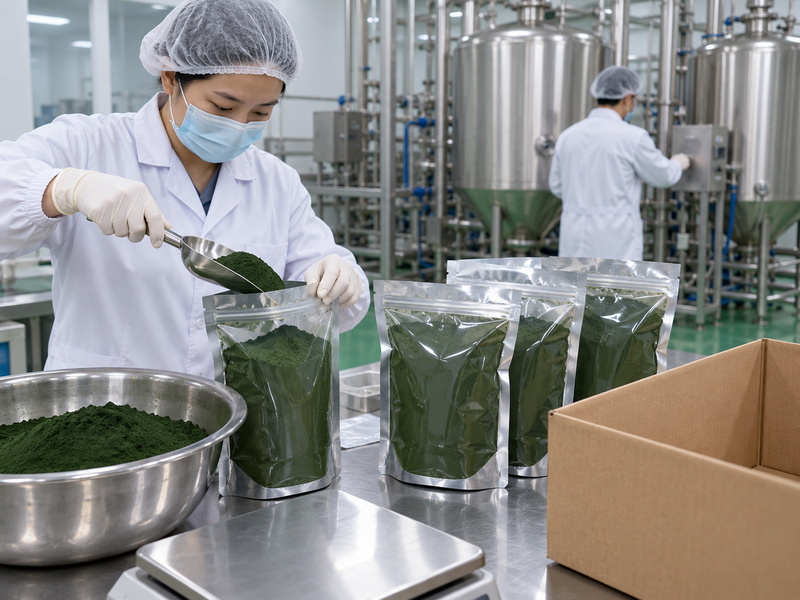
Use a commercial-lot powder and the proposed process order. Record raw-material temperature, hydration time, mixing settings, pH, heat treatment if any, transfer and fill time. Sample before and after key steps and from early and late packs. Measure visible lumps, particle distribution if useful, sediment, top-to-bottom solids and sensory properties. Collect line observations such as foam, deposits, filter pressure and cleaning time. These outcomes often decide whether a powder is commercially usable even when a bench beaker looks convincing.
Write pass criteria before the run. State the acceptable sediment and redispersion behavior at each checkpoint, plus any sensory stop rule. Include a control beverage without Chlorella and a known reference grade where available. A pilot should also test package geometry because a narrow neck, opaque bottle or carton can change what consumers see and how they shake. Retain samples for the planned shelf-life program. If trial batches differ, investigate the material and process records rather than averaging away a failure. A production pilot is the bridge between a powder claim and a launch decision.
10. How should a buyer specify dispersibility?
Specify a test method and a decision threshold
Write down ingredient identity, form, dose, liquid or model matrix, temperature, addition sequence, mixing energy and observation times. Define what counts as a dry lump, visible speck or unacceptable sediment. If your finished product uses a complex recipe, put its exact pilot method in a controlled internal document and reference it in the purchase specification. A supplier can screen to a simpler agreed method, but the buyer should retain final application approval. Include lot sampling, retained samples and change notification for drying, milling or agglomeration changes.
Keep the acceptance rule honest. A supplier cannot guarantee every beverage recipe merely by meeting one water-dispersion test. Require a traceable commercial-lot sample and compare recent lots, then set limits based on successful trials. Use particle size or moisture as supporting controls only when they predict your observed performance. Confirm identity, contaminants and microbiology separately; good suspension is not a food-safety result. Chlorella powder dispersibility becomes a useful buying term when everyone can repeat the test and understand the consumer outcome it protects.
| Specification element | Example of a usable definition | Owner |
|---|---|---|
| Matrix and dose | Approved formula at stated g/L | Buyer R&D |
| Mixing | Device, speed, time, addition | Process team |
| Visual check | Photo standard and lump rule | Quality team |
| Hold and redispersion | Times, temperature, shake count | Product team |
What to do next. Screen two or more commercial lots with one fixed wetting test, then run the selected grade through the real beverage process and storage study. Define acceptable appearance and redispersion before procurement locks a grade. That approach protects the drink consumers will actually open, not just the sample that looked good beside a mixer.
FAQ
Q1: Does Chlorella powder dissolve in water? Whole biomass normally forms a suspension; some components may enter solution, but the entire powder does not dissolve.
Q2: Is finer powder always easier to disperse? No. Fine particles can clump, float, foam or affect handling; test the actual grade in the intended matrix.
Q3: Can a water test qualify a smoothie formula? It can screen a grade, but final approval requires the full recipe and production process.
Q4: Is sediment always a product failure? That depends on the product brief, amount settled, appearance and whether ordinary shaking restores uniformity.
Q5: Which lot should a pilot use? Use a traceable commercial lot, ideally alongside a second lot and a retained reference grade.