
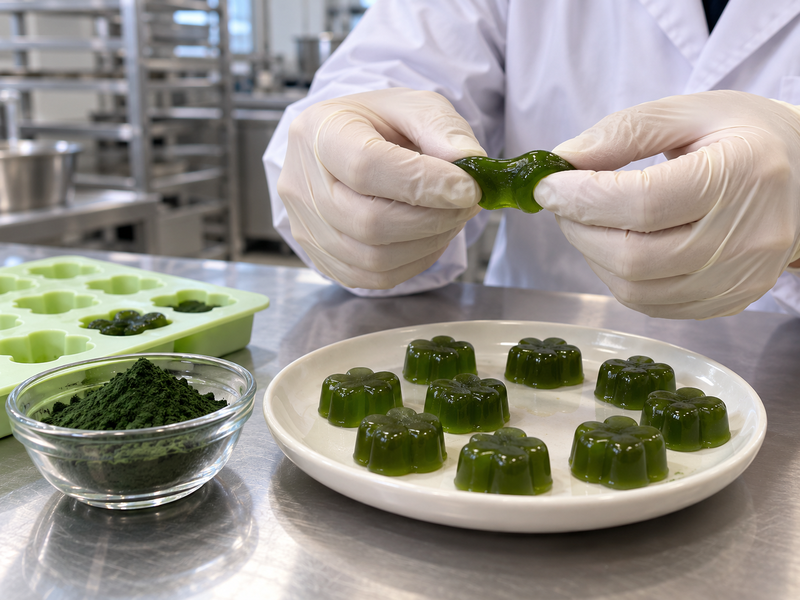
Chlorella powder for greens gummies manufacturers must fit within a small piece while preserving chew, dose uniformity, color and flavor. Whole Chlorella vulgaris powder occupies physical space and can settle or create visible particles; it is not a dissolved green colorant. The buying decision is whether a named broken-cell lot works in the intended pectin or gelatin system at a declared amount per piece.
A supplier’s powder sample and COA support this assessment, but they do not establish that a finished gummy is stable, compliant or pleasant to eat. Build a pilot gate before committing to volume.
Contents
- What dose fits in the actual gummy?
- Which powder identity and physical properties matter?
- How should pectin and gelatin formulas be separated?
- At what point should the powder enter the process?
- How do you prove dose uniformity across a batch?
- What color and flavor are acceptable?
- Which chew and storage tests are necessary?
- What raw-material and finished-product records differ?
- How should the ingredient quote be evaluated?
- What acceptance rule releases a bulk order?
1. What dose fits in the actual gummy?
Begin with piece mass, serving size and the proposed milligrams of chlorella per piece. Calculate the powder’s percentage of the total gummy mass before asking a supplier whether a formula is feasible. A 100 mg addition in a 2 g piece would be 5% by mass; that is an arithmetic illustration, not a recommended level. At higher load, the powder might change viscosity, texture and taste. If the intended daily serving is two gummies, specify whether the declared amount refers to each piece or the two-piece serving.
Build a full solids and water balance, including sugar or polyols, acid, gelling agent, flavors and other greens. A small amount may serve an ingredient-list purpose but cannot be assumed to deliver a meaningful nutrient or wellness claim. Decide which product promise is worth testing before setting a dose.
| Formula input | Calculation | Buyer decision |
|---|---|---|
| Piece mass | Finished grams per gummy | Available loading space |
| Chlorella mass | Milligrams per piece | Declared dose |
| Serving count | Pieces per daily serving | Label basis |
| Total solids | Powder plus base ingredients | Process and chew risk |
2. Which powder identity and physical properties matter?
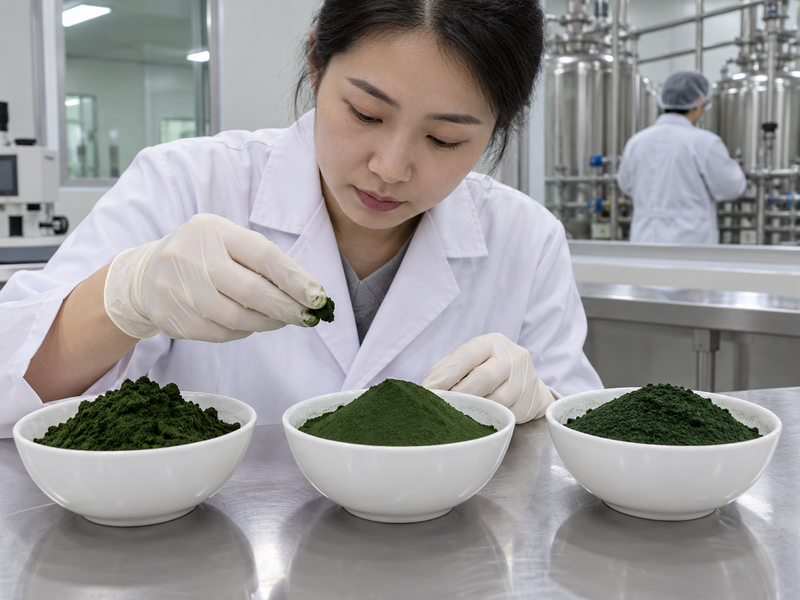
Request a TDS naming C. vulgaris, a declaration of cell-wall disruption, ingredient composition, particle-size distribution, moisture, bulk density and color. Ask for a sample tied to a lot COA with microbiology and relevant contaminants. Broken-cell processing and mesh are separate attributes; the product category makes this distinction. A powder can appear fine in a dry bag yet form perceptible particles in a gummy. Test the exact candidate in the gel, not just in water.
If a supplier offers a premix or extract, identify every carrier and processing aid before treating it as equivalent to the whole powder. Include the intended country of sale in the brief, because ingredient identity and permitted claims are market-specific. Retain a sample for comparison when commercial material arrives.
| Specification field | Evidence request | Gummy effect to test |
|---|---|---|
| Species and form | TDS and declaration | Label identity |
| Particle distribution | Sieve or laser method | Specks and mouthfeel |
| Moisture | Lot result | Gel solids and storage |
| Microbiology | Lot report | Post-heat addition risk |
3. How should pectin and gelatin formulas be separated?
Design separate trials for each gel system rather than generalizing from one. Pectin, gelatin and starch-based gummies differ in pH, temperature, setting behavior and water management. State the actual target recipe and cooking or depositing sequence. Keep control pieces without chlorella and a dose ladder in the same base. If the brand changes from gelatin to pectin to support a vegan label, repeat the ingredient qualification. The powder’s fiber and other insoluble material can interact with a gel differently from a dissolved flavor or color.
Check whether other greens or minerals are already close to the solids limit. Use fixed mold size and deposited weight so pieces can be compared fairly. A result from a commercial “super greens” gummy elsewhere would only show that such an application exists; it would not validate your dose, formula or manufacturing line.
| Matrix | Control variable | Critical response |
|---|---|---|
| Pectin | pH and solids | Set, stickiness and stability |
| Gelatin | Bloom/gel process | Elasticity and heat exposure |
| Starch or other | Process-specific setting | Depositing and release |
4. At what point should the powder enter the process?
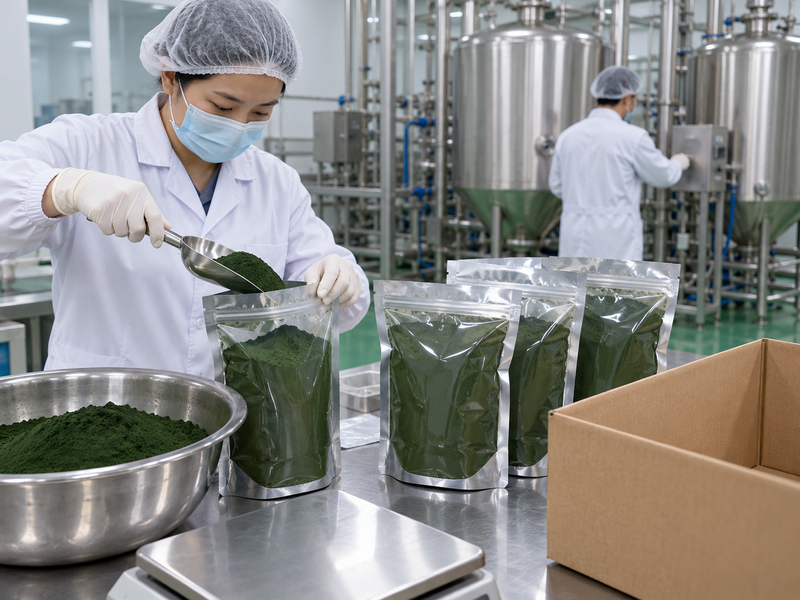
Compare a supplier- and process-compatible predispersion with direct addition at a controlled stage. Record mass temperature, pH, residence time, shear, hold time in the depositor and cooling conditions. Powder added too early may see avoidable heat exposure; added too late may form clumps or create a microbiological control problem. Those are hypotheses for the plant to test, not universal rules. If the line has a validated lethality step, any post-step ingredient addition must be reviewed in the finished product’s hazard plan.
Watch the first and last pieces deposited because a tank held for a long time may change viscosity or allow settling. Document whether recirculation or agitation is needed and whether it alters piece weight. Scale-up should reproduce the bench’s mixing energy and hold time closely enough to make the results meaningful.
5. How do you prove dose uniformity across a batch?
Sample gummies at the start, middle and end of depositing and from several mold positions. Weigh individual pieces, then use a validated analytical or process-control method to estimate chlorella content rather than relying only on green appearance. Color can mask variation when another green ingredient is present. Check the depositor hopper for sediment or floating particles, and inspect cut pieces for a concentrated bottom layer. Record both mean and variability against a prewritten limit.
If the label declares milligrams per serving, that declared amount needs an appropriate control plan. A batch average may be acceptable while individual pieces vary widely, especially when consumers take only one or two pieces. Recheck uniformity after any change in powder fineness, viscosity, tank agitation or hold time.
| Sample location | Result | Failure indication |
|---|---|---|
| First deposits | Piece mass and content | Poor start-up mix |
| Middle deposits | Same measures | Stable process check |
| Last deposits | Same measures | Settling or viscosity drift |
| Cross-section | Particle distribution | Layering or clumps |
6. What color and flavor are acceptable?
Set a target appearance before evaluating candidates. Whole chlorella generally creates a green biomass look, which may be attractive in a greens gummy but can make translucent fruit colors muddy. Compare color under fixed lighting at release and after storage. Use a blind sensory panel in the final acid, sweetener and flavor system. Score first bite, bitterness, marine or grassy notes, aftertaste and whether small particles are perceived. Fruit aroma may mask one note but its acid and color can create another issue.
Test the declared daily serving, not a single half piece. If extra flavor or sweetener is needed to pass, add that to the commercial cost and label review. Do not make a wellness or “detox” claim from a green appearance or ingredient name. Require the brand’s own evidence for any claim in its market.
7. Which chew and storage tests are necessary?
Measure piece weight, texture or bite force, stickiness, surface condition and color at release and through the proposed shelf life. Check the intended jar, pouch or blister in realistic temperature and humidity conditions. A gummy can pass immediately after setting yet sweat, harden, clump or show color drift later. Compare the control and chlorella arms under the same pack and storage conditions. Record water activity using a method appropriate to the finished product and evaluate microbiology through the product’s hazard plan.
If the brand adds a sour coating, test coated and uncoated pieces because surface moisture and abrasion can alter appearance. Avoid assuming an ingredient’s dry shelf-life number applies to a finished gummy. The gel matrix and package determine the relevant stability outcome.
| Checkpoint | Physical gate | Sensory or safety gate |
|---|---|---|
| Release | Set, piece weight, appearance | Initial taste |
| Midlife | Stickiness and color | Aftertaste drift |
| End of life | Texture and pack condition | Microbiology and acceptance |
8. What raw-material and finished-product records differ?
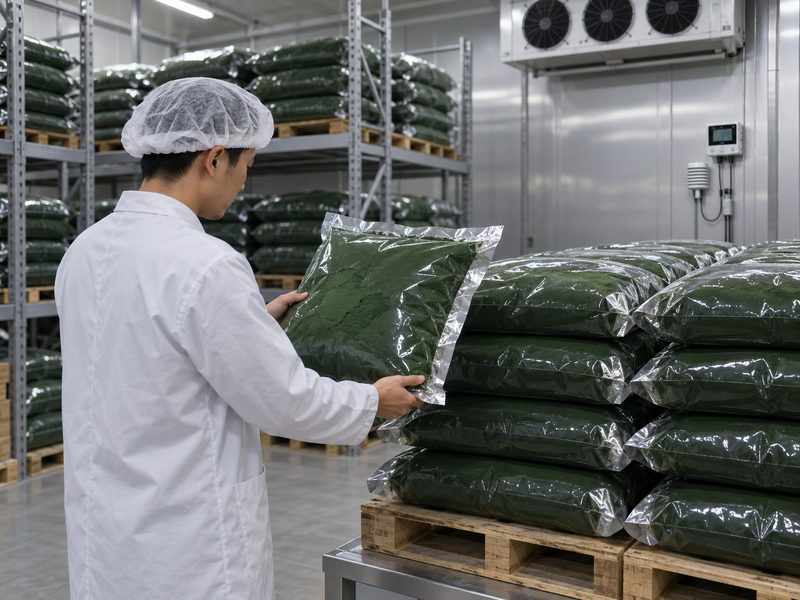
For the powder, collect identity, TDS, actual-lot COA, microbiology, contaminants, processing and allergen declarations, plus claim certifications where needed. For the finished gummy, collect formula, batch record, piece-weight and content-uniformity results, stability, packaging and label review. A powder supplier’s documentation cannot establish the finished gummy’s dose uniformity or shelf life. The FDA’s dietary supplement CGMP guide describes component and production-control responsibilities for U.S. dietary supplements; requirements for a conventional confectionery food or other destination need separate review.
Clarify which company supplies raw powder and which company manufactures finished gummies. Do not imply that a raw-material quote includes turnkey gummy OEM work unless that service is separately contracted.
| Record | Raw ingredient owner | Finished gummy owner |
|---|---|---|
| Species and powder COA | Supplier provides; buyer approves | References accepted lot |
| Dose uniformity | Not established by powder COA | Manufacturer validates |
| Shelf life | Dry powder storage guidance | Finished pack validation |
| Claims | Ingredient facts | Brand and market review |

9. How should the ingredient quote be evaluated?
Request powder pricing for the actual anticipated volume, destination, delivery term, pack and desired call-off schedule. Convert the quote to ingredient cost per gummy and per retail serving at the approved dose. Include deposition losses, tank residue, off-weight pieces, extra flavors, and any process time needed for predispersion or cleaning. A low powder price cannot rescue a formula whose pieces fail texture or uniformity. Compare the cost of an approved whole-powder formula with any alternative only after the alternatives meet the same product brief.
Ask for the proposed commercial grade’s specification and a representative sample. Confirm MOQ and lead time in writing. Forecast seasonal volume realistically; a small pilot can consume only grams while the commercial minimum may be much larger.
| Commercial line | Input | Consequence |
|---|---|---|
| Powder per piece | Approved milligrams × quote | Ingredient cost |
| Line loss | Tank and reject mass | Usable yield |
| Reformulation | Flavor and gel adjustments | True formula cost |
| Volume terms | Pack, MOQ and call-offs | Inventory risk |
10. What acceptance rule releases a bulk order?
Approve a lot only when the stated species and broken-cell processing, analytical quality, piece dose, uniformity, chew, color, flavor, storage and market review all pass. Put methods and limits in a signed specification. Link pilot samples to lot identifiers and retain finished pieces. If the brand changes gelling agent, piece size, flavor or depositing equipment, reassess the controls most likely to shift. A second ingredient lot is useful when color or particle perception is near its limit.
The purchase order should name raw powder supply explicitly and cite the accepted grade; finished gummy manufacturing terms belong in a separate agreement if relevant. This gives the buyer a workable raw-material decision without confusing a plausible formula with an already validated commercial gummy.
Attach a pilot-batch map to the approval: ingredient lot, addition point, mass temperature, hold time, agitation rate, mold positions sampled, and piece weights at the beginning and end of depositing. A single photograph of attractive gummies says little about whether the last tray contains the same amount of chlorella as the first. Have quality review the content-uniformity method and result before marketing fixes the declared amount per serving. If an off-spec tray can be segregated, define the identification and disposition procedure.
If it cannot, the entire batch may be at risk. These practical controls often decide whether a promising bench recipe is ready for commercial supply.
For the next lot, test powder identity and release data first, then make a small confirmation batch using the approved process. Compare cross-sections, chew and flavor with retained reference pieces. A change in particle size can affect perception even when the reported dose is identical. If the supplier offers a different drying or milling grade, treat it as a change requiring requalification, not an automatic substitute.
This protects both the label amount and the eating experience while keeping the contract focused on the raw ingredient the buyer actually ordered.
FAQ
Q1. Is chlorella a dissolved green color? No. Whole biomass is particulate and must be tested for distribution and mouthfeel.
Q2. Can a powder COA prove each gummy’s dose? No. The finished-piece process needs its own uniformity control.
Q3. Does a pectin result carry over to gelatin? No. Gel chemistry and process conditions differ.
Q4. Should chlorella be added after heating? Test addition timing against dispersion and the plant’s microbiological control plan.
Q5. Does a raw powder quote include gummy manufacture? Only if a separate contract explicitly says so.
Next step: Contact SpirulinaCN with the gummy base, intended chlorella milligrams per piece, batch size, anticipated quantity and country of sale. Request a broken-cell powder sample, TDS, lot COA and ingredient quote for a pilot focused on uniformity, chew and flavor.