
Chlorella powder EU novel food status supplier discussions should begin with the exact organism and product form offered, not a generic “chlorella approved” statement. A 2022 Article 4 consultation outcome concludes that six named chlorella-related species, within the submission described, are not novel food under Regulation (EU) 2015/2283. That record is a useful starting point for dried biomass sourcing, but it does not automatically settle a different taxon, highly changed processing or every finished-product use.
The EU buyer’s decision is whether the offered chlorella powder can be documented as matching relevant official status evidence before a purchase order and market launch.
Contents
- What is the actual market-access question?
- Which species appear in the 2022 outcome?
- How should the supplier substantiate the name?
- Why does product form matter?
- How should processing be compared?
- What does the EU Catalogue add?
- How should intended use be recorded?
- When is a new regulatory review needed?
- What belongs in a status dossier?
- What is the pre-order decision?
1. What is the actual market-access question?
The question is not whether algae in general have been eaten in Europe. It is whether this supplier’s named species, material form, manufacturing process and intended use fit the available record of food use or an applicable authorization. The European Commission’s Novel Food status Catalogue page says its tool is nonbinding and non-exhaustive.
Food business operators remain responsible for supporting pre-15 May 1997 consumption where that is the basis for a non-novel conclusion, and national authorities can have relevant requirements.
Ask the buyer’s regulatory lead to frame a specific hypothesis: “This SKU is dried biomass of the named species, made by the described process, for the stated food category.” Then compare the official consultation outcome and current Catalogue entry with those facts. This approach keeps a sourcing conversation from drifting into a claim that every “chlorella” extract or delivery format has a single EU status.
A supplier’s sales deck may help identify questions, but it does not replace the official text or the operator’s own evidence file.
| Status question | Required fact | Source of evidence |
|---|---|---|
| Which organism? | Scientific name and records | Supplier identity dossier |
| What material? | Biomass, extract or blend | TDS and process description |
| How made? | Cultivation and downstream steps | Manufacturer statement |
| Where used? | Food or supplement category | Buyer’s formulation brief |
2. Which species appear in the 2022 outcome?
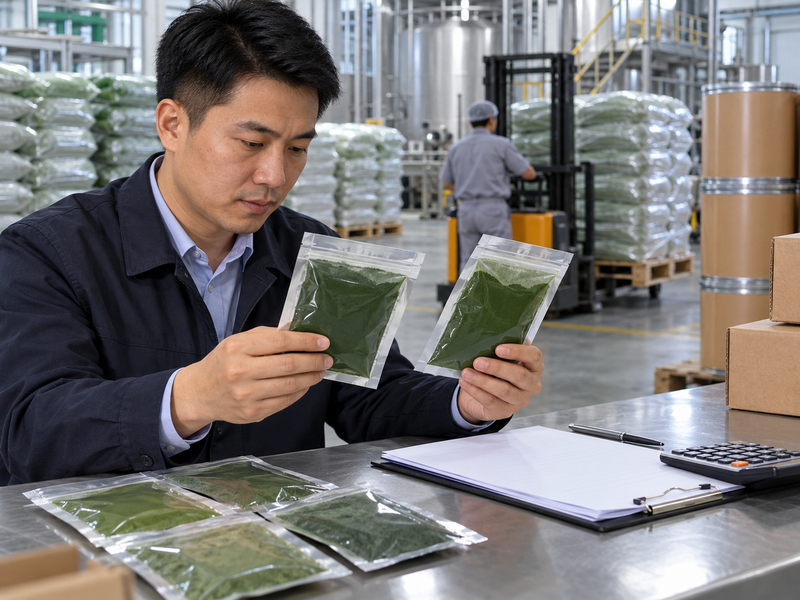
The Czech Republic’s published Article 4 outcome names Auxenochlorella protothecoides, Auxenochlorella pyrenoidosa, Chlorella sorokiniana, Chlorella vulgaris, Jaagichlorella luteoviridis and Parachlorella kessleri. Its conclusion says those listed species do not fall within the novel-food regulation’s scope on the evidence considered. The document describes dried biomass, cultivation modes and food or supplement uses. It also notes that chlorella taxonomy is difficult, which makes careless common-name matching especially risky.
Put the supplier’s exact Latin name next to the relevant named species. “Chlorella sp.” on a package is not sufficient to decide which of the six is present. If the supplier uses an older or alternative taxonomic name, request the mapping and basis from its organism records. If the material is a blend, list each organism and its proportion; an outcome for one species does not automatically cover an unlisted component.
Avoid claiming the decision establishes blanket authorization for every alga, strain, modified extract or technological use. It is a status finding for the subject of that consultation, with a defined factual description.
| Name in outcome | What the buyer must match | If missing |
|---|---|---|
| C. vulgaris | Offered culture and lot | Request identity record |
| C. sorokiniana | Product name and culture | Resolve synonym ambiguity |
| A. pyrenoidosa | Current and historic names | Document mapping |
| Any other named species | Exact Latin designation | Escalate if uncertain |
3. How should the supplier substantiate the name?
Request the accepted scientific name, any synonym used on labels, strain or culture identifier if held, and a description of how the manufacturer controls organism identity across cultivation and production. The aim is a traceable link from master culture to sold lot, not a claim that every lot needs a new taxonomic publication. A TDS can state a species, while supporting records explain why that statement is credible. Ask how the supplier handles mixed cultures, unexpected organisms and changes of production strain.
If the supplier offers broken-cell chlorella powder, establish that the underlying organism is the claimed species; cell disruption is a processing detail, not a substitute for identity. Compare lot COA, bag label, invoice and sample documents. A mismatch between C. vulgaris on the quotation and unspecified “chlorella” on the bag is a solvable documentation gap if caught before shipment. If identity remains unresolved, the regulatory team cannot make a sound status comparison.
Do not treat a high chlorophyll or protein value as species identification; those assays answer different questions.
4. Why does product form matter?
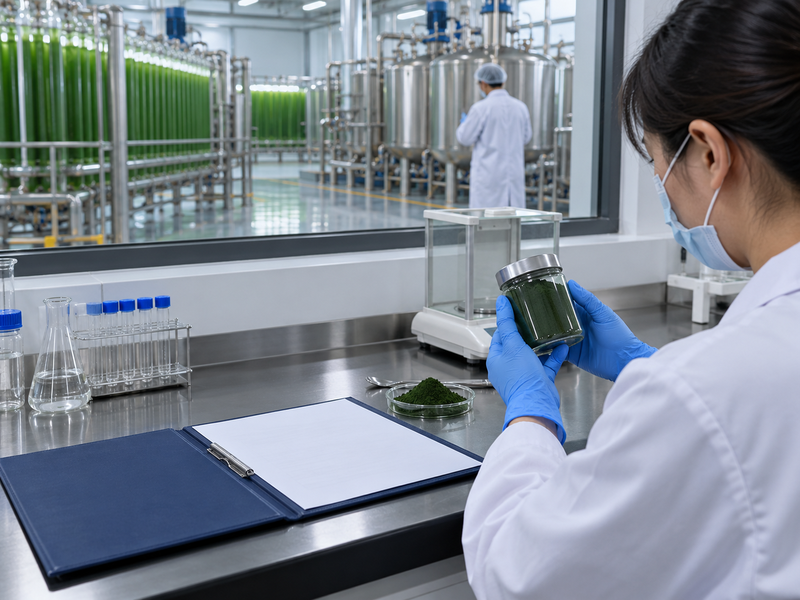
The 2022 consultation document describes dried biomass as a fine powder for food ingredients or supplements and also mentions a lyophilized chlorella extract within the request. That wording does not mean any concentrated fraction sold today has an automatic status conclusion. A whole-biomass powder retains a different composition and production story from a purified protein, solvent extract, isolated pigment or chemically modified fraction.
Ask the manufacturer for a concise material balance and processing description, including any carrier or additive.
For a proposed SKU, compare dry biomass form, composition and intended function with the official description. If the supplier calls an extract “chlorella powder,” ask what was removed or concentrated. If a powder is blended with another ingredient, analyze each component and the final use separately. The regulatory lead may need additional evidence or an Article 4 consultation route for a material that does not clearly fit the existing outcome.
The buyer should resolve that before treating a sample’s good sensory performance as an EU market-access decision.
| Offered form | Key question | Review status |
|---|---|---|
| Dried whole biomass | Named species and process match? | Compare outcome closely |
| Broken-cell biomass | What changed beyond disruption? | Document process and composition |
| Concentrated extract | Which fractions and solvents? | Escalate exact status |
| Multi-ingredient blend | What are all components? | Review each and final use |
5. How should processing be compared?
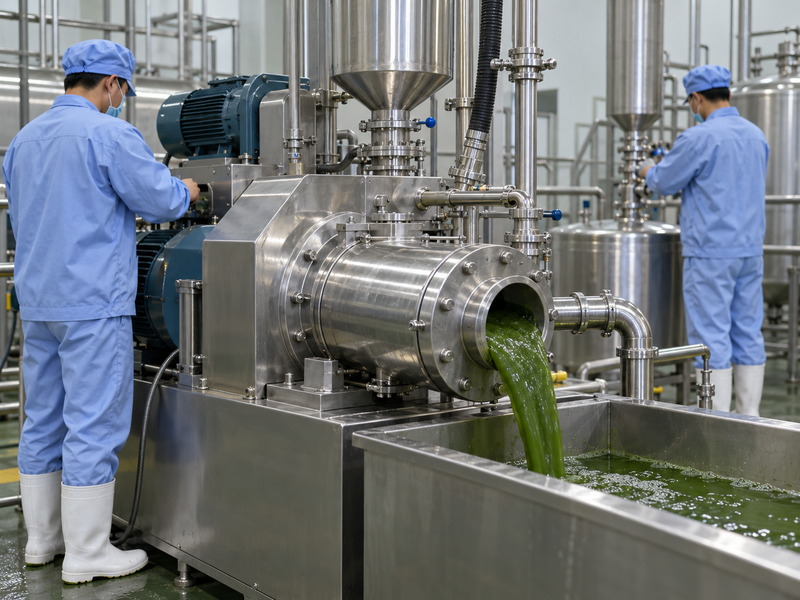
Record cultivation mode, harvest, washing, drying, cell-wall treatment, milling and any extraction or fermentation. The 2022 outcome explicitly describes autotrophic, heterotrophic and mixotrophic cultivation for the subject material, but that does not erase the need to compare downstream transformation. Novel-food status can turn on significant changes in composition or production, so the buyer should describe the actual marketed article, not only the starting algae. Ask the supplier to identify any new process applied after the underlying evidence was established.
The comparison should focus on material differences that could change the nature of the product. A routine particle-size reduction may be straightforward to explain; a novel solvent fractionation or highly enriched constituent deserves closer review. This is not an article-wide judgment that a particular processing method is legally novel. It is an instruction to document what is being sold and have competent regulatory staff evaluate whether the existing evidence applies.
Request a process summary suitable for a confidential regulatory dossier, with sensitive details shared under an appropriate agreement if needed.
6. What does the EU Catalogue add?
The Commission’s Catalogue can orient the buyer to named foods and status information. Its own page warns that it is nonbinding and non-exhaustive, and that entries should be read with the Union list and national rules. It also explains that supplement-only histories may not support a new conventional-food use. Search by the scientific name and save the entry reviewed with a date, because catalogue information can change as Member States submit new facts.
Use the Catalogue to flag an issue and the Article 4 consultation page to read the actual published outcome. An isolated search result or screenshot without the species and description is too thin for purchasing approval. Do not confuse the Catalogue’s absence of an entry with proof of non-novel status.
If the exact material is outside the six-species record or its process is materially different, ask the responsible national authority or qualified EU adviser about the appropriate next step. Keep the source version in the regulatory file so a later reviewer can reconstruct the September 2026 decision.
| Official source | Useful for | Limitation |
|---|---|---|
| Article 4 outcome PDF | Exact species and subject description | Not every future product form |
| Novel Food Catalogue | Orientation to current status | Nonbinding, non-exhaustive |
| Union list | Authorized novel foods and conditions | Not a full list of non-novel foods |
| National authority | Market-specific clarification | Requires a concrete SKU question |
7. How should intended use be recorded?
Describe whether the ingredient will be used in a dietary supplement, beverage, bakery product or another conventional food, at what level and for what function. The 2022 outcome discusses food components and supplement forms for its subject; the buyer must still check the exact finished product and national requirements. A status conclusion about dried biomass does not approve a nutrition claim, health claim, color-additive function, contaminant level or finished-food label. Those remain separate assessments.
Provide the regulatory reviewer with the intended destination Member State and planned distribution area. The Commission Catalogue guidance notes national restrictions may apply and advises contacting national authorities. A buyer who sources for multiple EU markets should record where the item will actually be placed, not rely on one import address. If formulation changes from a small supplement dose to a high-use beverage ingredient, re-evaluate the status and other relevant rules.
The purchasing file should identify the buyer’s intended use rather than asking the supplier to certify every possible application.
8. When is a new regulatory review needed?
Trigger review when the supplier changes species, strain identity evidence, manufacturing site, cultivation or downstream process, product form, carrier, intended function or market. A status file made for dried C. vulgaris biomass cannot silently cover a new concentrated extract. Likewise, a quotation that alternates between “chlorella” and a different algal genus should not be released until the name is resolved. A different supplier may require a new evidence chain even when its declared species matches.
Document the change and ask whether the existing official outcome still describes the product. If the fit is uncertain, the responsible EU food business operator can seek qualified advice or use the Article 4 consultation framework. Do not infer from the 2022 PDF that a supplier has already obtained an individual authorization; its conclusion concerns novel-food status of the named subject, not a certificate awarded to a vendor.
The status check should be repeated at significant changes and at commercial launch, because an ingredient decision frozen at sample stage may no longer describe the bulk order.
| Change event | Immediate question | Action |
|---|---|---|
| New species name | Same organism or different? | Get taxonomic mapping |
| New extraction | Same material as prior powder? | Regulatory reassessment |
| New market/use | Same regulatory context? | Destination review |
| New supplier | Same evidence chain? | Rebuild SKU dossier |
9. What belongs in a status dossier?
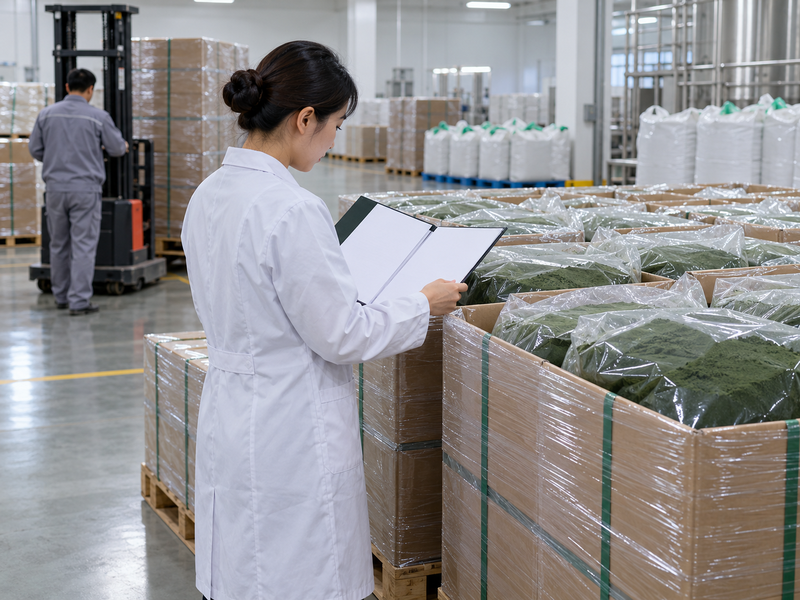
Keep the supplier’s signed product identity and process summary, TDS, proposed label, sample and lot references, and the buyer’s intended use. Attach the 2022 outcome and a dated Catalogue review, with a short comparison explaining where the SKU matches and where uncertainty remains. Include the responsible regulatory reviewer’s decision and any national-authority correspondence. The dossier should be understandable to a second buyer or auditor without assuming that a generic “EU compliant” line proves a status match.
Separate status evidence from ordinary quality release. A COA for microbes and metals does not answer historical consumption or taxonomy; a non-novel conclusion does not show the lot meets the buyer’s contaminant limits. If a supplier cannot disclose a full process publicly, arrange a confidential technical review rather than filling the gap with an assumption. Record the version and date of every source. The published consultation outcome predates this article’s September 2026 date, while later live changes should be assessed only at the actual decision date.
10. What is the pre-order decision?
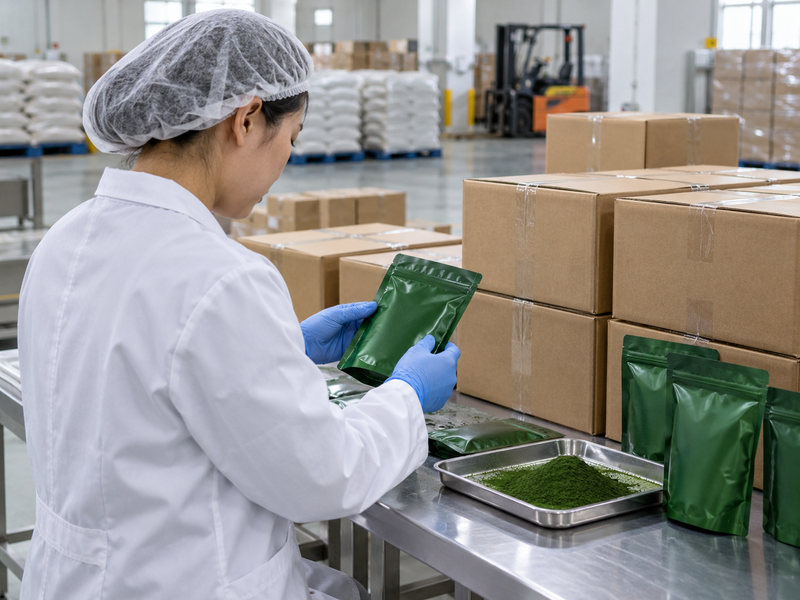
Release the sourcing decision when the named species is supported, the actual product form and process are described, the intended use is recorded, and the buyer’s regulatory team has documented how the official status evidence applies. If those facts do not align, hold the order or contract it with an explicit regulatory condition. Do not convert a promising sample or supplier’s broad assurance into EU market clearance.
The chlorella product discussion can start the technical exchange, but a real SKU needs its own documents.
Procurement should request a matched sample and quote only alongside the identity and process facts needed for the status review. This avoids paying to qualify a powder that later fails a basic market-access question. The conclusion is deliberately narrow: the 2022 outcome is strong primary evidence for its listed species and described material; the operator still owns the fit assessment for its exact article, destination and use.
FAQ
Q1. Is every chlorella product automatically non-novel in the EU? No. The 2022 outcome names six species and describes a subject material; compare the exact SKU and process.
Q2. Does Chlorella vulgaris appear in the 2022 outcome? Yes, but the buyer must substantiate that the offered lot is actually that species and form.
Q3. Is the Novel Food Catalogue legally binding? The Commission calls it nonbinding and non-exhaustive.
Q4. Does non-novel status approve a health claim? No. Claims and labeling require separate review.
Q5. What if the supplier offers an extract? Obtain its process and composition, then have the EU regulatory team assess whether the existing status evidence fits.
Next step
For a novel food status check on an EU chlorella order, contact SpirulinaCN with the application, target specification, anticipated quantity and destination Member State. Request the scientific name, organism identity record, product-form and process description, plus a matched sample and available lot documents for the buyer’s own regulatory review.