
Chlorella powder dietary fiber testing is more complicated than reading a “crude fiber” line on an old product sheet. The two terms can come from different analytical methods and may produce different numbers. For food and supplement buyers, the right question is which measured fiber value can be used for the intended formula, specification and destination label.
An original food-application study describes total dietary fiber testing in microalgal ingredients using an AOAC method. That method choice is useful context, not a value to assign to every commercial chlorella powder. Ask for the offered lot and its actual method.
1. Is the report about crude or dietary fiber?
Read the analyte and method lines before comparing numbers. Crude fiber is a narrower historical measurement; total dietary fiber is defined through a specific analytical approach. Do not replace one with the other in a label worksheet. Ask the laboratory to state whether soluble and insoluble fractions are included and whether any processing step in the powder affects the assay.
2. What grade and cell-wall state was tested?
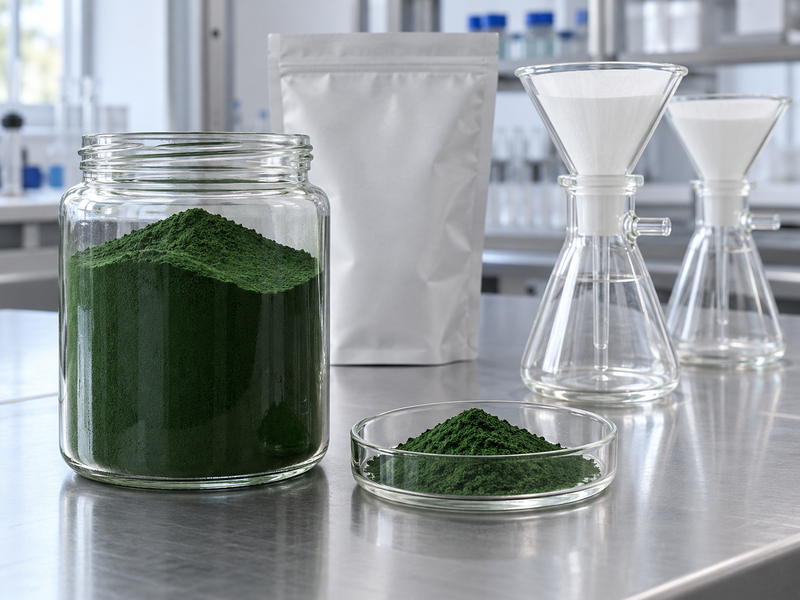
Confirm species, grade, cell-wall processing method and lot. Broken-cell and intact-cell powders can behave differently in extraction and a food matrix, so the approved laboratory sample must match what will ship. Particle size is a separate characteristic; a fine powder is not proof of any particular cell-wall breakage level. Keep the cell-wall report, fiber assay and physical sample together.
| Field | Buyer question |
|---|---|
| Species and grade | Does it match the intended ingredient? |
| Cell-wall state | Was the offered process tested? |
| Assay | Crude fiber or dietary fiber? |
| Lot | Does the result belong to the shipment? |
3. Are the units suitable for formulation?
Request grams per 100 grams of powder as received. If the supplier sends a dry-matter figure, obtain moisture from the same lot before converting. A finished food with a small addition of chlorella receives only a fraction of the powder’s per-100-gram value. Calculate the contribution at the planned dose and account for the rest of the recipe before discussing any fiber claim.
4. Does a fiber result predict product texture?
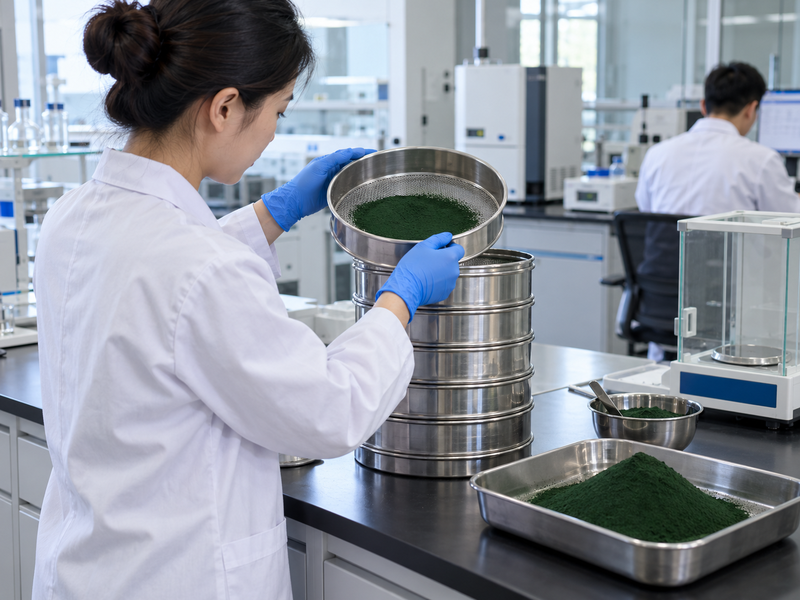
No. The same number can accompany different particle sizes, hydration behavior and sensory effects. Run a side-by-side application trial at the intended inclusion level. Record water uptake, viscosity, sediment, grit, color and flavor where relevant. The fiber assay answers a composition question; the pilot answers whether the raw material works in the product.
5. When should a second laboratory confirm the number?
If a label declaration or purchase guarantee depends on dietary fiber, send a sealed split of the approved lot to a qualified lab using the agreed method. Compare results on the same moisture basis. Resolve differences in sample preparation, cell-wall disruption during analysis and reporting units before treating one number as an outlier. Keep uncertainty and repeat-lot variation visible in the decision record.

6. Which label rules must be checked?
The FDA’s labeling guidance explains that dietary fiber has a regulatory definition in the United States. Other markets may use different definitions or methods. Have a regulatory reviewer assess the final food, serving and permitted declaration. A laboratory’s “fiber” line does not by itself authorize a front-of-pack claim.
| Purpose | Evidence needed |
|---|---|
| Ingredient screening | Current method and lot result |
| Formula design | As-is value and serving math |
| Label claim | Finished-product and market review |
7. What other raw-material information belongs in the file?
Review identity, moisture, microbiology, relevant contaminants, particle size, cell-wall processing and shelf-life evidence. If fiber content is high but the powder clumps in your line, the lot may still fail the practical brief. Record an accepted sample and a defined incoming test instead of relying on the supplier’s description alone.
8. How should procurement write the specification?
Name the fiber measurand, method, units, as-is basis, sampling plan and tolerance. Avoid copying a literature value into the contract. Request several commercial lot results, then decide whether fiber is a guaranteed minimum or simply a monitored property. If it is not central to the product, a less restrictive specification may deliver a more reliable supply at better cost.
For a practical comparison, take two powder samples with different reported fiber values and mix each into the same base at the planned dose. Measure viscosity or texture immediately after mixing and again after the normal hold period. Calculate the actual dietary fiber contribution per finished serving on the correct basis. If neither sample contributes a meaningful amount to the product brief, move fiber to a monitoring field and choose the material on safety, sensory and manufacturing performance. Keep both test reports so the team can revisit the decision if the formula changes.
FAQ
Are crude fiber and dietary fiber interchangeable? No. Check the named method and analyte.
Does broken-cell powder always have less fiber? Do not assume it; test the offered grade.
Can the powder COA support a finished-food claim? Only after formula and destination label review.
Why measure moisture? It connects dry-basis values to the powder used in the recipe.
What should be retained from a trial? The lot code, assay, sample and finished-product results.
Send your application, dose, required fiber method, quantity and destination to request a matched chlorella grade and report.