
A chlorella manufacturer should be able to show where an order is actually made, who controls each production step, and which records connect the delivered powder or tablets to that site. A polished factory photograph does not answer those questions. A buyer needs a process map, named responsibilities, and evidence from recent commercial lots before relying on a production claim.
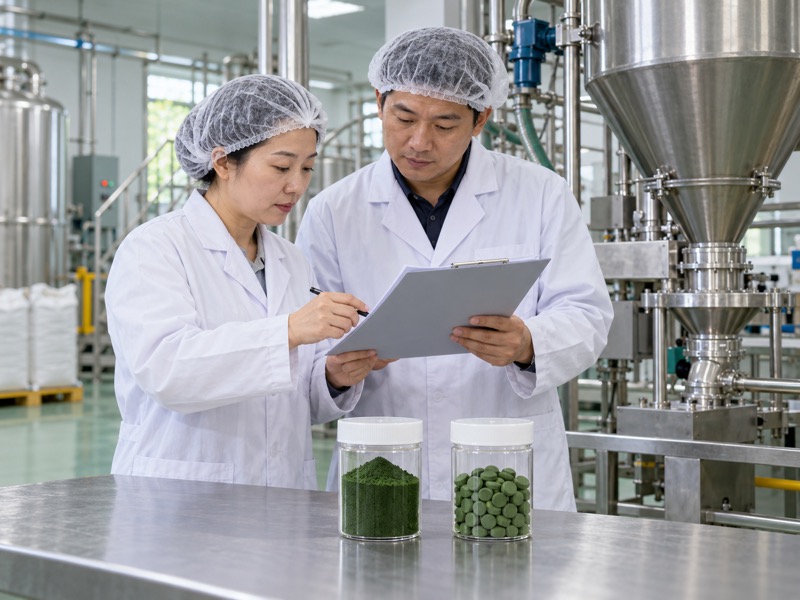
Chlorella is whole green microalgal biomass sold in several forms. It is different from phycocyanin-rich blue spirulina extract and from whole spirulina. Our current catalog lists chlorella powder and tablets. It does not establish a specific Chlorella species, cultivation route, cell-wall treatment, tablet recipe, certification, or factory location. Request the current specification and lot documents for the exact product offered. Any description of manufacturing capability should be checked against the named site and process before an order is placed.
This guide concentrates on site ownership, production handoffs, powder and tablet operations, capacity, contract work, change control, and release authority. A credible maker can document the route from culture to shippable product and take responsibility when it changes.
Contents
- What does a chlorella manufacturer actually make?
- Which stages should a chlorella manufacturer control?
- How can the buyer follow identity through the process?
- How can a buyer verify chlorella manufacturer capacity?
- Where do powder and tablet routes diverge?
- How should subcontracted operations be disclosed?
- What should change control and deviation handling cover?
- How should samples, pilots, and commercial lots align?
- Which documents belong in the manufacturer file?
- How should buyers choose a chlorella manufacturer?
1. What does a chlorella manufacturer actually make?
Define the legal maker and the physical site
The word *manufacturer* can describe several businesses. One company may grow and dry biomass; another may buy powder and press tablets. A trader may own the brand while production happens elsewhere. Ask for the producing site's legal name and address, the invoice issuer, and the party responsible for release. If they differ, request their relationship in writing.
Ask the seller to describe the product it is proposing: whole-cell powder, treated powder, or a tablet made from a defined powder and other ingredients. Tablets can include binders or processing aids; a tablet label cannot be inferred from the powder label. A company that only presses purchased powder should describe itself accurately. The buyer can then decide whether the arrangement meets its purchasing policy.
The seller should connect a recent finished lot to a production record and release decision at the named site.
| Business role | Physical work to identify | Buyer evidence |
|---|---|---|
| Biomass producer | Culture, harvest, concentration | Site and batch flow record |
| Powder processor | Drying, treatment, milling, packing | Process route and powder lot record |
| Tablet maker | Blending, compression, packing | Formula, line record, tablet lot link |
| Brand or trader | Sourcing and commercial coordination | Manufacturer identity and responsibility map |
2. Which stages should a chlorella manufacturer control?
Draw a route that matches the offered product
Request a one-page flow diagram for the exact grade, from culture or purchased biomass to packed product. Name the site and owner of cultivation, harvest, concentration, any cell-wall treatment, drying, milling, blending, tableting, packing, and release. Mark hold points and lot splits or combinations. Proprietary machine settings are unnecessary for this review.
An original Chlorella vulgaris production study documents one research-scale route from controlled cultivation through centrifugation and spray drying. It illustrates why the word “chlorella” alone does not tell a buyer how a commercial powder was made. The study is an example of process stages, not evidence that any offered product uses its conditions. Ask the seller for its own records rather than copying published settings into a purchase specification.
Mark handoffs. A transfer from grower to dryer or tablet plant can introduce a new lot number, storage condition, and release decision. Those are the points where identity and responsibility can be lost.
3. How can the buyer follow identity through the process?
Link lots across every handoff
Start with the species or strain identity on the specification. Connect incoming biomass, intermediate, final powder, and tablet lot numbers. Ask how blended lots and rework are recorded. A “pure chlorella” claim does not identify which material became the shipped cartons.
ISO 22005 sets general principles for traceability systems in the food chain. It does not prescribe one chlorella process or prove that a particular facility follows the standard. It is useful as a framework for asking whether the maker can retrieve the history and location of materials. A buyer can request a short mock-trace exercise: select one packed lot and ask the maker to identify its inputs, process dates, packing run, and affected customers. Record the time needed to complete the exercise and any missing links.
Pigment or protein results characterize a lot; they do not prove its production site. The site's blue spirulina versus chlorella guide explains the product distinction.
| Handoff | Record to connect | Question if a number changes |
|---|---|---|
| Culture to harvest | Culture and harvest batch | Was material pooled? |
| Harvest to treatment | Wet biomass transfer | Was another site involved? |
| Treatment to drying | Intermediate lot and date | What hold conditions applied? |
| Powder to tablet line | Powder issue and blend record | Were other ingredients added? |
| Packing to dispatch | Finished lot and shipping unit | Can cartons be located? |
4. How can a buyer verify chlorella manufacturer capacity?
Review output evidence for the intended route
State capacity for the offered grade and its bottleneck. A large cultivation area says little about a small tablet line. Request monthly output range, normal batch size, lead time, and comparable recent runs. Redacted production records can support the claim.
Compare the planned order to the site’s proven routine. A one-kilogram evaluation sample, a pilot batch, and repeated pallet orders create different scheduling, segregation, and packing demands. If a seller quotes a sharp increase in capacity, ask what will change: shifts, equipment, subcontractors, source biomass, or packaging line. A capacity claim is useful only when its underlying route remains the same as the one approved by the buyer.
Harvest moisture, drying load, powder handling, and tablet formulation affect throughput. Ask for a production plan and a way to communicate delays; laboratory yields are not plant guarantees.
| Claim | Better evidence | Decision use |
|---|---|---|
| Monthly powder capacity | Recent production summary for the grade | Test order size against routine output |
| Tablet capacity | Press and packing-line run history | Check finished-form bottleneck |
| Lead time | Material and line schedule assumptions | Set realistic purchase dates |
| Expansion headroom | Written change plan and qualification steps | Decide when a new sample is needed |
5. Where do powder and tablet routes diverge?
Inspect the final-form operation
Powder and tablets share some upstream biomass, yet they are different manufacturing products. A powder buyer needs to understand milling or sieving, powder flow, packing format, and protection against moisture during storage. A tablet buyer also needs the formula, blending order, compression conditions, tablet weight controls, breakage handling, and packaging integrity. A maker that can dry powder does not automatically have a qualified tablet line. Ask which site performs the additional steps and whether the quoted tablet uses the same powder grade evaluated in the sample.
Added tablet ingredients can change labeling, allergen review, size, and chlorella content per unit. Request the full ingredient statement and finished specification. If using buyer-supplied powder, test blend compatibility and pilot compression before setting a routine price.
Keep purchase specifications form-specific. A powder release record and a tablet release record may refer to related material, but they answer different questions. Their lot numbers should be linked so a complaint about broken tablets can be traced to both compression and the incoming powder.
6. How should subcontracted operations be disclosed?
Make each outside site visible to the buyer
Subcontracting can be sensible when a specialist performs drying, cell-wall treatment, tablet compression, or packing. The buyer should know the site and activity before approving the route. Ask who selects and evaluates the contractor, who owns the material while it is there, who investigates a deviation, and who has authority to release the finished lot. A purchase order addressed to one company does not erase the operational role of another.
Request a responsibility matrix that covers specifications, batch instructions, sampling, test review, change notices, complaint handling, and recalls. It can be concise. The point is to prevent two firms from assuming the other will act. The FDA's dietary-supplement CGMP guide discusses responsibility in contract manufacturing for products sold as U.S. dietary supplements. Its requirements are market and product specific; use it only when that regulatory route applies. For other markets, confirm the relevant framework with the buyer's regulatory team.
If a contractor changes, assess whether the new site or process requires samples or renewed approval.
7. What should change control and deviation handling cover?
Ask who approves a changed route
Manufacturing changes are common: a new biomass source, different dryer, tablet binder, packing film, subcontractor, or production site. Ask the maker which changes are classified as material to the customer and how much notice is given before shipment. The agreement should identify who approves a new route, which documents or samples support it, and whether a lot made before approval can be supplied. The exact threshold should reflect the buyer's use and market; avoid a blanket rule that every machine adjustment requires formal requalification.
For deviations, ask how the maker records affected lots, disposition, and corrective action. It should summarize events that could affect the buyer's product and identify shipped lots quickly when an issue is discovered after dispatch.
ISO 22000 describes requirements for a food safety management system across the food chain. Certification to a system standard is separate from evidence that a particular chlorella grade and lot meet the buyer's specification. Use a site's certificate, when applicable, alongside change and deviation records.
| Proposed change | Buyer question | Likely review item |
|---|---|---|
| New cultivation source | Does species and grade identity stay the same? | Source and equivalence file |
| New dryer or treatment site | Does the powder behave the same? | Process and sample comparison |
| Tablet formula change | Does the label or performance change? | Full formula and pilot tablets |
| Packing change | Does storage protection remain suitable? | Material and shelf-life evidence |
8. How should samples, pilots, and commercial lots align?
Bridge the sample to the intended production route
Record whether the sample came from a routine lot, pilot equipment, or a special sales run. Note its lot, date, site, form, and any tablet ingredients. Compare its specification with the later order.
A pilot should reproduce the key handoffs of the planned route. For powder, that may mean the same biomass source, treatment and drying pathway, and packing material. For tablets, it also means the intended blend and compression line. A supplier can change scale while keeping the same technical target, but the buyer should test whether the result still works in its formulation or consumer package. The comparison should use agreed measurements, not only a visual judgement of green color.
Document approval, a restricted approval, or a need for another trial. A first commercial lot from a different site needs a new route review.
9. Which documents belong in the manufacturer file?
Keep a short dossier that can be used later
The file should let a new buyer understand who makes the product, where it is made, how the route is controlled, and which specifications were approved. Request a current company and site identification, process flow, product specification, ingredient statement, sample and lot references, applicable system certificates with scope, subcontractor responsibility map, and a representative finished-lot record. Add the agreed change-notice procedure and a named quality contact. Separate current approved files from expired or superseded versions.
Use separate files for powder and tablets when formulations or sites differ. Tablets need their own formula and release evidence. Confirm intended use and destination before requesting market-specific declarations.
A useful file answers the buying decision and records the review date. A large packet without a named site or lot bridge leaves responsibility unresolved.
10. How should buyers choose a chlorella manufacturer?
Score the production relationship, then confirm it with a lot
Compare two offers against the same product form, destination, volume, and specification. Start with non-negotiable points: named production site, complete process route, product identity, and willingness to disclose material subcontractors. Then compare capacity evidence, powder or tablet capability, change notice, release responsibility, and response quality. Price matters, but a lower quote that depends on an undefined site or an untested tablet recipe cannot be evaluated fairly against a documented route.
Mark each requirement met, open, or unacceptable and cite its evidence. Assign an owner to each open point. Use a site visit to investigate specific gaps. Check the first shipped lot against the approved route before expanding volume.
Our catalog offers chlorella powder and tablets, and the appropriate next step is a request for the current product specification, exact manufacturing route, sample origin, and lot documents for the chosen form. Those records will tell the buyer more than a claim about being a “leading” manufacturer.
| Comparison point | Maker A | Maker B | Evidence to retain |
|---|---|---|---|
| Named site and route | Met / open / unacceptable | Met / open / unacceptable | Flow and site record |
| Form capability | Met / open / unacceptable | Met / open / unacceptable | Powder or tablet run |
| Capacity and lead time | Met / open / unacceptable | Met / open / unacceptable | Recent output summary |
| Change and release control | Met / open / unacceptable | Met / open / unacceptable | Procedure and contact |
| First-lot match | Met / open / unacceptable | Met / open / unacceptable | Approved sample and shipped lot |
Frequently asked questions
Q1: Is a chlorella brand always the manufacturer?
No. A brand may own the specification while another company grows, processes, compresses, or packs the material. Ask for the physical sites and a responsibility map.
Q2: Can the same maker supply both chlorella powder and tablets?
Possibly. Confirm the powder and tablet production sites, the tablet formula, and how the powder lot links to the finished tablet lot.
Q3: Does a food safety certificate prove the offered lot is suitable?
It supports review of the named system and scope. Suitability still depends on the exact product specification, route, lot results, and intended market.
Q4: How can a buyer check a claimed monthly capacity?
Ask for the batch size, bottleneck step, recent comparable runs, lead-time assumptions, and a plan for orders larger than routine output.
Q5: What should trigger a new sample after approval?
A material change in source, site, treatment, drying, tablet formula, or packing may warrant one. Define the trigger and comparison tests with the maker before routine supply.